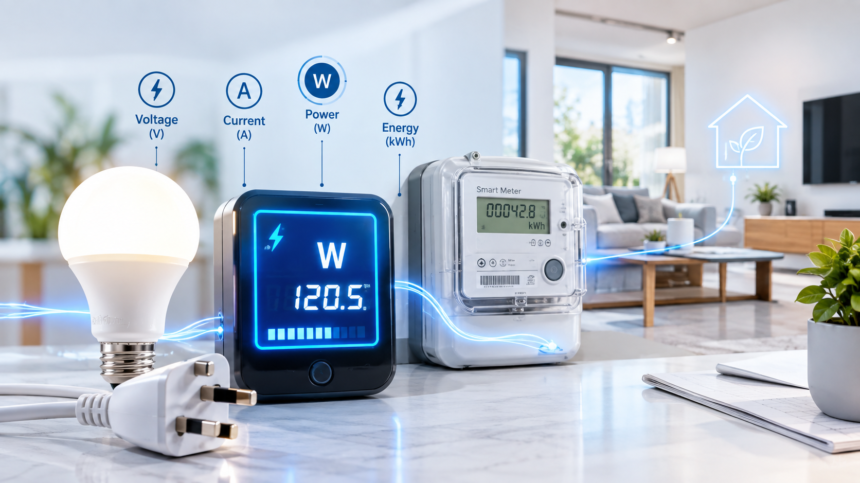
The term Wattios can be confusing because it looks like the name of an electrical measurement. In modern science, however, Wattios is not a separate SI unit. It is a term historically connected with the watt, the standard unit used to measure electrical power.
The word is associated with older Spanish forms such as watio, wattio, and wattios. In modern Spanish, the standard term is vatio, while international scientific and engineering terminology uses watt (W).
Understanding what Wattios refers to also means understanding watts, volts, amps, watt-hours, and kilowatt-hours. These measurements appear on appliance labels, electricity bills, solar equipment, batteries, inverters, and many other electrical products.
This guide explains what Wattios means, where the term comes from, how watts work, how electricity consumption is calculated, and why power ratings matter in everyday life.
What Does Wattios Mean?
Wattios is a historical term associated with the watt and older Spanish electrical terminology. It should not be treated as a separate modern unit of measurement.
The modern scientific unit is the watt, represented by the symbol W. A watt measures power, which describes the rate at which energy is transferred or used.
For example, an appliance rated at 100 watts has a power rating of 100 W. An appliance rated at 1,000 watts has a power rating of 1,000 W, which is equal to 1 kilowatt (kW).
The distinction is important because Wattios does not represent a different type of electricity. When the term appears in an electrical context, it is generally related to the concept of watts and power.
The word may also appear in business names, websites, products, or other commercial contexts. In those cases, its meaning depends on how the organization uses the name and should not automatically be interpreted as an electrical unit.
| 🔗 You may also like: |
|---|
| How Long Do Solar Panels Last? |
| Latest Breakthroughs in Quantum Computing |
Where Does the Word Wattios Come From?
The history of Wattios is connected to the development of the word watt, which was named after Scottish engineer James Watt.
James Watt is widely associated with important improvements to steam-engine technology. His surname was later adopted as the name of the SI unit of power.
As scientific terminology developed across different languages, the name appeared in different forms. Historical Spanish terminology included forms such as watio, wattio, and wattios.
Modern Spanish uses vatio for the watt, while English and international scientific writing use watt.
This linguistic history helps explain why someone searching for information about watts may encounter the term Wattios. It is better understood as a historical or language-related variation than as a new measurement.
What Is a Watt?
A watt is the SI unit of power.
Power describes how quickly energy is transferred or used. One watt is defined as:
1 watt = 1 joule per second
This means that a device operating at one watt transfers or uses energy at a rate of one joule per second.
For everyday electrical equipment, watt ratings provide a convenient way to describe how much power a device requires under specified operating conditions.
A small electronic device might have a power rating of only a few watts. A household heater or electric oven may require thousands of watts.
The watt therefore provides a common language for comparing the power requirements of electrical equipment.
Watts, Kilowatts, Megawatts, and Gigawatts
Electrical power can be expressed using different units depending on the size of the system.
The most common relationships are:
- 1 kilowatt (kW) = 1,000 watts (W)
- 1 megawatt (MW) = 1,000 kilowatts
- 1 gigawatt (GW) = 1,000 megawatts
Household appliances are usually described in watts or kilowatts. Larger electrical systems can require much larger units.
For example, a 2,000-watt heater can also be described as a 2 kW heater.
Power stations, large industrial facilities, utility-scale solar installations, and electrical grids may use megawatts or gigawatts because their power levels are much larger.
However, a power rating by itself does not tell you how much electricity a device will consume over a day or month. Time matters too.
Watts, Volts, and Amps: What Is the Difference?
Watts, volts, and amps describe different aspects of electricity.
Watts (W) measure power.
Volts (V) measure electrical potential difference, commonly called voltage.
Amps (A) measure electric current.
These measurements are related. For a basic electrical calculation:
Power (W) = Voltage (V) × Current (A)
For example, if a device operates at 10 volts and draws 2 amps:
10 V × 2 A = 20 W
The device therefore has a basic power demand of 20 watts under those conditions.
This relationship is useful for understanding simple electrical systems. Real-world AC systems can be more complicated because factors such as power factor can affect calculations.
For ordinary household appliances, the manufacturer’s rating label is usually the best starting point. More complex electrical installations should be designed using appropriate electrical calculations rather than relying only on a simple watts-volts-amps formula.
Watts vs. Watt-Hours: Why the Difference Matters
One of the most common electricity mistakes is confusing power with energy.
A watt measures power. It describes the rate at which energy is being used or transferred.
A watt-hour (Wh) measures energy over a period of time.
A kilowatt-hour (kWh) is also a unit of energy and is commonly used for electricity consumption.
For example, a device operating continuously at 1,000 watts is using 1 kilowatt of power. If it operates at that level for one hour:
1 kW × 1 hour = 1 kWh
If it operates for three hours:
1 kW × 3 hours = 3 kWh
This is why household electricity consumption is generally expressed in kilowatt-hours rather than simply watts.
A device’s watt rating tells you how much power it uses at a particular moment or operating condition. Its kWh consumption tells you how much energy it uses over time.
| 🔗 You may also like: |
|---|
| Quad Equalizer |
| Best Wireless Earbuds Under $200 |
How to Calculate Electricity Consumption
You can make a basic estimate of electricity consumption when you know an appliance’s wattage and how long it operates.
The formula is:
Energy used (kWh) = Watts ÷ 1,000 × Hours Used
Consider a 500-watt appliance that operates for four hours.
First convert watts into kilowatts:
500 ÷ 1,000 = 0.5 kW
Then multiply by the operating time:
0.5 × 4 = 2 kWh
The appliance would therefore use approximately 2 kWh if it operated continuously at its rated 500 watts for four hours.
You can extend the calculation to estimate daily or monthly consumption. If an appliance uses approximately 2 kWh per day, multiplying that figure by the number of days gives a basic longer-term estimate.
However, this calculation assumes the appliance continuously operates at its stated power level. Many modern devices do not.
Refrigerators, air conditioners, computers, heat pumps, and other equipment can change their power consumption during normal operation. Settings, workload, temperature, maintenance, and usage patterns can all affect actual energy consumption.
How to Estimate Electricity Costs
Once you have an estimated energy consumption in kilowatt-hours, you can calculate an approximate running cost.
The basic formula is:
Estimated cost = Energy used (kWh) × Electricity price per kWh
For example, if a device consumes 3 kWh and your electricity tariff charges a particular amount per kWh, multiply 3 by that rate to estimate the energy cost.
The electricity price should come from your own utility tariff because rates vary between countries, providers, billing plans, usage levels, and pricing structures.
Actual electricity bills may also include taxes, fixed charges, tiered rates, or other fees. Therefore, a wattage-based calculation should be viewed as an estimate rather than an exact prediction of the final bill.
Even so, these calculations are useful when comparing appliances and identifying equipment that may contribute significantly to household electricity consumption.
Understanding Appliance Power Ratings
An appliance’s power rating indicates how much electrical power it is designed to use under specified conditions.
A label may show several electrical values, including:
- Voltage
- Current
- Frequency
- Power in watts or kilowatts
- Other manufacturer specifications
The watt rating is useful when determining the approximate electrical demand of a product. However, it does not necessarily mean the appliance consumes exactly that amount continuously.
A refrigerator, for example, may cycle its compressor on and off. An air conditioner may adjust its operation depending on the room temperature. A computer may consume different amounts of power depending on whether it is idle or performing demanding tasks.
For this reason, the rated wattage is often best treated as a starting point when estimating electricity use.
Common Appliances and Their Power Consumption
Different appliances require different amounts of power because they perform different tasks.
Small electronics and lighting products often have relatively low power requirements. Equipment that generates heat, moves air, pumps water, or performs other energy-intensive tasks can require considerably more power.
Examples of household equipment include:
- Refrigerators
- Air conditioners
- Electric kettles
- Electric heaters
- Ovens
- Water heaters
- Washing machines
- Televisions
- Fans
- Computers
- Chargers
A useful comparison involves both power and operating time.
An electric kettle may have a relatively high watt rating but operate for only a few minutes. A refrigerator may consume less power at a particular moment but operate throughout the day.
Likewise, an air conditioner can have a substantial effect on electricity consumption when it operates for many hours, particularly during periods of high cooling demand.
Does Higher Wattage Mean Higher Electricity Costs?
Not necessarily.
A higher wattage means an appliance can use energy at a higher rate while operating at that power level. It does not automatically mean the appliance will consume more electricity over an entire month.
Operating time is equally important.
Imagine a 2,000-watt appliance that operates for only 15 minutes. Compare it with a 100-watt device that remains switched on for many hours.
The lower-powered device could eventually consume more total energy because it operates for much longer.
A useful way to remember the relationship is:
Power tells you the rate. Time determines how long that rate is applied.
That is why electricity consumption is measured in watt-hours or kilowatt-hours rather than watts alone.
Does Lower Wattage Mean Better Energy Efficiency?
A lower watt rating does not automatically mean a product is more energy efficient.
Efficiency depends on how much useful work, heating, cooling, lighting, or other output an appliance provides for the energy it consumes.
For example, one light may use fewer watts but also produce less light. A larger appliance may require more power because it is designed to serve a larger space or handle a greater workload.
When comparing similar products, consider:
- Power rating
- Energy consumption
- Operating time
- Capacity
- Useful output
- Performance
- Energy-efficiency information
The best choice is not necessarily the appliance with the smallest number of watts. It is the product that provides the required performance without unnecessary energy consumption.
How to Compare Appliances Before Buying
The purchase price of an appliance is only one part of its overall cost.
Electricity consumption can affect the cost of owning a product over many years. When comparing similar appliances, start by considering how much capacity and performance you actually need.
Then examine the product’s power rating and available energy information.
If a manufacturer provides estimated annual energy consumption, that information can be particularly useful because it may provide a more realistic comparison than looking only at the watt rating.
Other factors also matter, including expected lifespan, warranty, maintenance requirements, repairability, and features.
A product with a higher initial price may have lower operating costs, while a cheaper product could cost more over time if it consumes substantially more energy.
How Understanding Watts Can Help Save Electricity
Understanding power ratings can make it easier to identify where electricity is being used at home.
One simple step is to switch off lights and equipment when they are not needed. Heating and cooling equipment can also consume substantial energy, so avoiding unnecessary operation can reduce waste.
Air-conditioning systems should be maintained according to the manufacturer’s recommendations. Keeping equipment in suitable condition helps it operate as intended.
Refrigerators can also benefit from basic maintenance. A properly functioning door seal helps prevent unnecessary loss of cooled air.
For washing machines, using suitable loads and appropriate settings can avoid unnecessary cycles. Lighting is another area where efficient technology can reduce electricity use while providing the required level of illumination.
The basic principle is straightforward: understand the power demand of your equipment and avoid unnecessary operating time.
Wattios, Solar Power, Inverters, and Batteries
Watts are especially important when planning a solar, inverter, UPS, or backup-power system.
Solar panels, inverters, batteries, and appliances all have different ratings, and those ratings describe different things.
For example:
Watts or kilowatts = power
Watt-hours or kilowatt-hours = energy
An inverter must be capable of handling the electrical load connected to it. A battery, meanwhile, is commonly described in terms of energy capacity, such as watt-hours or kilowatt-hours.
The distinction becomes important when several appliances operate at the same time.
If a home runs an air conditioner, refrigerator, lights, computer, and other equipment simultaneously, their combined demand can be much higher than the requirement of any individual device.
Some appliances also have temporary startup or surge requirements. Motors and compressors can require more power when starting than during normal operation.
Therefore, adding normal operating wattages alone may not always be sufficient for correctly sizing a solar, inverter, or backup system.
A proper design should consider the total load, operating time, battery capacity, inverter capability, system losses, and potential startup demand.
Common Mistakes When Understanding Wattios
Several misunderstandings can make electrical information more complicated than it needs to be.
Confusing Watts With Kilowatt-Hours
Watts measure power, while kilowatt-hours measure energy consumed over time. They are related but are not interchangeable.
Assuming the Highest Wattage Costs the Most
A high-powered appliance may run for only a short period. A lower-powered appliance that operates continuously can consume more energy overall.
Assuming Lower Wattage Always Means Better Efficiency
Efficiency depends on useful output as well as energy consumption. A lower watt rating does not automatically indicate better performance.
Assuming Rated Wattage Is Constant
Many appliances adjust their power consumption while operating. Their actual energy use may therefore differ from a simple calculation based on the maximum or rated wattage.
Ignoring Operating Time
A watt rating becomes much more meaningful when combined with realistic information about how many hours the appliance operates.
Forgetting Standby Consumption
Some electronic products can continue consuming a small amount of electricity while connected to a power source, even when they appear to be inactive.
Understanding these differences makes appliance labels and electricity calculations much easier to interpret.
Is Wattios a Company, App, or Energy Platform?
The term Wattios can appear in different contexts, so it is important not to assume that every use refers to the same thing.
In electrical discussions, the word is connected with the watt and historical terminology. Elsewhere, businesses or products may use Wattios as part of a brand or commercial name.
For example, Wattios Coffee is a separate business name in Spain. Its use of the word does not change the scientific definition of the watt.
When you encounter the term online, consider the surrounding context. References to voltage, current, appliances, electricity, power, or energy are likely discussing the electrical concept. References to products or businesses may simply be using Wattios as a name.
| 🔗 You may also like: |
|---|
| Honor 600 Pro vs Magic6 Pro |
| Security Thermal Upgrades for Glass Doors |
Electrical Safety and Practical Considerations
A watt is a measurement of power and does not represent a separate type of electrical product or hazard.
However, electrical equipment must still be used according to its manufacturer’s specifications. Voltage, current, frequency, power ratings, and other requirements should be checked before connecting equipment to an electrical supply.
Extra care is necessary with high-power appliances, batteries, solar equipment, inverters, and backup systems.
Basic wattage calculations can help with understanding and preliminary planning, but they should not replace professional electrical design for complex installations.
If an electrical project involves significant loads, permanent wiring, solar installation, battery systems, or other complex equipment, appropriate professional guidance is important.
Bottom Line
Wattios is primarily a historical and language-related term associated with the watt, rather than a separate modern measurement unit. In contemporary science and engineering, the standard unit of power is the watt (W).
The most useful concept to remember is the difference between power and energy. Watts indicate the rate at which power is being used or transferred, while watt-hours and kilowatt-hours describe energy used over a period of time.
This distinction is useful far beyond electrical terminology. It can help you understand appliance labels, estimate electricity consumption, compare products, evaluate running costs, and understand the basic requirements of solar, inverter, battery, and backup-power systems.
When evaluating an appliance, do not look at wattage alone. Consider its operating time, energy consumption, capacity, useful output, efficiency, and normal operating conditions. That gives you a much more realistic picture of how much electricity the equipment may actually use.
FAQs
What does Wattios mean?
Wattios is a historical term connected with the watt and older Spanish electrical terminology. The modern scientific term is watt (W).
Is Wattios an official SI unit?
No. The official SI unit of power is the watt, represented by W.
Is Wattios the same as watts?
Wattios is historically connected to the watt, but it is not a separate modern unit. The standard scientific term today is watt.
What does one watt equal?
One watt equals one joule per second. It measures the rate at which energy is transferred or used.
How many watts are in one kilowatt?
There are 1,000 watts in one kilowatt.