A garden fence occupies a large part of the view, yet it is often chosen after the paving, furniture and plants. That can leave a boundary which feels disconnected from everything around it. A successful design starts by considering what the fence needs to do, how much of it will remain visible, and how its colour will sit beside the house throughout the year.
Dark grey can provide a useful starting point for a coordinated garden, but the colour alone does not guarantee a balanced result. Height, surface texture, planting depth and the position of seating all affect the finished space. Treat the boundary as part of the garden layout, and it becomes easier to compare materials without being distracted by a single attractive photograph.
Decide where privacy is actually needed
Begin with the places where people spend time. Sit at the dining table, stand beside the kitchen window and look back towards the house from the far end of the garden. Identify which views need screening and which can remain open. A fence that provides privacy beside a terrace may not need the same treatment along a less exposed stretch.
Distinguish privacy from enclosure. A continuous solid boundary creates a different experience from a fence with an open upper section or planting in front. Think about daylight reaching nearby windows and beds, as well as the view from neighbouring properties. Sketching these relationships can reveal whether the proposed height solves a real problem or simply adds more visible surface.
Test the colour beside materials you already have
Colour names are a starting point, not a reliable substitute for a sample. Grey finishes can look warmer or cooler beside red brick, pale render, sandstone or timber. Examine a sample upright in its intended position rather than laying it flat on an indoor table. Look at it in morning light, afternoon shade and from the room that overlooks the garden.
When comparing finishes and layouts, eComposite Products’ dark grey composite fence panels provide a reference for considering a darker boundary alongside different panel styles. Use that comparison to narrow the appearance you want, then check the specification of the particular system. A category photograph cannot establish how a complete fence will perform on your site.
Bring paving and furniture samples into the same view if possible. Matching every grey exactly is unnecessary, but accidental near-matches can be distracting. A deliberate contrast between charcoal fencing and a warmer paved surface may feel more settled than several slightly different cool greys competing for attention.
Give the boundary a clear role in the layout
Decide whether the fence should be a prominent architectural element or a quieter background. In a courtyard with little planting, most of its surface will remain visible. Panel proportions, posts and corners will therefore need careful attention. In a deeper garden border, foliage can interrupt the boundary and shift the emphasis towards the plants.
A simple drawing helps connect the fence with doors, steps and paths. Mark where a gate will open, where bins need to pass and where furniture will be carried through. An attractive panel arrangement becomes frustrating if a narrow access point makes ordinary garden tasks difficult.
Use planting to introduce depth and seasonal change
Planting should respond to the conditions along the boundary, rather than being chosen only for contrast with grey. The Royal Horticultural Society’s guidance on planning a garden border recommends assessing soil, light and exposure before selecting plants. That gives a more useful foundation than assuming that a plant seen beside a similar fence will suit your garden.
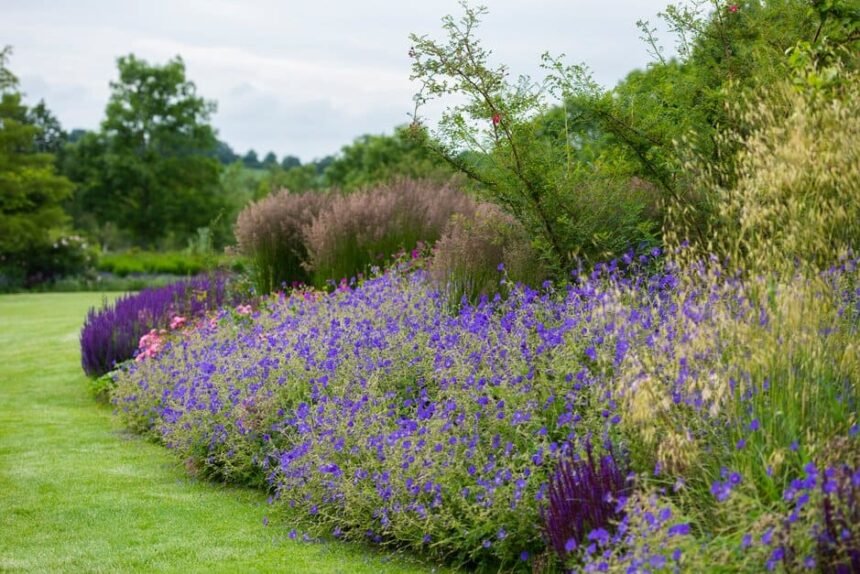
Once those conditions are understood, consider the view in layers. A few structural plants can provide continuity, while smaller plants bring changes in texture and flowering. Leave enough room for their mature spread and for access behind them. A narrow strip packed with plants that will outgrow it creates a maintenance problem rather than a convincing soft edge.
Imagine the border in winter as well as summer. If most of the plants lose their leaves, more fencing will be visible for several months. That may suit a clean, simple design, or it may suggest including some suitable evergreen structure. Keep the planting plan realistic about the time available for pruning and general care.
Compare the complete fencing system
Two fences with similar boards may have quite different installation requirements. Review the posts, fixings, support details and permitted panel dimensions as a single system. Ask the supplier or installer how the design accommodates changes in level and movement in the materials. Avoid combining components merely because they appear to fit.
Before agreeing a quotation, establish the practical details:
- Which boards, posts, caps, fixings and finishing pieces are included?
- How will the fence follow slopes, corners and changes in ground level?
- What foundation or mounting arrangement is specified for this site?
- What clearances and movement allowances does the installation guidance require?
- Who will remove the existing fence and make good disturbed surfaces?
- What maintenance instructions and written warranty terms apply?
Ask for answers against the actual proposed layout. A general statement about strength or durability is less useful than confirmation that the chosen configuration suits the location. Where site conditions are uncertain, settle them before ordering materials.
Plan for ordinary maintenance and future access
A lower-maintenance material still needs an accessible setting. Allow space to clear leaves, inspect fixings and clean the surface using the supplier’s approved method. Do not assume that a treatment intended for timber is appropriate for composite boards. Check before using strong cleaners, coatings or pressure-washing equipment.
Think about attachments at the same time. Planters, climbing supports, lighting and storage hooks can add loads or require holes in the structure. Establish suitable fixing points with the system supplier instead of treating every panel as a mounting surface. Independent supports may offer a more flexible arrangement for features that could move later.
Make the final decision from the whole view
Before committing, review the proposal from the main indoor and outdoor viewpoints. Check the sample colour, the amount of exposed fencing, the planting space and the route through the garden together. Compare quotations on the same scope, including preparation and finishing work, so that a cheaper panel price does not obscure missing parts of the project.
The most useful boundary is one that supports everyday life in the garden: privacy where it matters, workable access, planting with room to develop, and a finish that belongs beside the house. Choosing dark grey is one design decision within that larger plan. Resolve the layout and practical details with equal care, and the fence can remain a coherent part of the space as the garden changes.
| 🔗 You may also like: |
| Best brick tiles for interior feature walls in the uk |
| Choosing the right travertine tiles and fitting them the smart way |