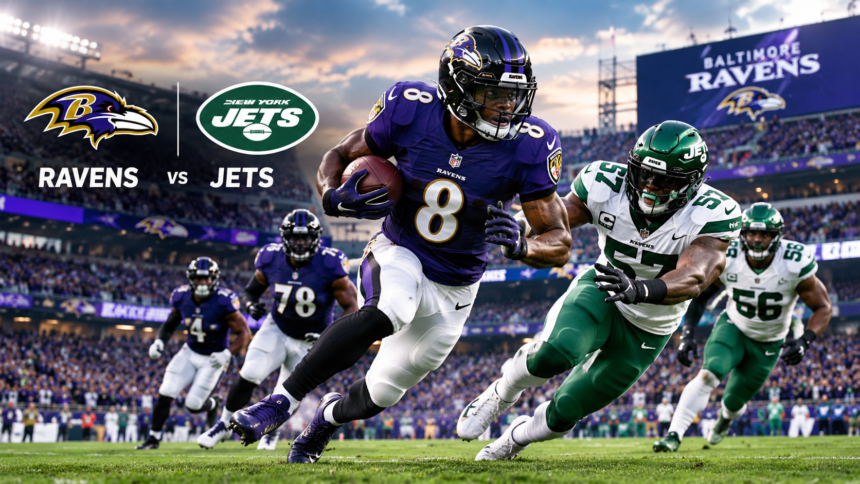
The New York Jets faced the Baltimore Ravens on November 23, 2025, in a Week 12 matchup of the NFL regular season. Baltimore earned a 23–10 victory at home, using a strong second-half performance and two rushing touchdowns from Derrick Henry to secure the win.
The game featured contrasting offensive approaches. Jets quarterback Tyrod Taylor threw for 222 yards and connected with John Metchie III for a touchdown, while Ravens quarterback Lamar Jackson helped lead a rushing attack that produced the game’s decisive points. Baltimore’s defense also made important plays, including an interception by cornerback TJ Tampa.
This article covers the New York Jets vs Baltimore Ravens player stats and box score, including passing, rushing, receiving, defensive performances, the quarter-by-quarter score, and the key factors that shaped the result.
New York Jets vs Baltimore Ravens Match Overview
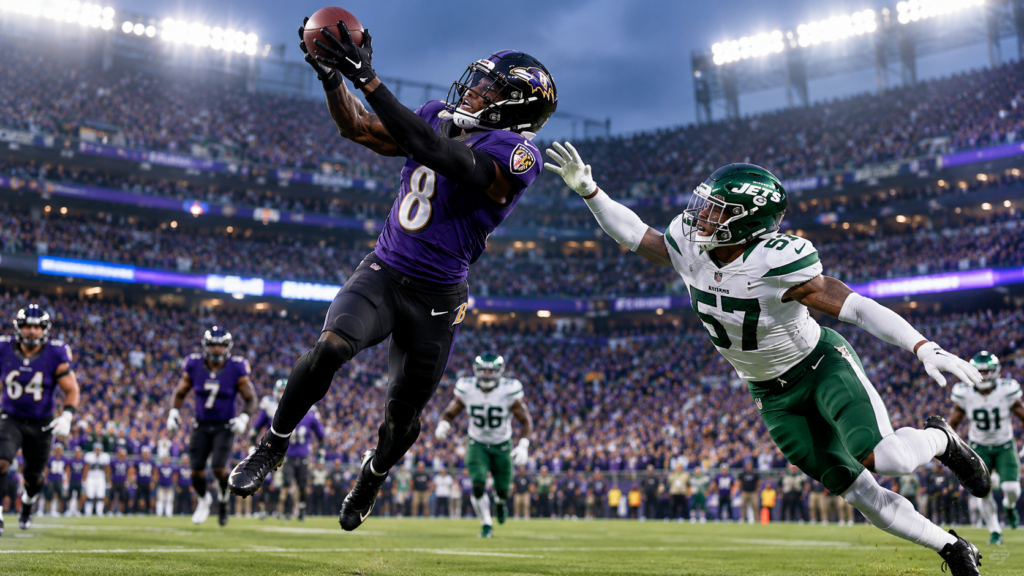
M&T Bank Stadium, Baltimore
Jets record after game
2–9
Ravens record after game
6–5
Baltimore entered the game looking to continue its winning run, while New York was trying to improve its position after a difficult start to the season. The Jets remained competitive in the first half, but the Ravens pulled away after halftime.
Derrick Henry was central to Baltimore’s victory, scoring twice on the ground. The Ravens also benefited from defensive pressure and a takeaway, helping them control the game despite Jackson throwing for fewer yards than Taylor.
 You may also like: Pittsburgh Steelers vs Detroit Lions Match Player Stats
New York Jets vs Baltimore Ravens Box Score
The final score was Baltimore Ravens 23, New York Jets 10. The quarter-by-quarter breakdown shows how the game changed after halftime.
| Quarter | New York Jets | Baltimore Ravens |
|---|---|---|
| First | 0 | 0 |
| Second | 7 | 3 |
| Third | 0 | 14 |
| Fourth | 3 | 6 |
| Final | 10 | 23 |
Neither team scored in the opening quarter. New York then took a 7–0 lead in the second quarter when Tyrod Taylor threw a 13-yard touchdown pass to John Metchie III. Baltimore answered with a 31-yard field goal from Tyler Loop, leaving the Jets ahead 7–3 at halftime.
New York Jets Player Stats
The Jets produced their strongest offensive moments through Taylor’s passing and Hall’s combined rushing and receiving contributions. However, New York struggled to turn its opportunities into enough points to challenge Baltimore in the second half.
Jets passing stats
| Player | Comp/Att | Passing yards | TD | INT | Sacks |
|---|---|---|---|---|---|
| Tyrod Taylor | 17/28 | 222 | 1 | 1 | 3 |
Taylor completed 17 of 28 attempts, finishing with 222 passing yards, one touchdown, and one interception. His completion rate was approximately 60.7%, and his passer rating was 82.7.
His most important passing play was the 13-yard touchdown to Metchie in the second quarter. That connection completed a 79-yard scoring drive and temporarily gave New York the lead. Taylor also used his mobility to gain 19 rushing yards on five carries.
Despite his productive passing total, Taylor was sacked three times for a combined loss of 18 yards. His interception-free first-half approach helped the Jets remain competitive, but New York could not maintain its early advantage after halftime.
Jets rushing stats
| Player | Carries | Rushing yards | Longest run |
|---|---|---|---|
| Breece Hall | 16 | 44 | 9 |
| Tyrod Taylor | 5 | 19 | 8 |
| Arian Smith | 1 | 8 | 8 |
| Isaiah Davis | 4 | 7 | 2 |
Hall led New York in rushing attempts, carrying the ball 16 times for 44 yards. His average of 2.75 yards per carry shows how effectively Baltimore limited the Jets’ ground production.
Taylor added a useful running option with 19 yards on five attempts. Smith contributed eight yards on his single carry, while Davis recorded seven yards across four attempts.
The Jets had several ways to move the ball, but their rushing attack did not generate the consistent gains needed to sustain drives and keep the Ravens’ offense off the field.
Jets receiving stats
| Player | Receptions | Receiving yards | TD | Targets |
|---|---|---|---|---|
| Breece Hall | 4 | 75 | 0 | 4 |
| John Metchie III | 6 | 65 | 1 | 7 |
| Adonai Mitchell | 2 | 42 | 0 | 7 |
| Mason Taylor | 3 | 21 | 0 | 5 |
| Andrew Beck | 1 | 10 | 0 | 1 |
| Allen Lazard | 1 | 9 | 0 | 3 |
Hall was New York’s leading receiver by yardage, recording 75 yards on four catches. His 40-yard reception was the longest listed for the Jets and helped demonstrate his value beyond traditional running plays.
Metchie delivered the team’s only touchdown reception and finished with six catches for 65 yards. Mitchell added 42 yards on two receptions, although he had seven targets, illustrating that not every passing opportunity resulted in a completed catch.
Mason Taylor contributed three receptions for 21 yards. Beck and Lazard added smaller contributions to the passing game.
Hall’s combined production was particularly important: 44 rushing yards plus 75 receiving yards gave him 119 yards from scrimmage. That made him one of New York’s most productive offensive players even though the team scored only 10 points.
Jets defensive stats
| Player | Total tackles | Additional contribution |
|---|---|---|
| Jamien Sherwood | 13 | 3 solo tackles |
| Harrison Phillips | 8 | 1 tackle for loss |
| Jowon Briggs | 5 | 1 sack, 1 tackle for loss |
Sherwood led the listed Jets defenders with 13 total tackles. His workload reflected the defense’s need to respond to Baltimore’s rushing attempts and short-yardage scoring opportunities.
Phillips recorded eight tackles and one tackle for loss. Briggs added five tackles, a sack, and a tackle for loss, providing pressure in the defensive front.
New York’s defense kept the Ravens scoreless in the first quarter and limited them to three points in the second. However, penalties and missed opportunities during the third quarter helped Baltimore sustain the drives that produced both Henry touchdowns. The Jets also failed to convert a fourth-and-2 opportunity at midfield, giving Baltimore another chance to build momentum.
You may also like: Buffalo Bills vs Miami Dolphins Player Stats
Baltimore Ravens Player Stats
Baltimore’s offense did not produce a particularly strong passing performance, but the team found a winning formula through Henry’s touchdowns, contributions from its receivers, and effective situational play.
Ravens passing stats
| Player | Comp/Att | Passing yards | TD | INT | Sacks |
|---|---|---|---|---|---|
| Lamar Jackson | 13/23 | 153 | 0 | 0 | 1 |
Jackson completed 13 of 23 passes for 153 yards without a passing touchdown or interception. His completion rate was approximately 56.5%, and his passer rating was 76.9.
Although his passing numbers were modest, Jackson helped Baltimore move the ball on important possessions. In the second quarter, his completions to Zay Flowers helped set up the Ravens’ first scoring drive, which ended with Loop’s 31-yard field goal.
Jackson was also involved in Baltimore’s rushing game, recording 11 yards on seven carries. His ability to contribute as a runner gave the offense another option, even though Henry ultimately supplied the touchdowns that determined the result.
Ravens rushing stats
| Player | Carries | Rushing yards | TD | Longest run |
|---|---|---|---|---|
| Derrick Henry | 21 | 64 | 2 | 17 |
| Lamar Jackson | 7 | 11 | 0 | 6 |
| Zay Flowers | 2 | 11 | 0 | 11 |
| Keaton Mitchell | 2 | 10 | 0 | 9 |
| Mark Andrews | 2 | 2 | 0 | 2 |
Henry was Baltimore’s leading rusher with 64 yards on 21 carries. His average was approximately 3.0 yards per attempt, but his two touchdowns were far more important than his overall rushing average.
Both scores came in the third quarter, with Henry crossing the goal line from two yards away on each occasion. The first touchdown put Baltimore in front 10–7, and the second extended its lead to 17–7.
Jackson, Flowers, Keaton Mitchell, and Andrews also contributed rushing attempts. Their combined involvement gave Baltimore additional ways to use its personnel, but Henry’s short-yardage effectiveness made the biggest difference.
This performance illustrates why rushing efficiency cannot be measured by total yardage alone. A running back who converts goal-line opportunities into touchdowns can influence a game substantially even when his average per carry is modest.
Ravens receiving stats
| Player | Receptions | Receiving yards | TD | Targets |
|---|---|---|---|---|
| Zay Flowers | 5 | 58 | 0 | 6 |
| Devontez Walker | 1 | 30 | 0 | 1 |
| Derrick Henry | 2 | 24 | 0 | 2 |
| DeAndre Hopkins | 2 | 13 | 0 | 3 |
| Isaiah Likely | 1 | 10 | 0 | 3 |
| Mark Andrews | 1 | 9 | 0 | 3 |
| Keaton Mitchell | 1 | 9 | 0 | 1 |
Flowers led the Ravens in receiving, finishing with five catches for 58 yards. His work after the catch helped Baltimore move the ball during a first half in which the offense struggled to find a consistent rhythm.
Walker recorded 30 yards on his only reception, providing Baltimore with a significant gain on limited involvement. Henry added 24 receiving yards on two catches, contributing to his overall offensive workload.
Hopkins, Likely, Andrews, and Keaton Mitchell also recorded receptions. While none of the listed Ravens receivers scored a touchdown, their contributions helped create opportunities for the running game and the kicking unit.
Baltimore’s receiving totals were lower than New York’s leading individual numbers, but the Ravens did not need a high-volume passing performance to win. Their ability to score rushing touchdowns and convert late drives into field goals proved sufficient.
Ravens defensive stats
| Player | Total tackles | Additional contribution |
|---|---|---|
| Roquan Smith | 11 | 6 solo tackles |
| Kyle Hamilton | 10 | 6 solo tackles |
| Teddye Buchanan | 8 | 4 solo tackles |
| Dre’Mont Jones | — | 1.5 sacks |
| Mike Green | — | 1 sack |
| TJ Tampa | — | 1 interception |
Smith led the listed Baltimore defenders with 11 tackles, including six solo stops. Hamilton followed with 10 tackles, also recording six solo tackles, while Buchanan contributed eight tackles.
Jones and Green supplied pass-rush production, with 1.5 sacks and one sack respectively in the supplied defensive statistics. Tampa’s interception added a takeaway to Baltimore’s defensive effort.
The Ravens’ defense helped restrict New York’s scoring opportunities after the Jets’ second-quarter touchdown. Although Taylor passed for 222 yards, the Jets were unable to turn that production into a second touchdown.
Defensive performance is not measured only by yards allowed. Tackles for loss, sacks, interceptions, and the ability to stop drives on critical downs can all influence the final score. Baltimore’s defense helped keep the Jets from building on their first-half lead.
Scoring Summary: Jets vs Ravens
The scoring sequence explains how Baltimore transformed a halftime deficit into a comfortable final margin.
| Quarter | Time | Scoring play | Score after play |
|---|---|---|---|
| Second | 4:04 | John Metchie III 13-yard TD reception; Nick Folk extra point | Jets 7–0 |
| Second | 1:35 | Tyler Loop 31-yard field goal | Jets 7–3 |
| Third | 8:49 | Derrick Henry 2-yard rushing TD; Loop extra point | Ravens 10–7 |
| Third | 3:33 | Derrick Henry 2-yard rushing TD; Loop extra point | Ravens 17–7 |
| Fourth | 14:41 | Nick Folk 42-yard field goal | Ravens 17–10 |
| Fourth | 9:35 | Tyler Loop 35-yard field goal | Ravens 20–10 |
| Fourth | 0:41 | Tyler Loop 27-yard field goal | Ravens 23–10 |
New York’s touchdown gave the visitors the advantage before halftime. Baltimore’s response was limited to a field goal, leaving the Jets with a narrow lead at the break.
The two third-quarter rushing touchdowns changed the direction of the game. Henry’s scores were followed by Folk’s 42-yard field goal, which briefly brought New York within seven points.
Loop then kicked a 35-yard field goal to restore a 10-point lead and added a 27-yarder late in the fourth quarter. Those kicks completed Baltimore’s 23-point performance without requiring another touchdown.
Key Takeaways From the Jets vs Ravens Game
1. Derrick Henry delivered the decisive scores
Henry’s 64 rushing yards were not an exceptionally high total, but his two touchdowns came at a critical point in the game. Both scores arrived in the third quarter and turned Baltimore’s three-point halftime deficit into a 10-point lead.
His ability to finish short-yardage opportunities was the biggest difference between the teams’ offensive results.
2. Tyrod Taylor outpassed Lamar Jackson
Taylor finished with 222 passing yards, compared with Jackson’s 153. Taylor also threw one touchdown, while Jackson did not throw a touchdown pass.
However, passing yards alone do not determine a game’s outcome. Baltimore scored twice on the ground, and its defense helped prevent New York from responding with another touchdown.
3. Breece Hall was a versatile offensive threat
Hall recorded 119 yards from scrimmage, combining 44 rushing yards with 75 receiving yards. His four catches were especially valuable because they gave New York another way to move the ball when rushing lanes were limited.
Despite Hall’s production, the Jets did not consistently convert offensive opportunities into points.
4. Baltimore improved after halftime
The Ravens scored 14 points in the third quarter after managing just three in the second. Their adjustments, combined with New York’s missed opportunities and penalties, helped Baltimore gain control of the contest.
5. Special teams helped Baltimore finish the game
Loop made four field goals, from 31, 35, and 27 yards, plus the opening 31-yard attempt listed in the scoring log?
Correction: Baltimore made three field goals, from 31, 35, and 27 yards. These kicks supplied nine points and helped the Ravens maintain their advantage after the two rushing touchdowns.
Folk’s 42-yard field goal was New York’s only scoring contribution after halftime. The difference in scoring opportunities ultimately favored Baltimore.
You may also like: Indianapolis Colts vs Denver Broncos Match Player Stats
Conclusion
The New York Jets vs Baltimore Ravens player stats show a matchup in which passing production and scoring efficiency told different stories. Taylor threw for more yards than Jackson, and Hall delivered 119 total yards from scrimmage, but New York finished with only 10 points.
Baltimore found its advantage through Henry’s two third-quarter touchdowns, contributions from Flowers and the receiving group, and a defense that limited the Jets’ second-half scoring. Loop’s three field goals added valuable insurance.
FAQs
What was the final score of the New York Jets vs Baltimore Ravens game?
The Baltimore Ravens defeated the New York Jets 23–10 on November 23, 2025, during Week 12 of the NFL regular season.
How many passing yards did Tyrod Taylor record?
Taylor completed 17 of 28 passes for 222 yards, one touchdown, and one interception. He also rushed five times for 19 yards.
How many touchdowns did Derrick Henry score?
Henry scored two rushing touchdowns, both in the third quarter. Each touchdown came on a two-yard run.
Who led the Jets in receiving yards?
Breece Hall led the Jets with 75 receiving yards on four receptions. John Metchie III followed with 65 yards and the team’s only receiving touchdown.
How many passing touchdowns did Lamar Jackson throw?
Jackson threw for 153 yards but did not record a passing touchdown or interception. Baltimore scored its two touchdowns through Henry’s rushing plays.
Where was the Jets vs Ravens game played?
The game took place at M&T Bank Stadium in Baltimore, Maryland. The Ravens were the home team.