Search for the “latest breakthroughs in quantum computing 2024” and you will find two very different stories. Some headlines suggest that quantum computers are about to transform every industry, while others argue that the technology is still too experimental to matter. The reality is somewhere between these extremes.
2024 was an important year for quantum computing, particularly in error correction, logical qubits, new hardware architectures, and early industry applications. Researchers made genuine progress toward reliable quantum machines, but the technology is still far from replacing conventional computers for everyday or commercial workloads.
Understanding what actually changed in 2024 requires looking beyond raw qubit numbers and focusing on reliability, error correction, and the ability to perform useful calculations.
Qubits, in Plain Terms
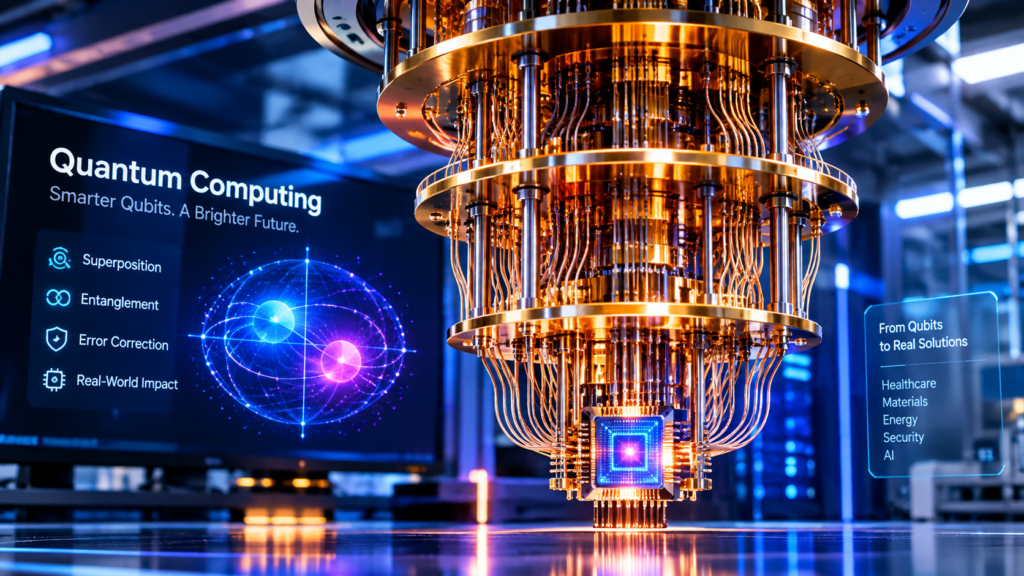
A classical computer stores information using bits represented as either 0 or 1. A quantum computer uses qubits, which can exist in combinations of 0 and 1 through a property called superposition. Qubits can also become entangled, meaning their states can have strong correlations that have no direct classical equivalent.
However, not all qubits are equally useful. Three concepts are especially important:
Physical qubit: A real hardware unit used to perform quantum operations. Physical qubits are sensitive to noise and environmental disturbances.
Logical qubit: A more reliable unit created by combining multiple physical qubits through quantum error-correction techniques.
Fault-tolerant quantum computer: A machine capable of maintaining accurate logical qubits long enough to run complex quantum algorithms reliably.
Much of the major quantum news in 2024 involved moving from unreliable physical qubits toward more dependable logical qubits. This distinction is important because a machine with more physical qubits is not automatically more powerful or useful.
The Real Progress in 2024
Error Correction Crosses a Major Threshold
One of the biggest quantum computing developments of 2024 came from Google Quantum AI. In December, Google introduced its Willow quantum chip, a 105-qubit superconducting processor.
The important achievement was not simply the number 105. Google demonstrated that increasing the size of its error-correcting code could actually reduce the logical error rate. Tests using progressively larger 3×3, 5×5, and 7×7 qubit grids showed the error rate falling by roughly half each time the code size increased.
This is known as below-threshold error correction, a major goal of quantum computing research for decades. In simple terms, it means adding more error-correction resources can make a logical qubit more reliable instead of creating more errors than it fixes.
Google also reported that its logical qubit could operate longer than the individual physical qubits used to construct it. The company demonstrated a random circuit sampling calculation in about five minutes, while estimating that a classical supercomputer would require an extraordinarily long time to perform the same task.
The demonstration does not mean quantum computers are now faster than classical computers for everything. Instead, it showed important progress toward building quantum systems that can become more reliable as they scale.
Logical Qubits Start Beating Physical Ones
Another important milestone came in April 2024 when Microsoft and Quantinuum demonstrated four logical qubits using 30 physical qubits on Quantinuum’s H2 trapped-ion processor.
According to the companies, the logical qubits had an error rate roughly 800 times lower than the corresponding physical qubits. The system also completed more than 14,000 circuit runs without an uncorrected error.
This represents an important change in how quantum computing progress should be measured. Researchers are increasingly interested in how many reliable logical qubits a system can produce rather than simply counting its physical qubits.
A separate Harvard, MIT, and QuEra research team also demonstrated a neutral-atom processor containing 48 logical qubits. The work showed that quantum error correction can be integrated into a larger neutral-atom system, providing another possible route toward scalable quantum computing.
The development was significant enough to be recognized alongside Google’s Willow work as one of the major physics breakthroughs of 2024.
A First Topological Qubit
In November 2024, Quantinuum researchers working with Harvard, Caltech, and the University of Chicago reported an experimental demonstration of a topological qubit.
The idea behind topological approaches is to make quantum information naturally more resistant to certain errors rather than depending entirely on correcting errors after they occur. If the approach can eventually be scaled, it could potentially reduce the enormous hardware overhead required for fault-tolerant quantum computing.
However, this was still a small-scale research demonstration. A successful experimental topological qubit does not mean large fault-tolerant topological quantum computers already exist. Considerable engineering and research challenges remain.
More Hardware Architectures Are Emerging
Quantum computing is not following a single hardware path. Different research groups are exploring different ways to build and control qubits.
IBM continued developing superconducting processors, including its 133-qubit Heron processor, while improving gate speed and system performance. Trapped-ion systems, such as Quantinuum’s processors, focus heavily on high-fidelity operations.
Neutral-atom systems from companies such as QuEra and Pasqal offer another approach, using lasers to control atoms and allowing researchers to rearrange them during computations.
Photonic quantum computing uses particles of light rather than matter-based qubits and could eventually offer advantages in networking and scalability.
Classical computing is also becoming more closely connected with quantum hardware. NVIDIA’s CUDA-Q, for example, is designed to connect classical GPU computing with different quantum systems. This reflects an increasingly important idea: the future of computing may involve hybrid quantum-classical systems, rather than quantum computers operating completely independently.
Real Pilots, Not Just Research Papers
Quantum computing also moved closer to practical industry applications during 2024.
IBM and Moderna explored quantum computing for biological problems, including modeling the folded structure of a 60-nucleotide mRNA molecule using IBM’s Heron processor. The results matched classical approaches in the experiment, but the work helped researchers investigate how quantum systems might handle increasingly complex molecular problems.
Microsoft and the Pacific Northwest National Laboratory also demonstrated a large-scale materials screening workflow through Azure Quantum Elements. The system examined 32 million candidate materials and reduced them to a much smaller group for further analysis. Importantly, this achievement relied on classical computing and AI rather than quantum hardware, showing how quantum-related platforms can combine several computational technologies.
In cybersecurity, JPMorgan Chase, Toshiba, and Ciena expanded work on quantum key distribution across fiber networks. These efforts reflect growing interest in preparing financial and communications infrastructure for a future where quantum technologies affect cybersecurity.
The Honest Limits of Quantum Computing
Despite the breakthroughs, 2024 did not produce a quantum computer that replaced classical computers for commercially important general-purpose workloads.
| Breakthrough | What Improved | What’s Still Limited |
| Google Willow | Demonstrated below-threshold error correction | Only 105 physical qubits |
| Microsoft + Quantinuum | About 800× lower logical error rate | Only four logical qubits |
| Harvard/MIT/QuEra | 48 logical qubits demonstrated | Still a research-scale system |
| Topological qubit research | New approach to error resistance | Very early-stage demonstration |
| Industry pilots | More realistic applications explored | No broad quantum advantage yet |
The central challenge remains scale. Useful fault-tolerant quantum computers may require tens of thousands, hundreds of thousands, or potentially millions of physical qubits, depending on the algorithm, architecture, and error-correction strategy.
Current systems remain much smaller, and maintaining qubit quality becomes increasingly difficult as machines grow. Heat, electromagnetic interference, material imperfections, control errors, and other environmental effects can introduce noise.
Cybersecurity is another reason researchers are preparing early. In August 2024, NIST finalized three post-quantum cryptography standards designed to protect digital systems against future quantum attacks. The concern is not that today’s quantum computers can break modern encryption. Rather, sensitive encrypted information could potentially be collected today and decrypted in the future if sufficiently powerful quantum computers become available.
What’s Next: Updates Through 2026
Progress continued after 2024.
In February 2025, Microsoft announced Majorana 1, an eight-qubit chip based on its topological quantum computing approach and presented a roadmap toward much larger systems. The claims attracted significant attention, although outside researchers raised questions about some aspects of the underlying technology and its scalability.
In October 2025, Google reported results from Quantum Echoes, claiming a major speed advantage over classical estimates on a problem designed to demonstrate quantum advantage. The result was important because researchers increasingly want demonstrations that can be independently verified rather than benchmarks based only on artificial tasks.
Google also expanded its research into neutral-atom quantum computing in 2026, adding another hardware approach alongside its superconducting program.
Meanwhile, research from Harvard, Quantinuum, Stony Brook, and the University of Chicago continued exploring topological quantum operations, including demonstrations involving a universal topological gate set.
New theoretical work has also suggested that fault-tolerant quantum computing might eventually require fewer physical qubits than older estimates suggested. If these improvements prove practical, the path toward powerful quantum algorithms could become significantly shorter.
The overall pattern is clear: quantum computing is moving from isolated laboratory demonstrations toward larger, more carefully engineered systems, although commercial-scale fault tolerance remains a long-term challenge.
Conclusion
The latest breakthroughs in quantum computing show real progress, but they should be viewed realistically. In 2024, researchers demonstrated below-threshold error correction, substantially improved logical-qubit reliability, larger logical-qubit systems, and new approaches such as topological quantum computing.
These achievements do not mean quantum computers are ready to replace classical machines. The technology still faces major challenges involving scale, reliability, error correction, and cost.
The most important change is that researchers are increasingly demonstrating better-quality qubits rather than simply more qubits. That shift could ultimately be more important than any single headline about processor size.
Quantum computing is still developing, but the progress made during 2024 and the advances that followed suggest that the field is gradually moving from theoretical promise toward increasingly practical and testable technology.
FAQs
Is quantum computing useful today?
Yes, but mainly for research and specialized experiments. Classical computers remain more practical for most everyday and business workloads. Quantum computing is currently being explored in areas such as chemistry, materials science, optimization, biology, and cybersecurity.
Is my encrypted data at risk right now?
Existing quantum computers cannot generally break modern encryption at practical scale. The bigger concern is the possibility of collecting encrypted information today and decrypting it later. This is why organizations are already moving toward post-quantum cryptography.
What was the biggest quantum breakthrough of 2024?
Error correction was arguably the most important development. Google’s Willow demonstrated below-threshold error correction, while other teams showed significant progress with logical qubits and new error-resistant architectures.
What is the biggest obstacle?
Scale remains the biggest obstacle. Researchers need much larger numbers of reliable physical and logical qubits while keeping error rates low enough for useful algorithms.
Which industries could benefit first?
Chemistry, materials science, pharmaceuticals, and advanced research are among the strongest candidates. Cybersecurity is another major area, although its immediate focus is preparing systems for future quantum threats rather than using quantum computers for everyday security.