The phrase Ponas Robotas may seem like the name of an artificial intelligence system, robotics project, or futuristic technology. However, its clearest meaning is much simpler: it is the Lithuanian translation of “Mr. Robot.” The phrase is particularly associated with the television series Mr. Robot, which explores hacking, cybersecurity, digital surveillance, and the influence of technology on modern society.
At the same time, some online articles use Ponas Robotas as a creative expression for intelligent machines, AI assistants, and the future of robotics. This broader interpretation connects the phrase to real technological developments, but it is important to distinguish established facts from imaginative descriptions.
This guide explains what Ponas Robotas means, its linguistic origins, its connection to the television series, and how artificial intelligence and robotics are shaping the future.
What Does Ponas Robotas Mean?
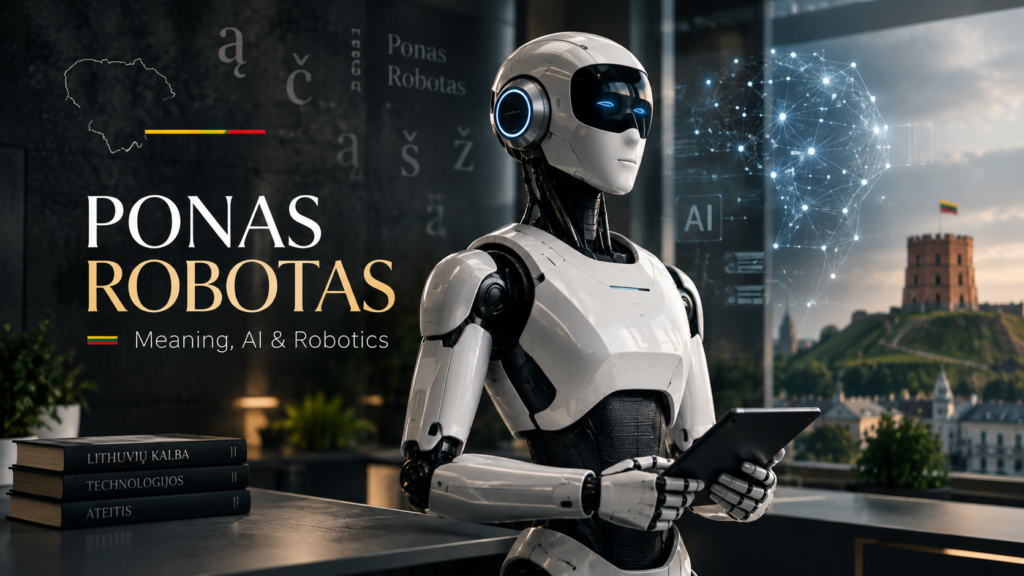
Ponas Robotas translates directly to “Mr. Robot” in English. It is a Lithuanian phrase made up of two words:
- Ponas: A respectful title meaning “Mr.,” “Sir,” or “Gentleman.”
- Robotas: The Lithuanian word for “robot.”
Together, the words describe a robot using a polite human title. The phrase itself does not establish the existence of a particular robot, AI platform, or technology company.
Language often gives machines human characteristics. People name their cars, vacuum cleaners, digital assistants, and other devices because these objects become part of everyday routines. A title such as “Mr. Robot” adds a recognizable personality to the idea of a machine.
This makes Ponas Robotas an interesting expression for discussing technology, but its literal translation should not be confused with a formal technical definition.
The Connection Between Ponas Robotas and Mr. Robot
The strongest established cultural connection is the television series Mr. Robot, which premiered in 2015 and concluded in 2019. In Lithuanian, the series is known as Ponas Robotas.
Created by Sam Esmail, the drama follows Elliot Alderson, a cybersecurity engineer and skilled hacker who becomes involved with the hacktivist group fsociety. The show examines the consequences of digital dependence, corporate influence, privacy violations, and the psychological effects of living in a technology-driven world.
Its central themes include:
Hacking and cybersecurity
The series portrays computer network vulnerabilities and the potential consequences of unauthorized access. Although it is a fictional drama, it helped bring cybersecurity concepts into mainstream entertainment.
Corporate power
The story explores how powerful corporations can influence individuals, financial systems, and society. It raises questions about who controls digital infrastructure and how technology can reinforce existing power structures.
Digital privacy
Mr. Robot highlights the value of personal information and the risks associated with surveillance, data collection, and insecure systems.
Technology and identity
The show also examines the relationship between technology, personal identity, and human behavior. Its title reflects a world in which technology is not merely a background tool but a central part of human experience.
When a conversation about Ponas Robotas includes Elliot Alderson, fsociety, E Corp, or hacking, the television series is almost certainly the intended subject.
Does Ponas Robotas Refer to a Real AI System?
There is no established technical definition that makes Ponas Robotas the name of a particular AI system or robotics platform. Some online content uses the phrase as a broad label for intelligent robots, but this is a creative or contextual usage rather than a recognized industry standard.
That distinction is important when researching the term. A website may describe Ponas Robotas as an advanced AI assistant, a humanoid robot, or a future automation concept. Unless the article identifies a real company, product, research project, or verifiable source, those descriptions should not be treated as evidence of an actual named technology.
The phrase can still serve as a useful metaphor for the growing relationship between people and intelligent machines. However, the metaphor and the literal meaning are different.
Where Does the Word Robot Come From?
The word “robot” has its origins in the Czech language. It became widely known through the 1920 play R.U.R. (Rossum’s Universal Robots) by Czech writer Karel Čapek.
The term is associated with the Czech word robota, referring to forced labor or arduous work. In the play, artificial workers are created to serve humans. The story explores the consequences of manufacturing artificial beings and the relationship between human creators and their creations.
Over time, the word robot spread into many languages, including Lithuanian, where it became robotas.
The original literary concept focused on artificial workers, while modern robotics encompasses a much broader range of machines, including industrial arms, autonomous vehicles, surgical systems, and domestic devices.
How Robotics Has Evolved
Robotics has developed from machines designed to repeat specific movements into systems capable of sensing environments, processing information, and adapting to changing conditions.
Early industrial robots were primarily designed for controlled environments. They performed repetitive tasks such as welding, assembly, and material handling. These systems were valuable because they offered speed, consistency, and precision.
Modern robotics combines mechanical engineering with computer science, sensors, machine learning, and artificial intelligence. This allows certain robots to operate in more complex environments and respond to situations that were not explicitly described in a simple fixed script.
The evolution can be understood through three broad stages:
- Programmed automation: Machines follow predefined instructions for specific tasks.
- Sensor-based robotics: Robots use cameras, proximity sensors, force sensors, or other inputs to respond to their surroundings.
- AI-enabled robotics: More advanced systems combine perception, planning, and learning techniques to handle a wider range of tasks.
Not every modern robot uses artificial intelligence, and not every AI system has a physical body. The combination of these technologies is what makes intelligent robotics a significant area of research and development.
How Artificial Intelligence Works With Robots
Artificial intelligence gives robots software capabilities that can help them interpret information and choose appropriate actions. A physical robot still requires hardware, motors, power systems, and control mechanisms, but AI can make its behavior more flexible.
A typical AI-enabled robotic system may include the following components.
Sensors and perception
Cameras, microphones, lidar, depth sensors, and other devices collect information about the robot’s environment. These inputs help the system detect objects, recognize obstacles, and estimate its position.
Machine learning
Machine learning allows software to identify patterns in data. Depending on the application, it can support object recognition, navigation, prediction, or improved task performance.
Planning and decision-making
A planning system determines how to approach a task. For example, a warehouse robot may need to select a route around obstacles, while a mobile assistant may need to decide how to reach a requested location.
Movement and control
Motors, wheels, robotic arms, and other mechanical components carry out the selected actions. Control software helps coordinate movement and respond to sensor feedback.
Feedback
The system can compare its results with the intended outcome. Feedback may be used to adjust future actions, improve performance, or identify when human assistance is required.
This process is sometimes summarized as:
Sense → Understand → Plan → Act → Evaluate.
It is a useful simplified model, not a guarantee that every robot independently learns or makes reliable decisions.
Real-World Examples of Intelligent Robotics
Although Ponas Robotas is not a standardized robotics product, several real technologies illustrate the capabilities often associated with the phrase.
Home robotics
Robot vacuum cleaners can map indoor spaces, detect obstacles, and schedule cleaning tasks. Some advanced home robots are designed to interact with smart-home systems or provide remote monitoring.
These devices demonstrate how automation can move beyond repetitive mechanical movement toward context-aware assistance.
Healthcare robotics
Hospitals use robots for tasks such as transporting supplies, delivering medications, supporting logistics, and assisting with certain medical procedures. For example, Moxi, developed by Diligent Robotics, is designed to support hospital workflows by handling delivery tasks.
Healthcare robots are generally intended to assist medical professionals rather than replace clinical judgment. Their usefulness depends on safety, reliability, and appropriate human supervision.
Manufacturing and logistics
Industrial robots and collaborative robots, often called cobots, are used for assembly, inspection, packaging, and material handling. AI-powered vision systems can help identify objects or detect quality issues.
In logistics, autonomous mobile robots may transport goods through warehouses, improving the efficiency of repetitive movement.
Humanoid robotics
Companies such as Boston Dynamics and Tesla have developed robotic systems that demonstrate progress in mobility, manipulation, and general-purpose robotics research. These projects illustrate the direction of the field, but they should not be confused with a verified product called Ponas Robotas.
Why People Give Technology Human Names
The human naming of machines is not a new phenomenon. Mechanical automata, fictional robots, and modern digital assistants have all encouraged people to imagine technology as something with personality or social presence.
Giving a machine a human title can make complex technology easier to discuss. Instead of describing a collection of sensors, software, and motors, people can refer to a character-like concept such as “Mr. Robot.”
This framing can also influence expectations. When users think of a machine as a helpful assistant, they may expect it to understand instructions, respond politely, and behave responsibly.
However, human-like language does not mean a robot has human emotions, consciousness, or independent intentions. A system may imitate conversation and social behavior without possessing human awareness.
Benefits of AI-Enabled Robotics
Intelligent robotics can provide practical advantages in carefully designed applications.
Efficiency: Robots can perform repetitive operations consistently and operate for extended periods when properly maintained.
Safety: Machines can be used for tasks involving hazardous environments, heavy materials, or exposure to dangerous conditions.
Accessibility: Assistive robots may help some users with mobility, reminders, navigation, or daily activities.
Productivity: Human workers can focus on judgment, communication, creativity, and tasks that require flexible expertise.
Precision: Robotic systems can perform certain controlled movements with high repeatability.
The benefits depend on the task, system design, operating environment, and cost. AI does not automatically make every robot more effective, and deployment requires testing and evaluation.
Challenges and Risks
The future of robotics also presents significant challenges.
Privacy
Robots equipped with cameras and microphones may collect sensitive information about homes, workplaces, and individuals. Developers need clear policies for data collection, storage, access, and deletion.
Cybersecurity
Connected robots can become targets for unauthorized access. Security measures such as encrypted communication, authenticated updates, access controls, and secure device configuration are important.
Reliability
An AI system can misinterpret visual information, misunderstand instructions, or make an incorrect prediction. In a physical environment, an error can have more serious consequences than a wrong answer from a text-based chatbot.
Cost and maintenance
Robotic hardware can be expensive to purchase, repair, and update. Batteries, sensors, motors, and other components require ongoing maintenance.
Employment changes
Automation may reduce demand for some repetitive tasks while creating new roles in system supervision, maintenance, engineering, safety, and operations. The effect on employment varies by industry and the way organizations implement technology.
These concerns show why responsible robotics requires more than advanced hardware. It also needs clear accountability, testing, human oversight, and effective security practices.
What Could the Future of Robotics Look Like?
Robotics is likely to become more capable as improvements in AI models, sensors, hardware, and computing continue. However, the exact pace of development is uncertain, and ambitious predictions should be treated as possibilities rather than guaranteed outcomes.
Several trends are worth watching.
More natural human-machine interaction
Voice interfaces and language models may make it easier for users to communicate with robots through ordinary instructions. Instead of programming every movement, people may increasingly describe a goal and allow the system to plan suitable actions.
Greater use of specialized robots
The future may include many different types of robots rather than one machine that performs every task. Wheeled robots, robotic arms, drones, humanoid systems, and specialized industrial machines each have different strengths.
Better autonomy with human oversight
Robots may become better at navigating changing environments and completing multi-step tasks. In safety-critical settings, human supervision and emergency controls will remain important.
Improved efficiency
Advances in computing, battery technology, and mechanical design may make some robotic systems more practical and affordable. Whether a specific robot becomes economical will depend on its capabilities and operating costs.
Stronger focus on responsible AI
As robots become more connected to homes, businesses, and public environments, privacy, security, transparency, and accountability will become increasingly important.
The future of robotics is therefore not simply about creating smarter machines. It is about developing systems that people can use safely, understand, and trust.
How to Understand Ponas Robotas in Different Contexts
The meaning of the phrase depends on the surrounding information.
| Context | Most likely meaning |
| Elliot Alderson, fsociety, hacking, or E Corp | The television series Mr. Robot |
| Lithuanian translation or language discussion | “Mr. Robot” |
| AI, sensors, and automation | A loose, non-technical reference to intelligent robotics |
| A named product or company | Requires independent verification |
| Vague claims about a revolutionary AI system | Check the source before accepting the claim |
This approach helps prevent confusion between a translation, a cultural reference, and an actual technology product.
Conclusion
Ponas Robotas is best understood as the Lithuanian phrase for “Mr. Robot,” most notably associated with the television series of the same translated title. Its connection to hacking, cybersecurity, privacy, and digital power gives it an important cultural meaning.
Some online discussions use the phrase more broadly to describe intelligent machines and the future of AI-powered robotics. While that interpretation can be a useful metaphor, it is not an established technical definition or proof of a specific AI system.
The real future of robotics is being shaped by developments in machine learning, sensors, automation, and human-machine interaction. These technologies offer opportunities to improve productivity, safety, and assistance, but they also create challenges involving privacy, reliability, cybersecurity, and employment.
Ultimately, Ponas Robotas represents an interesting intersection of language, entertainment, and technology. Understanding its original meaning—and separating verified facts from imaginative claims—is the best way to appreciate the phrase and the evolving world of intelligent machines.