Introduction
An EV charger can make electric vehicle ownership considerably more convenient, but the installation deserves more attention than simply choosing a charger from a catalogue.
Problems can arise when the property’s electrical capacity has not been considered, the charger is positioned inconveniently, cable routing is poorly planned or the installation does not account for the vehicle’s charging capability.
These issues are often easier to prevent than correct afterwards. Understanding what can go wrong gives homeowners and businesses a clearer idea of what to discuss before arranging EV Charger Installation Shropshire.
Problem 1: Choosing the Charger Before Checking the Property
It is easy to focus on charger specifications first. A higher charging rate may look attractive, but the property’s electrical system has to be capable of supporting the installation.
The charger should therefore be selected as part of the overall electrical assessment.
Factors such as the existing supply, current electrical demand and intended charging pattern can influence which option is appropriate.
A professional installer can assess these factors before recommending an installation.
Problem 2: Assuming Faster Charging Is Always Better
Charging speed matters, but it is only one part of the decision.
Slow charging around 3kW may suit some situations where the vehicle is parked for long periods. Fast charging options such as 7kW and 22kW can provide substantially quicker charging, while rapid and ultra-rapid charging are generally associated with dedicated public charging environments.
For a home, the question should be:
How quickly does the vehicle actually need to charge?
If a car remains parked overnight, there may be enough time for a lower-powered charging arrangement to meet everyday driving requirements.
Problem 3: Ignoring Cable Routing
A technically suitable charger can still be inconvenient if its cable route has not been properly considered.
The charger may need to be positioned some distance from the property’s electrical equipment. The route should be planned around walls, driveways, entrances and areas where people regularly walk.
Poor planning can leave cables crossing inconvenient areas or create unnecessary visual clutter.
Discussing the proposed route before installation helps avoid these problems.
Problem 4: Installing Where the Vehicle Is Not Normally Parked
A charger may be placed in a location that looks ideal from inside the property but proves awkward when the vehicle is parked.
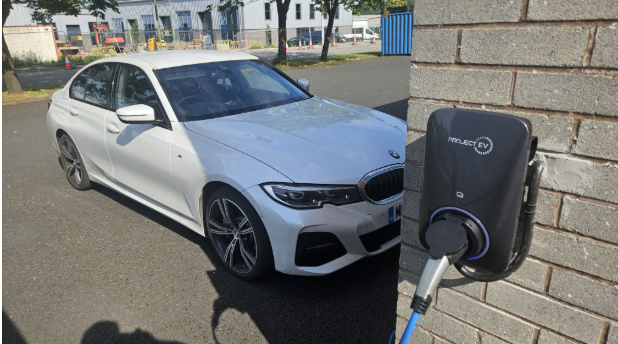
Think about how the car enters the driveway, where the charging socket is positioned on the vehicle and whether the cable can reach comfortably.
A good installation considers actual vehicle use rather than simply selecting the nearest wall.
Problem 5: Forgetting Future Electrical Demand
A charger may be the first major electrical upgrade a property receives, but it may not be the last.
A homeowner could later install another EV charger, electric heating, additional appliances or other high-demand equipment.
Businesses may expand their fleet or add several charging points.
Planning the installation with future requirements in mind can help avoid unnecessary modifications later.
Problem 6: Treating Installation as a DIY Project
EV chargers are connected to a property’s electrical infrastructure and should be installed and tested by appropriately qualified professionals.
Improvised electrical work can create safety concerns and may leave the property with an installation that is unsuitable for the intended load.
Professional EV Charger Installation Telford involves more than mounting the physical unit. The electrical connection, protective equipment, testing and overall installation need to be considered.
Problem 7: Not Testing After Installation
The installation process should not end when the charger switches on.
Testing is an important part of confirming that the equipment has been installed correctly and operates as intended.
A proper handover should also explain basic operation so that the user understands how to start and stop charging and use relevant features.
This can be especially useful with smart chargers that offer more functions than simply connecting the vehicle.
Problem 8: Forgetting Commercial Requirements
A home charger and a workplace charging system can have very different requirements.
A business may need to consider:
- Number of vehicles
- Number of charging points
- Parking arrangements
- Electrical capacity
- Employee access
- Visitor access
- Future fleet expansion
- Operating hours
Installing one charger may be relatively straightforward, but several chargers require more careful planning.
How a Proper Installation Can Prevent These Issues
A structured process helps identify potential problems before physical work begins.
Step 1: Discuss Requirements
The installer should understand the vehicle, property and expected charging pattern.
Step 2: Assess the Electrical System
Existing capacity and electrical infrastructure should be considered.
Step 3: Select the Appropriate Charger
The charger should match the property’s requirements rather than being selected purely on maximum charging speed.
Step 4: Plan the Installation
Location, cable routing and equipment placement should be established.
Step 5: Install and Test
The charger and associated electrical components should be professionally installed and tested.
Step 6: Handover
The user should understand how to operate the equipment and what to do if a problem occurs.
Benefits of Planning Before Installation
Fewer Unpleasant Surprises
Potential electrical or physical limitations can be identified before work starts.
Better Charger Placement
Planning helps create a charging point that is convenient to use.
Improved Long-Term Value
The installation can be designed around present needs while considering future requirements.
Reliable Operation
Proper installation and testing help ensure the charger performs as intended.
Easier Future Expansion
Early consideration of additional electrical demand can make future upgrades more straightforward.
Conclusion
Many EV charger installation problems are not caused by the charger itself. They result from choosing equipment without considering the property, overlooking cable routing, misunderstanding charging requirements or failing to plan for future demand.
Taking time to assess these details before installation can produce a more practical result.
For homeowners and businesses arranging EV Charger Installation Shropshire, professional planning can help identify potential complications before they become expensive changes. EV Charger Installation Telford can similarly provide a structured route from property assessment through installation, testing and handover.