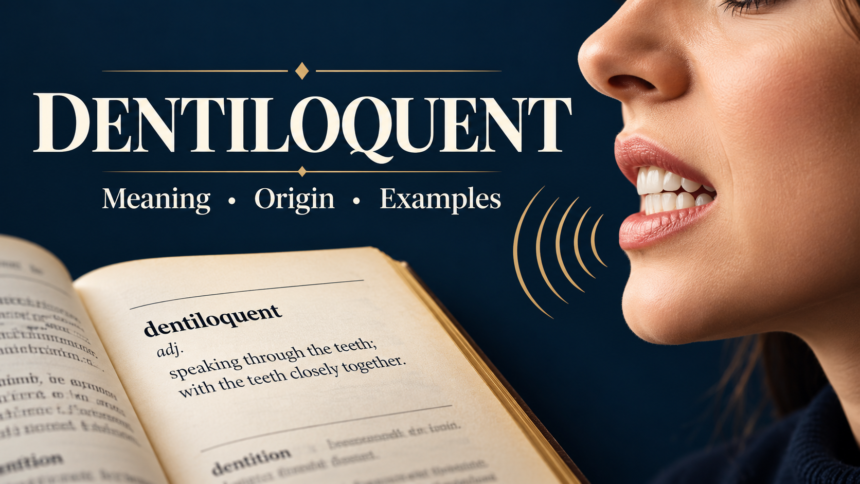
English contains many unusual words that describe everyday actions in surprisingly precise ways. Some words explain emotions, while others describe gestures, expressions, or particular ways of speaking. Dentiloquent belongs to this second category. Although it is rarely used in ordinary conversation, it describes a recognizable manner of speech that many people have encountered in real life, films, and books.
The word refers to speaking through the teeth, especially when the teeth remain close together or the jaw is held tightly. Imagine someone trying to respond calmly during an argument while keeping their mouth almost closed. Their words may sound restrained or tense because of the way they are speaking. This is the basic idea behind dentiloquent.
Understanding the term involves more than learning a short definition. Its linguistic roots, grammatical role, historical background, and practical examples help explain why the word exists and when it might be useful. Whether you encountered it while reading fiction, exploring unusual vocabulary, or searching for a precise descriptive word, this guide explains dentiloquent in straightforward English.
What Does Dentiloquent Mean?
Dentiloquent is a rare English adjective that describes speaking through or between the teeth. It generally refers to a manner of speaking in which the teeth remain close together instead of allowing the mouth and jaw to move as freely as they normally would during conversation.
In simple terms, dentiloquent means talking through your teeth. The word describes how someone produces speech rather than what the person is saying. A speaker might deliver a warning, answer a question, or make an ordinary comment in a dentiloquent manner.
For example, imagine a person saying, Please leave the room,” while keeping their jaw tight and their teeth nearly closed. The words themselves are straightforward, but the physical manner of speaking gives the delivery a distinctive quality.
Dentiloquent speech may sound controlled, compressed, or slightly muffled, depending on the speaker. However, these qualities are possible effects rather than strict requirements of the definition. The main feature is speech produced through closely held teeth.
It is also important not to confuse the word with anger itself. Someone speaking through clenched teeth might be frustrated, but the word does not automatically establish an emotional state. The surrounding situation, facial expression, and tone of voice help readers understand the speaker’s feelings.
Dentiloquent Definition and Part of Speech
The simplest definition of dentiloquent is speaking through the teeth.
Grammatically, dentiloquent functions as an adjective. An adjective describes a person, action, voice, expression, or other noun. In this case, it identifies a particular manner of speaking.
Consider the sentence, He gave a dentiloquent reply.” The adjective describes the reply by suggesting that the words were delivered through closely held teeth.
Another example is, Her dentiloquent voice made the warning sound restrained.” Here, the word describes the quality of the speaker’s delivery rather than the literal meaning of the warning.
Because dentiloquent is unfamiliar to many English speakers, writers should use it where its meaning can be understood from context. In general communication, the phrase speaking through clenched teeth” is usually clearer. In literary writing or discussions of rare vocabulary, however, the shorter adjective can be useful.
The word should not be treated as a synonym for every kind of quiet, unclear, or unusual speech. Whispering, mumbling, stuttering, and speaking through the teeth describe different features of communication.
| Internal Link |
|---|
| 🔗 You may also like: Incfidelibus Explained: Meaning, Latin Origins, and Linguistic Roots |
| 🔗 You may also like: Assimilasjon: Meaning, Context, and Linguistic Background |
Origin and Etymology of Dentiloquent
The structure of dentiloquent provides a useful clue to its meaning. Its form is associated with Latin vocabulary connected to teeth and speech. Understanding these linguistic elements makes the word easier to remember and places it within a broader family of English expressions.
The Latin noun dens, whose genitive form is dentis, means tooth.” This root has influenced numerous English words associated with teeth and dentistry. Examples include dental, dentist, dentition, and denture.
The speech-related element is connected with the Latin verb loqui, meaning to speak.” This root appears in English vocabulary associated with speaking, conversation, and verbal expression.
Words such as eloquent, loquacious, colloquy, and soliloquy illustrate related linguistic connections, although each has its own established meaning and word history.
Together, the tooth-related and speech-related elements help explain why dentiloquent describes speaking through the teeth.
Its related noun, dentiloquy, has a documented historical record. The Online Etymology Dictionary dates dentiloquy to 1737 and defines it as the act or practice of speaking through the teeth or with the teeth closed.
The history of the adjective should be distinguished from that of the related noun. A documented date for dentiloquy does not automatically establish the first recorded use of dentiloquent itself.
This distinction matters when discussing etymology. Similar-looking words can share linguistic elements without having identical histories or dates of first use.
Is Dentiloquent a Real English Word?

Yes, dentiloquent is a documented English vocabulary term, but it is extremely uncommon. It has not become a normal part of everyday conversation, where speakers generally prefer familiar phrases that communicate the same idea.
The word also appears in historical discussions of English vocabulary. Thomas Blount’s Glossographia, published in 1656, is cited in research on obscure English words as an early source recording dentiloquent with a meaning related to speaking through the teeth.
There is an important distinction between a word being documented and a word being widely used. Historical dictionaries can preserve unusual terms that appeared infrequently or never gained lasting popularity among ordinary speakers.
Dentiloquent is an interesting example of how vocabulary can survive in reference works even when a simpler expression remains more practical in everyday communication.
Some modern dictionary resources have also listed the term in new-word suggestion or usage-monitoring sections rather than presenting it as a common established headword. Such listings should be interpreted according to the status of the specific entry.
For most readers, the practical conclusion is simple: dentiloquent has a recognizable meaning and historical documentation, but it remains a rare word. Its presence in a vocabulary list does not mean that most English speakers know or regularly use it.
How to Pronounce Dentiloquent
Dentiloquent is commonly rendered approximately as den-TIL-uh-kwent. This pronunciation guide is a practical approximation rather than a substitute for a dictionary’s recorded audio.
Breaking the word into smaller sound units can make it easier to pronounce. The opening sounds lead into a stressed middle syllable, followed by a shorter unstressed sound and the final portion of the word.
Because the term is unfamiliar, readers may need to practice it before using it naturally in conversation. It can help to say the word slowly first and then repeat it at a normal speaking pace.
Pronunciation is only one part of understanding unusual vocabulary. Knowing how the word functions in a sentence is equally important. Someone may pronounce dentiloquent correctly but still use it awkwardly if the surrounding sentence does not describe the intended manner of speaking.
For this reason, examples are particularly useful. They show how the word connects to a person, a voice, a reply, or a specific action.
Real-Life Examples of Dentiloquent
Dentiloquent is easier to understand when it is placed in familiar situations. The following original examples illustrate how the word can describe speech without automatically assigning an emotion to the speaker.
Example 1: During an Argument
I’m not discussing this again,” he said in a dentiloquent voice.
The sentence suggests that the speaker delivered the words through closely held teeth. The argument provides context for possible frustration, but the adjective itself describes the physical manner of speaking.
Example 2: In a Workplace Conversation
The manager gave a dentiloquent response while maintaining a polite expression.
Here, the word suggests that the manager’s speech was physically restrained. The sentence does not require the manager to be shouting or openly expressing anger.
Example 3: During a Difficult Conversation
Everything is fine,” she replied dentiloquently, although her jaw remained tight.
The contrast between the spoken words and the physical delivery gives the sentence additional descriptive detail. The reader can infer that the situation may be uncomfortable without treating that interpretation as part of the word’s formal definition.
Example 4: In a Performance
The actor used a dentiloquent delivery to make the character’s warning sound controlled.
This example demonstrates how the term can be used when discussing acting or vocal performance. It describes a deliberate way of producing dialogue.
Example 5: In Everyday Life
He answered the question dentiloquently without opening his mouth very far.
The sentence emphasizes the physical action directly, making the meaning relatively easy to understand even for someone encountering the word for the first time.
These examples show that dentiloquent works best when the sentence provides enough context to communicate what the speaker is physically doing.
| Internal Link |
|---|
| 🔗 You may also like: Asiaks: Meaning, Context, and What You Should Know |
| 🔗 You may also like: What Does Понуде Mean? Translation, Usage, and Examples |
How Dentiloquent Is Used in Fiction and Creative Writing
Creative writing often depends on details that help readers imagine how a character behaves. Dialogue conveys what a character says, but the description surrounding that dialogue can reveal how the words are delivered.
Dentiloquent offers a compact way to describe speech produced through closely held teeth. A novelist, screenwriter, or short-story writer might use it when a character speaks without opening their mouth fully.
For instance, a writer could describe a character delivering a brief response in a dentiloquent manner while keeping the physical details of the scene in focus. This may be useful when the writer wants to avoid repeating longer descriptions of clenched teeth.
However, the word should not replace every description of tense dialogue. Sometimes a direct phrase such as she spoke through clenched teeth” creates a clearer image and maintains the natural flow of the story.
The best choice depends on the intended audience and writing style. A literary passage aimed at readers who enjoy uncommon vocabulary may accommodate dentiloquent more easily than a fast-paced story intended for a broad audience.
Writers should also avoid relying on the word alone to communicate an entire emotional scene. A character’s posture, expression, actions, and surrounding circumstances can establish the emotional meaning more effectively than an unfamiliar adjective on its own.
Dentiloquent vs. Similar Words
Several English words describe unusual ways of speaking, but they do not all mean the same thing. Comparing them helps clarify the specific meaning of dentiloquent.
Dentiloquent vs. Mumbling
Mumbling generally means speaking unclearly, quietly, or with insufficient articulation. Dentiloquent specifically refers to speaking through the teeth.
A person can mumble without clenching their teeth. Similarly, someone speaking through their teeth may remain understandable despite the restricted movement of their jaw.
Dentiloquent vs. Whispering
Whispering involves producing speech in a very quiet voice, typically without the normal vocal-fold vibration associated with ordinary voiced speech.
Dentiloquent describes the physical manner in which speech is produced through closely held teeth. A person might whisper dentiloquently, but the two words identify different features of speech.
Dentiloquent vs. Stuttering
Stuttering is a speech fluency condition involving disruptions such as repetitions, prolongations, or blocks. Dentiloquent does not refer to those disruptions. It describes the position of the teeth during speech.
The terms should not be used interchangeably because they refer to different characteristics of communication.
Dentiloquent vs. Eloquent
Eloquent means expressing ideas clearly, effectively, or persuasively. It is associated with the quality of expression rather than the physical position of the teeth.
Although the words look somewhat similar, their meanings are different. A person could speak eloquently while speaking through their teeth, but neither quality necessarily implies the other.
Dentiloquent vs. Loquacious
Loquacious describes someone who talks a great deal. It concerns the amount or frequency of speech, not the way the teeth are positioned.
A loquacious person may speak normally, whisper, or speak through clenched teeth. The terms describe separate characteristics.
Why Is Dentiloquent So Rare?
One reason dentiloquent remains uncommon is that English already has a clear, familiar expression for the same basic action: speaking through clenched teeth.
When a simple phrase communicates an idea effectively, speakers often have little reason to choose a rare alternative. This is especially true in everyday conversations, where clarity and speed generally matter more than specialized vocabulary.
Another factor is that dentiloquent describes a fairly specific physical detail. Most people do not need to identify this manner of speaking with a separate adjective in their routine communication.
Nevertheless, rare words can remain useful in particular contexts. Vocabulary enthusiasts may appreciate their precision, while writers may use them to vary descriptions or explore unusual expressions.
Rarity does not automatically make a word more accurate, sophisticated, or appropriate. A good vocabulary choice is one that communicates the intended idea to the reader without creating unnecessary confusion.
For general audiences, a familiar phrase will often be the better choice. For an article about unusual English words, historical vocabulary, or descriptive language, dentiloquent may be exactly the term worth exploring.
When Should You Use Dentiloquent?
Dentiloquent is most suitable when you need to describe a particular manner of speaking and the context makes the meaning clear.
It can be appropriate in vocabulary articles, literary analysis, creative writing, and discussions of descriptive language. It may also be useful when comparing rare English words with familiar expressions.
In everyday writing, however, consider whether your readers will understand it immediately. If the answer is uncertain, introduce the word alongside a plain-English explanation.
For example, a writer might first explain that a character spoke through clenched teeth and then describe the delivery as dentiloquent. This approach teaches the word without making the sentence unnecessarily difficult to follow.
Avoid using dentiloquent as a substitute for anger, aggression, nervousness, or dishonesty. Those interpretations depend on context and are not the same as the word’s core meaning.
The goal is not simply to use an unusual word. It is to choose the word that best expresses the intended meaning for the people who will read it.
| Internal Link |
|---|
| 🔗 You may also like: Babeltee Explained: Meaning, Context, and Online Usage |
| 🔗 You may also like: Dentiloquent: Meaning, Word Origins, and Real-Life Examples |
Conclusion
Dentiloquent is a rare English adjective that describes speaking through or between the teeth. Its meaning is straightforward once connected with the familiar action of talking while keeping the jaw and teeth close together.
Its linguistic background connects it with vocabulary related to teeth and speech, while the history of the related noun dentiloquy offers further insight into its development. The word can be useful in creative writing, literary discussion, and the study of unusual English vocabulary, although it remains uncommon in everyday conversation.
The most important point is to distinguish the manner of speaking from the emotion behind it. Dentiloquent speech may occur during anger, discomfort, restraint, or a deliberate performance, but the word itself does not establish why someone is speaking that way.
For everyday communication, speaking through clenched teeth” is usually the clearest expression. For readers exploring unusual vocabulary, dentiloquent offers a concise and distinctive way to describe a familiar human action.
FAQs
What does dentiloquent mean in simple English?
Dentiloquent means speaking through the teeth, particularly when the teeth remain close together or the jaw is held tightly. The familiar phrase speaking through clenched teeth” expresses a similar idea.
Is dentiloquent an adjective?
Yes. Dentiloquent is used as an adjective to describe a person, voice, reply, or manner of speaking.
Does dentiloquent always mean someone is angry?
No. Although people may speak through clenched teeth when frustrated, the word describes how speech is physically produced. The speaker’s emotional state depends on the context.
What is the origin of dentiloquent?
The word’s form is associated with Latin elements connected to teeth and speaking. Its related noun, dentiloquy, has a documented etymological history linked to Latin dens and loqui.
What is the difference between dentiloquent and dentiloquy?
Dentiloquent is an adjective describing a manner of speaking. Dentiloquy is a related noun referring to the act or practice of speaking through the teeth or with the teeth closed.
Can dentiloquent be used in a sentence?
Yes. For example: He delivered a dentiloquent reply while keeping his jaw tightly closed.” The adjective describes the physical manner of speaking.
Is dentiloquent commonly used today?
No. It is a rare English word. Most speakers use expressions such as talking through one’s teeth” or speaking through clenched teeth” instead.
Is dentiloquent the same as mumbling?
No. Mumbling generally involves unclear or indistinct speech, while dentiloquent specifically concerns speaking through closely held teeth. The two can overlap, but their meanings differ.