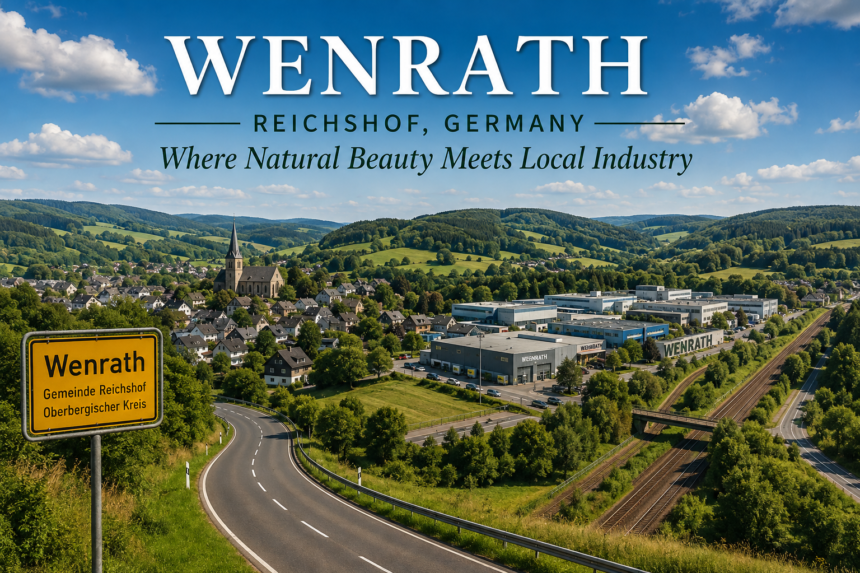
Search for “Wenrath” and you will not find a famous town, a brand or a tourist hotspot. You will find something quieter and, in its own way, more interesting: a tiny German village with fewer than 300 residents, sitting in green hills — with a surprisingly busy industrial estate right next door.
One thing needs clearing up at the start. The village’s official name is Wehnrath, with an “h”. That is the spelling the municipality of Reichshof uses, and it is the spelling on the map. “Wenrath” is a variant that turns up in print from time to time — a 2012 report in the German Bundestag’s archive, about a visit to the local tyre factory, used “Reichshof-Wenrath”. Both spellings point to the same small place.
This guide covers what Wenrath (Wehnrath) actually is: where it lies, how it grew from a farming hamlet into a village with a serious industrial area, which companies are based there, what the surrounding countryside offers, and whether it is worth a trip. Everything below is based on what can be checked — municipal records, official planning documents and the village’s own German reference entries.
| 🔗 You may also like: |
|---|
| Comisaco Explained: The Dam Partnership Behind Uruguay’s Rice |
| Mopedum Explained: Sweden’s Nostalgia Museum in Nynäshamn |
The Short Answer: What Wenrath Is
Wenrath — officially Wehnrath — is a village in the municipality of Reichshof, in the Oberbergischer Kreis district of North Rhine-Westphalia, in western Germany. It is one of 106 villages and hamlets that make up Reichshof, a large rural municipality spread over roughly 114 square kilometres of hills, forest and farmland.
The village itself is small. Fewer than 300 people live there — the municipality’s count put the population at 286 at the end of 2024. Most visitors would drive through in a minute or two: a cluster of houses, village streets, and green land in every direction.
What makes Wehnrath stand out from Reichshof’s other small villages is what sits beside it: the Gewerbegebiet Wehnrath, a planned commercial and industrial area that has grown in sections since the late 1980s. Around fifty businesses are based there, including the headquarters of one of Europe’s biggest bicycle tyre makers. That mix — a sleepy village on one side, real industry on the other — is the whole story of the place, and it is why the old description still fits: this is where Reichshof’s natural beauty meets local industry.
Wenrath or Wehnrath? The Story of Two Spellings
German place names are usually fixed and official, so two spellings for one village can cause real confusion. Search results, old articles and even a German parliament report use “Wenrath”, while every current document from the municipality of Reichshof — planning files, street lists, the official clubs register — uses “Wehnrath”.
If you are looking for the village on a map, in a sat-nav or in official information, “Wehnrath” is the spelling that works. The village even has a smaller neighbour with a related name, Oberwehnrath, a hamlet of about a dozen residents. Street names in the area follow the official spelling too, such as the Wehnrather Straße in the nearby village of Sinspert.
Wenrath is not the only name on this site that turned out to have a spelling puzzle behind it. The German measuring-probe term in our Messonde explainer also exists in two spellings, and the French word in our Tracqueur explainer is mostly searched in a misspelled form. Small spelling differences can hide the real thing — which is exactly what happened here.
Where Wenrath Is: Reichshof and the Oberbergisches Land
Wehnrath lies in the south-eastern part of North Rhine-Westphalia, in a low mountain region called the Oberbergisches Land — the southern, hillier half of the Bergisches Land, east of Cologne. The German reference entry for the village places it north-east of the Wiehltalsperre, the reservoir on the River Wiehl, and gives the nearest centres as Gummersbach, about 15 kilometres north-west, Cologne about 64 kilometres west, and Siegen about 39 kilometres south-east.
Reichshof, the municipality it belongs to, is a patchwork of 106 villages and hamlets with no single big town at its centre. The town hall sits in Denklingen, one of the larger villages. The whole municipality is rural in character: wooded hills, meadows, small farming settlements and quiet roads. The postcode for Wehnrath is 51580, shared with the rest of Reichshof.
This is not the Germany of big-city postcards. It is the Germany of village churches, volunteer fire brigades, half-timbered houses and walking trails — a region people often pass through on the way somewhere else, and rarely stop to look at properly.
A Village of Fewer Than 300 People
Daily life in Wehnrath is village life. With under 300 residents, it is the kind of place where community runs on volunteers. The municipality’s official list of clubs and institutions includes the Dorfgemeinschaft Wehnrath, the village community association that organises local activities and keeps village traditions going.
The same official list shows the village’s volunteer fire brigade unit — Löschzug IV West of the Freiwillige Feuerwehr Reichshof — based on Am Busch, at the edge of the industrial area. In small German communities, the volunteer fire brigade is often the backbone of local life, and in Wehnrath it has an extra job: the commercial area next door, with its factories and warehouses, needs proper fire cover, and the village has its own fire station for exactly that reason.
Numbers tell the scale honestly. The whole of Reichshof has around 18,700 residents spread across those 106 villages — an average of well under 200 people per village. Wehnrath, at 286, is actually one of the larger small places in the municipality, helped by the jobs and activity its industrial area brings.
The Industrial Area: Wehnrath’s Other Half
The Gewerbegebiet Wehnrath is a planned commercial and industrial estate, built on open land next to the village and developed in stages. The municipality’s own history records that the site — chosen because it sits by the A4 motorway, the Cologne–Olpe autobahn — was opened up and successfully marketed from 1988 onwards. Formal development plans for its sections followed in 1990, 1992, 1997 and 2002, and the area kept growing section by section.
The municipality’s published overview counts the businesses section by section: 27 in sections I and II, 11 in section III, 10 in section IV and 6 in section V — around 54 companies in total. A newer joint area, the Gewerbepark Wehnrath-Sinspert, is counted by Reichshof as one of its three major planned commercial areas, alongside Hunsheim and Allenbach. For a village of under 300 people, that is a remarkable amount of economic weight.
The estate’s streets have plain, practical names — Gewerbeparkstraße (“commercial park street”), Am Busch, Otto-Hahn-Straße — and its buildings are what you would expect: production halls, warehouses, workshops and offices, surrounded by the same green hills as the village. Industry here did not replace the countryside; it was placed inside it, one planned section at a time.
How companies organise themselves in places like this is a story of its own. Business networks and shared innovation programmes — the kind described in our article on the Kellogg Innovation Network — are one way firms learn from each other, and the pressure on every manufacturer to modernise is also why AI transformation is a governance challenge for industrial companies, not just a technology upgrade.
Two Companies That Put Wehnrath on the Map
Ask a German cyclist about Wehnrath and they may not know the village — but they will know what is made there. The headquarters of Ralf Bohle GmbH stands at Otto-Hahn-Straße 1 in the Wehnrath commercial area. Bohle makes Schwalbe tyres and inner tubes, and it is one of the largest producers of bicycle tyres and tubes in Europe. The municipality’s planning documents describe around 200 employees at the Reichshof site, with thousands more working in the company’s joint-venture factories in Indonesia and Vietnam. If you ride a bike in Europe, there is a fair chance your tyres began life in this small village.
A second name sits on Gewerbeparkstraße: Bahama GmbH, which has been making very large parasols and sun umbrellas — its best-known product line is called Jumbrella — since 1950, and gives the Wehnrath commercial park as its home address. Giant parasols for cafés, hotels and beer gardens on one street; world-class bicycle tyres on the next. It is an odd, very German mix, and it sums the place up well.
For anyone researching a company based in an out-of-the-way industrial estate like this, the practical lesson is to check the basics yourself — our guide to researching a company’s real website address shows how to confirm you have found the genuine business and not a copycat.
| 🔗 You may also like: |
|---|
| Research Dossier for a Target Company: How to Build a Complete Company Intelligence Report |
| Capacity Requirements Planning: A Practical Guide |
Why the A4 Motorway Matters
None of this industry would be in Wehnrath without the road. The A4 autobahn, running between Cologne and Olpe, passes a few kilometres north of the village — the municipality puts the motorway roughly three kilometres from the commercial area, and names the Reichshof-Denklingen interchange as a main connection. For factories that ship goods across Germany and Europe, that short hop to the motorway network is the difference between a viable site and an impossible one.
The B256 main road also runs through the municipality, linking its villages with nearby towns. Public transport, by contrast, is thin, as it is in most rural areas: bus line 321 connects Wiehl, Sotterbach, Wehnrath, Sinspert and Eckenhagen, but it runs only a handful of times a day and mainly on school days. In practice, Wehnrath is car country — for the people who live there, and for the lorries that serve its factories.
The Natural Side: Hills, Forest and the Reservoir
Turn away from the industrial estate and Wehnrath is all countryside. The Oberbergisches Land is a landscape of soft, wooded hills, small valleys, meadows and farmland. The Wiehl reservoir lies just to the south-west of the village — a drinking-water reservoir set among forested slopes, with walking paths around parts of its shore.
The seasons change the place completely. Spring brings fresh green growth and blossom in the hedgerows; summer is deep green and quiet; autumn colours the beech and oak woods on the hills; winter can be misty and still, with frost on the meadows. There are no famous viewpoints and no ticket offices — just a working rural landscape that rewards slow travel: a walk, a bike ride, a drive down lanes that were never built for speed.
For photographers and walkers who prefer empty paths to crowded sights, that is the real offer here. Reichshof presents itself gently for hiking and cycling, and Wehnrath’s corner of the municipality is as good a place as any to step into that network of trails.
Things to Do and See Near Wenrath
Be honest with yourself about scale: Wehnrath has no museum, no castle and no old town. What it offers is a base and a starting point.
Walk or cycle the countryside. Local trails connect Reichshof’s villages through forest and farmland, and the reservoir shore is the natural first destination from Wehnrath.
Visit Eckenhagen. The best-known village in the municipality, Eckenhagen is a recognised climatic health resort, with the quiet, clean-air, rest-and-recuperation character that German spa villages are known for. It is the closest thing Reichshof has to a visitor centre.
Look at the small landmarks. Denklingen, where the town hall sits, has a castle at its heart; the old fortified house at Sotterbach is another small piece of the area’s history. None of these are major attractions — they are the modest, real remains of a rural past, and they suit the pace of the area.
See industry up close. It may sound strange, but the commercial area is itself the most unusual sight: world-market companies operating from a village edge. You cannot tour the factories, but driving along Gewerbeparkstraße and Otto-Hahn-Straße gives a clear picture of how modern rural Germany actually works.
How to Get to Wenrath
By car, the route is simple: take the A4 between Cologne and Olpe, leave at the Reichshof-Denklingen interchange, and follow local roads towards Reichshof and Wehnrath. From Cologne the drive is roughly an hour in normal traffic; from Gummersbach, about twenty minutes.
By public transport, expect a slower journey. Regional trains serve towns such as Gummersbach and Wiehl, but the last stretch to Wehnrath depends on the infrequent 321 bus, which is timed mainly for school traffic. Most visitors — and nearly all locals — come by car. If you plan to explore the wider municipality, a car is close to essential.
When you search for directions, remember the spelling: “Wehnrath, 51580 Reichshof” is the address form that maps and official sources recognise.
Is Wenrath Worth Visiting?
That depends entirely on what you want. If your trip needs famous sights, busy streets, nightlife or a list of landmarks to tick off, Wenrath is the wrong place — honestly, it barely registers as a destination at all.
But if you like quiet countryside, empty walking trails and seeing how ordinary Germany lives and works away from the postcards, the area repays a day or two. The special thing here is the contrast, and it is a real one: a village of fewer than 300 people, a community run by volunteers and a village fire brigade — and, five minutes away, an industrial estate whose tyres roll on bicycles all over the world. Few places show the two halves of modern rural Germany sitting side by side quite so clearly.
Wenrath Today — and What Comes Next
Wehnrath is still developing. Planning documents from the municipality in recent years deal with changes and extensions inside the commercial area, and even the village fire station has been the subject of an expansion plan, because a growing industrial estate needs growing safety cover. The Wehnrath-Sinspert commercial park gives Reichshof room to keep that growth going.
The tension is the same one found in rural business regions everywhere: jobs and tax income on one side, green landscape and village quiet on the other. Reichshof’s answer so far has been to concentrate industry in a few planned areas by the motorway and leave the rest of its 106 villages rural. Wehnrath is where that bargain is easiest to see — and so far, it is a bargain that seems to work.
Conclusion
Wenrath — officially Wehnrath — is a small village in Reichshof, North Rhine-Westphalia, with fewer than 300 residents and an industrial estate out of all proportion to its size. The spelling with an “h” is the one to use; the place behind both spellings is the same: green hills, a close village community, the headquarters of the Schwalbe tyre company, and a commercial area that exists because the A4 motorway runs a few kilometres away. It will never be a famous destination, and it does not try to be. It is simply a clear, honest example of how countryside and industry share the same ground in modern Germany.
FAQs
Is Wenrath a real place?
Yes. It is a real village in the municipality of Reichshof, Germany. Its official spelling is Wehnrath — “Wenrath” is a variant spelling that appears in some older and unofficial sources, including a 2012 German Bundestag archive report.
Where exactly is Wenrath in Germany?
Wehnrath is in the Oberbergischer Kreis district of North Rhine-Westphalia, in western Germany. It lies north-east of the Wiehl reservoir, about 15 kilometres south-east of Gummersbach and about 64 kilometres east of Cologne. Its postcode is 51580.
What is Wenrath known for?
Mainly for the Gewerbegebiet Wehnrath, its commercial and industrial area, which is home to around fifty businesses — including Ralf Bohle GmbH, the maker of Schwalbe bicycle tyres, and the parasol maker Bahama. It is also known for its quiet countryside setting in the hills of the Oberbergisches Land.
How many people live in Wenrath?
Fewer than 300. The municipality’s figures put Wehnrath’s population at 286 at the end of 2024, down slightly from 295 the year before. The neighbouring hamlet of Oberwehnrath is much smaller, with about a dozen residents.
How do you get to Wenrath?
By car is easiest: leave the A4 motorway (Cologne–Olpe) at the Reichshof-Denklingen interchange and follow local roads to Wehnrath. Bus line 321 links the village with Wiehl and Eckenhagen, but it runs only a few times a day, mainly on school days, so most people drive.