Artificial intelligence is changing how businesses operate, make decisions, manage employees, and serve customers. Companies are investing in AI tools to improve productivity, reduce manual work, automate processes, and discover new business opportunities. However, purchasing advanced AI software does not automatically create successful business transformation.
Many organizations introduce AI solutions but struggle to use them effectively across different departments. Some projects remain limited to small experiments, while others fail to deliver measurable results. The problem is not always the technology itself. In many cases, businesses lack clear leadership, accountability, decision-making structures, and policies for managing AI.
This is why AI transformation is a governance challenge, not simply a technology implementation project. Organizations need a clear framework that explains how AI should be selected, approved, managed, monitored, and improved. Without these foundations, even promising AI initiatives can become disconnected experiments.
The good news is that businesses can address these challenges by establishing practical governance policies, assigning responsibilities, involving employees, and measuring performance. Understanding these elements is essential for turning individual AI experiments into long-term business improvements.
Understanding AI Transformation and AI Governance
Before addressing the challenges, it is important to understand the relationship between AI transformation and governance.
AI transformation refers to the process of changing business operations through artificial intelligence. It involves introducing AI into existing workflows, improving decision-making, automating repetitive activities, and developing new ways to deliver products or services.
AI governance, on the other hand, establishes the policies, responsibilities, controls, and decision-making processes that guide how an organization uses artificial intelligence.
These concepts are closely connected, but they serve different purposes.
- AI adoption: Introducing AI tools into everyday business activities.
- AI transformation: Changing how an organization operates and creates value through AI.
- AI governance: Establishing rules and accountability to ensure AI is used responsibly and effectively.
For example, a company might introduce an AI assistant to help its customer service team respond to inquiries. Adoption occurs when employees start using the assistant. Transformation happens when the company redesigns its customer support workflow around AI-assisted services. Governance ensures that customer information remains protected, responses meet quality standards, and employees remain responsible for important decisions.
Without governance, AI adoption may increase without producing meaningful organizational improvements.
| 🔗 You may also like: |
| Software discovery is broken |
| Workforce management system cloud technology |
Why AI Transformation Stalls Without Governance
AI projects can encounter several problems when organizations focus more on purchasing technology than establishing operational responsibilities. These challenges often become more visible when businesses attempt to expand successful experiments across multiple departments.
1. Unclear Ownership and Accountability
One of the biggest obstacles to successful AI transformation is the absence of clear ownership. Different departments may participate in AI projects, but nobody has complete responsibility for approving decisions, managing risks, or monitoring results.
For example, the IT department may manage AI software, while the legal team handles compliance questions and department managers oversee employee activities. However, when an AI system produces an incorrect or potentially harmful recommendation, employees may not know who should investigate the issue.
This confusion delays decisions and weakens accountability.
Businesses should assign specific responsibilities to individuals or teams. Every important AI initiative needs an accountable owner who understands its purpose, monitors performance, and coordinates with relevant departments.
2. AI Pilot Projects Fail to Scale
Many organizations begin their AI journey with small pilot projects. These experiments help businesses understand how AI performs in practical situations and whether a particular solution can improve productivity.
However, a successful pilot does not guarantee successful enterprise-wide implementation.
A tool that works for one department may face integration problems, data limitations, security concerns, or workflow conflicts when introduced across the organization.
For example, a marketing department may successfully use AI to prepare campaign drafts. Expanding the same approach across sales, customer service, and legal teams requires different approval processes, data permissions, and quality standards.
To overcome this problem, organizations should develop a scaling strategy before expanding their pilots. They need clear ownership, technical requirements, employee training, and consistent governance rules.
3. Disconnected AI Tools and Shadow AI
When employees cannot access approved AI solutions or do not understand organizational policies, they may begin using personal AI accounts and unapproved applications.
This behavior is commonly known as shadow AI.
Although employees may use these tools to complete tasks faster, uncontrolled AI usage can create privacy, security, and compliance problems. Sensitive customer information, internal documents, or confidential business details may be shared with external platforms without proper authorization.
Disconnected tools also make it difficult for leadership to understand how AI is being used across the organization.
A practical solution is to establish an approved AI tool list, define acceptable usage policies, and provide employees with secure alternatives. Organizations should also regularly review AI applications and connections to identify unauthorized usage.
4. Weak Human Oversight
Artificial intelligence can analyze information and generate recommendations, but its outputs are not always accurate, fair, or appropriate.
Problems become more serious when businesses allow AI systems to influence important decisions without meaningful human review.
For instance, an AI recruitment tool might rank job applicants based on available information. However, an unusual ranking does not necessarily represent a candidate’s actual abilities or potential.
Similarly, an AI-powered financial system might identify a transaction as suspicious, but a qualified employee may need to investigate the circumstances before taking action.
Organizations should define which decisions can be automated and which require human approval. Employees must also have the authority to question, reject, or correct AI-generated recommendations.
Human oversight should be based on the potential impact of each use case rather than applied identically to every AI activity.
5. Lack of Clear Decision-Making Processes
AI transformation introduces decisions that traditional business structures may not be designed to handle. Employees need to know who can approve new AI applications, who reviews potential risks, and who makes the final decision when departments disagree.
For example, the sales team might want to use an AI tool to generate personalized customer messages, while the legal department may have concerns about data privacy and communication accuracy.
Without an established decision-making process, these discussions can delay implementation or encourage departments to develop separate solutions.
An AI governance framework should clearly identify approval authorities, consultation requirements, and escalation procedures. This allows employees to resolve problems without waiting for senior management to handle every issue.
6. Measuring AI Success Through the Wrong Metrics
Some businesses measure AI progress through software subscriptions, employee logins, training sessions, and the number of generated outputs. Although these measurements provide useful information, they do not necessarily demonstrate business value.
An employee might use an AI writing assistant every day but spend additional time correcting its results. Similarly, a company may automate several tasks without improving customer satisfaction or reducing operational costs.
Organizations should connect AI performance with measurable business objectives.
Useful measurements include:
- Time saved on repetitive business activities.
- Improvements in service quality and customer satisfaction.
- Reduction in operational errors.
- Faster completion of important workflows.
- Lower administrative and processing costs.
- Improvements in employee productivity.
- Revenue growth or better customer retention where measurable.
The objective is not simply to increase AI usage. It is to determine whether AI is helping the organization achieve meaningful results.
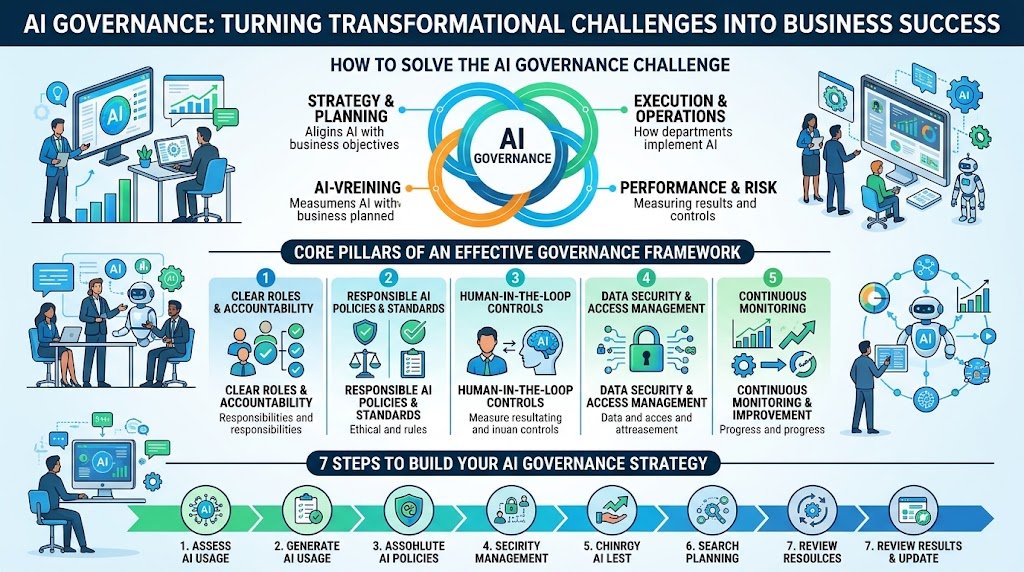
Core Pillars of an Effective AI Governance Framework
A successful AI governance framework provides a common structure for managing artificial intelligence across an organization. It should be practical enough for employees to follow and flexible enough to support changing business requirements.
The following pillars help establish a reliable foundation.
1. Clear Roles and Responsibilities
Every AI initiative should have clearly defined ownership. Organizations need to identify who approves projects, manages technical implementation, reviews compliance requirements, and monitors ongoing performance.
A cross-functional AI governance committee can bring together representatives from business operations, IT, cybersecurity, legal, compliance, and human resources.
Each participant should understand their responsibilities and decision-making authority.
For example, IT may evaluate technical security, legal teams may review regulatory obligations, and business managers may determine whether an AI solution addresses an actual operational need.
This shared structure prevents important decisions from falling between departments.
2. Responsible AI Policies and Ethical Standards
Organizations should establish policies that explain acceptable and unacceptable uses of artificial intelligence.
These policies should address data privacy, transparency, fairness, security, intellectual property, and human accountability.
For example, employees should understand which company documents can be entered into approved AI applications and which types of confidential information must remain protected.
Businesses should also evaluate AI systems for potential bias, inaccurate recommendations, and harmful outputs before using them in sensitive activities.
International frameworks can help organizations develop these standards. The OECD AI Principles provide guidance on trustworthy AI, while the NIST AI Risk Management Framework offers a structured approach to identifying and managing AI-related risks.
These resources can support governance planning, although organizations must still consider the laws and regulations applicable to their own activities.
3. Human-in-the-Loop Controls
Human oversight should be built into AI workflows according to their potential risks.
Low-impact activities, such as organizing meeting notes or suggesting internal document headings, may require limited review. However, decisions involving employment, financial services, healthcare, legal matters, or customer rights may require stronger human supervision.
A useful framework establishes three levels of oversight:
- Low-risk activities: AI can perform routine tasks under established policies, with periodic monitoring.
- Medium-risk activities: Employees review important outputs before they are used or shared.
- High-risk activities: Authorized professionals make or approve consequential decisions, supported by documented checks.
This approach allows businesses to benefit from automation without giving AI unlimited decision-making authority.
4. Data Security and Access Management
AI systems often depend on business documents, customer records, internal databases, and other organizational information. Poor data management can expose sensitive information or produce unreliable results.
Businesses should establish clear access controls to ensure employees and AI applications only use information they are authorized to access.
Important practices include:
- Classifying information according to sensitivity.
- Applying role-based access permissions.
- Reviewing third-party AI providers.
- Protecting confidential customer and employee information.
- Maintaining records of important AI activities.
- Regularly checking access permissions and integrations.
Data governance is particularly important when introducing AI agents that can interact with multiple business applications. Organizations must understand what information each agent can access and which actions it is authorized to perform.
5. Continuous Monitoring and Improvement
AI governance should not end when a project receives approval. Models, business requirements, regulations, and data sources can change over time.
Organizations need ongoing monitoring to identify inaccurate outputs, unexpected behavior, security concerns, and performance problems.
They should also establish a process for reporting AI incidents and reviewing employee feedback.
When problems occur, the responsible team should investigate the cause, determine the potential impact, and introduce corrective measures.
Regular governance reviews help ensure that AI systems continue to meet organizational standards as their use expands.
| 🔗 You may also like: |
| Guru knowledge base software |
| Digitaledge org |
How to Build an AI Governance Strategy That Works
Understanding governance principles is important, but businesses also need a practical implementation process. The following steps can help organizations establish a governance strategy without creating unnecessary administrative complexity.
Step 1: Assess Existing AI Usage
Start by identifying where artificial intelligence is already being used throughout the organization.
Review approved software, employee experiments, automated workflows, AI agents, and third-party integrations. Speak with department managers and employees to understand which tools they use and what problems they are trying to solve.
This assessment should identify:
- Existing AI applications and their owners.
- Business processes supported by AI.
- Types of information accessed by each system.
- Current approval and monitoring procedures.
- Potential security and compliance concerns.
- Projects that have failed to deliver expected results.
An accurate assessment helps leadership understand the difference between planned AI adoption and actual workplace practices.
Step 2: Establish an AI Governance Committee
Create a team responsible for overseeing the organization’s AI strategy and governance requirements.
The committee should include people with relevant business, technical, legal, security, and operational knowledge.
Its responsibilities may include approving AI use cases, reviewing significant risks, resolving departmental disagreements, and monitoring progress.
Smaller organizations may not need a separate committee. They can assign these responsibilities to an existing leadership or technology team.
The important requirement is that decision-making authority must be clear and accessible.
Step 3: Define Decision Rights and Escalation Paths
Employees should know what they can approve independently and when they need additional authorization.
For example, a marketing employee might be permitted to use an approved AI assistant for internal brainstorming but require managerial approval before publishing AI-generated customer-facing material.
Organizations should document these boundaries in simple language.
They should also establish clear escalation paths for situations involving questionable outputs, data exposure, ethical concerns, or unexpected AI behavior.
A practical escalation process should identify the responsible person, expected response procedure, and conditions that require suspending an AI system or workflow.
Step 4: Select AI Tools Based on Business Needs
Businesses should avoid purchasing AI software simply because it is popular or offers impressive demonstrations.
Instead, they should identify specific operational problems and evaluate whether an AI solution can address them effectively.
Before selecting a provider, consider:
- Data protection and privacy practices.
- Security features and access controls.
- Integration with existing business systems.
- Transparency about system limitations.
- Available monitoring and reporting capabilities.
- Pricing and long-term operating costs.
- Contractual responsibilities and data handling terms.
A suitable tool should support business objectives while meeting the organization’s governance requirements.
Step 5: Train Employees and Managers
AI governance cannot succeed if employees do not understand the rules.
Training should explain approved applications, responsible prompting, confidential information handling, output verification, and reporting procedures.
Managers also need training because they often make practical decisions about how AI changes departmental workflows.
For example, a customer service manager should understand when an AI-generated response needs human review and how employees should report inaccurate or inappropriate suggestions.
Training should be updated as tools, responsibilities, and organizational policies change.
Step 6: Introduce Governance Through Practical Projects
Rather than attempting to govern every possible AI application at once, begin with a limited number of business use cases.
Choose projects with clear objectives, manageable risks, and measurable outcomes.
For example, a company might introduce AI-assisted document classification within its internal administration department. It can evaluate accuracy, employee feedback, processing time, and data protection before expanding the approach.
Lessons from these projects can help improve policies and approval procedures.
Gradual implementation allows organizations to develop governance experience while maintaining control over potential risks.
Step 7: Review Results and Update the Framework
AI governance should develop alongside organizational capabilities.
Regular reviews should examine whether existing policies remain effective, whether employees understand their responsibilities, and whether AI systems are delivering expected results.
When teams demonstrate the ability to manage specific AI activities responsibly, organizations can consider giving them greater operational authority within approved boundaries.
This creates a balance between centralized oversight and departmental flexibility.
The goal is to establish a governance structure that supports innovation instead of creating unnecessary approval delays.
The Role of Leadership in Successful AI Transformation
Technology teams can implement AI platforms, configure access permissions, and manage technical performance. However, they cannot independently transform an entire organization.
Leadership must explain why AI is being introduced, which business objectives it should support, and how responsibilities will change.
Employees also need honest communication about the impact of AI on their roles. If workers believe that AI is being introduced without considering their experience or concerns, they may avoid using it or develop unofficial workarounds.
Effective leaders should involve employees in identifying suitable use cases and improving existing workflows.
Middle managers are particularly important because they connect organizational strategy with everyday operations. They need sufficient authority to guide their teams, resolve routine questions, and escalate significant concerns.
Leadership should also demonstrate responsible AI usage through its own decisions. When senior management follows the same governance standards expected from employees, it becomes easier to establish trust and accountability.
How Businesses Can Measure the Success of AI Governance
A governance framework should produce measurable improvements in both risk management and business performance.
Organizations can develop a balanced measurement system using three categories.
| Measurement area | Useful indicators |
| Adoption and operations | Active usage, workflow completion time, employee participation |
| Risk and quality | Error rates, human corrections, policy violations, security incidents |
| Business performance | Cost savings, productivity improvements, customer satisfaction, revenue impact |
These measurements should be connected to specific business objectives.
For example, if a company introduces AI to improve customer support, it might measure average response time, resolution quality, customer satisfaction, and the number of responses requiring substantial human correction.
Monitoring these indicators helps leadership understand whether the technology is improving the process or simply adding another layer of work.
It also makes it easier to identify projects that need improvement before additional resources are committed.
Common Challenges Businesses Face When Implementing AI Governance
Even with a well-designed framework, organizations may experience difficulties when putting AI governance into practice.
Resistance to organizational change: Employees may worry about changing responsibilities, job security, or increased monitoring. Businesses should communicate the purpose of AI initiatives and involve workers in implementation decisions.
Lack of technical expertise: Some organizations do not have enough employees with experience in AI security, data management, and risk assessment. They may need external expertise or targeted employee training.
Complex regulatory requirements: AI-related legal obligations can differ depending on industry, location, and application. Businesses should identify applicable requirements rather than relying on a single general policy.
Excessive approval procedures: Complicated governance processes can delay projects and discourage experimentation. Organizations should apply stronger controls to higher-risk applications while allowing routine, low-risk activities to move forward efficiently.
Changing AI capabilities: New models, tools, and autonomous agents introduce additional considerations. Governance frameworks must be reviewed regularly to remain relevant.
Addressing these challenges requires cooperation between leadership, employees, technical teams, and compliance professionals.
| 🔗 You may also like: |
| WhatsOnTech Understanding Technology in a Changing Digital World |
| Sparkpressfusion com explained |
The Future of AI Transformation Depends on Governance
Artificial intelligence will continue to influence business operations, workplace responsibilities, and organizational decision-making. As companies introduce more advanced AI applications and autonomous agents, the need for clear governance will become increasingly important.
Organizations that focus only on technology may find it difficult to coordinate AI activities across departments. They may also struggle with data protection, accountability, employee trust, and inconsistent business processes.
A governance-first approach provides a more sustainable direction. It connects AI investments with business objectives, establishes clear responsibilities, and ensures that appropriate controls are in place before systems expand.
The most successful approach is not necessarily the one that introduces the largest number of AI tools. It is the one that uses artificial intelligence to solve genuine business problems while maintaining accountability, transparency, and human judgment.
Ultimately, AI transformation is a governance challenge because successful transformation requires more than technical capability. It requires leadership, clear decision-making, responsible processes, and continuous improvement. Businesses that establish these foundations can move beyond isolated AI experiments and build reliable, scalable AI capabilities.
FAQs
Why is AI transformation considered a governance challenge?
AI transformation requires changes to business processes, employee responsibilities, and organizational decision-making. Without clear ownership, accountability, risk controls, and approval procedures, businesses may struggle to scale AI projects successfully.
What is the difference between AI governance and AI transformation?
AI transformation changes how an organization operates through artificial intelligence. AI governance establishes the policies, responsibilities, and controls that guide this process and ensure AI is used responsibly.
Who should be responsible for AI governance?
AI governance should involve business leadership, IT, cybersecurity, legal, compliance, and relevant department managers. A designated executive or cross-functional committee should coordinate the framework and maintain accountability.
Does AI governance slow down business innovation?
Effective AI governance should support innovation rather than prevent it. Clear approval procedures, approved tools, and defined risk boundaries help employees experiment confidently without creating unnecessary security or compliance problems.
How can a business start implementing AI governance?
A business can begin by assessing its existing AI usage, identifying potential risks, assigning responsibilities, establishing acceptable-use policies, and training employees. It should then introduce appropriate controls and regularly review performance.
What are the biggest risks of operating without AI governance?
Major risks include unauthorized access to sensitive information, inaccurate AI-generated decisions, biased outputs, regulatory problems, disconnected AI applications, and unclear accountability when something goes wrong.