
The Kellogg Innovation Network (KIN) is an initiative established in 2003 to bring business executives, academic experts, entrepreneurs, government representatives, and other influential professionals together to explore innovation and address important global challenges. It was originally developed at Northwestern University’s Kellogg School of Management to encourage collaboration, strategic discussions, and innovation-led growth across different industries.
Unlike traditional professional associations that mainly focus on industry connections, the Kellogg Innovation Network emphasized sharing knowledge, exchanging ideas, and developing relationships between people with different professional backgrounds. Its approach recognized that businesses could discover new opportunities by learning from academic research, technological developments, international markets, and other industries.
Over the years, KIN became associated with international leadership discussions and the KIN Global Summit, which brought together participants to examine business innovation and global prosperity. Its history also connects with The World Innovation Network (TWIN), an independent organization that developed from KIN’s original initiative.
Understanding the Kellogg Innovation Network provides valuable insight into how collaboration, leadership, and creative thinking can contribute to business development and long-term economic progress.
What Is the Kellogg Innovation Network (KIN)?
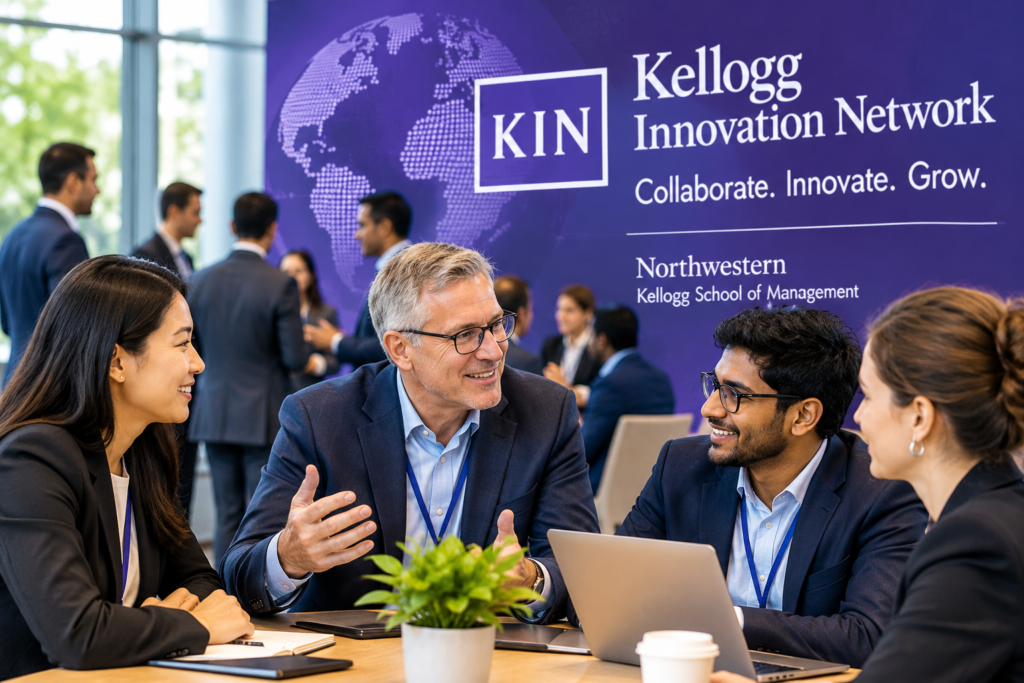
The Kellogg Innovation Network is a collaborative initiative historically associated with the Kellogg School of Management at Northwestern University. Established in 2003, it was designed to connect people who wanted to explore new approaches to innovation, business strategy, and global development.
The network brought together professionals from different sectors, including corporations, universities, nonprofit organizations, and government institutions. These participants contributed different experiences and ideas, creating opportunities to discuss challenges that could not always be addressed effectively by individual organizations.
KIN’s approach was based on the understanding that innovation does not happen only inside research departments or technology companies. It can also emerge through partnerships, communication, leadership discussions, and the exchange of knowledge between people with different areas of expertise.
The initiative therefore encouraged participants to think beyond traditional business practices and explore how cooperation could create lasting value.
| 🔗 You may also like: |
| Workforce management system cloud technology |
| 5 career habits of successful aviation professionals |
History and Origins of the Kellogg Innovation Network
The Kellogg Innovation Network was established in 2003 at Northwestern University’s Kellogg School of Management. Its development reflected growing interest in innovation as a source of business growth, competitive advantage, and broader economic progress.
During this period, businesses were dealing with changing technologies, international competition, new customer expectations, and increasingly connected markets. Traditional approaches to management were not always sufficient to address these developments. Organizations needed opportunities to exchange knowledge and understand how different industries were responding to change.
Robert C. Wolcott played a central role in founding KIN, working with Kellogg faculty member Mohanbir Sawhney and a group of corporate innovation leaders. Their objective was to create a platform where business leaders, academics, and other professionals could discuss important challenges and explore new possibilities.
The network gradually developed an international perspective, encouraging participants to consider innovation beyond individual companies and national boundaries.
One of its important historical milestones was the first KIN Global Summit in 2009. The event focused on building global prosperity through innovation and action, bringing together participants from more than 20 countries and six continents.
This gathering helped establish KIN’s identity as a platform for high-level conversations about innovation, leadership, and international cooperation.
Founders and Their Vision
The development of the Kellogg Innovation Network was closely connected with the work of Robert C. Wolcott and Mohanbir Sawhney.
Robert C. Wolcott
Robert C. Wolcott was the founder of the Kellogg Innovation Network in 2003 and played an important role in developing its collaborative approach. His work focuses on corporate innovation, entrepreneurship, business growth, and the impact of technological change on organizations.
His vision emphasized the importance of bringing together people who could contribute different perspectives to complex business and societal challenges. Rather than limiting discussions to corporate executives, KIN encouraged participation from academic institutions, government, nonprofit organizations, and other professional communities.
Wolcott later became associated with The World Innovation Network, which continued the broader ambition of connecting innovative leaders internationally.
Mohanbir Sawhney
Mohanbir Sawhney is a professor at the Kellogg School of Management and a prominent academic voice in technology, marketing, digital strategy, and business innovation.
He founded the Center for Research in Technology & Innovation (CRTI) in June 2001. The center provides an academic environment for examining how technology and innovation influence business organizations.
His work helped establish an intellectual foundation for conversations about innovation, research, and practical business applications.
Together, the founders’ contributions helped shape an initiative that connected academic knowledge with real-world business experience.
Main Mission and Objectives of KIN
The main mission of the Kellogg Innovation Network was to encourage innovation through collaboration, knowledge-sharing, and strategic dialogue.
Its approach recognized that organizations could benefit from learning beyond their own industries and professional environments. By connecting people with different experiences, the network created opportunities to examine problems from multiple perspectives.
Its central objectives included:
1. Encouraging Cross-Industry Collaboration
KIN encouraged business leaders, academics, entrepreneurs, and public-sector representatives to exchange ideas. Different industries often face similar challenges but approach them in different ways. Sharing these experiences can reveal new opportunities and practical solutions.
2. Supporting Innovation-Led Growth
The network promoted discussions about how innovation could contribute to business performance and long-term development. Leaders were encouraged to consider new business models, emerging technologies, and changing market conditions.
3. Building International Relationships
Connecting professionals from different countries helped participants understand global challenges and learn from international experiences. These relationships also created opportunities for further discussions and cooperation.
4. Connecting Ideas With Practical Action
Innovation requires more than creative thinking. Organizations must evaluate ideas, develop strategies, allocate resources, and implement suitable solutions. KIN’s broader philosophy encouraged participants to consider how discussions could contribute to meaningful outcomes.
The KIN Global Summit and International Leadership
The KIN Global Summit was one of the most recognizable activities associated with the Kellogg Innovation Network.
These gatherings brought together business executives, academics, entrepreneurs, government representatives, and nonprofit leaders to discuss important issues affecting organizations and society.
The first KIN Global Summit took place in June 2009 under the theme “Building Global Prosperity: Innovation and Action.” Participants represented different industries and professional backgrounds, creating opportunities for international discussions about economic development and innovation.
Later summits continued exploring topics related to global prosperity, business leadership, entrepreneurship, and social progress.
The 2012 summit, for example, included the KIN Prize competition, which supported interdisciplinary student teams developing action plans addressing global challenges. The projects covered areas such as healthcare access, clean energy, food availability, and environmental improvement.
These activities demonstrated that innovation discussions could extend beyond traditional corporate objectives and include wider social and economic concerns.
However, historical summit information should not be confused with a current event schedule. Anyone interested in present-day gatherings should consult the relevant official organization.
Why Cross-Sector Collaboration Matters
Cross-sector collaboration was one of the most important ideas behind the Kellogg Innovation Network.
Businesses, universities, governments, and nonprofit organizations often possess different types of knowledge and resources. When they work independently, they may overlook opportunities that become visible through cooperation.
For example, a technology company developing a new digital service may understand technical requirements but need additional knowledge about customer behavior, business regulations, and market demand.
A university researcher may contribute relevant research, while an entrepreneur may provide practical experience in developing and testing products. A public-sector representative may offer insight into regulatory or community requirements.
Combining these perspectives can help organizations understand problems more completely and evaluate potential solutions.
The KIN approach highlighted the importance of creating environments where different professionals could exchange knowledge and explore shared opportunities.
Role of the Kellogg Innovation Network in Business Growth
Innovation is an important part of business development because markets, customer expectations, and competitive conditions continue to change.
Companies that depend entirely on established products and operating methods may struggle when new technologies or competitors change their industries.
The collaborative philosophy associated with KIN offers several useful lessons for organizations seeking sustainable growth.
Identifying New Business Opportunities
Discussions with professionals outside an organization’s usual environment can reveal market opportunities, customer needs, and possible improvements.
For example, a traditional manufacturer may learn about digital production methods through conversations with technology specialists.
Improving Strategic Decision-Making
Different perspectives can help managers evaluate business challenges more carefully. Instead of depending on assumptions, organizations can compare experiences, examine available evidence, and consider alternative strategies.
Encouraging Entrepreneurship
Entrepreneurs can benefit from exchanging ideas with experienced executives, researchers, and potential business partners. Such discussions may help them understand market requirements and evaluate whether a proposed business idea is practical.
Creating Long-Term Value
Business innovation should not focus exclusively on immediate financial results. Strong strategies also consider customer relationships, organizational capabilities, responsible growth, and the ability to adapt to future developments.
These principles reflect the wider business philosophy associated with KIN rather than guaranteed outcomes for every participant.
| 🔗 You may also like: |
| Software discovery is broken |
| Guru knowledge base software |
Technology and Innovation in a Changing Business Environment
Technology has significantly changed how organizations operate, communicate, and compete.
Artificial intelligence, cloud computing, digital platforms, automation, and data analytics have created new opportunities for businesses while introducing additional challenges.
However, successful technological innovation involves more than purchasing software or adopting new equipment. Organizations must understand how technology affects their customers, employees, business models, and competitive position.
For example, a company introducing artificial intelligence into its operations needs to consider data quality, employee training, customer expectations, security, and responsible implementation.
The Kellogg Innovation Network’s emphasis on collaboration provides a useful perspective on these challenges. Technical specialists, business managers, academic researchers, and other stakeholders can contribute different knowledge to the decision-making process.
This approach helps explain why innovation requires both technological understanding and effective organizational leadership.
Leadership and Organizational Transformation
Strong leadership is essential for developing an environment where innovation can grow.
Employees may have useful ideas for improving products, services, and internal processes, but these ideas need an environment where people feel comfortable sharing suggestions and discussing problems.
Managers must communicate organizational objectives, encourage constructive feedback, and provide appropriate support for experimentation.
Organizational transformation may also require changes to established procedures, management practices, employee responsibilities, and business priorities.
One important lesson from KIN’s collaborative philosophy is that innovation should not be treated as the responsibility of a single department. Marketing, finance, technology, operations, and leadership teams may all contribute to improving business performance.
When organizations encourage communication across these departments, they can develop a broader understanding of challenges and identify more practical opportunities for improvement.
Connection With Northwestern University’s Kellogg School of Management
The Kellogg Innovation Network originated within the academic and business environment of Northwestern University’s Kellogg School of Management.
The Kellogg School of Management is known for its work in management education, leadership, marketing, strategy, entrepreneurship, and organizational development.
Its academic environment provided a foundation for connecting research-based knowledge with the practical experiences of business professionals.
However, it is important to distinguish KIN from the school’s Center for Research in Technology & Innovation.
Understanding the Center for Research in Technology & Innovation (CRTI)
The Center for Research in Technology & Innovation, commonly known as CRTI, was founded in June 2001 by Mohanbir Sawhney.
Its purpose is to advance the understanding and practice of innovation in a changing business environment. The center brings together faculty, researchers, students, and business leaders to examine important developments in technology and management.
CRTI also works to translate academic research into practical business resources, including frameworks, case studies, tools, simulations, and executive learning experiences.
Its work covers areas such as digital transformation, emerging technologies, entrepreneurship, business growth, and organizational innovation.
Although CRTI and KIN have historical connections through the Kellogg academic environment and their shared interest in innovation, they are distinct initiatives with different roles.
CRTI continues to operate as a research and educational center within the Kellogg School of Management.
From Kellogg Innovation Network to The World Innovation Network (TWIN)
An important part of KIN’s history is its development into The World Innovation Network, commonly known as TWIN.
According to TWIN’s official history, the organization developed from the Kellogg Innovation Network and later became independent of the Kellogg School of Management while maintaining strong connections with Northwestern University and the wider Chicago community.
TWIN continues the broader idea of bringing together leaders from different professional sectors to build relationships, explore opportunities, and address significant challenges.
Its activities connect people working in business, government, academia, arts, and philanthropy.
This development is important for understanding the distinction between KIN’s original institutional identity and the later independent organization.
KIN represents the historical initiative established in 2003 at Kellogg, while TWIN represents its subsequent organizational evolution.
Readers interested in current activities, participation opportunities, or international gatherings should consult TWIN’s official website rather than assume that historical KIN programs operate in exactly the same way today.
Kellogg’s Current Innovation and Executive Education Programs
Although the historical KIN initiative developed into an independent organization, the Kellogg School of Management continues to emphasize innovation through research, teaching, and executive education.
Its growth and business innovation programs are designed to help leaders develop strategies for encouraging new ideas and implementing organizational change.
These programs address areas such as innovation management, business growth, strategic thinking, and organizational culture.
Kellogg’s executive education offerings also include live online and in-person learning experiences. Participants can explore practical approaches to responding to changing markets and improving organizational capabilities.
The school’s Center for Research in Technology & Innovation contributes to this wider educational environment through research, business simulations, and applied learning resources.
These activities should be understood as current Kellogg educational and research initiatives, not automatically as KIN membership programs.
Who Can Learn From the Kellogg Innovation Network?
The collaborative ideas associated with the Kellogg Innovation Network can be useful for several professional groups.
Business Executives: Managers and senior leaders can learn the importance of considering different perspectives when developing business strategies and managing organizational change.
Entrepreneurs: Startup founders can benefit from exchanging ideas, understanding market requirements, and learning from experienced professionals.
Academic Researchers: Researchers can explore how their work connects with practical business challenges and emerging industry requirements.
Government Representatives: Public-sector professionals can gain insight into how cooperation between institutions and businesses may contribute to economic development.
Nonprofit Leaders: Nonprofit organizations can explore partnerships and innovative approaches to addressing social and community challenges.
The practical value of these principles depends on the goals, knowledge, and activities of the people involved.
Key Lessons Businesses Can Learn From KIN
The history and collaborative philosophy of the Kellogg Innovation Network offer several lessons that organizations can apply to their own operations.
- Look Beyond Your Industry: Useful ideas can come from organizations working in completely different markets.
- Encourage Open Communication: Employees and external partners should have opportunities to share constructive suggestions.
- Connect Research With Practice: Academic knowledge becomes more valuable when organizations understand how to apply it to real business challenges.
- Experiment Carefully: Businesses should test promising ideas and evaluate their results before making major investments.
- Think Long Term: Sustainable innovation requires planning, continuous learning, and the ability to adapt.
- Build Meaningful Relationships: Professional connections can support knowledge-sharing and future collaboration when there are common interests and clear objectives.
These lessons demonstrate that innovation is not simply about developing something new. It also involves creating the right environment for ideas to be evaluated, improved, and implemented.
| 🔗 You may also like: |
| Digitaledge org |
| Sparkpressfusion com explained |
Conclusion
The Kellogg Innovation Network represents an important chapter in the development of collaborative business innovation. Established in 2003 at Northwestern University’s Kellogg School of Management, it brought together business executives, academics, entrepreneurs, government representatives, and nonprofit leaders to explore new approaches to innovation and global prosperity.
Its emphasis on cross-sector collaboration, strategic dialogue, and knowledge-sharing demonstrated the value of connecting people with different professional experiences. Through initiatives such as the KIN Global Summit, the network encouraged discussions about entrepreneurship, technology, leadership, and international development.
Its subsequent evolution into The World Innovation Network also highlights how collaborative initiatives can develop beyond their original academic settings.
For modern businesses, the central lesson remains relevant: meaningful innovation requires more than creative ideas. It depends on collaboration, informed leadership, practical planning, and a willingness to learn from different perspectives.
FAQs
What Is the Kellogg Innovation Network?
The Kellogg Innovation Network (KIN) was a collaborative initiative established in 2003 at Northwestern University’s Kellogg School of Management. It brought together business leaders, academics, government representatives, and other professionals to discuss innovation and global challenges.
When Was the Kellogg Innovation Network Founded?
KIN was established in 2003. Robert C. Wolcott played a central role in its founding, working with Mohanbir Sawhney and corporate innovation leaders.
Who Founded the Kellogg Innovation Network?
Robert C. Wolcott founded KIN in 2003 with the involvement of Kellogg faculty member Mohanbir Sawhney and a group of corporate innovation leaders.
What Was the Main Purpose of KIN?
Its main purpose was to encourage cross-industry collaboration, knowledge-sharing, innovation-led growth, and strategic discussions about business and global challenges.
What Was the KIN Global Summit?
The KIN Global Summit was an international gathering associated with the network. It brought together leaders from business, academia, government, and nonprofit organizations to discuss innovation and global prosperity.