Finding a company’s website sounds simple until you need to research hundreds of businesses, distinguish similar company names, or verify whether a domain actually belongs to the organization you are targeting. This is where target company URL research becomes important.
Target company URL research is the process of finding, checking, and verifying the official website or domain associated with a specific business. It is commonly used for B2B sales, lead generation, recruitment, SEO competitor research, market research, business intelligence, and CRM data management.
The goal is not simply to find a website that contains a company’s name. The real objective is to identify the correct business website and make sure it belongs to the exact company being researched.
A reliable process typically follows this path:
Company Name → Potential URL → Identity Verification → Official Domain → Business Research
This distinction matters because search engines can return directories, social media profiles, news articles, marketplaces, subsidiaries, brands, and unrelated companies with similar names. A wrong URL can therefore lead to an entire research project being built around the wrong business.
What Is Target Company URL Research?
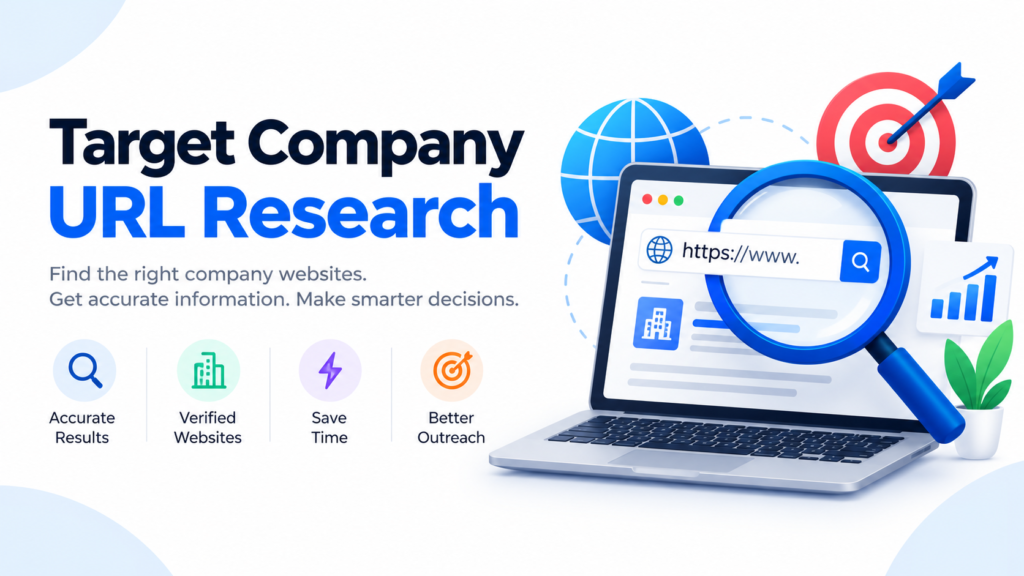
Target company URL research means identifying the official web address of a company and verifying that the website represents the intended organization.
For example, a researcher may receive a spreadsheet containing 500 company names but no website information. Before analyzing those companies, the researcher needs to determine which domain belongs to each business.
The process becomes more complicated when companies have:
- Similar or identical names
- Multiple brands
- Parent and subsidiary companies
- Regional websites
- Old domains
- Rebranded identities
- Product-specific websites
- Country-specific domains
A company name alone is therefore not always enough.
A verified domain provides a stronger starting point for researching the business, its products, services, markets, careers, leadership, competitors, and online presence.
Why Is Target Company URL Research Important?
A company website often acts as the central source of first-party business information.
Once the correct URL has been identified, researchers can explore the company’s products, services, locations, business model, careers, announcements, and other publicly available information.
This is particularly valuable in several areas.
B2B Sales
Sales teams can use verified company domains to understand potential customers before contacting them. The website may reveal products, target industries, company locations, recent launches, partnerships, and business priorities.
SEO and Digital Marketing
SEO professionals need accurate domains before performing competitor research, keyword analysis, content comparisons, backlink research, or digital PR investigations.
Recruitment
Recruiters can use official websites to find careers pages, company information, employment opportunities, and links to legitimate applicant systems.
Market Research
Researchers can compare businesses within an industry by studying their official websites, products, markets, positioning, and geographic presence.
CRM Data Quality
A verified domain can help distinguish duplicate accounts, incorrect company names, subsidiaries, and outdated records inside a CRM.
The basic principle is simple: better company identification produces better research.
How to Find the Correct Company URL
The first step is to create a clean list of the companies you want to research.
Ideally, each record should include more than a company name. Useful information includes:
- Company name
- Country
- City
- Industry
- Known brand name
- Parent company
- Existing social profile
- Previous website, if available
This additional context becomes extremely useful when several businesses have similar names.
For example, searching only for “Mercury” could produce financial companies, technology businesses, manufacturers, and other organizations. Adding a country or industry can significantly narrow the search.
A query such as:
Mercury technology company USA official website
is much more specific than searching for “Mercury” alone.
However, search results should be treated as potential matches rather than automatic proof.
Clean and Standardize Company Names First
Poor company data can make URL research unnecessarily difficult.
A database might contain:
Bright Future Technologies Private Limited
while another source uses:
Bright Future Technologies
These may represent the same organization.
Before searching, review common legal suffixes such as:
- Inc.
- Incorporated
- Ltd.
- Limited
- LLC
- LLP
- PLC
- GmbH
- Pvt. Ltd.
At the same time, do not remove words that are actually part of the company’s public brand identity.
Also look for spelling mistakes, duplicate records, abbreviations, former names, and parent-subsidiary relationships.
Clean input generally produces better matching results.
Search for Potential Company Domains
Once the company information is clean, search for possible domains.
For small lists, manual research may be sufficient. Search the company name together with useful identifiers such as its country, city, industry, or product.
For example:
ABC Technologies India official website
or:
ABC Technologies software company UK
Review several results rather than automatically selecting the first one.
A search result could be:
- The official company website
- A business directory
- A social media profile
- A news article
- A review website
- A marketplace
- An unrelated business
- A parent company
- A similarly named organization
The objective is to identify the website that best matches the target company’s complete identity.
Automated Target Company URL Research
Manual searches are practical for a handful of companies but become inefficient when the list grows into hundreds or thousands of records.
Automated company-domain lookup tools can speed up the discovery process by matching company names with potential domains.
A typical workflow looks like:
Company List → Automated URL Lookup → Potential Domains → Confidence Review → Verification
Automation is particularly useful for repetitive tasks such as processing large spreadsheets and identifying likely domains.
However, automated matching should not be confused with final verification.
A system may identify a domain because its name closely resembles the submitted company name. That does not necessarily prove that it belongs to the intended business.
Automation is best used to accelerate discovery, while verification confirms the result.
How to Verify an Official Company Website
Verification is the most important part of target company URL research.
Before marking a domain as confirmed, examine the website itself.
1. Check the Company Name
Look at the name displayed on the website.
The website name does not always need to exactly match the legal company name. Businesses may use abbreviations, trading names, or consumer-facing brands.
What matters is whether you can establish a clear connection between the website and the target organization.
2. Check the Industry
Does the website describe the same type of business?
If your target is a software company but the website belongs to an industrial equipment manufacturer with the same name, the match is probably incorrect.
Industry is one of the strongest ways to distinguish companies with similar names.
3. Check the Location
Look for the company’s headquarters, offices, country, or markets served.
Location is especially useful when researching smaller companies with common names.
A location difference does not automatically mean the domain is wrong. A multinational business may operate in several countries. Instead, determine whether the location difference has a reasonable explanation.
4. Check Products and Services
Read the main product and service pages.
Do they correspond with what you already know about the company?
If the target company is known for financial software but the website sells construction equipment, you likely have the wrong organization.
5. Review the About Page
The About page can provide valuable first-party evidence, including:
- Company history
- Mission
- Headquarters
- Founders
- Business activities
- Markets served
- Corporate relationships
6. Review the Contact Page
Check business addresses, telephone numbers, locations, and official contact details.
These details can help confirm that the website represents the intended business.
7. Check Legal Information
Privacy policies, terms, copyright notices, and other legal pages sometimes reveal the registered company name behind a brand.
This can be especially useful when the public brand name differs from the legal entity.
What If Two Companies Have the Same Name?
This is one of the most common challenges in company URL research.
Imagine your target company is called Pioneer Solutions. There could be several businesses with that name across different countries and industries.
Instead of relying on the name alone, combine it with additional information.
Useful identifiers include:
- Country
- City
- Industry
- Product
- Founder
- Parent company
- Company size
- Known brand
- LinkedIn profile
The more independent details agree, the stronger the match becomes.
A good rule is:
Never confirm a company URL based solely on a matching company name when the name is common.
Parent Companies, Subsidiaries, and Brands
Corporate structures can make URL research more complicated.
A target company may be owned by a larger parent organization. It may also operate a separate website for a brand or product.
For example, you could find:
Parent Company → Subsidiary → Brand → Product Website
All of these websites may be legitimate, but they represent different levels of the organization.
If your research concerns the entire company, identify the primary corporate or company domain.
If your research concerns a particular product or brand, the dedicated website may also be relevant.
The important thing is to record the relationship clearly instead of treating every domain as the same entity.
Regional and Country-Specific Company Websites
International companies often operate multiple web properties.
A company might use:
- A global .com website
- Country-specific domains
- Regional subdomains
- Country folders
- Separate language versions
For example, a company might structure its websites as:
example.com
in.example.com
example.com/uk/
The correct URL depends on the purpose of the research.
For corporate research, the global domain may be the most appropriate.
For local SEO, sales, recruitment, or market research, a regional website may provide more relevant information.
For structured databases, it can be useful to store both the primary domain and the relevant regional URL.
Rebrands and Domain Changes
Company websites can change over time.
A business may:
- Rebrand
- Merge with another company
- Be acquired
- Change its legal identity
- Move to a new domain
- Shut down
- Launch a new corporate website
An old domain may still appear in directories, historical articles, databases, and archived records.
If an old domain redirects to a new website, investigate the reason for the change before updating your database.
The business may have completely rebranded, or the old domain may simply have been replaced while the underlying organization remained the same.
Recording domain history can be valuable for SEO, market research, and CRM maintenance.
Target Company URL Research for B2B Sales
For sales teams, accurate company URL research is often the first step in account research.
A basic workflow can be:
Target Accounts → Domain Verification → Company Research → Qualification → Contact Research → Outreach
After confirming the domain, a salesperson can examine:
- Products
- Services
- Industries
- Company locations
- Business model
- News
- Careers
- Partnerships
- Technology offerings
This creates a more informed understanding of the prospect.
Instead of sending generic outreach, sales teams can use relevant company information to make communication more specific.
Target Company URL Research for SEO
SEO professionals also depend on accurate company domains.
Once competitor URLs have been verified, teams can investigate:
- Ranking keywords
- Content strategies
- Backlinks
- Competitor pages
- Search visibility
- Website structure
- Content gaps
- Digital PR opportunities
For example, a list of competing company names can first be converted into verified domains. Those domains can then be analyzed using dedicated SEO platforms.
This separation is important.
URL discovery identifies the correct website. SEO tools analyze what that website is doing.
Starting with the wrong domain can invalidate the entire competitor analysis.
Target Company URL Research for Recruitment
Recruiters can use official websites to find legitimate employment information.
After verifying the company domain, look for pages such as:
- Careers
- Jobs
- Join Us
- Work With Us
- Vacancies
- Opportunities
Some businesses send candidates to an external applicant-tracking platform.
That is not necessarily a problem. The important point is to reach the careers platform through a trusted company website whenever possible rather than relying on an unknown job listing.
Target Company URL Research for Market Research
Market researchers can use verified company websites to understand businesses directly from their own published information.
Useful areas include:
- Products
- Services
- Markets
- Geographic coverage
- Customer segments
- Partnerships
- Company announcements
- Business positioning
- New product launches
This can support competitor mapping, industry research, investment analysis, and strategic planning.
Because the information comes from the company’s own website, it can also provide useful first-party context that may not appear in third-party databases.
Manual vs. Automated Company URL Research
Both methods have advantages.
| Factor | Manual Research | Automated Research |
| Speed | Slower | Faster |
| Large lists | Difficult | Suitable |
| Ambiguous names | Strong | Requires review |
| Human judgment | Strong | Limited |
| Repeatability | Moderate | High |
| Bulk processing | Limited | Strong |
| Complex cases | Better | May need manual review |
The strongest approach is usually a combination of both.
Use automation for scale and repetitive discovery.
Use human judgment for ambiguous, high-value, or unusual records.
Common Mistakes to Avoid
Several mistakes repeatedly reduce the accuracy of company URL research.
Choosing the First Search Result
Search ranking does not prove ownership. The first result may be a directory, advertisement, or unrelated business.
Ignoring Location
Two companies can have the same name but operate in different countries.
Trusting a Match Score Completely
A high similarity score is useful but does not replace verification.
Confusing Brands With Companies
A product or brand website may not be the primary corporate website.
Ignoring Redirects
Redirects can reveal rebrands, acquisitions, or domain migrations.
Confusing Parent Companies and Subsidiaries
Related organizations can have different websites and different business identities.
Using Outdated Directories
Third-party databases can contain old information. Use first-party sources whenever possible for final verification.
Importing Unverified URLs Into a CRM
Incorrect URLs can contaminate account records and create additional cleanup work later.
Can AI Automate Target Company URL Research?
AI can assist with many parts of company URL research.
It can help with:
- Cleaning company names
- Identifying duplicate records
- Comparing similar businesses
- Classifying industries
- Finding likely domains
- Summarizing company websites
- Detecting inconsistencies
- Organizing research results
- Prioritizing uncertain matches
For example, an AI-assisted workflow could compare:
Company Name + Country + Industry + Candidate Domain
and identify whether the available information appears consistent.
However, AI should not automatically be treated as the final authority.
AI systems can encounter outdated information, incomplete databases, ambiguous company names, or incorrect associations.
For high-value research, the final domain should still be checked against current first-party information.
How to Build a Scalable URL Research Workflow
A scalable workflow does not need to be complicated.
Start by separating your records into three categories:
High Confidence:
The company and domain clearly match.
Needs Review:
The domain appears possible but additional verification is required.
No Match:
No reliable domain has been identified.
You can also add fields such as:
- Verification status
- Verification date
- Primary domain
- Regional URL
- Company country
- Industry
- Parent company
- Notes
This makes your research easier to maintain and audit.
For large datasets, researchers should avoid spending the same amount of time on every company. Clear matches can move quickly through the process, while uncertain records receive deeper investigation.
How Often Should Company URLs Be Verified?
There is no single schedule that works for every organization.
High-value sales accounts and frequently changing industries may require more regular checking than a static research database.
A URL should be reviewed when:
- The website stops working
- Emails begin bouncing
- A company announces a rebrand
- An acquisition occurs
- Company information changes
- CRM data conflicts with the website
- A significant amount of time has passed
Recording a Last Verified date makes ongoing maintenance much easier.
Privacy and Ethical Considerations
Company URL research generally involves publicly available business information, but responsible research still matters.
Researchers should collect information that is relevant to a legitimate purpose and avoid unnecessary collection of personal data.
For sales, recruitment, and marketing databases, organizations should consider applicable privacy, data-protection, retention, and communications requirements.
The fact that information is publicly accessible does not automatically mean it should be collected or used without limits.
A good research process focuses primarily on accurate business information and uses personal information only when there is a legitimate reason and appropriate compliance framework.
A Practical Target Company URL Research Checklist
Before marking a company URL as verified, ask:
- Does the company name match?
- Does the industry match?
- Does the location make sense?
- Do the products or services match?
- Does the About page support the identity?
- Does the Contact page provide consistent information?
- Is the domain current?
- Is this the main company rather than a subsidiary or brand?
- Is there a regional website?
- Does an old domain redirect to a new one?
- Can the website be connected to reliable first-party information?
If several important answers remain uncertain, the URL should be marked Needs Review rather than Verified.
Final Thoughts
Target company URL research is more than finding a domain in a search engine. It is the process of connecting the correct company with the correct digital identity.
A reliable workflow starts with clean company information, identifies potential domains, and then verifies those domains using company name, industry, location, products, branding, corporate structure, and first-party evidence.
This matters because an incorrect URL can affect everything that comes afterward. Sales teams may research the wrong prospect. Recruiters may follow the wrong employer. SEO teams may analyze the wrong competitor. Market researchers may build inaccurate company profiles, and CRM systems may accumulate unreliable account data.
Automation can make the process much faster, especially for large company lists. However, human verification remains important when names are similar, businesses operate internationally, companies have multiple brands, or domains have changed.
The most effective approach is therefore a hybrid one: use technology for discovery and scale, then use verification to establish accuracy.
Once the correct website has been confirmed, it becomes a reliable starting point for deeper business research, sales prospecting, recruitment, SEO analysis, market intelligence, and CRM enrichment.
In short, the best target company URL is not simply the first domain that looks familiar. It is the domain that can be confidently connected to the exact business you intended to research.