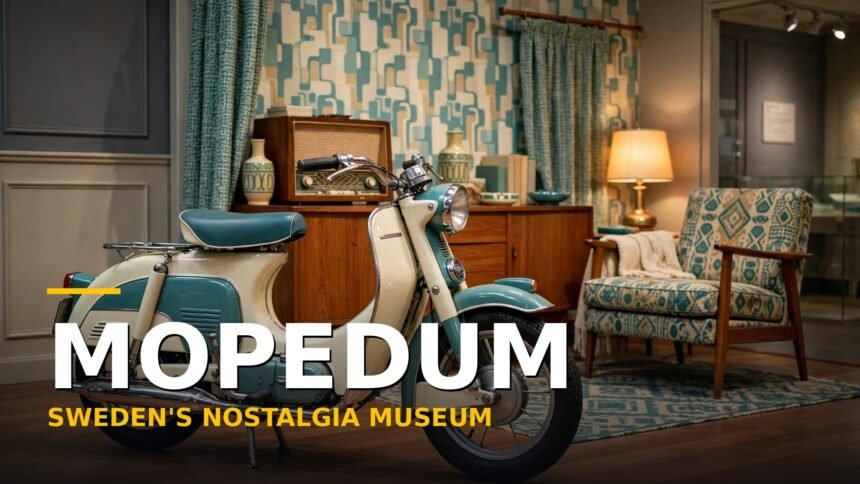
Some museums hold gold and paintings. Mopedum held something else: the smell of a 1960s kitchen, a teenager’s first moped, the biscuits people ate while the radio played. It was a small museum in a Swedish harbour town with a strange name and a simple idea — to keep the everyday life of three decades safe, exactly as people lived it.
This guide explains Mopedum in simple words: what it was, where it stood, what visitors found inside, and why a museum about mopeds ended up being about almost everything else. It also answers the question many readers now ask first — whether it is still open — with an honest account of what the public listings say.
| 🔗 You may also like: |
|---|
| Tracqueur Explained: Is It a Real Word, a Tracker, or Just a Typo? |
| Bilieter: Meaning, Origin, Uses and Its Role in Modern Ticketing |
The Short Answer
Mopedum — full name Mopedum, Svenska nostalgimuseet, the Swedish Nostalgia Museum — is a museum in Nynäshamn, a port town south of Stockholm. It stands, or stood, near the harbour in the town’s old bathhouse, at Vikingavägen 39. Its theme is the golden age of the moped, the years 1952 to 1979, but the mopeds are only the start. Inside, whole rooms were dressed as real homes from the 1950s, 1960s and 1970s — furniture, clothes, toys, tools and household things — telling the story of one couple’s life across three decades. Next door, its café, Radiokakan, served nostalgic coffee with Cuba Cola and the classic Swedish biscuit cake called radiokaka.
One honest note belongs right at the top, because readers deserve it: major travel listings now report Mopedum as permanently closed. This guide tells the museum’s story as it was loved for years, and a later section explains the closure reports and what to check before planning any visit.
Mopedum at a Glance
Name: Mopedum – Svenska nostalgimuseet (the Swedish Nostalgia Museum)
Where: Vikingavägen 39, 149 40 Nynäshamn, Sweden, near the harbour
Setting: The town’s old bathhouse
Theme: The golden age of the moped, 1952–1979, and everyday Swedish life in those years
Inside: Classic mopeds, workshop items, and full period rooms — 1950s, 1960s and 1970s interiors with furniture, clothes, toys and household goods
The story device: The rooms follow the life of a couple through the three decades
Café: Radiokakan, serving nostalgic coffee, Cuba Cola and radiokaka
Status: Reported permanently closed on major travel listings — check current information before visiting
Why 1952 to 1979? The Golden Age of the Moped
Those start and end years are not random. In 1952, Sweden changed its rules and created a class of light, motor-assisted bicycles — small engines, pedals, modest speed — that could be ridden without a driving licence from the age of fifteen. For a generation of Swedish teenagers, especially outside the big cities, that small change was a door opening. A moped meant freedom: to reach a job, a friend in the next village, a dance on a Saturday night. Through the 1950s and 1960s, Swedish makers such as Crescent and Monark, and imports like Puch, put mopeds under a huge share of the country’s young people.
The museum chose 1979 as the end of the story because that is roughly where the classic era fades — tastes changed, new rules and new machines arrived, and the simple pedal-and-engine moped of the old kind gave way to something more like a small motorcycle. Mopedum’s founders picked the years when the moped was not just transport but a piece of Swedish identity, and built the museum inside that frame. The dates on the door are, in effect, the first exhibit.
Inside the Museum: Three Decades, One Life Story
What made Mopedum special was not the machines alone. Plenty of museums line up old vehicles in a row. Mopedum built rooms. Visitors walked through interiors dressed year by year as the 1950s, then the 1960s, then the 1970s — and the rooms followed the life of a couple through those same years, from young life to family life, so the furniture, clothes and objects changed the way a real home changes as people grow older.
Reviewers who wrote about it over the years keep returning to the same words: quirky, detailed, loving. Toys and household goods. Clothes and furniture. Workshop items and the tools of ordinary work. Many visitors said the mopeds themselves turned out to be only a small part of what they remembered afterwards — the stronger feeling was recognition. A kitchen like grandmother’s. A radio like the one at home. A school bag, a packet, a poster — the small change of everyday life, kept safe. One review called it a trip down a moped-laden memory lane, which is perhaps the best summary the museum ever received.
The setting added to the effect. The museum stood in Nynäshamn’s old bathhouse — a building with its own place in the town’s everyday history — near the harbour, where the ferries and boats keep the town’s older rhythm going. A nostalgia museum inside a remembered building, in a port town that still works: the whole visit pointed the same way.
The Machines Themselves
The mopeds at the centre of all this deserve their own moment, because they were genuinely beautiful little machines. The classic Swedish-era moped was a light motor-assisted bicycle: a small engine of about 50cc, pedals you could still use, and speed kept modest by design — these were built as bicycles with help, not as small motorcycles. Their styling followed the decades around them: the neat, upright lines of the 1950s, the brighter colours and chrome of the 1960s, the longer, sleeker shapes of the 1970s.
The names on the tanks were the names of a Swedish childhood. Crescent and Monark were the home-grown giants — bicycles and mopeds from Swedish factories that whole neighbourhoods rode. Husqvarna, better known abroad for other machines, built them too. And imports like the Austrian Puch brought a slightly sportier flavour that many teenagers dreamed about. In a museum row, those badges do quiet work: older visitors do not read them, they recognise them — and recognition is the whole point of Mopedum. Each machine was somebody’s first freedom, first job journey, first Saturday night.
More Than Mopeds: Why Everyday Things Matter
It is fair to ask why a museum of ordinary things deserves a guide at all. The answer is that ordinary things are the first history to disappear. Palaces are protected; paintings are insured; but the chair everyone sat on, the cup everyone drank from and the moped everyone rode are thrown away precisely because they were common. When the last one goes, a whole way of life becomes hard to even picture.
Mopedum’s way of fighting that loss was to show life whole, not in single pieces. A moped on its own is a machine. A moped outside a 1960s kitchen window, near the couple’s coats and the children’s toys, is a story about how people actually lived — how far work was, how Saturdays felt, what freedom cost and what it bought. That is why so many visitors who came for the vehicles wrote afterwards about society: the museum used three decades of small things to show how a country changed while nobody was looking.
The Café: Radiokakan
Next to the museum sat its café, called Radiokakan — and even the café was an exhibit you could eat. It served Cuba Cola, the Swedish cola with its own long history, and radiokaka — “radio cake” — a classic Swedish no-bake cake of chocolate and biscuit, said to have earned its name in the years when families gathered around the radio and wanted something sweet with the programme.
The pairing was the museum in miniature: nothing fancy, everything remembered. A nostalgic coffee in Radiokakan was not a break from the exhibitions; it was the last room of them, the one where the 1950s and 1960s came with a taste. Visitors mentioned the café in their reviews with the same warmth as the rooms, which tells you the founders understood something true — memory lives in flavours as much as in objects.
Nynäshamn: The Town Around It
Nynäshamn is a port and fishing town on Sweden’s east coast, south of Stockholm, joined to the capital by a commuter train line and known to travellers as a ferry port — including the boats for the island of Gotland. It has the harbour, the boats and the working-town feel that suit a museum of everyday life. Mopedum stood a short walk from the harbour area at Vikingavägen 39, and travel guides to the town listed it among the essential things to see — often as the place that surprised visitors most.
That position mattered. People arrived in Nynäshamn for ferries, for the sea, for a day out of Stockholm — and found, in the old bathhouse, a museum that explained the Sweden those journeys crossed. Small towns rarely hold a whole era in one building. For years, this one did.
A Standout Among Sweden’s Small Museums
Sweden is a country of small museums. Nearly every town keeps something: a railway room, a fishing hut, a schoolhouse, a workshop — much of it cared for by local societies and private collectors rather than big state institutions. The best of them share one quality: they were assembled by people who lived the history they show, and who could not bear to watch it thrown away.
Mopedum belonged to that family, but reviews suggest it stood out inside it, and the reason was design. Many small collections arrange objects by type — all the radios here, all the tools there. Mopedum arranged them by life: a couple, three decades, rooms that aged as the people in the story aged. That single choice turned a collection into a narrative, and it is why visitors who had “seen many small museums” wrote about this one differently — with the attention usually saved for a good novel or a well-made film. It treated everyday memory as something worth the same care as art, and then proved the point room by room.
Is Mopedum Still Open?
Now the question this guide promised to answer plainly. The major travel listings for Mopedum — the pages where its reviews live — now carry the note that the location has been reported permanently closed. That note appears on the museum’s listings across several countries’ editions of the same travel platform, which makes it hard to dismiss as a single mistake. This guide found no public announcement of a reopening, and the museum should be treated as closed unless newer information says otherwise.
So the practical advice is simple. Do not travel to Nynäshamn only for Mopedum without checking its current status first — listings change, and small museums sometimes return in new forms. And if it stays closed, the record it leaves still has value: hundreds of visitor accounts describing a small, loving museum that did its job so well that people who came for mopeds left thinking about their own families. Plenty of grander institutions manage less.
What Visitors Took Home
The last thing worth recording about Mopedum is the pattern in how people described leaving it. Visits were not quick — reviewers spoke of a fun couple of hours, long for a small museum — and the hours were not spent only looking. They were spent telling. A grandparent would stop at a kitchen table and start explaining a whole childhood to a grandchild. A couple would argue happily about whether the wallpaper in their first flat matched the 1970s room. The exhibits worked like keys, and every older visitor carried a lock they fitted.
That is the real craft the museum practised, and it is rarer than it sounds. Many collections preserve objects; Mopedum preserved recognition. It understood that a moped, a radio or a biscuit cake is never just a thing — it is a place in a life where a person once stood, and when the thing is set back in its room, the person can stand there again for a moment. If the doors stay closed, that is the loss: not a set of old machines, but a room-sized time machine, built out of ordinary life, in a small harbour town that understood exactly what it was keeping.
| 🔗 You may also like: |
|---|
| Quad Equalizer: Complete Guide to Four-Channel Audio Equalization |
| Your Topics | Multiple Stories: How One Idea Becomes Multiple Powerful Stories |
Conclusion
Mopedum was never really just about mopeds. It was the Swedish Nostalgia Museum in Nynäshamn — the old bathhouse near the harbour filled with the years 1952 to 1979: the machines that gave young Swedes their freedom, and the kitchens, clothes, toys and tools that made up their lives, arranged as one couple’s story across three decades, with a café that served the era’s own tastes. Travel listings now report it permanently closed, and this guide has said so honestly rather than pretend otherwise. But a museum’s work can outlast its doors. Mopedum proved that everyday things, kept with care, can hold a country’s memory better than many grander collections — and that is a story worth keeping, even in an article.
FAQs
What is Mopedum?
Mopedum, full name Mopedum – Svenska nostalgimuseet (the Swedish Nostalgia Museum), is a museum in Nynäshamn, Sweden. It covers the golden age of the moped, 1952 to 1979, and shows everyday Swedish life in those years through classic mopeds, workshop items and full period rooms filled with furniture, clothes, toys and household goods.
Where is Mopedum located?
It is located at Vikingavägen 39, 149 40 Nynäshamn, Sweden, in the town’s old bathhouse near the harbour. Nynäshamn is a port town south of Stockholm, reachable by commuter train and known for its ferries, including boats to the island of Gotland.
Why does Mopedum cover the years 1952 to 1979?
Because those years frame the classic Swedish moped era. In 1952 Sweden created a licence-free class of light motor-assisted bicycles for riders from fifteen, and the moped became a symbol of freedom for a generation of young Swedes. By the end of the 1970s that classic era had faded as rules and machines changed, so the museum tells its story inside those dates.
Is Mopedum only about mopeds?
No — visitors consistently said the mopeds were only one part of it. The museum’s rooms were dressed as real homes from the 1950s, 1960s and 1970s, following one couple’s life across the decades, with furniture, clothes, toys, tools and household objects. Its café, Radiokakan, added the era’s tastes: Cuba Cola and radiokaka, the classic radio cake.
Is Mopedum still open?
Major travel listings now report the location as permanently closed, and this guide found no announcement of a reopening. Treat it as closed unless newer information appears, and always check its current status before planning a trip to Nynäshamn — small museums occasionally return in new forms, and listings do change.