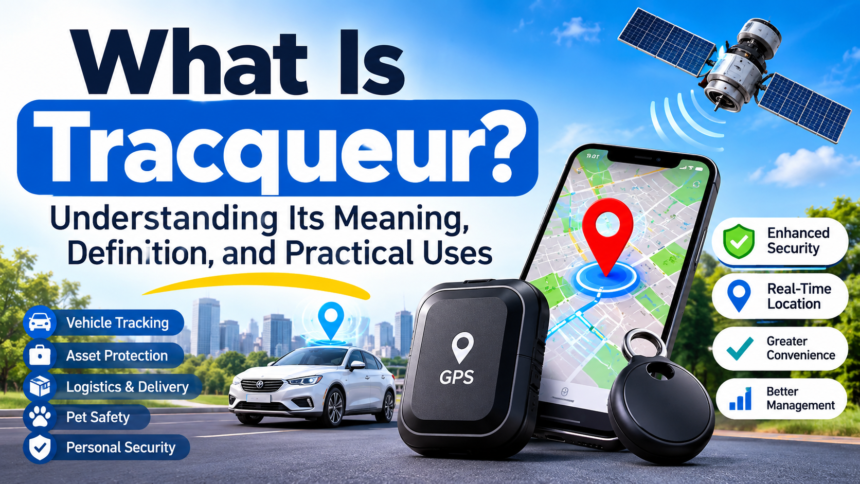
Type “tracqueur” into a search engine and you will find pages and pages about it. It is a GPS tracker, says one site. It is a fitness band, says another. It is a clever software platform, says a third. They all sound sure of themselves, and they all describe something different. So which one is telling the truth?
Honestly? None of them — at least, not about the name itself. This guide explains the whole story in simple words. Tracqueur, with that exact spelling, is not a real French word, and no real product, app or company with that name can be found. But the trail behind the spelling is real and genuinely interesting: a true French word, a real French company that helped recover stolen cars for more than twenty years, and a wave of websites that turned one wrong letter into a whole industry of confident nonsense.
| 🔗 You may also like: |
|---|
| Incfidelibus Explained: Is It a Real Latin Word? |
| Amateurallrue Explained: What It Means and Why It Is Trending |
The Short Answer
No standard French dictionary lists the word “tracqueur”. There is no entry for it, because French does not build the word that way. The real word is traqueur — spelled with one “c” — and it is a good, honest word that means a tracker: someone or something that follows a trail and finds what it is looking for.
As for a product called Tracqueur: there is none that anyone can point to. No maker, no shop listing, no app in the app stores, no company registration. Every article that describes “the Tracqueur device” or “the Tracqueur platform” is describing something its writer invented, usually by copying another article that invented it first. What does exist is the real world of tracking itself — satellite trackers, tiny Bluetooth tags, vehicle recovery systems, and the web trackers that follow you around the internet. That real world is what the rest of this guide is about.
The Real French Word: Traqueur
French builds this word in a simple way. The verb is traquer, which means to track, to hunt down, to follow something until you find it. Add the ending that turns a verb into a person or a thing that does the action, and you get traqueur: a tracker.
The oldest dictionary meaning comes from hunting. In the French dictionaries — Larousse, Littré, and the dictionary of the Académie française — a traqueur is the man employed to track and drive out game animals during a hunt, so the hunters can find them. Used more loosely, the word describes anyone who searches for something with real determination and does not give up: a relentless seeker. English translators simply render it as “tracker”.
The word has also picked up a newer, technical life. In modern French writing about privacy and the web, a traqueur is an online tracker: the small pieces of code hidden in websites, apps and emails that record what you do and report it back to some company. When a French privacy guide warns you about traqueurs, it means cookies, tracking pixels and similar tools. So the real word covers both trails in the forest and trails on the internet — following, in either world.
Notice what is missing from all of this: the second “c”. French spelling gives the word one “c”, in traquer and in traqueur. “Tracqueur” adds a letter that no dictionary accepts. It is the same kind of error as the one in our Incfidelibus story, where one extra letter turned a real Latin word into a fake ancient mystery. One wrong letter, copied often enough, starts to look like a word of its own.
The Real Company Behind the Similar Name
Here is where the story gets better, because a real company really did build its name on this word — spelled the French way, with one “c”. Groupe Traqueur was founded in France in 1997 and became the French leader in recovering stolen vehicles. Its work was serious and practical. A small hidden device was fitted to a car, a motorbike, a boat or a machine. If the vehicle was stolen, the company worked to track it down, locate it and secure it, in cooperation with the police.
The clever part was how it found things. Satellite signals are weak or blocked in exactly the places thieves like best — underground car parks, metal containers, covered yards. So Traqueur’s systems combined tools: GPS satellite positioning and mobile-network links on some products, and radio signals on others, because a radio signal can still be followed where a satellite signal cannot reach. The group also ran fleet services, helping companies see where their vehicles were and how they were being used. It was part of the LoJack international network for stolen-vehicle recovery, founded a European alliance of tracking companies, and was listed on the stock exchange in Paris. In 2020 it was acquired by Safety Systems Group.
Hold on to the spelling lesson here, because it is the heart of this whole article. The real company is Traqueur — one “c”. When websites about “tracqueur” borrow this company’s 1997 founding and its vehicle-recovery history to make their spelling sound real, they are dressing a typo in a real firm’s clothes. The firm deserves its own story; the typo does not get to steal it.
Do Not Confuse It With Traccar Either
One more similar name deserves a clear mention, because searches mix all three together. Traccar — spelled with a double “c” but ending in “-car”, with no “q” at all — is a real, free, open-source GPS tracking platform. Its phone apps can turn your own phone into a GPS tracker that reports its position to your own server, and its server software works with many kinds of GPS devices. It is a genuine tool with real users, built in the open.
So the map of names looks like this. Traqueur: a real French word, and a real French vehicle-recovery company. Traccar: a real open-source tracking platform. Tracqueur: a spelling found in neither dictionary nor any real product — only in articles. Three names that look almost the same, three completely different levels of real.
So Where Did “Tracqueur” Come From?
If the word is not real and the product does not exist, why do so many pages describe it in such detail? The answer is a pattern this site has met several times now. Somebody — a writer, a tool, a content farm — used the wrong spelling in an article about trackers. Search engines noticed people landing on it. Other sites, hunting for easy topics, copied the term and wrote their own versions. Each new article had to sound complete, so each one quietly filled the gaps with invention.
That is why the descriptions fight each other. One cluster of articles calls tracqueur a fitness tracker that watches your heart rate and your sleep. Another calls it a software platform that manages whole business workflows. Others call it a small GPS box for cars, pets and keys. A real product cannot be three different things at once, sold by nobody, found in no shop. Conflicting descriptions are the fingerprint of invention — the same fingerprint we found behind Amateurallrue, a term with no real referent that content sites dressed up as a creative movement. When ten articles agree a word exists but none can agree on what it is, the word is the product. The articles are the business.
What Tracking Really Is: The Real Subject Under the Name
Strip the fake name away and a real, useful subject remains — because tracking itself is very real, and it is worth understanding properly. Every tracker, whatever its shape, does the same basic job in two steps: it works out where something is, and it tells someone. The variety comes from how it does each step.
Satellite positioning (GPS and its sister systems) is the method most people picture. The device listens to signals from satellites and works out its place on Earth. It is accurate and works almost anywhere outdoors — in cars, boats, delivery vans and hikers’ pockets. Its weakness is cover: thick roofs, tunnels and underground car parks can block the sky.
Bluetooth tags work the opposite way: tiny range, tiny power. A small tag on your keys or in your bag talks to phones near it, and those phones quietly report where the tag was last seen. It is perfect for finding lost things around town, and useless for following a van across the country. Mobile-network and Wi-Fi signals fill the gaps: a device can estimate its place from the phone masts and Wi-Fi networks around it, which works indoors and in cities where satellites struggle. Radio tags (RFID) are the short-range workers of warehouses and shops, read as goods pass a gate. Real systems often mix these methods, so that when one signal fails, another still answers.
And then there is the digital cousin, the one the French word names directly. A web tracker does not follow a thing through streets; it follows a person through pages. Cookies remember you, tiny invisible images report that you opened an email or a page, and scripts note what you clicked and how long you stayed. It is the same idea — observe, record, report — pointed at behaviour instead of location. Our guide to InstaPV, the anonymous Instagram viewer, deals with the same borderland: tools that watch, and the rules that keep watching honest.
Where Tracking Genuinely Helps
Used on your own things, with clear consent where people are involved, tracking earns its keep every day. A recovery system in a car can mean the difference between a stolen vehicle found by evening and one never seen again — that was Groupe Traqueur’s whole real business. A tag in a suitcase ends the airport guessing game. A collar tracker brings a wandering dog home. Delivery firms plan routes and answer “where is my parcel?” honestly instead of guessing. Farmers and builders keep sight of expensive machines left on open land. Families share location by choice, so a parent knows a child arrived safely, with everyone in the arrangement aware and able to switch it off.
Notice the common thread in every good example: the owner of the thing being tracked knows about it and wants it tracked. That thread is not decoration. It is the whole difference between a tool and a violation, which brings us to the part of this subject that matters most.
The Privacy Side: Consent Is the Line
A tracker small enough to hide is small enough to abuse, and the law in many places treats secret tracking of a person as a serious matter. Slipping a device into someone’s car or bag to follow them without their knowledge is not a clever trick; it is a violation of their privacy, and it can be a criminal offence, quite apart from the damage it does to trust. The same goes for stalking behaviour of every kind. This article will not help anyone do that, and no honest article should.
The digital side has its own version of the same line. Websites are expected to ask before they follow you with non-essential trackers, and browsers and privacy tools increasingly block the following that happens without a fair say. You are allowed to care about this: checking what a site stores, refusing the cookies you do not need, and using browsers that limit cross-site tracking are all normal, healthy habits. Whether the trail is physical or digital, the fair rule is one sentence long: track your own things freely, and track people only with their clear knowledge and agreement.
How to Check a Name Like This Yourself
The tracqueur story is worth one more thing: it teaches a checking habit that works on any too-good name you meet online, in about five minutes.
Check the spelling against a dictionary first. For a word that claims to be French, a French dictionary settles it. Traqueur is there; tracqueur is not. A word that fails the dictionary test has to prove itself some other way — and the burden is on the word, not on you. Then look for the thing itself. A real product can be bought somewhere. A real app sits in an app store with a named developer. A real company appears in registrations, exchange listings or its own long-running website. Our guide to target company URL research walks through exactly these checks, and the research dossier method shows how to keep what you find in one tidy record. Finally, compare the stories. If the articles about a name describe three different products and name no maker, you are not looking at a product with good marketing. You are looking at a spelling with good luck.
| 🔗 You may also like: |
|---|
| CNLawBlog Explained: Two Publications Behind One Name |
| Voozon Explained: What Voozon.com Is, and What It Is Not |
Final Thoughts
Tracqueur is a small spelling with a large lesson. The word itself does not exist in French, and no product, app or company carries the name — the confident guides that describe one are copying each other’s inventions, down to three different imaginary products sharing one imaginary label. What is real is close by and better: traqueur, the genuine French word for a tracker, in the hunting field and on the modern web; Groupe Traqueur, the real company that spent over twenty years finding stolen vehicles across France; Traccar, the real open-source platform that turns phones into trackers; and the tracking technology itself, genuinely useful when it follows your own things with consent, and genuinely wrong when it follows people in secret. Check the spelling, look for the thing itself, and compare the stories. Do that, and a name like tracqueur can never fool you — it can only teach you.
FAQs
What does tracqueur mean?
Strictly, nothing of its own — “tracqueur” is a misspelling. The real French word is traqueur (one “c”), from the verb traquer, to track or hunt down. A traqueur is a tracker: in old dictionary use, a man who tracks game on a hunt; in modern French tech writing, an online tracker such as a cookie or script that records what you do on a website. Articles that define “tracqueur” as a specific device or product are building on the wrong spelling.
Is tracqueur a real French word?
No. No standard French dictionary — Larousse, Littré, the Académie française dictionary, or modern references like WordReference — lists “tracqueur” with a double “c”. They all list traqueur, spelled with one “c”. The double-c spelling appears only in recent English-language web articles, which is one of the clearest signs that it began as an error and was copied from site to site.
Is Tracqueur a company or an app I can buy or download?
There is no verified company, product or app under the exact name “Tracqueur” — no maker, no shop listing, no app-store page. Do not confuse it with two real neighbours: Groupe Traqueur (one “c”), a real French stolen-vehicle recovery and fleet telematics company founded in 1997 and acquired by Safety Systems Group in 2020; and Traccar, a real free open-source GPS tracking platform with apps that report a phone’s position to your own server.
What is the difference between traqueur, tracqueur and Traccar?
Traqueur (one “c”, ends “-eur”) is the real French word for a tracker and the name of a real French vehicle-recovery company. Tracqueur (double “c”, ends “-eur”) is a misspelling found only in web articles, attached to invented and conflicting product descriptions. Traccar (double “c”, ends “-car”, no “q”) is a real open-source GPS tracking platform. Three look-alike names; only two of them are real.
Is it legal to track someone with a GPS tracker?
Tracking your own property — your car, your bag, your pet — is normal and generally fine. Tracking another person without their knowledge and consent is a very different matter: it is a serious invasion of privacy and is against the law in many places, whatever device is used. Rules differ by country, so treat consent as the line: if the person does not clearly know and agree, do not do it.