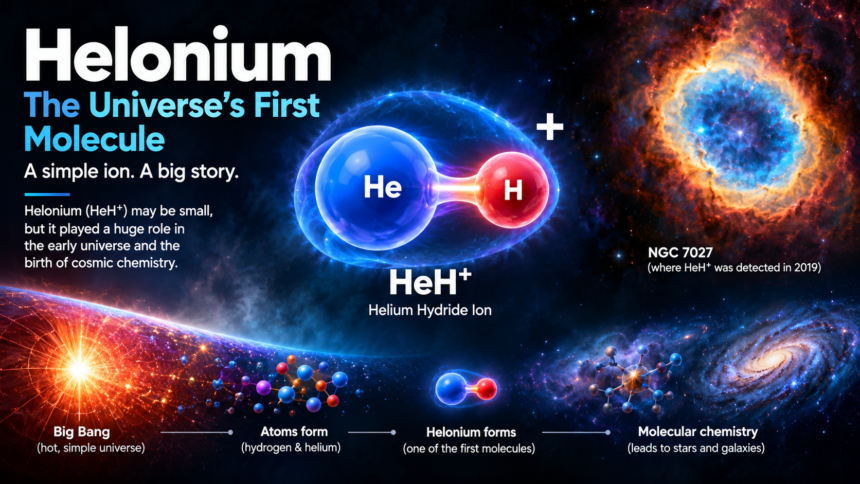
Helonium, more commonly known as the helium hydride ion (HeH⁺), is one of the most fascinating molecular ions in chemistry and astronomy. Although it contains only one helium atom and one hydrogen atom, it holds an important place in the history of the universe. Scientists believe that HeH⁺ was among the earliest molecular species to form as the universe cooled after the Big Bang.
For decades, researchers understood how to produce helonium in laboratories, but they could not confirm its presence in space. That changed in April 2019, when astronomers detected its distinctive spectral signature in a planetary nebula called NGC 7027. The discovery provided important evidence supporting theories about how chemistry began in the early universe.
Understanding helonium reveals more than the behavior of an unusual chemical ion. It helps explain how the simplest elements interacted, how molecular hydrogen could eventually form, and how the first stages of cosmic chemistry contributed to the conditions needed for the earliest stars.
What Is Helonium?
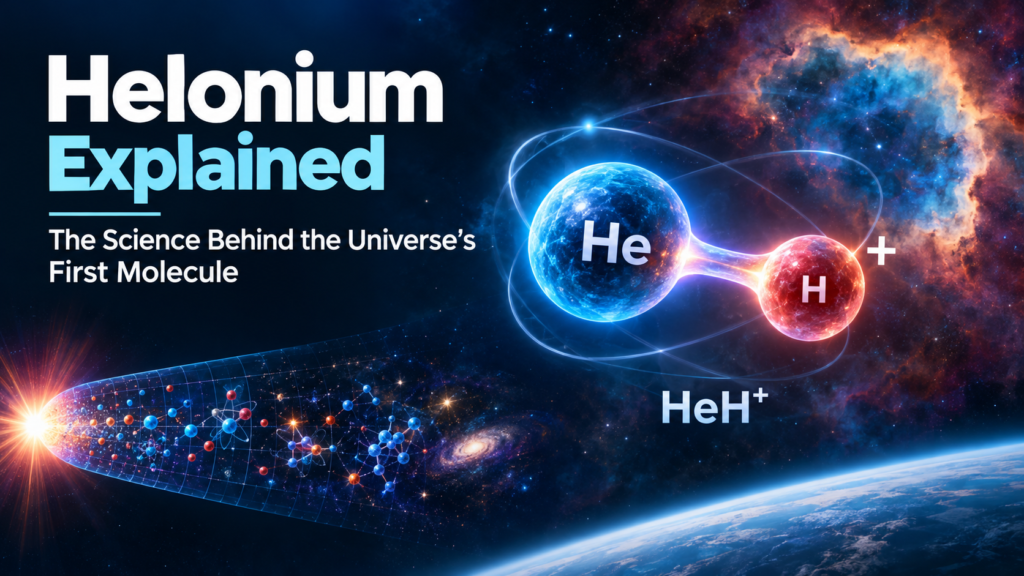
Helonium is another name for the helium hydride ion, a positively charged molecular ion represented by the chemical formula HeH⁺. It consists of one helium atom bonded to a hydrogen nucleus, with a net electrical charge of +1.
The name may sound like that of a chemical element, but helonium is not an element on the periodic table. Instead, it is a molecular ion formed from two different elements: helium and hydrogen.
Helium is a noble gas known for its low chemical reactivity. Hydrogen, meanwhile, is the simplest and most abundant element in the universe. When a helium atom interacts with a proton under suitable conditions, the resulting helium hydride ion can form.
Helonium is especially important because scientists consider it a leading candidate for the first molecular ion formed in significant quantities during the universe’s early chemical evolution.
| 🔗 You may also like: |
|---|
| Latest Breakthroughs in Quantum Computing 2024: Real Advances, Challenges and What’s Next |
| QuantumRun Foresight Explained: Future Trends & Emerging Technologies |
What Does the Formula HeH⁺ Mean?
The formula HeH⁺ contains three important pieces of information:
- He: Represents one helium atom.
- H: Represents one hydrogen nucleus in the molecular ion.
- +: Indicates that the entire ion carries one positive electrical charge.
Helonium is classified as a heteronuclear diatomic molecular ion. The term diatomic means that it contains two atomic nuclei, while heteronuclear means those nuclei belong to different elements.
Its simple structure makes HeH⁺ valuable for studying chemical bonding, molecular spectroscopy, and quantum chemistry.
Why Is Helonium Called the Universe’s First Molecule?
The early universe was initially far too hot for ordinary atoms and molecules to exist in stable forms. As the universe expanded, it gradually cooled, allowing particles to combine and eventually form neutral atoms.
Hydrogen and helium became the principal elements of this early cosmic environment. However, the first stages of molecular chemistry were challenging because heavier elements, dust grains, and the solid surfaces that facilitate many chemical reactions today did not yet exist.
Helonium offered one possible route into this new chemical era.
As neutral helium atoms became available alongside protons, they could react through a process known as radiative association. During this reaction, helium and a proton combine, and excess energy is carried away by an emitted photon.
The process can be represented as:
He + H⁺ → HeH⁺ + photon
This reaction allowed a molecular ion to form even in the simple gas-filled environment of the early universe.
Scientists describe HeH⁺ as a likely first molecular species because theoretical models indicate that it could form before other important molecules became abundant. However, calling it the universe’s first molecule is a useful scientific shorthand rather than a claim that every detail of the earliest chemical timeline is settled.
The Chemical Properties of Helonium
Helonium has several unusual properties that distinguish it from familiar substances such as helium gas, hydrogen gas, and water.
Its most important characteristic is its positive electrical charge. This charge influences how the ion interacts with other particles and helps explain its strong tendency to transfer a proton to suitable chemical partners.
Chemical Formula and Structure
The chemical formula of helonium is HeH⁺. It contains helium and hydrogen and has a net charge of +1.
Unlike a neutral molecule, HeH⁺ has an uneven distribution of electrical charge. Its bonding behavior is governed by quantum mechanics, including the attraction between positively charged nuclei and the ion’s electron.
The ion is also exceptionally simple from a molecular physics perspective. Because it contains only two nuclei and one electron, scientists can use it to test theoretical calculations and investigate fundamental principles of molecular bonding.
Is Helonium the Strongest Acid Known?
Helonium is often described as the strongest acid known because it has an exceptionally strong tendency to donate its proton to another chemical species.
In the Brønsted–Lowry definition of acidity, an acid is a substance that donates a proton. HeH⁺ can transfer its proton to a suitable reaction partner, leaving neutral helium behind.
However, the phrase “strongest acid” requires context. Acid strength depends on the chemical environment, the substance being compared, and the conditions under which the reaction occurs. Helonium’s extraordinary proton-donating ability in the gas phase does not mean it is a conventional liquid acid that can be stored in a bottle.
Its high reactivity also explains why it cannot be maintained as an ordinary bulk substance under everyday conditions.
Helonium vs. Helium: What Is the Difference?
Helonium and helium are related, but they are chemically different.
Helium is a chemical element with the symbol He and atomic number 2. A neutral helium atom contains two protons and two electrons. Its filled electron shell makes it unusually resistant to many chemical reactions.
Helonium, on the other hand, is the molecular ion HeH⁺. It contains helium and hydrogen and carries a positive charge.
The distinction matters because helium has many practical applications, including cryogenic cooling, leak detection, and specialized scientific equipment. Helonium is primarily valuable as a subject of chemical and astronomical research.
It is not a newly discovered element, does not have its own atomic number, and should not be confused with ordinary helium gas.
The History of Helonium: From Laboratory to Space
The scientific story of helonium spans almost a century, beginning with laboratory experiments and culminating in its confirmed astronomical detection.
1925: First Laboratory Identification
In 1925, physicists Thorfinn R. Hogness and E. G. Lunn reported experimental evidence for the helium hydride ion while investigating ionization in hydrogen and helium using electron-impact experiments.
Their work demonstrated that a molecular ion involving helium could exist under suitable laboratory conditions. This was significant because helium had long been regarded as an exceptionally unreactive element.
Although scientists could produce HeH⁺ in the laboratory, confirming its natural presence in space presented a separate challenge.
1970s: Interest in Interstellar Helonium
As theoretical models of early-universe chemistry developed, scientists increasingly considered the possibility that HeH⁺ existed in astronomical environments.
Researchers expected the ion to form in certain regions containing helium ions, hydrogen, and energetic radiation. Yet decades of searching failed to produce a definitive astronomical detection.
The problem was largely observational. Astronomers needed instruments capable of distinguishing the ion’s characteristic spectral signature from other sources of infrared radiation.
April 2019: Detection in Space
A major breakthrough occurred in April 2019, when researchers reported the first confirmed astronomical detection of HeH⁺ in the planetary nebula NGC 7027.
The research team used NASA’s Stratospheric Observatory for Infrared Astronomy, known as SOFIA. This airborne observatory carried a specialized infrared instrument called GREAT, which helped researchers identify the ion’s characteristic emission.
The finding was published in the journal Nature and confirmed that helium hydride ions exist in a natural astrophysical environment.
The discovery was important because it connected laboratory chemistry and theoretical predictions with direct observations of the universe.
How Scientists Detected Helonium in Space
Detecting helonium was not as simple as taking a photograph of a molecule. Astronomers identified it through spectroscopy, a technique that studies the light emitted or absorbed by matter.
Molecules and ions interact with radiation at characteristic frequencies. By measuring these signals, researchers can identify chemical species even when they are located thousands of light-years away.
Why Was SOFIA Important?
Earth’s atmosphere absorbs much of the infrared radiation coming from space. This makes some astronomical signals difficult or impossible to observe clearly using ground-based telescopes.
SOFIA carried its telescope aboard a modified Boeing 747SP aircraft, allowing observations from above much of the atmosphere’s water vapor.
Its GREAT instrument was designed to detect specific far-infrared and submillimeter spectral lines. Researchers used this capability to identify the signature associated with HeH⁺ in NGC 7027.
The discovery demonstrated how specialized astronomical instruments can help scientists confirm predictions that have remained unverified for decades.
Why NGC 7027 Was a Suitable Target
NGC 7027 is a young planetary nebula, a glowing cloud of gas produced during the later evolution of a star similar in its earlier life to the Sun.
The nebula contains hot, ionized regions where radiation and chemical reactions create conditions suitable for the formation of HeH⁺.
These conditions make it an important environment for studying the interaction between helium, hydrogen, and energetic radiation.
Although NGC 7027 is not the early universe itself, observing HeH⁺ there provides valuable information about its behavior under astrophysical conditions.
How Helonium Helped Begin Cosmic Chemistry
The importance of helonium extends beyond the discovery of a rare molecular ion. It provides clues about the chain of chemical reactions that eventually allowed more complex molecules to develop.
During the early stages of cosmic history, hydrogen and helium dominated the available matter. Heavier elements such as carbon, oxygen, and iron became widespread only after stars formed and produced or dispersed these elements through stellar processes.
Without dust grains or solid surfaces, the earliest chemical reactions had to occur primarily in the gas phase.
HeH⁺ could participate in reactions that transferred chemical activity from helium toward hydrogen. One important pathway involves a reaction between the helium hydride ion and neutral hydrogen, producing molecular hydrogen ions.
These reactions helped connect the earliest stages of chemistry to later molecular processes.
From Helonium to Molecular Hydrogen
Molecular hydrogen, H₂, became essential to the development of the first stars because it could help cool collapsing clouds of gas.
As gas cools, gravity can more effectively gather matter into dense regions. Under suitable conditions, these regions can collapse and eventually form stars.
Helonium was not the direct cause of star formation, and it was not the only chemical species involved. Rather, it formed part of the network of early reactions that helped establish the conditions for subsequent chemistry.
Another important ion, H₃⁺, plays a major role in interstellar chemical reactions. Through its interactions with other particles, it can help initiate pathways toward molecules containing carbon, oxygen, and other elements.
The wider story therefore involves a sequence of chemical developments, not a single molecule independently creating the universe’s later complexity.
| 🔗 You may also like: |
|---|
| AelfTech.com: Technology, AI & Digital Innovation Guide |
| Truzio Technologies Explained: ERP, IT Services, Products & Company Guide |
Where Does Helonium Occur Naturally?
Helonium is not a stable material that accumulates in Earth’s atmosphere or appears naturally as a familiar gas at ground level.
Its natural occurrence is associated mainly with specific astrophysical environments, including regions where hot gas, radiation, and ionized particles interact.
The 2019 detection in NGC 7027 provided direct evidence of its presence in space. The ion’s formation and destruction depend on local conditions, including temperature, particle density, radiation, and the availability of helium and hydrogen.
Scientists also use theoretical models to investigate the abundance of HeH⁺ in the early universe. These calculations help explain how the first molecular species could have formed as the cosmos cooled.
Although the ion is short-lived in many ordinary chemical environments, it can exist long enough under suitable conditions to be detected through its spectral signature.
What Are the Uses of Helonium?
Helonium does not have widespread commercial applications comparable to those of elemental helium. Its value lies mainly in scientific research.
Astrophysics and Astronomy
Astronomers study HeH⁺ to understand the physical and chemical conditions of nebulae and other regions of space.
Its spectral signature can provide information about molecular formation, ionized gas, and the chemical processes taking place around evolving stars.
The 2019 detection also gave researchers an observational reference point for improving models of early-universe chemistry.
Laboratory Chemistry
Chemists investigate the helium hydride ion to explore molecular bonding, proton transfer, reaction dynamics, and the behavior of ions.
Because its structure is simple, HeH⁺ is useful for testing quantum-chemical calculations and comparing theoretical predictions with laboratory measurements.
Cosmology
Cosmologists and astrochemists use models of early molecular formation to investigate how the universe transitioned from a hot, ionized environment to one containing neutral atoms and molecules.
Helonium contributes to this research by helping scientists examine the earliest stages of chemical evolution.
It is not a fuel, medicine, or ordinary industrial material. Its significance comes from what it reveals about the fundamental processes that shaped the universe.
Common Misconceptions About Helonium
Several misunderstandings can arise when people first encounter the term.
Helonium is a chemical element. This is incorrect. HeH⁺ is a molecular ion formed from helium and hydrogen, not a separate element on the periodic table.
Helonium and helium are the same substance. They are different chemical species. Helium is an element, while helonium is a positively charged ion containing helium and hydrogen.
Helonium was first discovered in space in 2019. The year 2019 marks its first confirmed astronomical detection. Scientists had already produced and studied it in laboratory experiments in 1925.
Helonium created the universe. This is an exaggeration. The Big Bang preceded the formation of atoms and molecules. HeH⁺ formed later and contributed to the chemical evolution of the young universe.
Helonium has many everyday uses. Its principal importance is scientific. It does not have the same commercial applications as helium gas.
| 🔗 You may also like: |
|---|
| WhatsonTech: Technology, Trends & Digital Innovation Guide |
| TechTrendery.com USA: Technology Trends & Digital Innovation |
Conclusion
Helonium, or the helium hydride ion HeH⁺, is a remarkable example of how a very simple molecular species can provide insight into the history of the universe. Formed from helium and hydrogen, this positively charged ion occupies an important place in theories about the earliest stages of cosmic chemistry.
Its scientific history began with laboratory experiments in 1925 and reached a major milestone in 2019, when astronomers confirmed its presence in the planetary nebula NGC 7027. That discovery helped bridge the gap between theoretical predictions and astronomical observations.
Helonium did not create the universe, nor was it solely responsible for the formation of stars. Its importance is more specific and scientifically meaningful: it represents one of the earliest steps in the development of molecular chemistry.
By studying HeH⁺, scientists can better understand how simple atoms began interacting, how molecular hydrogen eventually formed, and how the chemical processes that shaped later stars and galaxies first emerged.
FAQs
What does helonium mean?
Helonium is another name for the helium hydride ion, HeH⁺. It is a positively charged molecular ion containing helium and hydrogen.
What is the chemical formula of helonium?
The chemical formula is HeH⁺. The plus sign indicates that the ion carries one positive electrical charge.
Is helonium a real chemical substance?
Yes. Scientists produced and identified HeH⁺ in laboratory experiments in 1925, and astronomers confirmed its presence in space in 2019.
Why is helonium called the first molecule in the universe?
Theoretical models indicate that HeH⁺ was likely among the earliest molecular species to form after the universe cooled enough for chemical reactions to occur. The phrase describes its place in early cosmic chemistry.
Who discovered helonium?
Thorfinn R. Hogness and E. G. Lunn reported its laboratory identification in 1925. The first confirmed astronomical detection was reported by an international research team in 2019.
Where was helonium first detected in space?
Astronomers detected HeH⁺ in NGC 7027, a planetary nebula approximately 3,000 light-years from Earth, using NASA’s SOFIA airborne observatory.
Is helonium the same as helium?
No. Helium is a neutral chemical element under ordinary atomic conditions, while helonium is the positively charged molecular ion HeH⁺.
Can helonium be stored in a container?
Not as an ordinary bulk substance under everyday conditions. Its high reactivity means it is generally studied under specialized laboratory or astrophysical conditions.
Does helonium have industrial or medical uses?
There are no established widespread medical or industrial applications comparable to those of elemental helium. HeH⁺ is mainly important for research in chemistry, molecular physics, and astronomy.