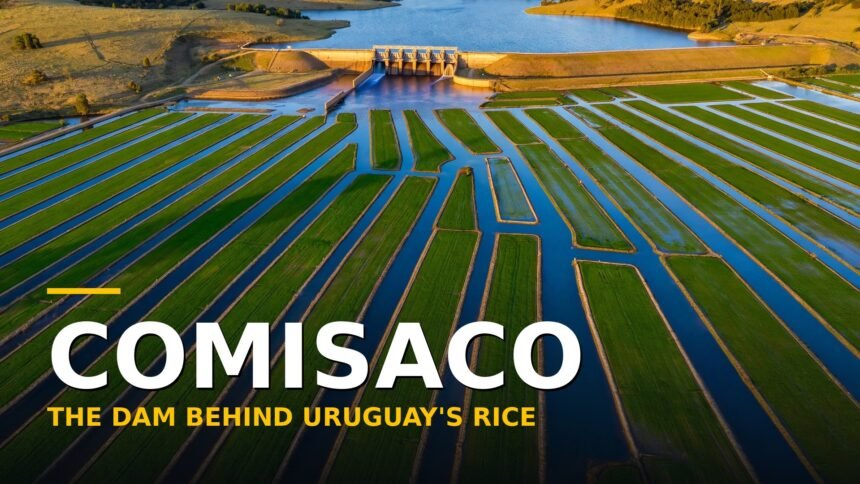
Some company names appear in the news every day. Others never make a headline, yet quietly hold up a whole industry. Comisaco is one of the second kind. It is a Uruguayan company whose name appears in dry financial filings and on one short page of a rice company’s website — and behind that plain name sits a dam, more than two hundred kilometres of canals, and water for roughly ten thousand hectares of rice fields.
This guide explains Comisaco in simple words: what the company is, who owns its shares, what the India Muerta dam does, and why a business most people have never heard of matters so much to the rice on real dinner tables. Everything here is drawn from public records that anyone can check — the company’s own industry partners and audited financial reports.
| 🔗 You may also like: |
|---|
| How the Global Trader Programme Helps Trading Companies Save Tax in Singapore |
| Target Company URL Research: How to Find and Verify the Right Business Website |
The Short Answer
Comisaco S.A. is a company in Uruguay that holds the concession to run the India Muerta dam — in plain terms, it is the organisation responsible for administering a large irrigation dam in the east of the country. The dam stands in the department of Rocha, between the towns of Velázquez and Lascano. From it, a network of canals stretches for more than two hundred kilometres and carries water to about ten thousand hectares of rice paddies in what is described as the main rice basin of Uruguay.
Half of the company — fifty percent of its shares — belongs to SAMAN, one of Uruguay’s best-known rice companies. SAMAN itself sits inside Camil Alimentos, the large Brazilian food group, whose published financial reports list Comisaco year after year as an associate company held at exactly that fifty percent stake. So the short story is this: Comisaco is the water company behind a large share of Uruguay’s rice, jointly held by the rice industry it serves.
Comisaco at a Glance
For readers who want the facts in one place, here is the whole picture on a single card:
Company: Comisaco S.A.
Country: Uruguay
What it does: Administers the India Muerta irrigation dam under a concession
Where: Department of Rocha, eastern Uruguay, between Velázquez and Lascano
The system: A dam plus more than 200 kilometres of canals
Area served: Approximately 10,000 hectares of rice paddies each year
Known shareholder: SAMAN (S.A. Molinos Arroceros Nacionales), holding 50 percent, as stated on SAMAN’s website and in Camil Alimentos’ audited financial reports
Why it matters: It supplies the controlled water that Uruguay’s main rice basin depends on
Everything in the sections below simply unpacks those few lines — who the partners are, how the dam and canals work, and why rice country needs them.
Who Owns Comisaco?
The clearest public record is the ownership line, because it appears in two independent places that agree with each other. SAMAN’s own corporate website, on its page about business associations, states it plainly: SAMAN owns fifty percent of Comisaco S.A., the concession holder for the administration of the India Muerta dam. Then the audited side: Camil Alimentos, the Brazilian group that controls SAMAN, publishes detailed financial statements, and those statements carry a table of subsidiaries and associates. Comisaco S.A. appears in that table in report after report — 2019, 2020, 2021 and on into 2025 — always as an associate, always at fifty percent, direct and indirect.
Two words in that record are worth understanding. An “associate” company is one where the investor holds a large share — here, half — but does not fully control it, the way it would control a subsidiary it owns outright. The filings even show the working relationship in numbers: tables of transactions between related parties include Comisaco, including expenses connected with rice parboiling, the heat treatment that is part of producing parboiled rice. In other words, Comisaco is not a name on a shelf. It is a working partner inside the group’s rice business, dealing with the group year after year.
Who holds the other fifty percent is not named in the sources this guide checked — the public emphasis is on the rice sector’s stake, and this article will not guess at the rest. What can be said is what the structure itself suggests: a dam that serves many rice growers is held as a shared venture, with the largest rice company of the region holding half. That is a common shape for irrigation partnerships, where the users of the water are also, together, its managers.
The India Muerta Dam: What Comisaco Actually Runs
The heart of Comisaco is not an office. It is a dam. The India Muerta dam stands in Rocha, in eastern Uruguay, between Velázquez and Lascano — farming country, in the heart of the eastern rice zone. Comisaco holds the concession for its administration: the legal right and duty to run it, granted for a set purpose and under set terms. A concession is how many countries organise things like this — the state keeps ownership of the public resource, and a company or partnership does the daily work of running it.
The scale is real. The canal network fed by the dam runs for more than two hundred kilometres, and the water reaches approximately ten thousand hectares of rice paddies each year. To picture a hectare: it is 10,000 square metres, roughly a large sports field. Ten thousand of them, under controlled water, in the country’s main rice basin. SAMAN describes this region plainly: the private sector has been the main force behind irrigation development in Uruguay, and rice producers rely heavily on dams like this one to secure their crops. Comisaco is the organisation standing where that reliance lands.
How a Concession Partnership Like This Works
The word “concession” does a lot of work in Comisaco’s story, so it is worth explaining in plain words. A dam and the water behind it belong, in the end, to the public — the river and the land are the country’s. But a public resource still needs daily management: gates opened and closed, canals cleaned, levels watched through floods and dry spells, and fair rules for sharing water among many farms. Governments often hand that daily job to a company or a partnership under a concession — a long-term, formal permission to run the system, with duties attached.
The shape of Comisaco fits that model in a sensible way. The users of the water — the rice sector itself, through its biggest company — hold a large share of the operator. That gives the growers a direct interest in the system being run well and fairly, because their own harvests depend on it, and it gives the operator direct knowledge of what the fields need and when. Money in such systems normally flows in a circle: the farms that use the water pay for the service, and the service maintains the dam and canals that make the water reliable. This article does not have Comisaco’s fee tables or its concession contract — those are not in the public sources checked — but the ownership record alone shows the partnership plainly: half operator, half industry, one shared interest in water arriving on time.
Why Rice Needs a Dam at All
To a reader who has never thought about rice farming, the link between a dam and a bowl of rice may not be obvious. Rice is a thirsty crop with a unusual demand: for much of its growing season it does best standing in shallow, controlled water. Too little water and the crop fails; too much, or water at the wrong time, and it fails differently. Rain alone is too unreliable a manager for a harvest that a whole region’s income depends on.
That is what irrigation solves. A dam stores water when there is plenty and releases it through canals when the fields need it, turning weather from a gamble into something closer to a schedule. The canals are the quiet heroes of the system — hundreds of kilometres of channels, gates and checks that carry the stored water out across flat rice country and let each grower take a share at the right moment. Running that system well is unglamorous work: watching levels, maintaining banks and gates, settling the order of who gets water when. It is also the difference between a basin that produces reliably and one that hopes. When SAMAN says producers “rely heavily” on these dams “to secure their crop production”, that is the plain truth of it.
What Happens in a Dry Year
A dam earns its keep most clearly when the rain fails. Uruguay knows this from hard experience: the country suffered a severe drought in 2022 and 2023, one of the worst in its modern records, which hit farms across the country and even strained drinking water supplies in the capital region. In years like those, every stored litre has to be stretched, shared and timed with extra care, and the difference between a farm with irrigation and a farm without it can be the difference between a smaller harvest and no harvest at all.
This is the quiet reason irrigation partnerships exist. In a wet year, almost any system looks adequate. In a dry year, the region finds out whether its water is managed by an organisation whose only job is that water — measuring what is stored, planning releases across the season, and keeping the canals in shape to carry every drop without waste. Comisaco’s ten thousand hectares are not just a statistic about size; in a drought, they are the measure of how much of the basin’s harvest the dam can still protect.
Uruguay, Rice and the Eastern Basin
Uruguay is a small country with an outsized name in rice. It is one of the world’s notable rice exporters, and its eastern departments — Rocha among them — are the heartland of that trade. The crop fits the land: flat plains, rivers and wetlands, and a farming culture that built milling and exporting businesses over generations. SAMAN, the company holding half of Comisaco, is one of the historic names of that industry — its full name, S.A. Molinos Arroceros Nacionales, means, roughly, the national rice mills company — and today it operates within Camil Alimentos, the Brazilian food group whose brands fill supermarket shelves across South America.
Inside that picture, Comisaco’s role comes into focus. Mills can only mill what farms harvest, and farms can only harvest what water allows. The dam company sits at the very start of the chain — before the seed, before the mill, before the export ship. Companies at the start of a chain are easy to overlook, because they sell nothing to the public and their work looks like nothing happening: water, flowing, on time. That is exactly what success looks like in irrigation.
Reading Comisaco in the Public Record
One more thing makes Comisaco a satisfying subject: it can be checked. Because its shareholder is part of a listed Brazilian group, the company appears inside audited, public financial documents — the associate tables, the related-party transaction tables — with the same fifty percent figure repeated across many years. That kind of boring consistency is what a real company looks like on paper. Nothing about the record is flashy, and that is the point: real infrastructure businesses leave steady, dull, matching traces in official documents.
It is worth pausing on how different that is from the names that usually fill search results. A company with a dam, a concession, named shareholders and a decade of filings can be verified in an afternoon by anyone willing to open the documents. The lesson travels well beyond Uruguay: when you want to know whether a company is real, look for the filings, the partners and the physical thing it runs. Comisaco passes all three tests at once.
| 🔗 You may also like: |
|---|
| Research Dossier for Target Company: How to Build a Complete Company Intelligence Report |
| Quartz Events Sponsor Matching Companies: A Guide for Businesses |
Conclusion
Comisaco is easy to miss and hard to replace. It is the Uruguayan company that administers the India Muerta dam under concession — fifty percent held by SAMAN, the rice company inside Brazil’s Camil Alimentos group, and recorded at that same share in audited filings year after year. From the dam, over two hundred kilometres of canals carry water to some ten thousand hectares of rice in the country’s main rice basin, in a region where producers rely on stored water to make their harvests secure. No slogans, no consumer brand, no headlines — just water, managed well, at the start of the chain that ends in exported rice. If you came here wondering what Comisaco is, that is the whole answer: the quiet partnership that keeps Uruguay’s rice heartland watered.
FAQs
What is Comisaco?
Comisaco S.A. is a Uruguayan company that holds the concession to administer the India Muerta dam in the department of Rocha, in eastern Uruguay. Through a canal network of more than two hundred kilometres, the dam’s water irrigates roughly ten thousand hectares of rice paddies in the country’s main rice basin.
Who owns Comisaco?
SAMAN — S.A. Molinos Arroceros Nacionales, the Uruguayan rice company within Brazil’s Camil Alimentos group — owns fifty percent of Comisaco, as stated on SAMAN’s own website and repeated in Camil’s audited financial reports, which list Comisaco as an associate company at a fifty percent stake. The holders of the remaining shares are not named in the sources checked for this guide.
What is the India Muerta dam?
It is a large irrigation dam in the department of Rocha, Uruguay, located between the towns of Velázquez and Lascano. It stores and releases water for rice irrigation across the eastern rice basin, feeding more than two hundred kilometres of canals. Comisaco administers it under a concession — the formal arrangement under which a company runs a public resource.
Why do rice farms need a dam?
Rice grows best with shallow, controlled water standing in the fields for much of its season, and rainfall alone is too unreliable to manage that. A dam stores water and releases it through canals on a schedule, so growers can flood and drain their paddies at the right times. In Uruguay’s main rice basin, producers rely heavily on this stored water to secure their harvests.
Is Comisaco part of the Camil group?
It is an associate of the group rather than a fully owned subsidiary. Camil Alimentos controls SAMAN, and SAMAN holds fifty percent of Comisaco — a large share that gives it a strong voice, recorded in Camil’s filings as an associate stake, with ongoing related-party transactions between the companies, including rice-parboiling expenses.