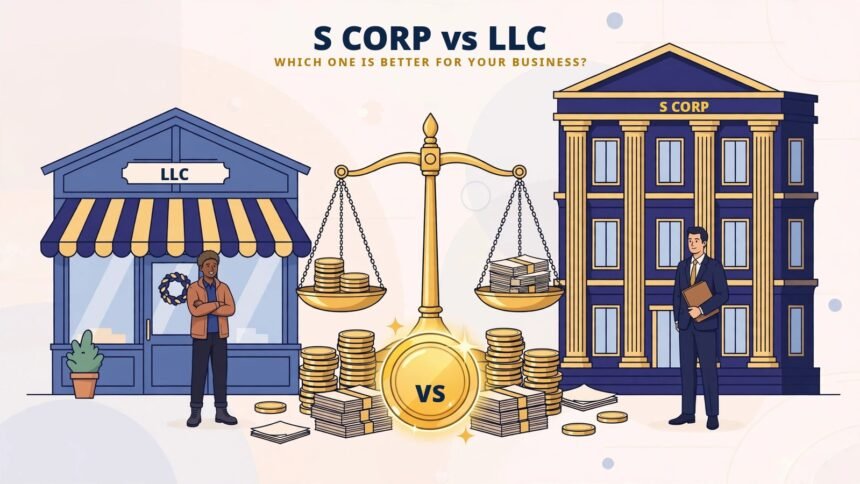
Here is the twist that most comparison pages bury: an LLC and an S corp are not two versions of the same thing. An LLC is a legal business structure, created by your state. An S corp is a tax status, granted by the IRS.
They sit on different levels, which is why the honest answer to “s corp vs llc” starts with a better question: how do you want your business structured, and how do you want it taxed?
The quick verdict, before the detail. Both routes protect your personal assets, and both pass profit through to your personal tax return. The LLC wins on simplicity and freedom. The S corp route can win on tax, once profits grow solid, because it lets working owners split their income into salary and distributions. Everything below explains that verdict, line by line.
S Corp vs LLC at a Glance
| Point | LLC (default taxation) | S corp (tax status) |
|---|---|---|
| What it is | A legal business structure formed under state law | A federal tax election made with the IRS (Form 2553) |
| Personal liability protection | Yes — owners are members | Yes — through the corporation or LLC underneath |
| How profit is taxed | Passes through to the owners’ personal returns | Passes through to the shareholders’ personal returns |
| Self-employment tax | Applies to the owners’ share of profit, in most cases | Payroll tax on salary only; distributions skip it |
| Who can own it | Almost anyone, including companies and foreign owners, with no limit on numbers | At most 100 shareholders; U.S. individuals, certain trusts and estates only |
| Ownership shares | Flexible percentages, set by agreement | One class of stock only; profit follows share counts |
| Payroll for working owners | Not required by default | Required — owners who work must draw a reasonable salary |
| Paperwork level | Low — a short state filing and an operating agreement | Higher — corporate formalities, payroll and its own tax return |
Read the first row twice, because it reframes the whole choice. You do not pick between two buildings. You pick a building, the LLC or the corporation, and then you may pick a tax system to run inside it.
The S corp is one of those tax systems.
What an LLC Is, in Sixty Seconds
An LLC is a limited liability company, formed by filing Articles of Organization with your state. It exists separately from its owners, who are called members. That separation shields personal assets like your house and savings from most business debts and lawsuits.
By default, the IRS taxes a one-member LLC like a sole proprietorship and a multi-member LLC like a partnership. Profit passes through to personal returns, and members generally pay self-employment tax on it. If you want the full picture first, our guide to the LLC meaning unpacks the structure word by word.
| 🔗 You may also like: |
|---|
| LLC Meaning: What Is a Limited Liability Company? |
| LLC Registration: How to Register an LLC in 8 Steps |
What an S Corp Is, in Sixty Seconds
An S corporation is a corporation that has elected a special tax treatment under Subchapter S of the tax code. The election is made by filing Form 2553 with the IRS, signed by every shareholder. Once approved, the corporation’s income, losses and credits flow through to the shareholders’ personal returns, so the company avoids the double taxation that hits ordinary C corporations.
The status comes with strict entry rules, all set by the IRS. The business must be a domestic corporation. It may have no more than 100 shareholders, and they may only be individuals, certain trusts, or estates — never partnerships, never other corporations, and never non-resident aliens. It may issue only one class of stock.
Certain financial institutions and insurance companies cannot elect at all. Miss any rule later, and the election can be lost.
The Tax Difference That Decides It
Both sides pass profit through to personal returns, so income tax looks similar. The real fight is over a different tax: the 15.3% combined Social Security and Medicare tax. On the LLC side, it arrives as self-employment tax, and it generally covers the working owner’s whole share of profit.
Earn more, and the tax simply grows with the profit.
On the S corp side, the mechanism changes. An owner who works in the business becomes an employee of it. The company pays that owner a salary, and payroll taxes apply to the salary. Any remaining profit can be taken as distributions, and distributions do not carry the 15.3% tax. That split is the entire S corp advantage, and it can be worth real money.
A Worked Example With Round Numbers
Say a one-owner business makes $100,000 in profit. Run as a default LLC, the owner generally faces self-employment tax on the full $100,000. Run with S corp taxation instead, the owner might take a $60,000 salary and $40,000 as distributions. Payroll tax now touches only the $60,000.
On these round numbers, the $40,000 escapes roughly $6,000 of the 15.3% tax.
What “Reasonable Salary” Actually Means
Reasonable is the word the whole strategy hangs on, and the IRS defines it by comparison. What would a similar business pay a hired stranger to do your job? Your duties, your experience, your hours, and pay at comparable firms all feed the answer. A working owner who pays herself almost nothing while taking fat distributions is painting a target on the return.
Get the salary into a defensible range and the strategy is legitimate, even boring. Many owners document the thinking once — a salary survey, an accountant’s note — and then simply run payroll like any employer. The saving survives because the law taxes wages and distributions differently on purpose, not because anyone found a loophole.
Two honest warnings belong beside that figure. First, the salary must be reasonable for the work — the IRS watches S corps closely, and a suspiciously tiny salary is an invitation to audits and back taxes.
Second, payroll processing, extra filings and accounting help all cost money. For a small profit, those costs can eat the saving whole, which is why advisers usually start running this calculation once yearly profit climbs into solid five figures.
Ownership: Freedom on One Side, Rules on the Other
Ownership is where the LLC quietly wins most comparisons. Members can be people, companies, other LLCs, or foreign nationals. Numbers are unlimited.
Profit splits can follow any bargain the members write into their operating agreement — 70/30 this year, weighted toward whoever brings in clients, almost anything lawful.
Formation: How Each One Starts
The LLC starts with one state filing. You submit the Articles of Organization, pay the state fee — anywhere from $70 to $300 across the eight major states we verified — and the company exists. An operating agreement and a free EIN finish the birth. Most owners complete the whole thing in a day of paperwork.
The S corp route starts one floor down. First, a corporation must exist, formed under state law with its own Articles of Incorporation, bylaws and stock. Only then does the tax election happen, on Form 2553 to the IRS.
An LLC can reach the same tax status with the same form, skipping the corporate birth entirely — but the state LLC filing still comes first. Either way, S taxation is a second step, never the first.
The S corp trades that freedom away. One class of stock means profit must follow share counts exactly; a 60% shareholder takes 60% of every distribution. No company may hold shares, no partnership may hold shares, and a single non-resident alien shareholder disqualifies the whole election.
Picture two equal partners where one works twice the hours. Inside an LLC, the agreement can pay the harder-working partner more this year. Inside an S corp, it cannot — equal shares mean equal distributions, whatever the hours say. Only salary can bend toward effort, and salary carries payroll tax.
For a family firm with three local owners, none of this stings. For a startup dreaming of investors, it can end the discussion in one line.
Getting Money Out, and Bringing Money In
Daily money shows the same contrast. LLC members simply draw their share of profit, in whatever rhythm the agreement allows. The S corp pays its working owners through payroll first, like any employer, and distributions follow share counts with no flexibility to favour one owner this month and another the next.
Growth money separates them further. Investors who fund startups overwhelmingly buy corporation stock, and the S corp’s single class of stock cannot offer the preferred shares investors demand. The LLC can admit new members on custom terms, which suits small private deals, but serious venture funding usually means converting to a C corporation anyway. Neither contestant wins the fundraising crown; the S corp just loses it earliest.
Selling the Business One Day
Exit day also treats them differently. A corporation’s owners can sell their stock, one clean transfer, and S corp shareholders enjoy that simplicity. LLC members sell membership interests instead, and buyers often push for an asset sale, which can leave the sellers with a heavier tax bill than a stock sale would.
None of this matters in year one. It matters a great deal in year ten, when a buyer appears — one more reason the choice deserves an accountant’s hour before it is made, not after.
Paperwork, Payroll and Running Costs
An LLC asks little of its owners after birth. Keep the state filings current, hold the operating agreement somewhere safe, and run the money through a business account. Many states want an annual report and a modest fee.
Beyond that, the structure mostly stays out of your way.
The S corp side carries a corporation’s habits. A corporation underneath the election needs directors, officers, bylaws and meeting minutes, because state corporate law demands them.
The tax status adds its own load: payroll must actually run, with withholding and employment tax filings, and the business files a separate S corporation return, Form 1120-S, every year. None of this is ruinous. All of it is recurring, and it is why accountants charge S corp clients more than LLC clients.
One more wrinkle: states mostly follow the federal pass-through treatment, but not all of them, and a few tax S corps at company level or add their own fees. Check your own state’s treatment before counting the saving.
What Happens at Tax Time
The yearly filing tells the same story. A multi-member LLC files a partnership return, Form 1065, and issues each member a Schedule K-1; a one-member LLC usually reports on the owner’s own return. The S corp files Form 1120-S and issues K-1s to its shareholders, who report on Schedule E of their personal returns.
Similar paper, in truth — the S corp simply adds payroll filings on top, quarter after quarter.
The Option Most People Miss: an LLC Taxed as an S Corp
Remember the first row of the table: the S corp is a tax system, not a building. Tax systems can be installed in more than one building. An eligible LLC can file the same Form 2553 and elect S corporation taxation, without giving up its LLC legal structure.
The combination is popular for good reason. Legally, the business keeps the LLC’s simple operating agreement and skips most corporate ceremony. For tax, the working members become employees, draw a reasonable salary, and take remaining profit as distributions — the same 15.3% saving described above.
Owners who formed an LLC first lose nothing by waiting; if the business is not formed yet, our LLC registration guide covers the state filing step by step.
Eligibility still guards the door. An LLC electing S status must meet the same IRS rules: no more than 100 members, every member an eligible U.S. individual, trust or estate, and only one class of ownership interest in practice.
The election also has a deadline — in general, it must be filed within two months and fifteen days of the start of the tax year it should cover — though the IRS does grant relief for some late elections. A foreign co-owner or an investor-member rules the whole option out.
Switching Later: You Are Not Locked In
Founders often freeze at this decision, fearing a permanent mistake. Relax a little: the common direction of travel is easy. A plain LLC can elect S corp taxation later, in any future year, as long as it meets the eligibility rules and files Form 2553 by the deadline. Nothing about the state structure changes; only the tax treatment does.
The reverse journey is rougher. An S corp election can be revoked or simply lost by breaking a rule, and the business then falls back to C corporation taxation — usually a worse seat. Turning a corporation into an LLC is heavier still: for tax purposes it generally counts as closing the corporation down, which can trigger tax on the spot.
The asymmetry is the lesson. Starting as an LLC keeps every door open; starting as a corporation closes one of them behind you.
Which One Should You Choose?
Choose the Plain LLC If…
Choose the plain LLC if the business is new, small, or still finding its feet. Profit is modest or irregular, so the payroll machinery would cost more than the tax it saves. Owners include a company, a foreign partner, or several members who want a custom profit split.
Simplicity itself has value here: every hour not spent on corporate formalities is an hour spent on customers. Landlords also tend to stay with the plain LLC, because rental income follows its own tax logic and rarely rewards the salary split.
Choose the S Corp Route If…
Choose the S corp route if the business earns steady, healthy profit and the owners work in it every day. The salary-and-distribution split then saves more than payroll and accounting cost. Every owner is a U.S. individual who fits the eligibility rules, and nobody plans to hand shares to outside investors soon.
Whether the route runs through a corporation or through an LLC electing S taxation matters less than the tax result; many owners pick the LLC version precisely because it keeps daily life simpler.
Notice what never decides the question: liability. Both routes shield personal assets in the same basic way, because the shield comes from the underlying entity, not from the tax label. Anyone selling you the S corp mainly as “more protection” is selling fog. The honest contest is tax savings against paperwork, with ownership freedom as the tiebreaker.
| 🔗 You may also like: |
|---|
| UploadArticle.com Explained: How It Works, How to Submit, SEO Value and Safety |
| HRMtaila Explained: Is It a Real AI HR Platform or Just a Buzzword? |
Conclusion
S corp vs LLC sounds like a duel, but the two live on different floors. The LLC is the structure: simple, flexible, protective. The S corp is a tax election: stricter, heavier, and capable of saving working owners real money once profits grow. Start with the structure that fits your owners and your plans. Then choose the tax treatment that fits your profit.
For many small firms, that journey begins with a plain LLC — and the S corp election waits, patiently, for the year the numbers finally justify it.
FAQs
Is an S corp better than an LLC?
Neither is simply better, because they are different kinds of thing. An LLC is a legal structure and an S corp is a tax status. The LLC wins on simplicity and ownership freedom. The S corp route can win on tax once profits are solid, thanks to the salary and distribution split.
Can an LLC be taxed as an S corp?
Yes. An eligible LLC can file Form 2553 with the IRS and elect S corporation taxation while staying an LLC under state law. The LLC must meet the S corp eligibility rules: at most 100 members, all of them eligible U.S. individuals, certain trusts or estates, and effectively one class of ownership.
What is the biggest disadvantage of an S corp?
The restrictions and the routine. Ownership is limited to 100 eligible U.S. shareholders with one class of stock, and the business must run real payroll and file its own tax return each year. Working owners must also pay themselves a reasonable salary, which the IRS actively polices.
Does an S corp protect personal assets like an LLC does?
Yes, in the same basic way. The protection comes from the underlying legal entity — the corporation, or the LLC that elected S taxation — being separate from its owners. The tax label itself adds no extra shield, and both structures lose protection if owners mix personal and business money.
When should an LLC switch to S corp taxation?
When the tax saving clearly beats the extra costs. That usually happens when profit becomes steady and solidly into five figures, and the working owners can take a reasonable salary with room to spare. A tax professional can run your exact numbers before you file the election.