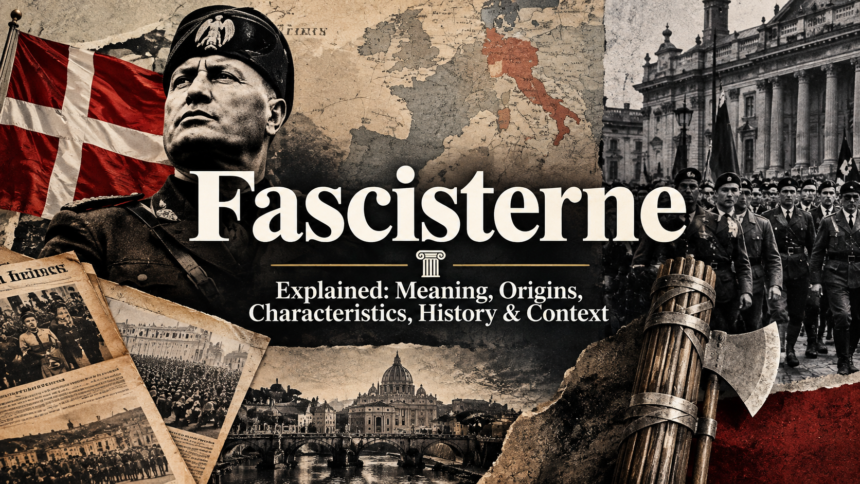
The word Fascisterne is Danish and translates into English as “the fascists.” It refers to people associated with or supporting fascism, a political movement and ideology that became especially influential in Europe during the first half of the 20th century. The term is closely connected with the history of Italian fascism, Benito Mussolini, authoritarian politics, nationalism, political violence, and the transformation of democratic institutions.
Although Fascisterne is a simple Danish word, understanding its historical meaning requires looking at the broader concept of fascism. Fascism developed in a period marked by political instability, economic difficulties, social conflict, nationalism, and the consequences of World War I. Italy became the central historical example, while related movements appeared in several other European countries.
This guide explains what Fascisterne means, where the term comes from, what fascists historically believed, how fascism developed in Italy, and how the concept became part of wider European political history.
What Does Fascisterne Mean?
Fascisterne means “the fascists” in Danish. It is the definite plural form used to describe a group of people who are identified as fascists. The underlying word is connected to fascist, meaning a person associated with fascism.
The word should therefore not be confused with fascism, which refers to the political ideology or movement itself. In simple terms, fascism describes the ideology, while Fascisterne refers to the people associated with it.
The historical meaning of the term is particularly connected with European fascist movements of the 20th century. These movements differed from country to country, so the word should be understood in its historical and political context rather than as a description of one identical organization everywhere.
Where Did the Word Fascism Come From?
The word fascism comes from the Italian fascismo, which is derived from fascio, meaning a bundle or group. It is ultimately connected to the Latin fasces, a bundle of rods associated with authority in ancient Rome.
Italian fascists adopted the fasces as a political symbol because they wanted to connect their movement with ideas of strength, unity, authority, and the historical legacy of Rome. The symbol became particularly associated with Mussolini’s movement.
The modern political meaning of fascism emerged in Italy after World War I. Benito Mussolini established the first fascist organization in Milan on March 23, 1919, initially known as the Fasci Italiani di Combattimento. The movement attracted war veterans and others who supported an aggressive form of nationalism and opposed socialism and parliamentary politics.
How Did Fascisterne and Fascism Develop?
Fascism did not appear in isolation. Its development took place during a period of major political and social instability after World War I.
Italy had experienced enormous human and economic costs during the war. Political conflict increased, strikes and social unrest became common, and fears of socialist and communist revolution influenced sections of the middle and upper classes. Fascist groups presented themselves as defenders of national order and claimed that strong political action was necessary.
Fascist activists also used organized violence against political opponents. In Italy, fascist squads became known for attacks against socialist organizations, trade unions, political meetings, and other opponents.
This combination of nationalism, anti-socialism, political mobilization, and violence helped fascism gain influence. However, historians emphasize that the reasons for fascism’s development varied between countries. There was no single explanation that completely describes every fascist movement.
Benito Mussolini and Italian Fascism
Benito Mussolini is the central historical figure associated with the origins of fascism. He became the leader of the Italian fascist movement and was later known as Il Duce, meaning “the leader.”
In October 1922, fascists organized the March on Rome. Mussolini himself did not lead the march physically, but the political crisis surrounding it helped bring him to government. King Victor Emmanuel III invited Mussolini to form a government.
Initially, Mussolini operated within Italy’s existing political system. Over the following years, however, the fascist movement increasingly weakened parliamentary democracy and concentrated political power around Mussolini and the Fascist Party.
By the mid-1920s, Italy had developed into an authoritarian fascist regime. Opposition parties were suppressed, political freedoms were restricted, censorship increased, and the Fascist Party became the dominant political organization.
Key Characteristics of Fascisterne
Fascist movements differed in their individual national circumstances, but several characteristics are commonly associated with historical fascism.
1. Extreme Nationalism
Nationalism was central to fascist politics. Fascist movements generally placed the nation above individual interests and promoted the idea that national unity and strength were essential.
In Mussolini’s Italy, the state and nation were presented as higher political goals. Fascist ideology promoted national revival and sought to overcome what its supporters regarded as political division and weakness.
2. Authoritarian Leadership
Fascist politics emphasized strong leadership and centralized authority. Mussolini became the symbolic center of the Italian fascist regime, with political power increasingly concentrated around him and the Fascist Party.
The idea of a decisive leader was important because fascists generally rejected the idea that political conflict should be resolved through ordinary parliamentary competition alone.
3. Opposition to Liberal Democracy
Historical fascist movements generally opposed liberal democracy, political pluralism, and parliamentary systems.
In Italy, the fascist government gradually dismantled democratic political competition. Opposition organizations were restricted or dissolved, censorship expanded, and political power became concentrated in the fascist state.
4. Political Violence
Violence played an important role in the rise of Italian fascism. Fascist squads attacked political opponents and organizations, particularly socialists and communists.
Violence was not simply an accidental feature of the movement. It was used as a political instrument to intimidate opponents and demonstrate the strength of fascist organizations.
5. Militarism and Discipline
Fascist movements frequently admired military organization, discipline, sacrifice, and physical strength. Military imagery and uniforms were used to create a sense of collective identity.
This emphasis reflected the political culture of post-World War I Europe, where millions of people had experienced military mobilization and wartime violence.
6. Anti-Socialism and Anti-Communism
Italian fascism developed partly through opposition to socialism and communism. Fascists presented themselves as a force capable of preventing revolutionary movements and restoring political order.
This opposition helped fascists gain support from some groups that feared socialist revolution or social disorder. At the same time, fascism was distinct from traditional conservative politics because it sought to create a mass political movement and transform society through the state.
7. Control and Political Conformity
As fascists consolidated power in Italy, political and social institutions were increasingly brought under state influence.
The fascist system sought to organize society around the state and reduce independent political activity. This included restrictions on opposition parties, organizations, media, and political expression.
Fascisterne and the Fascist State
One important concept associated with Italian fascism was the strong or total state. Fascist ideology emphasized that individual and class interests should be subordinated to the interests of the state and nation.
The Italian regime also attempted to organize economic and social life through a corporate state. Corporatism presented itself as a system intended to overcome class conflict by organizing employers and workers into state-controlled corporations.
In practice, the fascist government used these structures to increase political control over organized economic life.
It is important to distinguish between the ideological goal of total control and the actual operation of the Italian state. Historical scholarship notes that Mussolini’s Italy did not achieve complete control over every part of society. Institutions such as the monarchy and the Catholic Church retained areas of independence.
Fascisterne and Mussolini’s Italy
The Italian fascist regime existed from the early 1920s until 1943, although Mussolini later established a German-supported fascist state in northern Italy after his removal from power.
During the regime’s development, fascists attempted to reshape Italian society around nationalism, political loyalty, discipline, and state authority.
The government used propaganda to promote Mussolini and fascist ideas. Young people were also exposed to fascist organizations designed to encourage loyalty to the regime.
Education, public ceremonies, political organizations, and mass communication were used to spread fascist ideas and create a common political culture.
The regime also pursued imperial ambitions. Italy invaded Ethiopia in 1935 and expanded its colonial project in Africa, presenting imperial expansion as part of national revival.
Fascisterne, Nazi Germany and Fascism
Fascism is often discussed together with Nazism because the two movements developed in the same broad historical period and shared several characteristics.
The Nazi movement in Germany under Adolf Hitler was authoritarian, strongly nationalist, anti-communist, opposed to liberal democracy, and heavily reliant on propaganda and political violence. Nazi Germany also developed a highly repressive dictatorship.
However, fascism and Nazism should not simply be treated as identical concepts.
Nazism placed racism and antisemitism at the center of its ideology and pursued an explicitly racial vision of society. The Nazi regime also developed policies of racial persecution, mass murder, and genocide during World War II.
Historians therefore recognize important similarities between fascism and Nazism while also identifying significant differences in ideology, political development, and practice.
Did Fascism Exist Outside Italy?
Yes. Fascist or fascist-inspired movements appeared in several European countries during the interwar period.
Examples included the British Union of Fascists, Falange Española in Spain, the Iron Guard in Romania, and the Ustaše movement in Croatia. Fascist-inspired organizations also appeared elsewhere in Europe, including Scandinavia.
However, these movements were not identical copies of Mussolini’s organization. Their political goals, social bases, ideologies, and levels of influence differed according to national circumstances.
This is why the word Fascisterne should be understood as a broad historical reference rather than as the name of one single international organization.
What Happened to Fascisterne After World War II?
The defeat of Italy and Germany in World War II dramatically changed the political position of fascist movements in Europe.
Mussolini’s regime collapsed in 1943. After a period of German-backed rule in northern Italy, the remaining fascist government fell in 1945. Mussolini was captured and killed near the end of the war.
After 1945, openly fascist politics became associated with the defeated Axis powers and the destruction caused by the war. Nevertheless, some far-right and neo-fascist organizations emerged in Europe during the postwar period.
In Italy, the Movimento Sociale Italiano (MSI) was established in 1946 and drew some inspiration from the earlier fascist tradition.
The history of postwar fascism therefore continued, but its organizations and political environments were different from those of the interwar period.
Fascisterne in the Danish Context
Because Fascisterne is a Danish word, it can also appear in Danish historical and political discussions.
Denmark, like other European countries, experienced fascist-inspired political organizations during the interwar period. However, the existence and influence of such groups should not be confused with the establishment of Mussolini-style fascist rule in Italy.
The Danish term can therefore appear in historical writing when discussing fascists generally, Italian fascism, European fascist movements, or political developments during the 1920s and 1930s.
Understanding the surrounding sentence and historical period is important when translating or interpreting the word.
Fascisterne vs. Fascism: What Is the Difference?
The easiest way to understand the distinction is:
| Term | Meaning |
| Fascisterne | Danish for “the fascists” |
| Fascist | A person associated with or supporting fascism |
| Fascism | A political ideology and movement |
| Fascist movement | An organized political movement based on fascist ideas |
| Fascist regime | A government controlled by a fascist movement or leader |
This distinction is useful because Fascisterne describes people, while fascism describes the political ideology or movement.
For example, a historical article might discuss Fascisterne when referring to fascists as a group, while using fascism when explaining their political ideology.
Why Is Fascisterne Still Discussed Today?
The term remains relevant because fascism had a major influence on 20th-century European history.
The rise of fascist movements demonstrates how political instability, nationalism, economic difficulties, social conflict, organized political movements, and violence can interact during periods of crisis.
The history is also important for understanding World War II and the political development of modern Europe.
At the same time, historians and political scientists continue to debate exactly how fascism should be defined. Some definitions emphasize authoritarian leadership and extreme nationalism, while others focus on mass mobilization, political violence, anti-liberalism, revolutionary nationalism, or the attempt to create a new political and social order.
Because fascist movements differed between countries, applying the term requires attention to historical context.
Is Every Authoritarian Movement Fascist?
No. Authoritarianism and fascism are related but not identical concepts.
An authoritarian regime can restrict political competition and concentrate power without necessarily being fascist. Fascism is generally understood as a specific political ideology and movement with characteristics such as radical nationalism, anti-liberalism, mass mobilization, political violence, and strong leadership.
Similarly, using “fascist” as a general insult does not automatically make the person or organization being described historically fascist.
For historical analysis, the term is most useful when it is connected to identifiable political ideas, organizations, movements, and actions.
Fascisterne and the Meaning of Political Context
Context is especially important when interpreting the word Fascisterne.
In a Danish dictionary or historical text, it may simply mean “the fascists.” In a discussion about Mussolini, it could refer specifically to Italian fascists. In a broader European history article, it could refer to several fascist movements.
Therefore, translating the word without considering the surrounding subject can sometimes miss its intended historical meaning.
For readers researching the term online, the most useful approach is to examine both its linguistic meaning and the history of fascism.
Conclusion
Fascisterne means “the fascists” in Danish and refers to people associated with fascism. The term is closely connected with the history of fascist movements that developed in Europe after World War I, particularly Benito Mussolini’s movement in Italy.
Fascism was characterized by strong nationalism, authoritarian political leadership, opposition to liberal democracy, political violence, anti-socialism, militarism, and an emphasis on the authority of the state. Italian fascism became the most important early example and later influenced or provided a reference point for related movements in other countries.
The historical meaning of Fascisterne is therefore broader than a simple translation. It connects language, political ideology, European history, and the development of authoritarian movements during the 20th century. Understanding the term requires distinguishing Fascisterne, meaning “the fascists,” from fascism, the ideology and political movement itself.
FAQs
What does Fascisterne mean?
Fascisterne means “the fascists” in Danish. It is the definite plural form referring to a group of people associated with fascism.
Is Fascisterne the same as fascism?
No. Fascisterne refers to the fascists, while fascism refers to the political ideology and movement associated with them.
Who was the most famous fascist leader?
Benito Mussolini is the historical figure most directly associated with the founding and development of Italian fascism. Adolf Hitler led Nazi Germany, which shared important characteristics with fascist movements but also had a distinct racial and antisemitic ideology.
Where did fascism begin?
Modern fascism is generally traced to Italy after World War I, particularly to Benito Mussolini’s movement founded in 1919.
What were the main characteristics of fascism?
Commonly identified characteristics include radical nationalism, authoritarian leadership, opposition to liberal democracy, political violence, militarism, anti-socialism, mass political mobilization, and strong state authority.
Was fascism only found in Italy?
No. Fascist and fascist-inspired movements appeared in several European countries. However, their ideologies and political influence varied significantly between countries.
Why is Fascisterne an important historical term?
The term is useful because it connects the Danish language with a major period of European political history. Understanding Fascisterne also helps explain the rise of fascism, Mussolini’s Italy, related movements, and the political environment of interwar Europe.