Ask most owners what an SBA loan is, and they picture the government handing them a cheque. That picture is wrong, and fixing it is the fastest way to understand the whole system.
The U.S. Small Business Administration does not lend money to small businesses. Banks and credit unions do. The SBA stands behind the bank and promises to repay a large share of the loan if the borrower cannot. That single promise changes everything that follows: the rate, the term, and who gets a yes.
This guide explains SBA loans for small business in plain words: how the guarantee works, the loan programs that matter, what they really cost, who qualifies, and how the application actually runs. No hype, and no lender sales talk.
How an SBA Loan Actually Works
Picture a local bank weighing your application. Your business is young, your collateral is thin, and a normal loan looks risky. Now picture the same bank knowing that the federal government will repay 75 to 85 percent of that loan if things go wrong. The risk flips. Loans that would have been refused get approved, at rates and lengths a small business can survive.
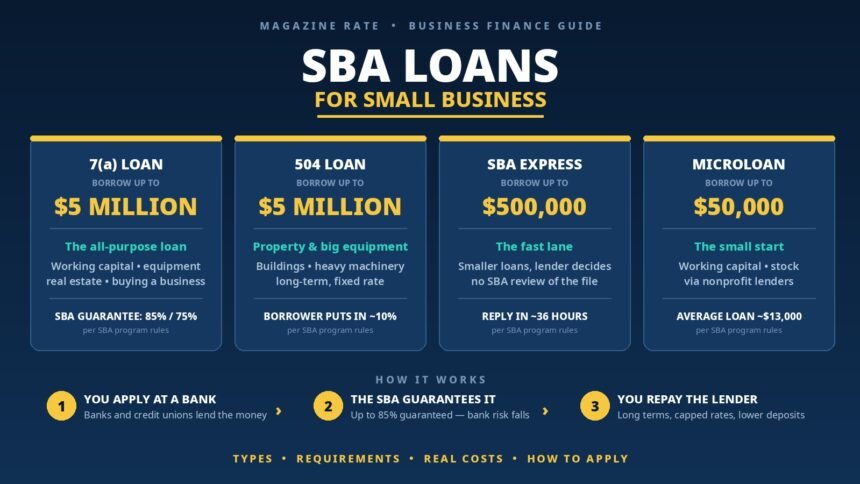
That is the guarantee, and it is the heart of every SBA loan. On standard 7(a) loans, the SBA guarantees up to 85 percent of loans of $150,000 or less, and 75 percent of larger ones. The guarantee is not free money and it is not a grant. You repay every dollar, with interest, to the lender. The SBA’s promise simply stands behind you.
The promise has a price, paid in responsibility. Every owner holding 20 percent or more of the business must give a personal guarantee. If the business fails and the loan remains, those owners owe the balance personally.
The SBA also asks a fair question at the door: could you have borrowed this money on reasonable terms without us? SBA loans exist for businesses that cannot quite get conventional credit, not for firms that banks are already chasing.
Notice what the guarantee does not do. It does not improve a weak business, excuse missing paperwork, or speed anyone to the front of the queue. It answers exactly one objection — the lender’s fear of loss — and leaves every other question about your business exactly where it was.
| 🔗 You may also like: |
|---|
| S Corp vs LLC: Which One Is Better for Your Business? |
| LLC Registration: How to Register an LLC in 8 Steps |
The Main SBA Loan Programs
SBA loans are a family, not a single product. Four programs cover almost every real need, and choosing the right one matters more than chasing the biggest number. Here they are side by side.
| Program | Maximum | Built for | Typical term |
|---|---|---|---|
| 7(a) loan | $5 million | Almost any sound business purpose | Up to 10 years; 25 years for real estate |
| SBA Express | $500,000 | Smaller needs, decided faster | Up to 7 years; 25 years for real estate |
| 504 loan | $5 million (CDC share) | Buildings and major equipment | 10, 20 or 25 years, fixed rate |
| Microloan | $50,000 | Working capital, stock, small equipment | Up to 6 years |
7(a): the Workhorse
The 7(a) program is the one most people mean when they say “SBA loan.” It covers working capital, equipment, inventory, buying another business, refinancing business debt, and purchasing the building the business sits in. Loans run up to $5 million, though most borrowers receive far less.
Terms stretch to ten years for most purposes and up to twenty-five years when real estate is involved, which is why monthly payments stay survivable.
504: the Property and Equipment Loan
The 504 program does one job: long-term, fixed-rate money for major fixed assets — land, buildings, and heavy machinery. Its structure is a three-way split. The borrower usually puts in about 10 percent, a bank lends roughly half, and a Certified Development Company, backed by the SBA, lends most of the rest.
The CDC share can reach $5 million, or $5.5 million for certain manufacturing and energy projects. Because the rate on the CDC portion is fixed, owners trade flexibility for certainty.
Microloans: Small Money, Open Doors
Microloans serve the businesses the big programs pass by. The SBA funds nonprofit community lenders, and those lenders make loans of up to $50,000 — the average is about $13,000. The money covers working capital, inventory, supplies and small equipment, but not real estate. Many intermediaries also offer training and advice alongside the loan, which quietly makes this the friendliest door for startups and very young firms.
Express: Speed at a Price
SBA Express sits inside the 7(a) family but moves at a different speed. Lenders decide these loans themselves, without waiting for SBA review, and the SBA responds to applications within about thirty-six hours. The trade-offs are a lower ceiling of $500,000 and a smaller guarantee of just 50 percent. When timing matters more than size, Express earns its name.
What an SBA Loan Really Costs
The headline rate is only the middle of the bill. An SBA loan carries the interest rate, a one-time guarantee fee, and usually a down payment, and each piece behaves differently from the others. Understanding all three stops the surprises.
Interest first. Lenders set the rate, but the SBA caps it: the loan is priced as a base rate, usually the prime rate, plus a spread that shrinks as the loan grows. On a small variable-rate loan of $50,000 or less, the cap allows up to 6.5 points above the base rate. On loans of $350,000 or more, the widest spread allowed is 3 points.
You negotiate within the cap, so quotes from two lenders can differ honestly.
Then the guarantee fee. The SBA charges the lender a fee on the guaranteed portion of most 7(a) loans, and lenders usually pass it to the borrower. The fee rises with the loan’s size and length, reaching up to 3.75 percent of the guaranteed part on the largest loans.
It is normally folded into the loan itself rather than paid in cash, but it is real money on the bill, so ask for it in writing before signing.
A Worked Example: Buying a $400,000 Building
Numbers make the 504 structure click. Say an established bakery buys its building for $400,000 through the 504 program. The owners put in 10 percent — $40,000. A bank lends half — $200,000. The CDC lends the remaining $160,000 at a fixed rate, repaid over twenty or twenty-five years.
Compare that with a conventional commercial mortgage, where a 20 to 30 percent deposit is common. The SBA route gets the bakery into its building with far less cash trapped in the walls — at the price of two lenders, two approvals, and a thicker file. That trade, in miniature, is the whole SBA story.
Finally, your own money. Most SBA borrowers put some skin in the game: a down payment of roughly 10 to 20 percent is typical on purchases of businesses and real estate, and owners are expected to have invested their own funds before asking the SBA to stand behind them. Cash flow still rules the decision, because a guarantee never excuses a business that cannot service the debt.
Who Qualifies — and Who Does Not
Eligibility comes in two layers: the SBA’s own rules, which are fixed, and the lender’s judgement, which is where most applications actually live or die. Clear the first layer and you are allowed to apply. Clear the second and the money arrives.
The SBA’s Baseline Rules
Its baseline is simple to state. A qualifying business operates for profit, is located and doing business in the United States, and counts as “small” under the SBA size standard for its industry — a generous test that most genuinely small firms pass.
Owners must have invested their own time and money. The loan must serve a sound business purpose, and the business must not be delinquent on debt owed to the U.S. government. If your business is not formally set up yet, fix that first; our LLC registration guide walks through the state filing step by step.
Some businesses are simply outside the tent. Lending and investment firms, speculative real estate ventures, and passive businesses that merely collect rent on property they do not operate in generally cannot use these programs. Rules also move: from March 2026, SBA guidance requires 7(a) borrowers to be wholly owned by U.S. citizens or nationals, a tightening from earlier years.
Guidance has been revised more than once, so confirm the current ownership rules with your lender before you build plans around them.
What Lenders Add on Top
The lender’s layer is practical. Most SBA lenders look for a personal credit score somewhere around 650 or higher, a couple of years of trading history for the standard programs, and cash flow that covers the payments with room to spare.
None of those numbers is an SBA law — they are how banks protect themselves inside the rules. A younger business is not automatically out; it simply gets pointed toward microloans, Express loans, or a smaller ask with a stronger plan.
How to Apply, Without the Mystery
Nobody applies “to the SBA.” You apply to a participating lender, and the lender works with the SBA behind the curtain. The SBA’s free Lender Match tool exists precisely for the first step: describe your business and your need, and interested lenders usually respond within about two business days. Banks holding the SBA’s Preferred Lender status can approve loans without sending them for SBA review, which shortens the road considerably.
Before you approach anyone, gather the file every lender will demand. Expect two to three years of business and personal tax returns, current financial statements, a debt schedule, legal documents for the business, and a short plan explaining exactly what the money buys and how it gets repaid. Owners will also complete personal financial statements, because those 20-percent-plus owners are guaranteeing the loan personally.
Then comes the honest wait. A straightforward SBA loan commonly takes several weeks from application to funding, and larger or property-backed deals can run toward ninety days. Express loans move faster, and microloans vary by intermediary. Build that timeline into your plans from the start: SBA money rewards businesses that prepare early, and punishes anyone who needs cash by Friday.
After You Apply: What the Lender Is Doing
Silence from a lender rarely means nothing is happening. Behind it, your file is being underwritten: cash flow tested against the payments, credit histories read, collateral valued, and the SBA’s own eligibility boxes ticked one by one. Non-preferred lenders send the package to the SBA for approval as well, which adds its own days.
Expect questions, and answer them fast. Most delays in SBA lending are not refusals in disguise; they are missing documents and slow replies. The borrowers who fund on schedule treat the application like a project, with one named person owning the file until the money lands.
| 🔗 You may also like: |
|---|
| LLC Meaning: What Is a Limited Liability Company? |
| How the Global Trader Programme Helps Trading Companies Save Tax in Singapore |
How Much Can You Actually Borrow?
The program ceilings — $5 million here, $50,000 there — are the size of the door, not the size of your loan. What you actually receive is set by a quieter calculation the lender runs on your cash flow: after every bill is paid, does the business throw off comfortably more than the new payment?
Lenders describe this cushion with a ratio, and they like to see earnings cover debt payments by a clear margin, not a whisker.
Three more dials turn the final number. Your own investment counts, because a lender reads a committed owner as a safer bet. Collateral counts, especially above modest loan sizes, though a shortfall alone does not have to kill an otherwise strong application.
And existing debt counts, because the new payment must fit beside the old ones. This is why two businesses asking for the same $300,000 walk away with different answers — and why the strongest application is the one whose numbers tell the story before the owner says a word.
SBA Loan or a Regular Bank Loan?
Owners who qualify for both often ask why anyone would choose the slower, fussier SBA route. The answer sits in three places. Down payments run lower, because the guarantee comforts the bank. Terms run longer — twenty-five years on property against the ten or fifteen a conventional lender may offer — so monthly payments shrink.
And borrowers with thin collateral or short histories, whom a bank would simply refuse, get a genuine hearing.
Conventional loans answer with speed and simplicity: fewer documents, no guarantee fee, no federal rulebook. A strong, established business with real collateral may rationally pay a little more for that ease. The SBA route wins when the file is young, the deposit is scarce, or the term makes the difference between straining and breathing.
How the business itself is structured matters here too, since its tax treatment shapes the cash available for payments — our s corp vs llc comparison explains that side of the decision.
The Honest Downsides
An SBA loan is often the best money a small business can borrow, and it is still a loan, with a bank’s caution baked in. The paperwork pile is real: tax returns, statements, projections, and personal documents from every major owner. Owners used to one-page online lending routinely underestimate it.
The personal guarantee deserves a second, sober look. It converts a business risk into a household one for every owner at 20 percent or above, and it does not vanish if the business closes. Add the guarantee fee, the weeks of waiting, and collateral expectations on larger loans, and the full picture emerges: cheaper, longer money, bought with effort and personal exposure.
For a sound business with a sound purpose, that trade is usually worth making — which is exactly the judgement the program was designed to reward.
One more distinction protects real money. An SBA loan is not a grant, and anyone promising “guaranteed government cash” for a fee is selling something the SBA warns about regularly. Grants exist in narrow places; these loans are mainstream, repayable, and proud of it. Knowing which game you are playing keeps you out of the wrong one.
Conclusion
SBA loans for small business are best understood as a partnership: a lender’s money, a government’s promise, and an owner’s responsibility. The guarantee turns thin files into fundable ones, the programs split cleanly by purpose — 7(a) for almost anything, 504 for property and equipment, microloans for small beginnings, Express for speed — and the costs stay capped and knowable.
Prepare the documents, respect the timeline, and choose the program that matches the job. Borrowed well, this is the most patient money most small businesses will ever meet.
FAQs
Does the SBA lend money directly to small businesses?
No. Banks, credit unions and other approved lenders make the loans. The SBA guarantees a portion of each loan — up to 85 percent on smaller 7(a) loans and 75 percent on larger ones — so the lender’s risk falls and approval becomes more likely.
What credit score do I need for an SBA loan?
The SBA sets no official minimum score, but lenders apply their own standards. In practice, many lenders look for a personal credit score around 650 or higher for standard programs. Microloan intermediaries are often more flexible, especially where training and support come with the loan.
How long does an SBA loan take to fund?
Most applications take several weeks, and larger or property-backed loans can run toward ninety days. SBA Express loans move fastest because lenders decide them directly, while microloan timing depends on the nonprofit intermediary handling the application.
Can a startup get an SBA loan?
Yes, though the door is narrower. Startups usually enter through microloans or smaller 7(a) and Express loans, backed by a strong business plan, owner investment, and projections the lender can believe. The guarantee helps, but lenders still want to see the owners’ own money committed first.
What can SBA loan money be used for?
Most sound business purposes qualify: working capital, inventory, equipment, buying a business, refinancing business debt, and purchasing or improving business real estate. The 504 program is narrower — buildings and major equipment only — while microloans cannot be used to buy real estate.