You see the letters everywhere. They sit at the end of shop names, on invoices, and in website footers: LLC. But what is the LLC meaning, really? Here is the short answer first. LLC stands for Limited Liability Company. It is a type of business in the United States. The business sits legally separate from its owners, so the owners are not personally responsible for most business debts.
That short answer hides a lot of useful detail. The three words in the name each carry a job. Together, they explain why this is now the most popular way to form a business in America. This guide breaks the meaning down in plain words, shows how an LLC works, and clears up the mix-ups that confuse almost everyone at first.
One more thing before the details. The definition is American. Every LLC is created by a U.S. state, under that state’s law. Keep that anchor in mind, because it explains almost everything else in this guide.
LLC Meaning in Simple Words
The fastest way to understand the term is to take it apart. Each word answers a different question. What is limited? Who is protected? And what exactly gets created?
“Limited” — Your Risk Has a Cap
Limited means capped. When you put money into an LLC, that money is at risk if the business fails. Your personal wealth beyond that point is not. The cap is the whole idea. A bad year can hurt the business without wiping out the family home.
“Liability” — Debts and Legal Claims
Liability means legal responsibility for debts and claims. Every business carries some. A supplier waits for payment. One customer slips on a wet floor. Then a loan comes due. Liability is the bill that lands on someone. The only question is whose name is on it.
“Company” — A Real Legal Entity
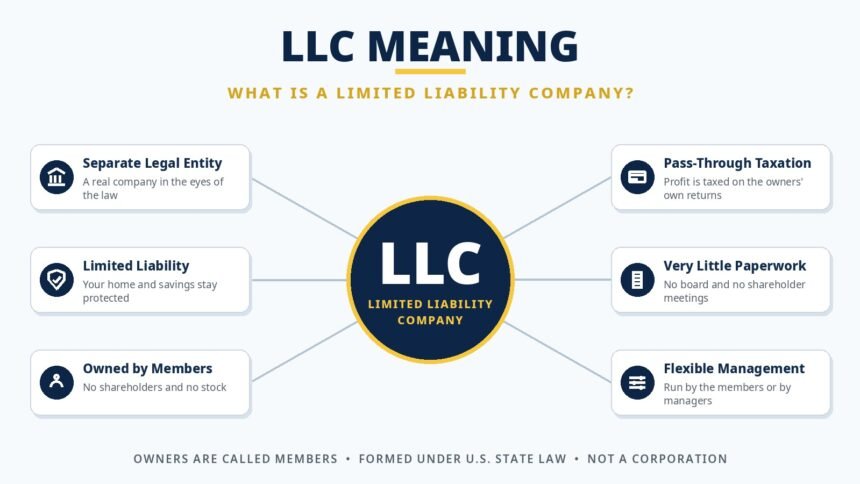
Company means the business exists on its own in the eyes of the law. It is not just a nickname for your work. An LLC can sign contracts, own property, open bank accounts, and go to court in its own name. That separate existence is what makes the protection possible.
Put the three words back together and the meaning is clear. An LLC is a company, created under state law, that keeps its owners’ personal risk capped when business debts or claims appear.
Why Business Names End With “LLC”
The letters are not decoration. In most states, the law requires the designator. A registered LLC’s legal name must end with “LLC,” “L.L.C.,” or the full words “Limited Liability Company.”
The rule protects the public. Before you sign a contract or lend money, the name itself warns you what kind of company you face. It tells you the owners’ personal assets sit behind a legal wall. Everyone dealing with the business gets that signal for free, every time the name appears.
Who Owns an LLC? Members, Not Shareholders
The owners of an LLC are called members. That word matters, because it marks a real difference from other business types. Corporations have shareholders. Partnerships have partners. Only LLCs have members.
A member can be almost anyone or anything. The IRS allows individuals, corporations, other LLCs, and even foreign entities to be members. There is no maximum number. One person can own the whole company, and millions of solo owners do exactly that.
Members own a share of the company, usually described as a percentage. That share decides how profits split and how much say each owner has. Unlike a corporation, an LLC issues no stock and holds no shares. Ownership stays simple, private, and flexible.
Percentages need not match money alone. Two members might split ownership evenly while one brings cash and the other brings skills. The operating agreement records the bargain they actually made. Nothing forces an LLC to copy the rigid share structure of a corporation.
| 🔗 You may also like: |
|---|
| LLC Registration: How to Register an LLC in 8 Steps |
| How the Global Trader Programme Helps Trading Companies Save Tax in Singapore |
How an LLC Works Day to Day
An LLC is born at state level, never at federal level. You file a short document, usually called the Articles of Organization, with your state. The state approves it, and the company legally exists from that moment. Our full LLC registration guide walks through every filing step in order.
Inside the company, one document runs the show: the operating agreement. It records who owns what, how decisions get made, and how profits are shared. Some states demand one by law. Every multi-owner LLC needs one in practice, because memory and friendship are poor substitutes for paper.
Member-Managed or Manager-Managed
Most small LLCs are member-managed. Every owner takes part in running the business. It suits a two-person bakery or a family shop, where the owners also do the daily work.
Larger or investor-backed LLCs often choose manager-managed instead. The members appoint one or more managers to run things. Owners who only invested money stay out of daily decisions. The choice is written into the operating agreement when the company forms.
One Member or Many: Does the Meaning Change?
The letters mean the same thing either way. A single-member LLC gives one person the full protective wall. No partners, no votes, no shared decisions. It is the simplest protected structure an American solo owner can hold.
A multi-member LLC shares that wall among several owners. Each member’s risk stays capped at what that member put in. The extra complexity sits in the paperwork, not the meaning. Percentages, voting, and exit rules must be written down, because several people’s money now shares one roof.
What Limited Liability Protects — and What It Does Not
The U.S. Small Business Administration puts the benefit plainly. In most instances, an LLC protects you from personal liability. Your vehicle, your house, and your savings accounts are not at risk if the LLC faces bankruptcy or lawsuits. Creditors can reach the company’s assets. They generally cannot reach yours.
Honest guides also name the limits, because the shield is not magic:
- Personal guarantees: sign one for a loan or a lease, and you owe the money yourself, LLC or not.
- Your own wrongdoing: fraud and deliberate harm are your personal problem, not the company’s.
- Mixed money: run personal spending through the business account, and a court may treat the two as one.
- Your own taxes and duties: some obligations, like certain payroll taxes, can still follow the people in charge.
The pattern is simple. The LLC protects you from the business’s honest problems. It does not protect you from your own promises or your own misconduct.
Habits That Keep the Wall Strong
The wall works best when owners act like the company is truly separate. Sign contracts in the company’s name, never your own. Keep one bank account for the business and another for yourself. File the state’s annual reports on time.
These habits cost nothing. Together, they prove the separation is real and not just paperwork. Skip them, and the meaning of “limited” slowly thins. Courts notice owners who treat the LLC as a costume. Owners who treat it as a real company keep the full protection the name promises.
How an LLC Is Taxed
Here is a surprise for many readers. The IRS has no tax category called “LLC.” The federal tax office simply taxes your LLC under an older category, based on how many members it has.
One member means the IRS treats the LLC like a sole proprietorship. Tax people call it a disregarded entity. The business files no separate income tax return, and the owner reports profit on a personal return. Two or more members means partnership treatment by default. The LLC files an information return, and each member reports a share of the profit.
An LLC may also choose corporate taxation. Form 8832 elects corporation treatment, and Form 2553 can elect S corporation status if the rules are met. With the default setups, profit passes through to the owners.
Pass-Through, in Plain Words
Pass-through confuses people, so here is a small example with round numbers. Say an LLC earns $60,000 in profit this year. Under the default rules, the company itself pays no federal income tax on that money. The $60,000 flows onto the owners’ personal returns instead.
One owner reports the full $60,000. Two equal owners report $30,000 each. The tax office taxes people, not the company. That single design choice is why small owners find the LLC so much simpler than a corporation.
Owners also count as self-employed for Social Security and Medicare taxes. Most small firms start with the default setup. They then review the choice with a tax professional as the business grows.
Key LLC Terms, Translated
LLC paperwork uses a small set of special words. Learn these six and every guide, form, and contract gets easier to read:
- Articles of Organization: the short state filing that creates the LLC. A few states call it a Certificate of Formation.
- Operating agreement: the internal rulebook covering ownership, decisions, and profit shares.
- Registered agent: the person or company that receives official mail and legal papers for the LLC.
- Membership interest: an owner’s share of the company, usually written as a percentage.
- Pass-through taxation: profit flows to the owners’ personal tax returns instead of being taxed at company level.
- Disregarded entity: the IRS label for a one-member LLC it ignores for income tax, taxing the owner directly.
None of these terms is hard once translated. They only look hard because lawyers wrote them first.
Advantages of Choosing an LLC
Owners pick this structure for a short list of practical reasons:
- Personal protection: business debts and most lawsuits stop at the company’s assets, not yours.
- Simple running: no board of directors, no shareholder meetings, no minutes to keep.
- Flexible ownership: almost anyone can be a member, in almost any number, with shares set by agreement.
- Tax choice: start with simple pass-through taxation, and elect corporate treatment later if it ever pays.
- Credibility: “LLC” at the end of a name signals a real, registered business to banks and clients.
Disadvantages Worth Knowing
The structure is not free of costs, and honest meaning includes the friction:
- State fees: formation costs money, and many states charge for annual reports or yearly taxes.
- Self-employment tax: members usually pay both halves of Social Security and Medicare taxes on their share.
- Harder fundraising: investors often prefer corporation stock, and an LLC cannot issue shares.
- State-by-state rules: each state writes its own LLC law, so moving or expanding across states adds paperwork.
For most small firms, the advantages clearly outweigh this list. But the list explains why bigger, investor-hungry companies often choose the corporation instead.
LLC vs Corporation vs Sole Proprietorship
The meaning of LLC sharpens when you set it beside its two closest rivals:
| Point | LLC | Corporation | Sole proprietorship |
|---|---|---|---|
| Separate legal entity? | Yes | Yes | No — owner and business are one |
| Owners are called | Members | Shareholders | The owner |
| Personal liability | Limited, in most cases | Limited, in most cases | Unlimited — fully personal |
| Default tax style | Pass-through to owners | Company taxed, then owners taxed on dividends | Pass-through to the owner |
| Formality level | Low — no board or shareholder meetings required | High — directors, officers, meetings, minutes | None — nothing to file to exist |
Read the table once and the LLC’s appeal makes sense. It borrows the corporation’s protective wall. Then it drops most of the corporation’s ceremony and keeps the sole proprietor’s simple tax flow.
The Common Mix-Up: LLC Is Not a Corporation
One error appears in shop signs and new websites every week. People write “Limited Liability Corporation.” It sounds right, and it is wrong. The C in LLC stands for Company, never Corporation. An LLC is its own legal form, created by its own state laws. It is not a type of corporation.
Two other look-alikes cause confusion. A “Ltd” company belongs to the United Kingdom and similar systems, not to U.S. state law. An LLP is a limited liability partnership, a different structure again, often used by law and accounting firms. Same family of ideas, three different legal animals.
The mix-up matters for a practical reason. Forms, bank applications, and contracts must name your structure correctly. Writing “corporation” where the law sees a company can delay filings and confuse lenders.
Does the LLC Meaning Exist Outside the United States?
Strictly, no. The LLC is an American invention, created by U.S. state law. No other country issues an “LLC” in this exact legal sense. Readers in other countries meet cousins of the idea instead.
The United Kingdom uses the private limited company, marked “Ltd.” Germany uses the GmbH. Both give owners a separate company with limited risk, much like the LLC. The details of filing, tax, and paperwork differ in every country. So the letters LLC always point back to one place: a business formed under the law of a U.S. state.
Where the LLC Came From
For a structure now used by millions, the LLC is young. Wyoming passed the first LLC statute in 1977. The idea answered a real gap. Before it, owners had to choose: the corporation’s protection with heavy formalities, or the partnership’s simplicity with full personal risk.
Growth waited on one question. Would the IRS tax this new thing like a partnership or like a corporation? In 1988, Revenue Ruling 88-76 gave the answer: a Wyoming LLC would be taxed as a partnership. The door opened. State after state passed its own LLC law, and by 1996 every state had one.
Later rules made the system even more flexible. Federal “check-the-box” rules, effective in 1997, let eligible companies simply choose their tax treatment. The young experiment from Wyoming became the default choice for new American businesses.
How Long Does an LLC Last?
One quiet advantage hides inside the meaning: an LLC does not automatically die with its owner. Most states allow an LLC to exist indefinitely, for as long as it keeps its filings and fees current. The operating agreement usually sets what happens if a member leaves, retires, or dies.
An LLC ends through dissolution. Owners vote to close it, or a trigger written into the agreement occurs. The company then winds up its affairs, pays its debts, and files final paperwork with the state. Until that day, the separate legal life continues on its own.
A Simple Example of the Meaning in Real Life
Examples make definitions stick, so picture two friends. Sara and Tom open a small bakery through an LLC. The bakery signs the shop lease. It borrows money for ovens. And it employs three bakers. Every debt and duty sits in the company’s name.
Now imagine a hard winter. Sales fall, and the bakery closes owing a supplier $8,000. That debt belongs to the LLC. The supplier can claim against the bakery’s remaining assets. Sara’s house and Tom’s savings stay out of reach, because neither friend signed a personal guarantee.
Change one fact and the ending changes. If Sara had run the same bakery as a sole proprietor, the $8,000 would be her personal debt. Same ovens, same flour, same hard winter. The only difference is the legal meaning of those three letters.
| 🔗 You may also like: |
|---|
| UploadArticle.com Explained: How It Works, How to Submit, SEO Value and Safety |
| HRMtaila Explained: Is It a Real AI HR Platform or Just a Buzzword? |
Conclusion
The LLC meaning is simple once the words are unpacked. A limited liability company is a state-created business that stands separate from its owners. The owners, called members, risk what they put into the company, not everything they own.
It files little paperwork, skips corporate ceremony, and passes its profit through to the owners by default. That mix of protection and simplicity is why three small letters now sit behind so many American business names.
FAQs
What does LLC stand for?
LLC stands for Limited Liability Company. “Limited liability” means the owners are not personally responsible for most business debts. “Company” means the business is a real legal entity of its own, created under state law. The C never stands for Corporation.
What is the meaning of LLC in business?
In business, LLC means a company whose owners, called members, are legally separate from the firm. The company can own property, sign contracts, and carry debts in its own name. If the business fails, the members usually lose only what they invested in it.
Is an LLC a corporation?
No. An LLC is a separate legal form with its own state laws. It borrows the corporation’s liability protection but skips the board of directors, stock, and shareholder meetings. An LLC can choose to be taxed like a corporation, but that tax choice does not turn it into one.
Who can own an LLC?
Almost anyone. Members can be individuals, corporations, other LLCs, and even foreign entities, and the IRS sets no maximum number of members. A single person can own an LLC alone. Several owners share it through membership percentages written into the operating agreement.
Does an LLC pay its own taxes?
By default, no separate federal income tax falls on the LLC itself. Profit passes through to the members, who report it on their own returns. A one-member LLC is treated like a sole proprietorship, and a multi-member LLC like a partnership, unless the company elects corporate taxation.