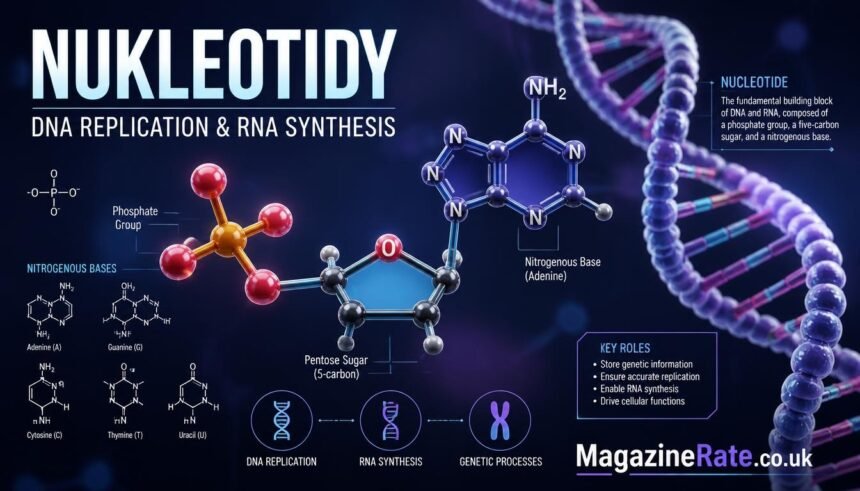
Life depends on the ability of cells to store, copy, and use genetic information. From the development of a single cell into a complex organism to the continuous replacement of damaged cells, biological systems rely on precise molecular processes. At the center of these activities are nucleotides, the essential building blocks of DNA and RNA. Often associated with the term Nukleotidy, these small but important molecules help maintain the genetic instructions that control cellular activities and support the continuation of life.
Nukleotides perform several connected functions in molecular biology. They provide the materials needed to construct DNA during replication, supply the building blocks for RNA during transcription, and contribute to other processes involved in genetic regulation and cellular communication. Their chemical structure allows them to connect in specific sequences, creating long molecular chains capable of carrying biological information.
Understanding how Nukleotidy work provides a clearer picture of how genetic information moves through living organisms. It also explains why accurate nucleotide selection is essential for normal cell function, inheritance, growth, and development. This article explores their structure, their involvement in DNA replication and RNA synthesis, and their wider importance in genetic processes.
What Are Nukleotidy?
Nukleotidy, corresponding to nucleotides in English biological terminology, are organic molecules that form the basic structural units of nucleic acids. DNA and RNA are both constructed from long chains of these molecules. The particular sequence of nucleotides within these chains determines the genetic information they carry.
Each nucleotide contains three main components: a nitrogenous base, a five-carbon sugar, and one or more phosphate groups. These components work together to give nucleotides their chemical properties and allow them to become part of DNA or RNA.
The nitrogenous base carries the information represented by the nucleotide sequence. The sugar provides the structural foundation, while the phosphate group helps connect neighboring nucleotides into a continuous chain.
DNA contains four primary nitrogenous bases: adenine (A), thymine (T), guanine (G), and cytosine (C). RNA also contains four main bases, but uracil (U) replaces thymine. This difference is one of the important chemical distinctions between the two nucleic acids.
Nucleotides are therefore more than simple molecular components. Their arrangement creates the coded information that cells use to maintain biological functions and produce proteins.
Understanding the Structure of Nucleotides
The structure of a nucleotide explains how it participates in genetic processes. Although individual nucleotides are extremely small, their chemical organization allows them to form stable and highly organized molecular chains.
Nitrogenous Bases
Nitrogenous bases are the information-carrying components of nucleotides. They are divided into two major groups: purines and pyrimidines.
Purines have a double-ring chemical structure and include adenine and guanine. Pyrimidines have a single-ring structure and include cytosine, thymine, and uracil.
In DNA, adenine pairs with thymine, while guanine pairs with cytosine. In RNA, adenine generally pairs with uracil, and guanine pairs with cytosine.
These complementary relationships are essential because they allow genetic information to be copied accurately. When one DNA strand serves as a template, its base sequence determines which nucleotides are added to the newly forming strand.
Five-Carbon Sugar
The sugar component is another essential part of nucleotide structure. DNA contains deoxyribose, whereas RNA contains ribose.
The difference between these sugars involves the chemical group attached to the second carbon position. Ribose has a hydroxyl group at this position, while deoxyribose has a hydrogen atom instead.
This relatively small structural difference contributes to the different chemical properties of DNA and RNA. DNA is generally more chemically stable, making it suitable for long-term storage of genetic information. RNA is more reactive and commonly performs temporary information-transfer and regulatory functions.
Phosphate Groups
Phosphate groups connect nucleotides into longer molecular structures. A nucleotide may contain one, two, or three phosphate groups, depending on its chemical form.
During DNA and RNA synthesis, nucleoside triphosphates provide the building blocks used by polymerase enzymes. As a nucleotide is added to a growing chain, phosphate bonds are broken and the remaining nucleotide becomes connected to the existing strand.
This chemical reaction supports the formation of phosphodiester bonds, which create the sugar-phosphate backbone of nucleic acids.
How Nukleotidy Work in DNA Replication
DNA replication is the biological process through which a cell produces a copy of its genetic material. This process is necessary before cell division because each resulting daughter cell must receive a complete set of genetic instructions.
Nukleotidy are essential to this activity because they provide the molecular building blocks used to construct new DNA strands.
DNA replication follows a template-based mechanism. Each original DNA strand helps guide the formation of a complementary strand, allowing the cell to create two DNA molecules with nearly identical genetic information.
1. Unwinding the DNA Double Helix
DNA normally exists as a double-stranded molecule twisted into a structure known as a double helix. The two strands are connected through interactions between complementary nitrogenous bases.
Before replication can begin, the double helix must open so that the nucleotide sequences become accessible.
An enzyme called helicase separates the two DNA strands by disrupting the hydrogen bonds between their paired bases. This creates an area known as the replication fork, where the original strands can serve as templates for new DNA synthesis.
Other proteins help stabilize the separated strands and prevent them from joining together again too quickly.
2. Preparing the DNA Template
Once the DNA strands have separated, the cell prepares them for copying. An enzyme called primase produces short RNA primers that provide starting points for DNA synthesis.
DNA polymerase, the enzyme responsible for building new DNA, cannot normally begin a completely new strand without an existing starting point.
The RNA primer provides the necessary free 3-prime hydroxyl group, allowing DNA polymerase to attach additional nucleotides.
This preparation stage is important because it establishes the correct starting position for the formation of new DNA strands.
3. Selecting Complementary Nucleotides
The next stage involves selecting the correct nucleotides according to the sequence of the original DNA template.
The complementary base-pairing rules determine which nucleotide should be added:
- Adenine (A) pairs with thymine (T).
- Thymine (T) pairs with adenine (A).
- Guanine (G) pairs with cytosine (C).
- Cytosine (C) pairs with guanine (G).
For example, if a section of the original DNA template contains the sequence A-T-G-C, the complementary sequence will be T-A-C-G.
DNA polymerase recognizes the appropriate incoming deoxyribonucleoside triphosphates and adds them to the growing strand. These include dATP, dTTP, dGTP, and dCTP.
The accuracy of this selection is essential because even a small change in the nucleotide sequence can affect genetic information.
4. Building New DNA Strands
DNA polymerase connects the selected nucleotides through phosphodiester bonds. New DNA strands are synthesized in the 5-prime-to-3-prime direction.
Because the two original DNA strands run in opposite directions, their copying processes are slightly different.
The leading strand is generally synthesized continuously toward the replication fork. The lagging strand is produced in shorter sections called Okazaki fragments.
These fragments are later joined together by an enzyme called DNA ligase, creating a continuous DNA strand.
The coordinated activity of DNA polymerase, primase, helicase, ligase, and other proteins allows the replication process to proceed efficiently.
5. Proofreading and Error Correction
DNA replication must be highly accurate to protect genetic information. Cells use several mechanisms to reduce mistakes during DNA synthesis.
Many DNA polymerases have proofreading capabilities that allow them to recognize and remove incorrectly incorporated nucleotides. Additional DNA repair systems can correct certain errors that remain after replication.
These mechanisms help maintain genetic stability across cell generations.
However, not every mistake is corrected. Some changes remain in the DNA sequence and become mutations. Depending on their location and effect, mutations may have no noticeable consequence, influence a biological characteristic, or contribute to disease.
The Role of Nukleotidy in RNA Synthesis
RNA synthesis, also known as transcription, is another major process that depends on nucleotides. Unlike DNA replication, which copies an entire DNA molecule before cell division, transcription usually involves copying selected sections of DNA into RNA.
This allows cells to use particular genetic instructions without changing the original DNA.
RNA molecules perform several functions, including carrying genetic messages, supporting protein production, and regulating gene activity.
Understanding Transcription
Transcription begins when specialized proteins and RNA polymerase identify a particular gene or DNA region that needs to be copied.
RNA polymerase binds to a DNA sequence called a promoter. The enzyme then opens a small section of the DNA double helix and uses one strand as a template.
The enzyme reads the DNA template and selects complementary RNA nucleotides to build a new RNA molecule.
RNA contains four primary nucleotide bases: adenine, uracil, guanine, and cytosine.
During transcription, adenine in the DNA template directs the addition of uracil to RNA rather than thymine. Guanine pairs with cytosine, and cytosine pairs with guanine.
This complementary process ensures that the RNA molecule carries information corresponding to the selected DNA sequence.
The Three Main Stages of RNA Synthesis
Initiation
Initiation is the first stage of transcription. RNA polymerase recognizes and attaches to the promoter region with the assistance of other proteins known as transcription factors in eukaryotic cells.
The DNA opens locally, allowing the enzyme to access the template strand and begin assembling RNA nucleotides.
Elongation
During elongation, RNA polymerase moves along the DNA template and adds complementary ribonucleotides to the growing RNA molecule.
The RNA strand develops in the 5-prime-to-3-prime direction. Unlike DNA polymerase, RNA polymerase can generally begin RNA synthesis without requiring a separate primer.
As the enzyme continues, the newly produced RNA strand separates from the DNA template, while the DNA strands can reconnect behind the transcription machinery.
Termination
Termination occurs when RNA polymerase reaches signals that cause transcription to stop.
The completed RNA molecule is released, and the transcription machinery separates from the DNA.
In eukaryotic cells, many RNA molecules undergo additional processing before becoming functional. For example, messenger RNA receives a protective 5-prime cap, a poly-A tail, and often undergoes splicing to remove non-coding introns.
These modifications help prepare the RNA molecule for its next biological role.
How Nukleotidy Support Protein Production
One of the most important outcomes of genetic information transfer is protein synthesis. Proteins perform a wide range of functions, including supporting cellular structures, transporting substances, controlling chemical reactions, and helping cells communicate.
Nukleotidy contribute to protein production by forming the RNA molecules that carry and interpret genetic instructions.
The process involves two major stages: transcription and translation.
During transcription, DNA information is copied into messenger RNA (mRNA). The mRNA then carries the genetic message to ribosomes, where protein production takes place.
Ribosomes read the mRNA sequence in groups of three nucleotides called codons. Each codon corresponds to a particular amino acid or provides a signal to start or stop protein synthesis.
Transfer RNA (tRNA) molecules help deliver the appropriate amino acids to the ribosome. Their anticodons recognize complementary codons on the mRNA, helping ensure that amino acids are assembled in the correct order.
Ribosomal RNA (rRNA) forms an important structural and functional component of ribosomes and participates in the chemical reactions involved in protein formation.
This relationship demonstrates how nucleotide sequences ultimately influence the proteins produced by living cells.
DNA Replication vs. RNA Synthesis
DNA replication and RNA synthesis both depend on nucleotide building blocks, but they serve different biological purposes.
DNA replication creates a copy of genetic material, while RNA synthesis produces RNA molecules from selected DNA sequences.
Several differences help explain their separate functions.
Purpose
DNA replication occurs to prepare genetic material for cell division. Its goal is to produce two DNA molecules containing essentially the same genetic information as the original.
RNA synthesis supports gene expression by producing RNA molecules needed for protein production and other cellular activities.
Building Blocks
DNA replication uses deoxyribonucleoside triphosphates containing adenine, thymine, guanine, and cytosine.
RNA synthesis uses ribonucleoside triphosphates containing adenine, uracil, guanine, and cytosine.
The presence of thymine in DNA and uracil in RNA is an important distinction between the two processes.
Enzymes
DNA polymerases are responsible for building new DNA strands during replication.
RNA polymerases produce RNA molecules during transcription.
Both enzymes select nucleotides according to complementary base-pairing rules, but their requirements and biological functions differ.
Accuracy
DNA replication generally requires a higher level of accuracy because permanent errors can affect genetic information passed to future cells.
RNA synthesis also requires appropriate nucleotide selection, but individual RNA molecules are temporary in many cellular processes. Errors in an RNA transcript generally do not permanently change the DNA sequence.
| 🔗 You may also like: |
| Metformin Online: A Convenient Approach to Metabolic Wellness |
| Metronidasool Medication Guide: How It Works, What It Treats, and Safety Precautions |
Other Genetic Processes That Depend on Nukleotidy
The importance of nucleotides extends beyond DNA replication and RNA synthesis. They also participate in several other biological processes that help maintain normal cellular activities.
DNA Repair
Cells regularly experience DNA damage from normal metabolic activity and environmental factors. Repair mechanisms identify certain forms of damage and help restore the original DNA sequence.
Nucleotides are required when repair enzymes replace damaged or missing sections of DNA.
Accurate nucleotide incorporation is important because repair systems must preserve the original genetic instructions as closely as possible.
Gene Regulation
Gene regulation determines when particular genes are active and how much RNA or protein they produce.
Certain regulatory mechanisms involve DNA sequences, RNA molecules, and proteins that interact with one another.
Small regulatory RNAs, for example, can influence the stability or translation of messenger RNA. These molecules are themselves constructed from nucleotides.
Genetic Inheritance
During reproduction, genetic information is passed from parents to offspring through DNA.
The nucleotide sequence of DNA contains inherited instructions that influence biological development and characteristics.
Accurate DNA replication and chromosome distribution help ensure that genetic information is transmitted during cell division and reproduction.
Genetic Research and Biotechnology
Nucleotides are widely used in molecular biology research and biotechnology.
Scientists use nucleotide-based methods to study DNA sequences, investigate genetic differences, and develop diagnostic techniques.
Polymerase chain reaction (PCR), for example, uses specially designed DNA primers and free nucleotides to produce copies of selected DNA regions.
DNA sequencing technologies also rely on nucleotide-based principles to determine the order of genetic material.
These applications have made nucleotide chemistry an important foundation of modern genetics and biomedical research.
Why Accurate Nucleotide Selection Matters
The correct selection of nucleotides is essential for maintaining the integrity of genetic information. DNA and RNA molecules depend on specific nucleotide sequences to perform their biological functions.
If an incorrect nucleotide becomes part of a DNA strand and escapes repair, it may create a permanent sequence change.
Some mutations have little or no effect because they occur in regions that do not alter an important biological function. Others may change the amino acid sequence of a protein, influence gene regulation, or disrupt normal cellular activity.
Errors during RNA synthesis can also affect the resulting RNA molecule and, in some cases, the protein produced from it.
Cells therefore use different mechanisms to support accurate genetic processes. These include enzyme selectivity, DNA polymerase proofreading, DNA repair pathways, and regulatory systems that monitor cellular activity.
Together, these mechanisms help protect the genetic information required for normal development and survival.
The Importance of Nukleotidy in Modern Science
Research into nucleotides has contributed significantly to modern biological and medical science.
Scientists study nucleotide structure and behavior to understand how genetic information is stored, copied, expressed, and sometimes altered. This knowledge supports research in genetics, molecular medicine, biotechnology, and pharmaceutical development.
Nucleotide chemistry is also important in the development of certain medicines and therapeutic technologies. Some treatments use modified nucleosides or nucleotide-related compounds to influence the activity of specific enzymes or interfere with the replication of certain viruses.
RNA-based technologies provide another example of the importance of nucleotide research. Messenger RNA platforms use carefully designed RNA molecules to provide cells with temporary instructions for producing selected proteins.
In addition, nucleotide-based methods support genetic testing, disease research, DNA sequencing, and laboratory diagnostics.
These applications demonstrate that nucleotides are not simply components of genetic material. They are also important tools for understanding biological systems and developing new scientific technologies.
| 🔗 You may also like: |
| Gastric Surgery Turkey |
| Cooling tower water treatment managing legionella risk in humid climates |
Common Misconceptions About Nukleotidy
Despite their importance, several misunderstandings exist about nucleotides and their functions.
One common misconception is that nucleotides and nucleosides are the same. Although they are closely related, they have different chemical structures. A nucleoside contains a nitrogenous base and a sugar, while a nucleotide also contains one or more phosphate groups.
Another misunderstanding is that DNA and RNA contain exactly the same nucleotides. Both share adenine, guanine, and cytosine, but DNA primarily uses thymine, whereas RNA uses uracil.
Some people also assume that nucleotides are involved only in storing genetic information. In reality, certain nucleotides participate in cellular energy transfer, signaling, and metabolic reactions. ATP, or adenosine triphosphate, is a particularly important example because it helps supply energy for many cellular activities.
Understanding these distinctions makes it easier to appreciate the wider biological significance of nucleotide molecules.
Conclusion
Nukleotidy play an essential role in maintaining and using the genetic information that supports life. As the fundamental building blocks of DNA and RNA, they make DNA replication, RNA synthesis, and many other genetic processes possible.
During DNA replication, nucleotides provide the materials required to produce new genetic strands. During RNA synthesis, they help convert selected DNA instructions into RNA molecules that support gene expression and protein production. Their involvement in DNA repair, cellular signaling, genetic research, and biotechnology further demonstrates their broad biological importance.
Understanding how nucleotides function provides a foundation for exploring molecular biology, genetics, and modern medical science. Although these molecules are small, their contribution to the storage, transmission, and expression of genetic information is fundamental to the organization and continuity of living systems.
FAQs
What are Nukleotidy in biology?
Nukleotidy refers to nucleotides, which are the basic molecular building blocks of DNA and RNA. Each nucleotide contains a nitrogenous base, a five-carbon sugar, and one or more phosphate groups.
How do nucleotides help in DNA replication?
Nucleotides provide the materials used by DNA polymerase to construct new DNA strands. Their complementary base-pairing properties allow each original strand to guide the formation of a corresponding new strand.
What is the difference between DNA and RNA nucleotides?
DNA nucleotides contain deoxyribose sugar and use thymine, while RNA nucleotides contain ribose sugar and use uracil instead of thymine. Both contain adenine, guanine, and cytosine.
Which enzyme uses nucleotides during DNA replication?
DNA polymerase is the main enzyme responsible for adding nucleotides to newly forming DNA strands. Other enzymes, including helicase, primase, and ligase, also contribute to the overall replication process.
How are nucleotides involved in RNA synthesis?
During transcription, RNA polymerase selects complementary RNA nucleotides and connects them to form an RNA molecule using a DNA strand as a template.
Do nucleotides play a role in protein synthesis?
Yes. Nucleotides form messenger RNA, transfer RNA, and ribosomal RNA. These molecules work together to interpret genetic instructions and assemble amino acids into proteins.
Why is nucleotide accuracy important?
Accurate nucleotide selection helps preserve genetic information. Errors that remain uncorrected may cause mutations, which can sometimes influence protein production or normal cellular functions.
Are nucleotides important outside DNA and RNA?
Yes. Certain nucleotides, including ATP and cyclic AMP, participate in energy transfer and cellular signaling. They therefore support several processes beyond genetic information storage.