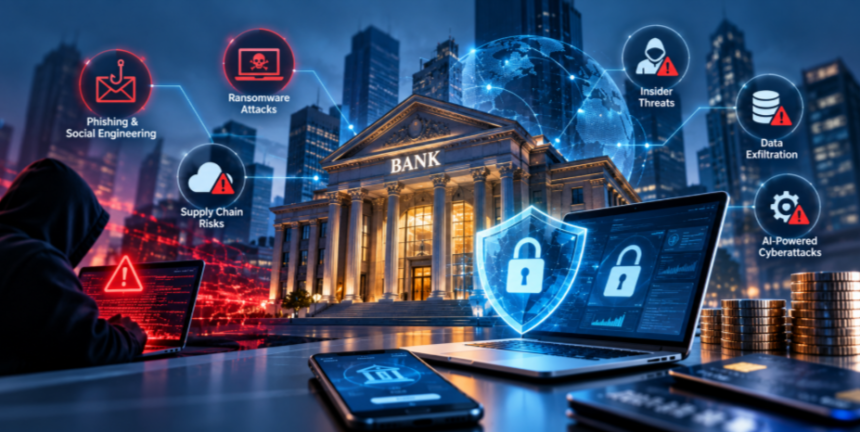
The banking industry is entering a period in which cybersecurity threats are becoming more sophisticated, financially damaging, and difficult to contain. As financial institutions accelerate digital transformation, expand cloud infrastructure, integrate artificial intelligence, and adopt real-time payment systems, their exposure to cyberattacks continues to grow.
In 2027, cybersecurity will no longer be measured solely by an institution’s ability to prevent unauthorized access. It will increasingly depend on how effectively financial organizations can protect critical operations, maintain transaction integrity, manage third-party dependencies, and recover from sophisticated attacks without disrupting customer services. Partnering with an experienced cybersecurity services provider can help financial institutions strengthen their security posture and address evolving threats across complex IT environments.
The financial consequences extend beyond direct losses. A single security incident can interrupt payment processing, expose sensitive customer information, trigger regulatory investigations, and undermine institutional confidence.
The biggest cybersecurity threats facing banks and financial institutions in 2027 include AI-powered cyberattacks, ransomware, third-party vulnerabilities, identity-based attacks, cloud security failures, payment fraud, and emerging cryptographic risks. Understanding how these threats intersect is essential to building a resilient financial infrastructure.
Why Is Cybersecurity Becoming More Complex for Financial Institutions in 2027?
Financial institutions operate some of the most interconnected technology environments in the global economy. Core banking platforms, payment networks, customer applications, cloud infrastructure, and external service providers continuously exchange sensitive information.
This interconnected ecosystem creates opportunities for attackers to exploit weaknesses across multiple systems.
Several developments are expected to intensify cybersecurity exposure in 2027:
- Accelerated AI adoption: AI-driven financial operations introduce additional risks involving automated decision-making, sensitive data, and model manipulation.
- Expanding digital transactions: Instant payments and digital banking reduce the time available to identify and stop fraudulent activity.
- Growing third-party dependencies: Financial institutions increasingly rely on external technology providers for essential operations.
- Complex regulatory requirements: Data protection, operational resilience, and incident reporting obligations continue to evolve across jurisdictions.
- Legacy infrastructure: Older banking systems can create security gaps when integrated with modern applications and cloud environments.
The challenge is not simply the growing number of attacks. It is the increasing potential for a localized security failure to spread across interconnected financial services.
- AI-Powered Cyberattacks and Deepfake Financial Fraud
Artificial intelligence is expected to become one of the most influential cybersecurity risk factors in 2027.
Attackers can use generative AI to create convincing phishing communications, impersonate trusted individuals, automate vulnerability discovery, and manipulate financial authorization processes.
Deepfake audio and video introduce additional risks for high-value transactions and identity verification. Fraudulent instructions that previously contained obvious inconsistencies can now appear highly credible.
The International Monetary Fund’s 2026 analysis highlights how AI can accelerate attacks and reduce the time available for financial institutions to detect and contain threats.
Key financial exposure: Consider an institution processing $500 million in daily digital transactions. Even a hypothetical 0.01% increase in successfully executed fraudulent transactions could represent $50,000 in additional daily exposure, depending on transaction values and recovery rates.
Financial institutions should prioritize transaction-level verification, behavioral analytics, independent payment authorization, and continuous monitoring of AI-enabled systems.
- Ransomware Attacks Targeting Core Banking Operations
Ransomware is evolving beyond traditional file encryption into coordinated attacks involving data theft, operational disruption, and extortion.
Banking institutions face particular exposure because prolonged system outages can interrupt payment settlement, customer access, lending operations, and regulatory reporting.
According to Verizon’s 2025 Data Breach Investigations Report, ransomware appeared in 44% of breaches analyzed across industries, compared with 32% in the previous report.
For financial institutions, the total economic impact can significantly exceed any ransom demand.
A hypothetical banking platform generating $2 million in daily transaction-related revenue could face substantial revenue disruption during a 24-hour outage, alongside recovery expenses and potential contractual liabilities. Revenue at risk should not, however, be treated as an automatic realized loss.
By 2027, ransomware resilience will depend on immutable backups, segmented infrastructure, tested recovery procedures, and the ability to restore critical banking services independently of compromised systems.
- Third-Party and Financial Supply Chain Cyberattacks
Modern banking operations depend on cloud providers, payment processors, identity verification platforms, fintech integrations, and managed technology services.
A security compromise affecting one critical provider can potentially disrupt multiple financial institutions simultaneously.
Verizon’s 2025 research found that third-party involvement accounted for 30% of analyzed breaches across industries, approximately double the previous year’s share.
This highlights a significant challenge: an institution may maintain strong internal security controls while remaining exposed through external technology dependencies.
In 2027, third-party cybersecurity assessments should extend beyond annual compliance questionnaires. Continuous vendor monitoring, software dependency visibility, contractual incident reporting, and concentration-risk assessments will become increasingly important.
Financial institutions should also establish contingency arrangements for essential providers whose failure could interrupt customer-facing operations.
- Identity-Based Attacks and Credential Compromise
Compromised identities remain among the most effective methods for gaining unauthorized access to financial systems.
Attackers increasingly target privileged accounts, application programming interfaces, service identities, and authentication tokens rather than relying exclusively on malware.
Verizon reported that credential abuse accounted for 22% of known initial access vectors in its 2025 breach dataset, while vulnerability exploitation represented another 20%.
For banks operating thousands of applications and automated workflows, machine identities can create additional exposure when access privileges are poorly governed.
The growing adoption of cloud infrastructure and AI-driven automation may further increase the number of credentials requiring protection.
Priority controls for 2027 include phishing-resistant multifactor authentication, privileged access management, short-lived credentials, continuous identity monitoring, and automated access revocation.
- Cloud Security Misconfigurations and API Vulnerabilities
Cloud infrastructure supports digital banking, analytics, fraud detection, and customer engagement. However, rapid modernization can introduce security weaknesses when access controls, encryption policies, and infrastructure configurations are inconsistently implemented.
Application programming interfaces are especially important because they connect banking applications with external financial ecosystems.
An exposed API could allow unauthorized access to account information, transaction records, or sensitive financial data.
For example, a hypothetical financial platform handling 10 million API requests daily could experience significant data exposure if a critical authorization weakness remained undetected.
The scale of potential damage would depend on the affected endpoint, accessible records, and existing security controls.
Financial institutions should adopt continuous cloud configuration assessment, API discovery, runtime monitoring, encryption enforcement, and zero-trust access policies.
- Real-Time Payment Fraud and Transaction Manipulation
Instant payment infrastructure improves transaction efficiency but creates a narrower window for fraud detection and intervention.
Once fraudulent funds are transferred across accounts or jurisdictions, recovery may become significantly more difficult.
The IMF’s 2026 research found that cyber-enabled fraud had nearly tripled over the period examined, while credit transfers and credit cards remained prominent channels for fraudulent payments.
In 2027, sophisticated payment fraud may combine stolen credentials, social engineering, synthetic identities, and AI-generated impersonation.
Banks processing high transaction volumes will need security controls capable of evaluating payment behavior before authorization.
Real-time risk scoring, beneficiary verification, transaction velocity analysis, and adaptive authentication can help reduce exposure without unnecessarily delaying legitimate payments.
- Insider Threats and Sensitive Financial Data Exposure
Not every significant cybersecurity incident originates outside an institution.
Insider-related risks can involve malicious activity, excessive access privileges, accidental disclosures, or compromised accounts operating within trusted environments.
Financial organizations maintain large volumes of confidential customer information, including identity records, transaction histories, financial statements, and payment credentials.
Unauthorized access to these datasets can create long-term regulatory, financial, and reputational consequences.
IBM reported that the average financial industry data breach cost reached $6.08 million in 2024, compared with the global average of $4.88 million.
This historical benchmark illustrates the potential financial impact of sensitive data exposure; it is not a forecast of 2027 breach costs.
Institutions should implement least-privilege access, data loss prevention, behavioral monitoring, and automated detection of unusual data transfers.
- Quantum Computing and Long-Term Encryption Risks
Quantum computing represents a longer-term cybersecurity challenge, particularly for institutions protecting financial information that must remain confidential for many years.
Although cryptographically relevant quantum computers are not established as an operational threat for 2027, attackers may collect encrypted information today with the intention of decrypting it in the future.
This creates potential exposure for long-retention financial records, confidential agreements, and sensitive identity information.
Financial institutions should begin identifying cryptographic dependencies and evaluating migration pathways toward standardized post-quantum cryptography.
The immediate priority is preparation rather than assuming widespread quantum-enabled attacks will occur in 2027.
How Can Banks Strengthen Cybersecurity Resilience in 2027?
Financial institutions need to move beyond fragmented security controls toward coordinated cyber resilience strategies.
A practical enterprise cybersecurity framework should combine preventive controls with measurable operational recovery capabilities.
Zero-trust security architecture
Continuously verify identities, devices, and application access while limiting unnecessary privileges.
AI-assisted threat detection
Correlate security events, identify suspicious behavior, and accelerate incident investigation while maintaining human oversight.
Third-party risk management
Continuously assess critical vendors, technology dependencies, and potential service concentration risks.
Operational resilience testing
Validate backup restoration, incident response, payment continuity, and recovery procedures under realistic attack scenarios.
Cybersecurity performance should be evaluated through measurable indicators such as incident detection time, containment time, critical vulnerability remediation, privileged access coverage, and recovery readiness.
For example, reducing the time required to contain a critical incident from 12 hours to 3 hours represents a 75% improvement in containment speed. Although the financial benefit varies by incident, faster containment can reduce the opportunity for further compromise.
What Will Define Banking Cybersecurity Success in 2027?
The defining cybersecurity challenge for financial institutions in 2027 will be managing interconnected risks without compromising digital banking performance.
AI-enabled attacks, ransomware, identity compromise, third-party vulnerabilities, and payment fraud are unlikely to operate as isolated threats. A single incident may combine several attack methods and affect multiple operational systems.
The institutions best prepared for this environment will be those that integrate cybersecurity into enterprise risk management, technology modernization, vendor governance, and operational resilience planning.
Cybersecurity investment should ultimately be measured by its ability to protect financial transactions, preserve customer confidence, minimize disruption, and maintain business continuity.
As the financial ecosystem becomes more automated and interconnected, resilience will become a defining characteristic of sustainable banking operations.
Read Also:- magazinerate.co.uk