
The Tennessee Titans defeated the Cleveland Browns 31–29 on December 7, 2025, at Huntington Bank Field in Cleveland, Ohio. The Week 14 matchup delivered an exciting finish, featuring Tony Pollard’s explosive rushing performance, Shedeur Sanders’ impressive passing numbers, and several decisive defensive and special-teams plays.
The final score tells only part of the story. Cleveland gained more total yards and recorded more first downs, but Tennessee made better use of key opportunities. The Titans combined an effective running game with timely turnovers and a blocked punt to secure a narrow victory.
This breakdown of the Tennessee Titans vs Cleveland Browns match player stats and box score covers the final score, team statistics, quarterback performances, rushing and receiving leaders, defensive contributions, and the moments that decided the game.
Tennessee Titans vs Cleveland Browns: Game Overview

The Titans entered the matchup looking to end a difficult stretch of the season, while Cleveland aimed to take advantage of playing at home. Both teams found ways to score, but Tennessee produced several game-changing plays that proved more valuable than Cleveland’s statistical advantage.
Tony Pollard led Tennessee’s offense with 161 rushing yards and two touchdowns. His long touchdown runs helped the Titans build an early advantage and regain control after Cleveland moved ahead before halftime.
Browns rookie quarterback Shedeur Sanders responded with a productive passing performance, throwing for 364 yards and three touchdowns while adding a rushing score. Despite his efforts, Cleveland’s mistakes and unsuccessful late two-point conversions left the team just short of a comeback.
| 🔗 You may also like: |
|---|
| Buffalo Bills vs Miami Dolphins Match Player Stats |
| Houston Texans vs Baltimore Ravens Match Player Stats |
Match Details
| Match Information | Details |
| Game | Tennessee Titans vs Cleveland Browns |
| Date | December 7, 2025 |
| NFL Week | Week 14 |
| Venue | Huntington Bank Field |
| Location | Cleveland, Ohio |
| Final Score | Titans 31, Browns 29 |
| Winning Team | Tennessee Titans |
| Leading Rusher | Tony Pollard — 161 yards |
| Leading Passer | Shedeur Sanders — 364 yards |
Tennessee Titans vs Cleveland Browns Final Score and Quarter-by-Quarter Results
The game featured several changes in momentum. Tennessee started quickly, Cleveland answered before halftime, and the Titans regained the advantage in the third quarter. The Browns continued to fight in the fourth quarter, but Tennessee held on to win by two points.
The quarter-by-quarter progression helps explain how a close contest developed and why the final result remained uncertain until the closing moments.
| Quarter | Tennessee Titans | Cleveland Browns |
| First Quarter | 14 | 3 |
| Second Quarter | 0 | 14 |
| Third Quarter | 10 | 0 |
| Fourth Quarter | 7 | 12 |
| Final Score | 31 | 29 |
First Quarter: Tennessee Starts Strong
Tennessee opened the game with an effective scoring drive, then benefited from Tony Pollard’s explosive 65-yard touchdown run. The early production helped the Titans establish a 14–3 lead and put pressure on Cleveland’s defense.
The Browns responded with a field goal, but Tennessee’s rushing attack created the biggest early highlight. Pollard’s ability to turn a routine handoff into a long touchdown immediately established him as the game’s most influential offensive player.
Second Quarter: Cleveland Takes the Lead
Cleveland answered with two touchdown drives and moved ahead 17–14 by halftime. Jerry Jeudy delivered one of the game’s biggest receiving plays with a 60-yard touchdown reception, demonstrating the Browns’ ability to generate explosive gains through the air.
The second quarter showed the contrast between the teams. Tennessee relied heavily on its running game, while Cleveland used Sanders’ arm to create scoring opportunities and shift momentum before the break.
Third Quarter: Pollard and the Titans Respond
Tennessee regained control after defensive back Xavier Woods intercepted a pass from Sanders. The turnover gave the Titans an important opportunity, which they used to help set up Pollard’s second rushing touchdown, a 32-yard score.
A field goal added to Tennessee’s advantage. The Titans entered the fourth quarter with a 24–17 lead, having turned a defensive play and a strong rushing attack into a meaningful scoreboard advantage.
Fourth Quarter: A Dramatic Finish
Both teams scored in the final quarter, and Cleveland continued to threaten the Titans’ lead. Harold Fannin Jr. recorded a late touchdown reception, helping the Browns close the gap to 31–29.
Cleveland’s unsuccessful two-point conversion attempts proved costly. Tennessee also blocked a Browns punt and recovered a late onside kick through Chimere Dike, preventing Cleveland from getting another opportunity to take the lead.
| 🔗 You may also like: |
|---|
| New York Jets vs Baltimore Ravens Match Player Stats |
| Pittsburgh Steelers vs Detroit Lions Match Player Stats and Box Score |
Tennessee Titans vs Cleveland Browns Team Stats Comparison
One of the most interesting aspects of this game was the difference between total offensive production and the final result. Cleveland gained substantially more yardage, but Tennessee capitalized on turnovers and special-teams opportunities.
The following team totals provide context for the individual player performances.
| Team Statistic | Tennessee Titans | Cleveland Browns |
| Total Yards | 292 | 412 |
| Total Plays | 64 | 64 |
| Yards per Play | 4.6 | 6.4 |
| Passing Yards | 108–117* | 351–364* |
| Rushing Yards | 184 | 61 |
| First Downs | 13 | 22 |
| Turnovers | 1 | 2 |
| Time of Possession | 31:56 | 28:04 |
Passing-yard figures can differ between summaries depending on whether the source reports gross passing yards or net passing yards after sacks. The official box score should be used for a definitive comparison.
What the Team Statistics Reveal
Cleveland’s 412 total yards compared with Tennessee’s 292 show that the Browns moved the ball more effectively overall. Cleveland also recorded 22 first downs, nine more than Tennessee, and averaged 6.4 yards per play.
However, offensive yardage does not automatically translate into victory. Cleveland lost the turnover battle, and Tennessee turned key opportunities into points. The Titans also generated 184 rushing yards, allowing them to sustain drives and manage the clock.
The Browns’ 61 rushing yards created another contrast. Cleveland depended heavily on Sanders’ passing production, while Tennessee used Pollard to produce explosive plays on the ground. The combination of turnovers, rushing touchdowns, and special-teams execution helped the Titans win despite trailing in several offensive categories.
Tennessee Titans Player Stats Breakdown
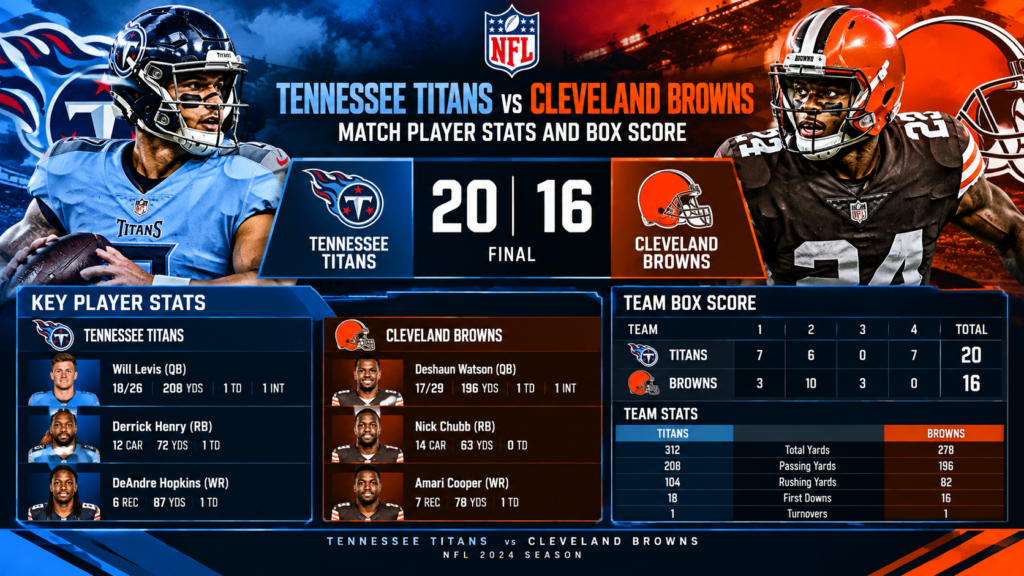
The Titans’ victory featured a productive running back, an efficient contribution from quarterback Cam Ward in key moments, and defensive plays that changed the game’s direction.
1. Cam Ward Passing Stats
Cam Ward handled the quarterback duties for Tennessee. His passing totals were modest compared with Sanders’ production, but he contributed two touchdown passes during the win.
| Passing Statistic | Cam Ward |
| Completions | 14 |
| Pass Attempts | 28 |
| Completion Percentage | 50.0% |
| Passing Yards | 117 |
| Passing Touchdowns | 2 |
| Interceptions | 1 |
| Sacks Taken | 1 |
Ward completed half of his attempts and averaged relatively few yards per pass. His performance was not built around high-volume passing; instead, Tennessee relied on its running game to generate much of the offense.
His touchdown passes to Elic Ayomanor and Chimere Dike provided important scoring support. Although Ward threw an interception, the Titans received enough production from Pollard and their defense to overcome the mistake.
2. Tony Pollard Rushing Stats
Tony Pollard was Tennessee’s standout performer and the most important offensive player in the game. He carried the ball 25 times for 161 yards and two touchdowns, averaging approximately 6.4 yards per carry based on those figures.
| Rushing Statistic | Tony Pollard |
| Rushing Attempts | 25 |
| Rushing Yards | 161 |
| Yards per Carry | 6.4 |
| Rushing Touchdowns | 2 |
| Long Touchdown Run | 65 yards |
Pollard’s first touchdown came on a 65-yard run in the opening quarter. His second was a 32-yard touchdown in the third quarter, helping Tennessee regain the lead after Cleveland had moved ahead.
His 161-yard performance gave Tennessee an offensive advantage that Cleveland struggled to match on the ground. Pollard’s long runs also reduced the pressure on Ward to produce a large passing total.
3. Titans Receiving Stats
Tennessee spread its passing production across multiple targets rather than depending on one receiver for most of its scoring.
Elic Ayomanor caught a 14-yard touchdown pass, while Chimere Dike added a five-yard touchdown reception. Dike also contributed on special teams by recovering Cleveland’s late onside kick.
These scoring plays gave Ward two touchdown passes despite Tennessee finishing with a relatively low passing total. Tyjae Spears was also listed among Tennessee’s contributors in the receiving game, although the exact full receiving totals should be confirmed against the official game log before publishing a complete statistical leaderboard.
4. Titans Defensive Stats
Tennessee’s defense played a decisive role by creating turnovers and limiting Cleveland’s opportunities to recover late in the game.
Cedric Gray led the Titans with 10 tackles and recovered a Browns fumble. Xavier Woods intercepted Sanders, returning the ball 35 yards and giving Tennessee a valuable field-position opportunity.
The defense also helped Tennessee take advantage of Cleveland’s struggles on the ground. Limiting the Browns’ rushing production forced Sanders to shoulder much of the offensive workload and made the Titans’ passing-defense opportunities more important.
5. Titans Special Teams Stats
Special teams delivered one of Tennessee’s most consequential plays when James Williams Sr. blocked a Cleveland punt. The resulting opportunity helped the Titans add points without requiring a long offensive drive.
The blocked punt was especially important because Cleveland had already demonstrated that it could move the ball through the air. By disrupting a routine special-teams play, Tennessee created another scoring opportunity and increased the pressure on the Browns.
Dike’s recovery of the late onside kick then helped Tennessee protect its two-point lead. These contributions illustrate why special-teams plays should be considered alongside passing, rushing, and defensive statistics when evaluating a close NFL game.
Cleveland Browns Player Stats Breakdown
Cleveland produced more total offense than Tennessee, but its players could not consistently convert that production into a winning result. Sanders led an aggressive passing attack, while several receivers created significant gains against the Titans’ defense.
1. Shedeur Sanders Passing Stats
Shedeur Sanders delivered one of the game’s strongest individual performances. The Browns quarterback completed 23 of 42 passes for 364 yards, three passing touchdowns, and one interception. He also scored a rushing touchdown.
| Passing Statistic | Shedeur Sanders |
| Completions | 23 |
| Pass Attempts | 42 |
| Completion Percentage | 54.8% |
| Passing Yards | 364 |
| Passing Touchdowns | 3 |
| Interceptions | 1 |
| Rushing Touchdowns | 1 |
Sanders demonstrated his ability to attack Tennessee’s defense through the air. His passing total significantly exceeded Ward’s, and he connected with multiple receivers for important gains.
However, the interception and unsuccessful two-point conversion attempts contributed to Cleveland’s defeat. His statistical output was impressive, but the final result showed how turnovers and late-game execution can outweigh individual passing numbers.
2. Browns Rushing Stats
Cleveland struggled to establish a consistent ground attack. The team finished with 61 rushing yards, making it difficult to balance its offense against Tennessee.
| Rushing Statistic | Browns Performance |
| Team Rushing Yards | 61 |
| Team Yards per Carry | 3.0 |
| Quinshon Judkins’ Attempts | 14 |
| Judkins’ Rushing Yards | 26 |
| Shedeur Sanders’ Rushing Yards | 29 |
| Sanders’ Rushing Touchdowns | 1 |
Quinshon Judkins managed 26 yards on 14 carries, while Sanders added rushing production through scrambles and a touchdown. The limited output from the running game placed additional responsibility on the rookie quarterback.
Cleveland’s offense remained productive because Sanders generated substantial passing yardage. Nevertheless, the contrast with Tennessee’s 184 rushing yards was significant. Pollard consistently created opportunities that the Browns struggled to reproduce on the ground.
3. Browns Receiving Stats
Cleveland’s receiving group generated several explosive plays and kept the game competitive. Harold Fannin Jr. was particularly effective, while Jerry Jeudy and David Njoku contributed important touchdowns.
| Receiver | Key Performance |
| Harold Fannin Jr. | 8 receptions, 114 yards, 1 touchdown |
| Jerry Jeudy | 76 receiving yards, including a 60-yard touchdown |
| David Njoku | 1-yard touchdown reception |
| Quinshon Judkins | 58-yard reception |
Fannin’s eight catches for 114 yards made him a major target in Cleveland’s passing attack. His late touchdown helped bring the Browns within two points of Tennessee.
Jeudy provided an explosive scoring play with his 60-yard touchdown reception, which helped Cleveland take the lead in the second quarter. Njoku also found the end zone on a short reception, although he later left the game with a reported knee injury.
Judkins’ 58-yard reception was another example of Cleveland’s ability to create significant gains through the passing game despite its limited rushing production.
4. Browns Defensive Stats
Cleveland’s defense had some success against Ward, holding Tennessee’s quarterback to 117 passing yards and recording an interception. Myles Garrett also registered a sack, adding to his season total.
The Browns’ main challenge was stopping Pollard. His two long touchdown runs exposed the difficulty Cleveland faced in containing Tennessee’s rushing attack.
Although the Browns forced Tennessee to operate with limited passing production, they were unable to consistently stop the run. The result was a frustrating defensive performance: Cleveland restricted one part of Tennessee’s offense but could not prevent the plays that mattered most.
5. Browns Special Teams Stats
Cleveland’s special-teams performance included a blocked punt by Tennessee that gave the Titans an important scoring opportunity.
Late in the game, the Browns attempted an onside kick to regain possession. Tennessee’s Chimere Dike recovered the ball, preventing Cleveland from mounting another offensive drive.
The Browns also failed to convert their late two-point attempts. In a game decided by two points, those missed opportunities became especially important.
| 🔗 You may also like: |
|---|
| Gaming Updates From eTrueSports and eTrueGames |
| Improve PC Gaming Performance |
Top Player Performances: Titans vs Browns
The individual leaders reveal how the two teams approached the game differently. Tennessee depended on its running back and timely defensive plays, while Cleveland relied heavily on its quarterback and receiving corps.
| Category | Tennessee Titans | Cleveland Browns |
| Leading Passer | Cam Ward — 117 yards | Shedeur Sanders — 364 yards |
| Leading Rusher | Tony Pollard — 161 yards | Quinshon Judkins — 26 yards |
| Leading Receiver | Confirm full team receiving log | Harold Fannin Jr. — 114 yards |
| Passing Touchdowns | Cam Ward — 2 | Shedeur Sanders — 3 |
| Rushing Touchdowns | Tony Pollard — 2 | Shedeur Sanders — 1 |
| Key Defensive Play | Xavier Woods’ interception | Myles Garrett’s sack |
| Game-Changing Contribution | Pollard’s two touchdown runs | Sanders’ passing production |
Tony Pollard deserves recognition as Tennessee’s leading offensive performer. His 161 rushing yards and two touchdowns provided the foundation for the win.
Sanders was Cleveland’s standout offensive player. His 364 passing yards and three passing touchdowns kept the Browns in contention, but his performance could not fully compensate for the team’s limited rushing output and missed late-game opportunities.
Why Did the Titans Beat the Browns Despite Gaining Fewer Yards?
The difference between total yardage and the final score is one of the most useful lessons from this matchup.
Cleveland finished with 412 total yards, compared with Tennessee’s 292. The Browns also recorded more first downs and generated more passing production. By those measures alone, Cleveland appeared to have the stronger offensive performance.
Tennessee, however, produced more decisive results from several key plays.
First, the Titans dominated the ground game. Pollard’s two touchdown runs created scoring opportunities that did not require long passing drives. His 65-yard and 32-yard touchdowns were especially important.
Second, Tennessee benefited from defensive takeaways. Woods’ interception and Gray’s fumble recovery helped disrupt Cleveland’s offensive rhythm and provided Tennessee with additional opportunities.
Third, special teams changed the game’s momentum. Williams’ blocked punt helped create another scoring opportunity, while Dike’s recovery of the late onside kick prevented a potential Cleveland comeback.
Finally, Cleveland’s unsuccessful two-point conversion attempts mattered in a game decided by two points. The Browns produced enough offense to remain competitive, but Tennessee executed more effectively in several high-pressure situations.
Titans vs Browns Head-to-Head History
The rivalry between the Cleveland Browns and the Tennessee Titans includes games played under different franchise names. Tennessee’s franchise history includes its time as the Houston Oilers, while Cleveland’s modern-era records also require historical context when comparing long-term totals.
According to the supplied Pro Football Reference head-to-head data, Cleveland entered this matchup with a 37–32 advantage in regular-season meetings against Tennessee. The December 7, 2025, victory gave the Titans another win in the series, making the listed regular-season record 37–33 in Cleveland’s favor and Tennessee’s favor, respectively, as reflected by the updated results.
Recent meetings have produced different outcomes. Cleveland defeated Tennessee 27–3 in September 2023, while Tennessee won 31–29 in December 2025. Earlier matchups included Tennessee’s 43–13 victory in 2019 and Cleveland’s 41–35 win in 2020.
These results show that historical records provide useful context, but they do not determine the outcome of an individual game. Each matchup depends on the available players, tactical decisions, turnovers, and execution on the day.
How to Read the Titans vs Browns Box Score
An NFL box score provides more than the final score. It helps explain how a team generated points, where its offense was strongest, and which players influenced the outcome.
- Passing statistics: Completions, attempts, yards, touchdowns, and interceptions help measure a quarterback’s performance.
- Rushing statistics: Carries, yards, and touchdowns show how effectively a team moved the ball on the ground.
- Receiving statistics: Receptions, receiving yards, and touchdowns identify the players who contributed to the passing game.
- Defensive statistics: Tackles, sacks, interceptions, and fumble recoveries show how defenders disrupted the opposing offense.
- Team statistics: Total yards, first downs, turnovers, and possession time help explain the broader game.
- Special-teams statistics: Field goals, extra points, blocked kicks, and returns reveal contributions that traditional offensive totals may overlook.
For this game, the most useful approach is to compare Cleveland’s passing production with Tennessee’s rushing efficiency and turnover impact. The contrast explains why the Browns gained more yards but still lost.
Conclusion
The Tennessee Titans vs Cleveland Browns matchup on December 7, 2025, demonstrated why football games cannot be judged by total yardage alone. Cleveland produced more offense overall, but Tennessee’s rushing attack, defensive takeaways, and special-teams execution proved decisive in the 31–29 result.
Tony Pollard’s 161 rushing yards and two touchdowns led the Titans, while Shedeur Sanders delivered an impressive 364-yard passing performance for Cleveland. Both players produced important moments, but Tennessee made more of its opportunities when the game was on the line.
For anyone reviewing the Tennessee Titans vs Cleveland Browns match player stats and box score, the central takeaway is straightforward: offensive volume matters, but turnovers, explosive plays, and late-game execution can determine the winner.
FAQs
Who won the Tennessee Titans vs Cleveland Browns game on December 7, 2025?
The Tennessee Titans won 31–29 against the Cleveland Browns at Huntington Bank Field in Cleveland, Ohio.
How many rushing yards did Tony Pollard record?
Tony Pollard recorded 161 rushing yards on 25 carries and scored two rushing touchdowns. His 65-yard and 32-yard touchdown runs were among the game’s defining plays.
How many passing yards did Shedeur Sanders have?
Shedeur Sanders threw for 364 yards, completing 23 of 42 attempts. He recorded three passing touchdowns and one interception, and he also scored a rushing touchdown.
What were the final team yardage totals?
Cleveland gained 412 total yards, while Tennessee finished with 292. Despite the difference, Tennessee won by capitalizing on turnovers, explosive rushing plays, and special-teams opportunities.
Which play helped seal the Titans’ victory?
Tennessee recovered Cleveland’s late onside kick through Chimere Dike. That recovery prevented the Browns from getting another possession and protected the Titans’ two-point lead.
Why did Cleveland lose despite its higher yardage total?
Cleveland struggled to establish its running game, committed turnovers, allowed two long rushing touchdowns, and failed to convert its late two-point attempts. Tennessee made better use of crucial scoring opportunities.