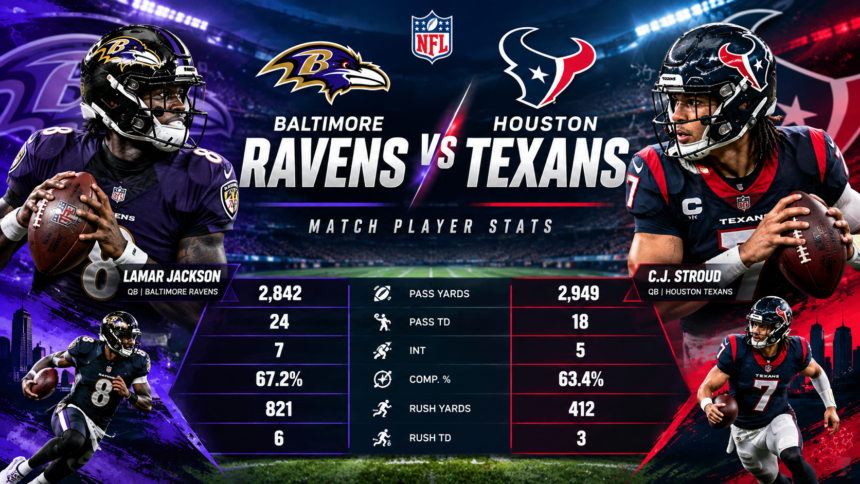
The Houston Texans delivered a dominant performance against the Baltimore Ravens on October 5, 2025, earning a convincing 44–10 victory at M&T Bank Stadium in Baltimore. The game featured an outstanding performance from quarterback C.J. Stroud, an effective Houston rushing attack, and a defensive effort that forced three turnovers. For the Ravens, the defeat highlighted the challenges of playing without several important starters and the difficulty of stopping a balanced offensive team.
The Houston Texans vs Baltimore Ravens player stats and box score provide a detailed picture of how the game unfolded. Houston finished with 417 total yards, compared with Baltimore’s 207, and scored on its first eight offensive possessions while Stroud was in the game. The Texans also controlled possession, converted important third downs, and built a 24–3 halftime lead that Baltimore could not overcome.
This matchup was especially significant because Baltimore had defeated Houston 31–2 in their Christmas Day meeting the previous season. The 2025 result gave the Texans a memorable road victory and demonstrated how much a team’s offensive efficiency, defensive execution, and turnover margin can influence an NFL game.
Houston Texans vs Baltimore Ravens Box Score

The final box score shows a clear advantage for Houston in scoring, yardage, rushing production, and possession. Baltimore managed only one touchdown, while the Texans consistently moved the ball and converted their opportunities into points.
| Team Statistic | Houston Texans | Baltimore Ravens |
|---|---|---|
| Final Score | 44 | 10 |
| Total Yards | 417 | 207 |
| Net Passing Yards | 250 | 163 |
| Rushing Yards | 167 | 44 |
| First Downs | 27 | 12 |
| Offensive Plays | 66 | 40 |
| Third-Down Conversions | 7 of 12 | 3 of 8 |
| Turnovers Lost | 0 | 3 |
| Penalties | 4 for 26 yards | 9 for 49 yards |
| Time of Possession | 36:33 | 23:27 |
| Sacks Allowed | 2 | 1 |
Houston gained 210 more total yards than Baltimore and held the ball for more than 13 additional minutes. The Texans also produced 123 more rushing yards, giving them greater flexibility on offense and making it harder for the Ravens to predict each play.
The turnover difference was another major factor. Baltimore threw three interceptions and failed to score an offensive touchdown until the third quarter. Houston protected the football throughout the game, allowing its offense to maintain control without giving the Ravens extra possessions through giveaways.
 You may also like: Buffalo Bills vs Miami Dolphins Player Stats
Houston Texans Player Stats
C.J. Stroud Leads Houston’s Passing Attack
C.J. Stroud was the standout offensive player in the game. The Texans quarterback completed 23 of 27 passes for 244 yards and four touchdowns without throwing an interception. His completion rate was approximately 85.2%, and his passer rating reached 143.9.
| Passing Statistic | C.J. Stroud |
|---|---|
| Completions/Attempts | 23/27 |
| Passing Yards | 244 |
| Passing Touchdowns | 4 |
| Interceptions | 0 |
| Passer Rating | 143.9 |
| Rushing Yards | 30 |
Stroud delivered accurate passes throughout the game and spread the ball among multiple receivers. He threw two touchdown passes to Xavier Hutchinson, one to Nico Collins, and one to Jaylin Noel. His ability to find open receivers helped Houston establish an early lead and maintain offensive pressure.
Stroud also recorded a 30-yard rushing attempt, providing an additional threat beyond his passing production. Backup quarterback Davis Mills completed two of four passes for 23 yards after Stroud left the game.
Nick Chubb and the Texans Rushing Game
Houston’s ground game supported Stroud’s passing success. Nick Chubb led the team with 61 rushing yards and one touchdown on 11 carries. His longest run was 27 yards, which resulted in a touchdown early in the third quarter.
| Houston Player | Carries | Rushing Yards | Touchdowns |
|---|---|---|---|
| Nick Chubb | 11 | 61 | 1 |
| Woody Marks | 7 | 24 | 0 |
| Dameon Pierce | 7 | 21 | 0 |
| C.J. Stroud | 1 | 30 | 0 |
| Braelon Allen | 2 | 15 | 0 |
The Texans finished with 167 rushing yards on 33 attempts, averaging approximately 5.1 yards per carry. Chubb supplied the most productive conventional rushing performance, while Stroud’s long run added valuable yardage.
Houston’s balanced approach mattered because the Ravens could not concentrate entirely on stopping the passing game. The Texans were able to attack through the air and on the ground, keeping the defense under pressure throughout the contest.
Houston Texans Receiving Stats
Christian Kirk led Houston in receiving yards with 64 on four receptions. Dalton Schultz contributed five catches for 60 yards, while Nico Collins recorded four receptions for 52 yards and a touchdown.
| Receiver | Receptions | Receiving Yards | Touchdowns |
|---|---|---|---|
| Christian Kirk | 4 | 64 | 0 |
| Dalton Schultz | 5 | 60 | 0 |
| Nico Collins | 4 | 52 | 1 |
| Jayden Higgins | 4 | 32 | 0 |
| Cade Stover | 2 | 23 | 0 |
| Xavier Hutchinson | 3 | 18 | 2 |
| Jaylin Noel | 2 | 13 | 1 |
Hutchinson made the most of his opportunities by catching two touchdown passes. Both scores helped Houston build its lead before halftime, making his contribution particularly important to the final result.
Collins added a touchdown on a 10-yard reception, while Noel caught a four-yard scoring pass in the fourth quarter. Together, the receivers gave Stroud several dependable options in the red zone, where successful execution can make a major difference.
Houston’s receiving production was distributed across the lineup rather than concentrated in one player. That variety made the offense difficult to defend and helped the Texans sustain drives across all four quarters.
Houston Defensive Player Stats
Houston’s defense also played a decisive role in the victory. The Texans intercepted Cooper Rush three times as a team, with safety Jalen Pitre recording two interceptions and cornerback Kamari Lassiter recording the other.
Linebacker E.J. Speed finished with six total tackles, while the defense recorded two sacks. Pitre’s interceptions were particularly important because they interrupted Baltimore’s attempts to build offensive momentum and gave Houston opportunities to extend its lead.
The Texans’ defensive performance complemented their offensive efficiency. By forcing turnovers and limiting the Ravens’ rushing attack, Houston reduced Baltimore’s ability to sustain drives or make the score competitive.
You may also like: Indianapolis Colts vs Denver Broncos Match Player Stats
Baltimore Ravens Player Stats
Cooper Rush Passing Statistics
With Lamar Jackson inactive because of an injury, Cooper Rush started at quarterback for Baltimore. He completed 14 of 20 passes for 179 yards, but he threw three interceptions and did not record a passing touchdown.
| Passing Statistic | Cooper Rush |
|---|---|
| Completions/Attempts | 14/20 |
| Passing Yards | 179 |
| Passing Touchdowns | 0 |
| Interceptions | 3 |
| Passer Rating | 58.1 |
Rush had some productive moments, including a 56-yard completion to Zay Flowers. However, Baltimore struggled to turn those opportunities into points. The three interceptions proved costly because Houston consistently capitalized on the Ravens’ mistakes.
Playing without Jackson also changed Baltimore’s offensive options. The Ravens had to rely on a backup quarterback while attempting to establish a running game against a Houston defense that was prepared to challenge their primary rushing threat.
Derrick Henry and Baltimore’s Rushing Attack
Derrick Henry led the Ravens in rushing with 33 yards and one touchdown on 15 carries. His average of 2.2 yards per carry reflected Houston’s success in limiting Baltimore’s ground game.
| Baltimore Player | Carries | Rushing Yards | Touchdowns |
|---|---|---|---|
| Derrick Henry | 15 | 33 | 1 |
| Keaton Mitchell | 3 | 8 | 0 |
| Justice Hill | 1 | 3 | 0 |
Baltimore finished with only 44 rushing yards on 19 attempts, averaging approximately 2.3 yards per carry. That limited production prevented the Ravens from consistently creating favorable passing situations or controlling the clock.
Henry scored Baltimore’s only touchdown on a one-yard run in the third quarter. The score followed the Ravens’ longest play of the day, the deep completion from Rush to Flowers, but it did little to change the overall direction of the game.
The performance was frustrating for Baltimore because establishing a stronger running game had been an important offensive objective. Houston’s defensive front and tackling helped prevent Henry from finding the space needed for bigger gains.
Baltimore Ravens Receiving Stats
Zay Flowers led Baltimore’s receivers with five catches for 72 yards. DeAndre Hopkins added two receptions for 46 yards, providing another source of downfield production.
| Receiver | Receptions | Receiving Yards | Touchdowns |
|---|---|---|---|
| Zay Flowers | 5 | 72 | 0 |
| DeAndre Hopkins | 2 | 46 | 0 |
| Mark Andrews | 2 | 22 | 0 |
| Isaiah Likely | 1 | 12 | 0 |
| Charlie Kolar | 1 | 10 | 0 |
| Justice Hill | 1 | 9 | 0 |
Flowers produced Baltimore’s most significant receiving play with his 56-yard catch. Hopkins also averaged 23 yards per reception, showing that the Ravens could generate explosive passing plays despite their overall offensive difficulties.
However, Baltimore’s passing game lacked the scoring efficiency needed to keep pace with Houston. The Ravens recorded no passing touchdowns, and their receivers could not compensate for the limited rushing production and costly turnovers.
Baltimore Defensive Player Stats
Baltimore’s defense struggled to contain Houston, allowing 417 total yards and 44 points. Several important defensive starters were unavailable, including linebacker Roquan Smith and defensive backs Kyle Hamilton and Marlon Humphrey. Their absences contributed to the challenges facing a unit that had difficulty stopping both the run and the pass.
Teddye Buchanan led the Ravens with 15 total tackles, including eight solo tackles. Trenton Simpson recorded 10 tackles and one sack, while Malaki Starks also finished with 10 tackles. Kyle Van Noy returned to the lineup and recorded his first sack of the season.
Although individual defenders produced tackles and a sack, Baltimore struggled to get Houston off the field. The Texans converted seven of 12 third downs and scored on their first eight offensive possessions while Stroud was playing. Those numbers show how consistently Houston moved the ball against the depleted defense.
Texans vs Ravens Scoring Summary by Quarter
The scoring timeline explains how Houston established control early and prevented Baltimore from mounting a serious comeback. The Texans scored in every quarter, while the Ravens managed only a field goal in the first quarter and a touchdown in the third.
| Quarter | Houston Texans | Baltimore Ravens |
|---|---|---|
| First Quarter | 7 | 3 |
| Second Quarter | 17 | 0 |
| Third Quarter | 10 | 7 |
| Fourth Quarter | 10 | 0 |
| Final Score | 44 | 10 |
First Quarter: Houston Starts Strong
Houston opened the scoring with a five-yard touchdown pass from Stroud to Hutchinson. Baltimore responded with a 27-yard field goal from Tyler Loop, making the score 7–3, but the Texans maintained their early advantage.
Second Quarter: Texans Build a 21-Point Lead
Ka’imi Fairbairn converted a 50-yard field goal before Stroud connected with Collins and Hutchinson for two more touchdowns. Houston entered halftime leading 24–3, having established a commanding advantage on both sides of the ball.
Third Quarter: Houston Extends Its Lead
Chubb broke free for a 27-yard rushing touchdown, and Fairbairn added a 57-yard field goal to make it 34–3. Baltimore eventually responded with Henry’s one-yard touchdown run, bringing the score to 34–10.
Fourth Quarter: Houston Completes the Victory
Stroud threw a four-yard touchdown pass to Noel, and Fairbairn added a 34-yard field goal. Houston finished with 44 points, while Baltimore failed to score in the final quarter.
What Was the Turning Point in Texans vs Ravens?
One of the most important moments came early in the third quarter when Jalen Pitre intercepted a pass intended for Derrick Henry. Baltimore had entered the second half trailing 24–3 and needed an early score to improve its chances of a comeback.
Instead, the interception gave Houston possession and disrupted Baltimore’s offensive plans. The Texans quickly converted the opportunity into another touchdown, extending their lead and making an already difficult comeback even less likely.
Pitre’s two interceptions demonstrated the value of defensive awareness and timely playmaking. Houston’s defense did more than limit yardage; it created opportunities for the offense to score and maintain its momentum.
You may also like: Pittsburgh Steelers vs Detroit Lions Match Player Stats
Why Did the Houston Texans Beat the Baltimore Ravens?
Several factors explain Houston’s convincing victory.
1. Efficient quarterback play: Stroud completed 23 of 27 passes and threw four touchdowns without an interception. His accuracy helped Houston sustain drives and finish scoring opportunities.
2. A productive rushing attack: Houston gained 167 rushing yards, compared with Baltimore’s 44. Chubb’s touchdown run and Stroud’s 30-yard carry contributed to that difference.
3. Turnover advantage: Baltimore threw three interceptions, while Houston did not throw any. Those mistakes limited the Ravens’ opportunities to build momentum.
4. Better third-down performance: Houston converted seven of 12 third downs, compared with Baltimore’s three of eight. Sustaining drives helped the Texans control possession and keep their offense productive.
5. Defensive execution: Houston recorded three interceptions and two sacks as a team. Its defense also restricted Henry and the Ravens’ other running backs, forcing Baltimore to depend more heavily on its passing game.
How Injuries Affected the Ravens
Baltimore entered the game without several key players, including Lamar Jackson, Roquan Smith, Kyle Hamilton, Marlon Humphrey, Ronnie Stanley, and Patrick Ricard. The team was also dealing with the season-ending loss of defensive tackle Nnamdi Madubuike.
These absences affected both offensive continuity and defensive depth. Jackson’s absence meant that Rush had to lead the offense, while injuries in the secondary and linebacker group made it more difficult to contain Houston’s receivers and rushing attack.
However, injuries alone do not explain the 34-point defeat. Baltimore also struggled with tackling, defensive positioning, third-down stops, and ball security. Houston executed its game plan more effectively and took advantage of the opportunities available.
Historical Significance of the 44–10 Result
The victory carried historical significance for both franchises. Houston’s 44 points represented a franchise record for a road game at that time, surpassing its previous high of 41 points. The 34-point margin also matched the largest home defeat in Ravens history.
For Baltimore, the result extended its losing streak to three games and left the team with a 1–4 record after five games of the 2025 season. For Houston, the win improved its record to 2–3 after a difficult start.
The result was also notable in the context of the teams’ previous meeting. Baltimore had beaten Houston 31–2 on Christmas Day in 2024. The Texans’ 2025 performance demonstrated a substantial improvement in their ability to attack the Ravens’ defense.
Key Takeaways From Texans vs Ravens Player Stats
The player statistics reveal more than the final score. They show how offensive balance, quarterback accuracy, turnovers, and possession combined to determine the result.
-
Best quarterback performance: C.J. Stroud completed 85.2% of his passes and threw four touchdowns without an interception.
-
Top Houston rusher: Nick Chubb recorded 61 yards and a touchdown on 11 carries.
-
Top Houston receiver: Christian Kirk led the Texans with 64 receiving yards.
-
Top Baltimore receiver: Zay Flowers finished with 72 yards on five catches.
-
Top Baltimore rusher: Derrick Henry recorded 33 rushing yards and one touchdown.
-
Defensive standout: Jalen Pitre intercepted two passes.
-
Biggest team advantage: Houston gained 417 total yards compared with Baltimore’s 207.
-
Most costly problem for Baltimore: Three interceptions and limited rushing production prevented the Ravens from keeping pace.
These figures make the Texans vs Ravens box score useful for readers researching individual player performances, team statistics, scoring plays, and the factors behind Houston’s win.
Conclusion
The Houston Texans vs Baltimore Ravens player stats and box score tell the story of a one-sided NFL matchup in which Houston excelled offensively and defensively. Stroud’s four touchdown passes, Chubb’s productive rushing performance, and Pitre’s two interceptions helped the Texans secure a 44–10 victory.
Baltimore’s injury problems presented significant challenges, but its three turnovers, limited rushing production, and defensive struggles made it difficult to compete. Houston’s 417 total yards, 27 first downs, and 36:33 time of possession demonstrate how thoroughly the Texans controlled the game.
For readers analyzing NFL player statistics, this matchup provides a clear example of how efficient quarterback play, a balanced offensive strategy, and defensive takeaways can turn a competitive fixture into a decisive victory.
FAQs
What was the final score of Texans vs Ravens on October 5, 2025?
The Houston Texans defeated the Baltimore Ravens 44–10 at M&T Bank Stadium in Baltimore.
How many touchdowns did C.J. Stroud throw against the Ravens?
Stroud threw four touchdown passes, connecting twice with Xavier Hutchinson and once each with Nico Collins and Jaylin Noel.
Who led the Texans in rushing yards?
Nick Chubb led Houston with 61 rushing yards and one touchdown on 11 carries.
Who led the Ravens in receiving yards?
Zay Flowers led Baltimore with five receptions for 72 yards. His longest reception covered 56 yards.
How many interceptions did Cooper Rush throw?
Rush threw three interceptions. Houston safety Jalen Pitre recorded two, while cornerback Kamari Lassiter recorded the third.
Did Lamar Jackson play in the game?
No. Jackson was inactive because of an injury, and Cooper Rush started at quarterback for Baltimore.
How many total yards did each team record?
Houston recorded 417 total yards, while Baltimore finished with 207. The Texans also led 167–44 in rushing yards.
What was the score at halftime?
Houston led Baltimore 24–3 at halftime after scoring three touchdowns and one field goal across the first two quarters.
Why was the Texans’ victory historically significant?
Houston won by 34 points, matching the largest home defeat in Ravens history and setting a franchise record for points scored in a road game at that time.