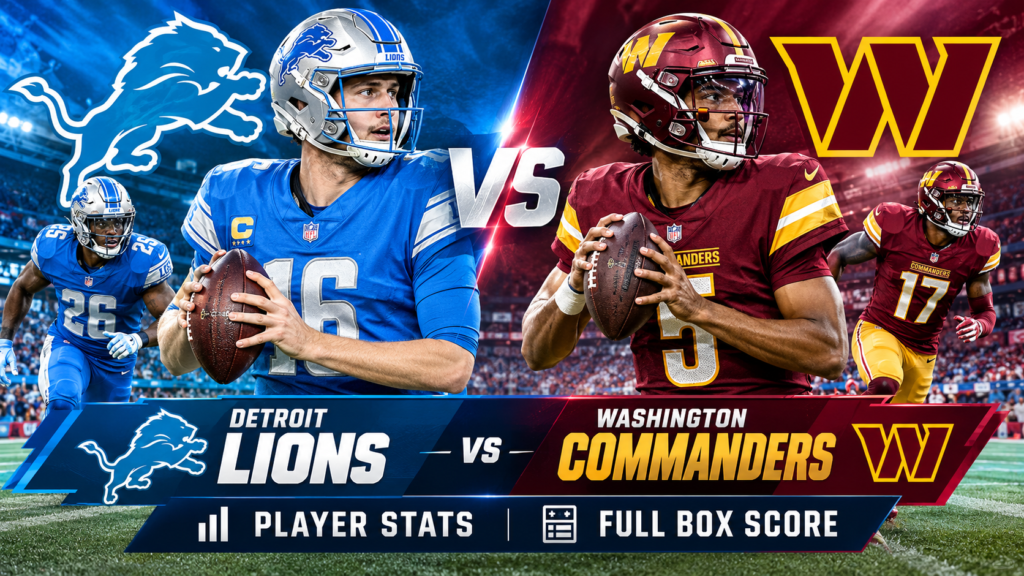
The Detroit Lions defeated the Washington Commanders 17–13 in their NFL preseason matchup at Ford Field. The game featured a long touchdown run by quarterback Joshua Dobbs, an important rushing score from Trayveon Williams, and several defensive plays that influenced the final result.
Washington opened the scoring with a defensive touchdown, but Detroit responded and gradually took control. Both teams scored seven points in the first quarter before the game remained scoreless in the second. The Lions then added a third-quarter touchdown and a decisive fourth-quarter field goal to secure the four-point victory.
For fans searching for Detroit Lions vs Washington Commanders match player stats, the box score provides a closer look at quarterback performances, rushing production, receiving leaders, defensive contributions, and the team statistics that shaped the contest.
Detroit Lions vs Washington Commanders Final Score
The preseason game took place at Ford Field, Detroit, Michigan. The Lions finished with 17 points, while the Commanders scored 13.
| Team | Q1 | Q2 | Q3 | Q4 | Final |
|---|---|---|---|---|---|
| Washington Commanders | 7 | 0 | 3 | 3 | 13 |
| Detroit Lions | 7 | 0 | 7 | 3 | 17 |
Detroit and Washington both scored touchdowns in the opening quarter. Neither team scored in the second quarter, making the third-quarter action particularly important. The Lions eventually established a four-point advantage and maintained it through the final whistle.
According to the official Washington Commanders game center, Detroit finished with 279 total net yards, compared with Washington’s 243. The Lions also recorded more time of possession, helping them manage the game during its closing stages.
| 🔗 You may also like: |
| Pittsburgh Steelers vs Detroit Lions match player stats |
| Texans vs Baltimore Ravens match player stats |
Detroit Lions vs Washington Commanders Team Stats
The overall statistics show that Detroit produced more total yardage and first downs. Washington, however, remained competitive and made several important defensive plays.
| Team Statistic | Washington Commanders | Detroit Lions |
|---|---|---|
| Final score | 13 | 17 |
| Total net yards | 243 | 279 |
| First downs | 9 | 17 |
| Penalties | 11 | 7 |
| Penalty yards | 84 | 35 |
| Time of possession | 27:18 | 32:42 |
| Third-down conversions | 4/12 | 9/17 |
| Fourth-down conversions | 0/1 | 2/2 |
| Red-zone scores | 0/2 | 1/3 |
Source: Official Washington Commanders game center.
Detroit’s advantage in first downs was one of the clearest differences between the teams. The Lions recorded 17 first downs, eight more than Washington. Their nine successful third-down conversions also helped extend possessions.
Penalties were another important factor. Washington committed 11 penalties for 84 yards, while Detroit was penalized seven times for 35 yards. Those extra yards could make it more difficult for the Commanders to sustain drives and reach scoring positions.
Despite these differences, the final score remained close. Washington’s defense created opportunities, and the Lions needed a late field goal to secure the win.
Washington Commanders Passing Stats
The Commanders used multiple quarterbacks during the preseason contest. Athan Kaliakmanis delivered the strongest passing performance by yardage, while Sam Hartman also completed several passes.
Washington Commanders quarterback box score
| Player | Completions/Attempts | Passing Yards | TD | INT |
|---|---|---|---|---|
| Athan Kaliakmanis | 11/14 | 162 | 0 | 0 |
| Sam Hartman | 9/11 | 67 | 0 | 0 |
| Jayden Daniels | 0/1 | 0 | 0 | 0 |
Athan Kaliakmanis
Kaliakmanis led Washington’s passing group with 162 yards on 11 completions from 14 attempts. He did not throw a touchdown or an interception in the supplied box score.
His completion rate was approximately 78.6%, reflecting an efficient passing performance. He also finished with the highest passing-yard total of any quarterback listed for either team.
For a preseason quarterback, these numbers offer useful information about passing accuracy and the ability to move the ball through the air. However, passing yards alone do not establish how well a quarterback performed in every situation. Pressure, third-down efficiency, decision-making, and the quality of each drive also matter.
Sam Hartman
Hartman completed nine of 11 attempts for 67 yards, with no passing touchdowns or interceptions. His completion rate was approximately 81.8%.
Although he recorded fewer passing yards than Kaliakmanis, Hartman’s completion percentage was slightly higher. He also contributed six rushing yards on one attempt.
His performance illustrates why quarterback statistics should be considered together. Completion percentage measures accuracy, while total passing yards provide a better indication of how much ground a quarterback covered through the passing game.
Jayden Daniels
Daniels recorded one passing attempt, which was incomplete. He finished with zero passing yards, touchdowns, and interceptions in the supplied statistics.
With only one attempt recorded, there is not enough passing volume to draw meaningful conclusions about his performance in this game.
Detroit Lions Passing Stats
Detroit relied on Joshua Dobbs and Luke Altmyer at quarterback. Altmyer led the Lions in passing yards, while Dobbs made his biggest contribution as a runner.
Detroit Lions quarterback box score
| Player | Completions/Attempts | Passing Yards | TD | INT |
|---|---|---|---|---|
| Luke Altmyer | 9/13 | 86 | 0 | 0 |
| Joshua Dobbs | 7/12 | 74 | 0 | 1 |
Luke Altmyer
Altmyer completed nine of 13 passes for 86 yards without a touchdown or interception. His completion rate was approximately 69.2%.
He finished with more passing yards than Dobbs, making him Detroit’s leading passer in the supplied box score. Altmyer also recorded three rushing attempts for three yards.
His statistics reflect a contribution through the passing game, although the overall effectiveness of his drives would require additional information, including play-by-play results and individual passing situations.
Joshua Dobbs
Dobbs completed seven of 12 attempts for 74 yards. He threw one interception but made up for much of his passing contribution with a remarkable rushing performance.
He carried the ball twice for 53 yards and one touchdown. His 50-yard touchdown run was the standout offensive play of the contest and helped Detroit answer Washington’s opening defensive score.
Dobbs’ performance demonstrates the difference between passing production and total offensive impact. Although his passing numbers were modest, his ability to gain significant yardage on the ground directly contributed to Detroit’s victory.
Detroit Lions vs Washington Commanders Rushing Stats
The running game played a major role in Detroit’s victory. The Lions received substantial production from Dobbs, Trayveon Williams, and Jacob Saylors.
Rushing leaders
| Player | Team | Carries | Rushing Yards | TD |
|---|---|---|---|---|
| Joshua Dobbs | Lions | 2 | 53 | 1 |
| Trayveon Williams | Lions | 10 | 36 | 1 |
| Jacob Saylors | Lions | 6 | 32 | 0 |
| Kaytron Allen | Commanders | 10 | 30 | 0 |
| Reggie Blackshear | Lions | 11 | 29 | 0 |
| Jordon Small | Lions | 3 | 16 | 0 |
| Sam Hartman | Commanders | 1 | 6 | 0 |
| Luke Altmyer | Lions | 3 | 3 | 0 |
The table highlights selected rushing performances rather than every player who recorded a carry.
Joshua Dobbs’ 50-yard touchdown run
Dobbs delivered the game’s most memorable offensive play when he broke free for a 50-yard touchdown run in the first quarter. The score helped Detroit respond after Washington had taken the lead through a defensive fumble recovery.
A long touchdown run can change the momentum of a preseason game because it rewards a successful block, effective running, and the ability to exploit space in the defense. Dobbs’ play also gave the Lions an immediate scoring answer without requiring a long passing drive.
He finished with 53 rushing yards on just two attempts, averaging 26.5 yards per carry. That average was influenced heavily by the long touchdown, but the play still made a decisive contribution to the result.
Trayveon Williams adds a touchdown
Williams recorded 36 rushing yards on 10 carries and scored one touchdown. His short rushing score in the third quarter gave Detroit a 14–10 lead after Washington had added a field goal.
Unlike Dobbs’ explosive run, Williams’ touchdown came from a short-distance rushing attempt. Both types of plays were valuable: one provided a major gain, while the other completed a scoring opportunity near the goal line.
Kaytron Allen leads Washington’s listed running backs
Allen carried the ball 10 times for 30 yards without scoring. His total placed him among Washington’s leading rushing contributors in the supplied statistics.
Although Allen did not produce a touchdown, his workload indicates that the Commanders used him regularly in the running game. Evaluating his overall effectiveness would also require details about blocking, short-yardage situations, and the downs on which his carries occurred.
| 🔗 You may also like: |
| New York Jets vs Baltimore Ravens match player stats |
| Tennessee Titans vs Cleveland Browns match player stats |
Detroit Lions vs Washington Commanders Receiving Stats
Washington’s receiving leaders produced several of the game’s biggest passing gains. Nick Nash led the listed receivers in yardage, while Detroit’s Jackson Meeks recorded the most receptions among the Lions players listed.
Receiving leaders
| Player | Team | Receptions | Receiving Yards | Longest Reception | TD |
|---|---|---|---|---|---|
| Nick Nash | Commanders | 2 | 62 | 55 | 0 |
| Jaden Bradley | Commanders | 2 | 42 | 30 | 0 |
| Antonio Williams | Commanders | 3 | 41 | 21 | 0 |
| Jacoby Jones | Commanders | 3 | 37 | 24 | 0 |
| Jackson Meeks | Lions | 4 | 33 | 11 | 0 |
| Trayveon Williams | Lions | 1 | 24 | 24 | 0 |
| Tyler Conklin | Lions | 2 | 21 | 18 | 0 |
| Cedrick Wilson Jr. | Lions | 2 | 21 | 17 | 0 |
Nick Nash leads the receiving chart
Nash finished with two receptions for 62 yards, including a 55-yard catch. He recorded the highest receiving-yard total among the players listed for both teams.
His average of 31 yards per reception shows how much impact one explosive play can have on a receiver’s final statistics. Even with only two catches, Nash generated more receiving yardage than any other player in the supplied receiving table.
Jaden Bradley and Antonio Williams contribute for Washington
Bradley recorded two catches for 42 yards, with a long reception of 30 yards. Williams added three receptions for 41 yards and a longest catch of 21 yards.
Together with Nash, their production helped Washington generate passing yardage despite failing to score an offensive passing touchdown in the listed statistics.
Jacoby Jones also contributed three receptions for 37 yards. These performances provided Washington with several receiving options rather than concentrating all the production in one player.
Jackson Meeks leads Detroit in receptions
Meeks caught four passes for 33 yards, making him Detroit’s leader in receptions among the listed players. His longest catch covered 11 yards.
Williams also contributed as a receiver, catching one pass for 24 yards. Conklin and Wilson each recorded two receptions for 21 yards.
These numbers show that Detroit distributed its receiving production among several players. The Lions’ offensive scoring, however, came through rushing touchdowns and a field goal rather than a passing touchdown.
Defensive Highlights and Key Plays
The defensive side of the game also played an important role. Washington produced an early defensive touchdown, while both teams recorded plays that affected field position and scoring opportunities.
Washington’s defensive touchdown
Washington opened the scoring when Joshua Josephs recovered a fumble in the end zone for a touchdown. Drew Stevens converted the extra point, giving the Commanders an early 7–0 lead.
The score highlighted the value of defensive awareness and ball recovery. A turnover can create points without the offense needing to move the ball downfield.
Detroit responded with Dobbs’ 50-yard rushing touchdown, tying the game at 7–7.
Maurice Hurst’s pass-rushing impact
The supplied defensive highlights credit Washington’s Maurice Hurst with five tackles and two sacks. Those figures identify him as one of the notable defensive contributors in the provided statistics.
Sacks can disrupt offensive rhythm by creating long-yardage situations and reducing the time available to execute passing plays. They may also force an offense to change its approach on subsequent downs.
Detroit generates pressure
D.J. Wonnum was credited in the supplied highlights with one sack, while Derrick Moore recorded one sack and one forced fumble. These plays illustrate Detroit’s ability to pressure the opposing offense and challenge ball security.
A forced fumble is especially important because it creates the possibility of an immediate change in possession. However, a forced fumble should not automatically be counted as a recovery; those are separate defensive statistics.
Quan Martin’s interception
The supplied defensive highlights also list an interception for Washington’s Quan Martin. An interception can stop an opposing drive and give the offense another opportunity to score.
Because the available team summary and player tables do not provide a complete defensive play-by-play breakdown, these individual defensive figures should be checked against the official detailed box score before publication.
Quarter-by-Quarter Game Highlights
First quarter: Both teams score touchdowns
Washington took an early 7–0 lead through Josephs’ fumble-recovery touchdown. Detroit answered when Dobbs ran 50 yards for a touchdown, bringing the score to 7–7.
The opening quarter established the game’s central themes: defensive pressure, turnovers, and the Lions’ ability to generate explosive rushing plays.
Second quarter: Neither team scores
Both teams were held scoreless in the second quarter. The lack of scoring kept the game level at halftime and left the outcome open.
For preseason teams, these periods can provide opportunities to evaluate different player combinations and defensive adjustments. The score alone, however, does not show which players performed best on individual drives.
Third quarter: Detroit takes the lead
Washington moved ahead 10–7 with a 27-yard field goal by Drew Stevens. Detroit answered late in the quarter when Williams scored on a one-yard rushing attempt.
The touchdown and successful extra point put the Lions ahead 14–10 entering the fourth quarter.
Fourth quarter: Detroit secures the win
Stevens converted a 32-yard field goal to bring Washington within one point at 14–13. Detroit then produced the final scoring play when Jake Bates made a 37-yard field goal.
That kick increased the Lions’ lead to 17–13. Washington could not produce enough additional scoring to overcome the deficit, and Detroit held on for the victory.
What the Box Score Reveals
Three major factors help explain Detroit’s win.
First, the Lions were more effective at sustaining drives. Detroit recorded 17 first downs compared with Washington’s nine. Its nine successful third-down conversions also helped the offense remain on the field.
Second, Detroit found value in the running game. Dobbs’ 50-yard touchdown run supplied an explosive scoring play, while Williams added a rushing touchdown. These scores proved more important than the Lions’ relatively modest passing totals.
Third, penalties favored Detroit. Washington lost 84 yards through penalties, compared with Detroit’s 35. The difference may have made some Washington drives more difficult to sustain.
Washington still demonstrated positive signs, including Kaliakmanis’ 162 passing yards and Nash’s 62 receiving yards. The Commanders also produced an early defensive touchdown and stayed within one score until the Lions’ final field goal.
| 🔗 You may also like: |
| Philadelphia Eagles vs Dallas Cowboys match player stats |
| Buffalo Bills vs Miami Dolphins match player stats |
Final Thoughts
The Detroit Lions defeated the Washington Commanders 17–13 in a preseason game decided by rushing touchdowns, defensive plays, and a late field goal. Joshua Dobbs delivered the most explosive offensive moment with his 50-yard touchdown run, while Trayveon Williams added a short rushing score to help Detroit establish its advantage.
Washington’s Kaliakmanis led the listed quarterbacks in passing yards, and Nick Nash was the leading receiver by yardage. Nevertheless, Detroit’s advantage in first downs, third-down conversions, and penalty yards helped the Lions maintain control of the contest.
The final box score shows that a team’s success is not determined by passing yards alone. Rushing efficiency, defensive pressure, turnovers, penalties, and the ability to finish scoring opportunities can all shape the outcome of a close NFL game.
FAQs
Who won the Detroit Lions vs Washington Commanders game?
The Detroit Lions won 17–13 against the Washington Commanders in the preseason matchup at Ford Field.
Who was the leading passer in the game?
Athan Kaliakmanis led the listed quarterbacks with 162 passing yards for Washington, completing 11 of 14 attempts without a touchdown or interception.
How many rushing yards did Joshua Dobbs record?
Dobbs recorded 53 rushing yards on two carries and scored one rushing touchdown. His longest run was a 50-yard touchdown.
Who led the game in receiving yards?
Nick Nash led the receiving leaders listed here with 62 yards on two receptions, including a 55-yard catch.
How did Trayveon Williams perform?
Williams rushed 10 times for 36 yards and one touchdown. He also caught one pass for 24 yards.
What was the halftime score?
The teams were tied 7–7 at halftime. Both teams scored in the first quarter, and neither scored in the second.
Where was the game played?
The game took place at Ford Field in Detroit, Michigan, the home stadium of the Detroit Lions.
Where can fans find the complete box score?
Fans can consult the official Washington Commanders game center for the matchup’s team statistics and listed passing, rushing, and receiving performances.