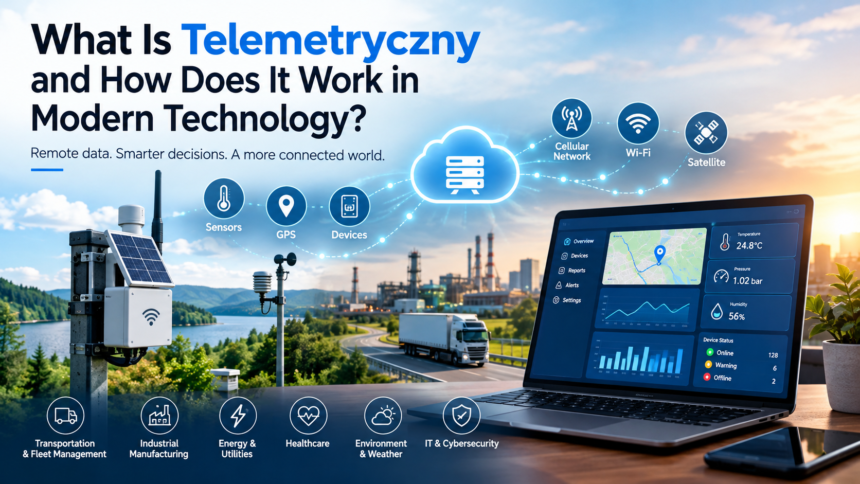
Telemetryczny is a Polish technical term that describes something related to telemetry, the process of measuring information remotely and transmitting it to another location. In English, its closest equivalent is telemetric, an adjective used for systems, devices, measurements, and technologies that collect and communicate data over a distance.
Although the word may seem unfamiliar to English-speaking readers, the technology behind it is widely used in modern life. Connected vehicles transmit engine information, weather stations report changing environmental conditions, and industrial sensors send equipment readings to monitoring platforms. These applications share the same basic principle: collecting information where it is generated and making it available somewhere else.
Understanding Telemetryczny helps explain how remote monitoring works, why organizations rely on transmitted data, and how telemetry supports industries ranging from transportation to healthcare and information technology.
What Does Telemetryczny Mean?
Telemetryczny comes from the Polish word telemetria, which means telemetry. It describes anything associated with remote measurement and the transmission of collected information.
For example, system telemetryczny means a telemetry system, while dane telemetryczne refers to telemetry data. These expressions are commonly associated with technical equipment that measures conditions and sends the resulting information to another device or central system.
The underlying concept is straightforward. Instead of requiring someone to inspect equipment physically every time a measurement is needed, a connected system can collect readings and transmit them automatically.
Consider a water tank installed at a remote industrial site. A sensor measures its water level and sends the reading to a monitoring platform. An operator can then check the available water supply without traveling to the tank.
However, telemetry does not always mean continuous monitoring. Some systems transmit readings every few seconds, while others report information at scheduled intervals or store measurements until a connection becomes available.
| 🔗 You may also like: |
| Software discovery is broken |
| Workforce management system cloud technology |
How Does Telemetryczny Technology Work?
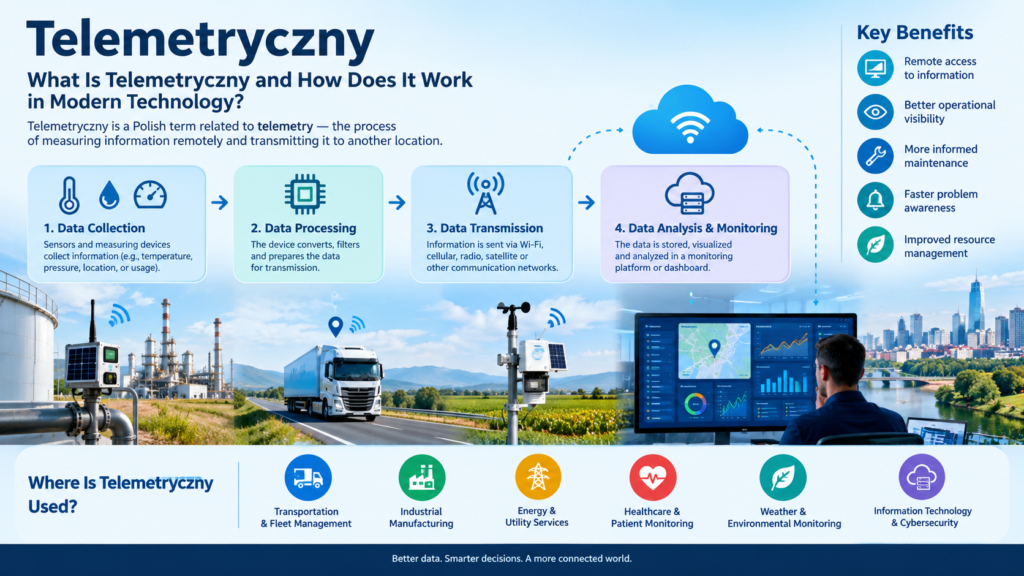
A typical telemetry system follows a sequence of connected steps: data collection, processing, transmission, and analysis. The exact design depends on what needs to be measured, where the equipment operates, and how quickly the information must reach its destination.
1. Data Collection
The process begins with a sensor, measuring instrument, or software component that collects information. Physical sensors may measure temperature, pressure, humidity, speed, vibration, or electrical consumption.
In digital environments, telemetry can also include application errors, server performance measurements, memory usage, and network activity.
The measurement method must suit the intended purpose. For instance, a temperature sensor installed in a factory requires different specifications from a medical device measuring a patient’s heart activity.
2. Data Processing
After collecting information, a device may process the readings before sending them. This can involve converting electrical signals into digital values, adding timestamps, checking measurement ranges, or organizing information into data packets.
A local controller may also filter unnecessary readings or identify conditions that require an immediate alert.
Processing at the source can reduce the amount of information transmitted, particularly when a device produces frequent measurements or operates through a limited-bandwidth connection.
3. Data Transmission
The processed information travels through a communication channel to a receiving device or monitoring platform. Depending on the installation, this may involve Wi-Fi, cellular networks, radio communication, satellite links, Ethernet, or other wired connections.
Remote equipment may use mobile networks such as LTE or specialized low-power communication technologies. The appropriate option depends on network availability, power consumption, coverage requirements, and operating costs.
An internet connection is not essential for every telemetry system. Some installations use dedicated radio links or other communication arrangements.
4. Data Analysis and Monitoring
Once the information reaches its destination, software can store, display, and analyze the readings. A dashboard may present current measurements, historical charts, equipment status, and notifications.
For example, a monitoring system might notify an operator when a machine’s temperature exceeds a configured limit. The operator can investigate the situation and decide whether maintenance is necessary.
The alert itself does not prove that a machine has failed. Reliable decisions require accurate measurements, appropriate thresholds, and an understanding of the equipment’s normal operating conditions.
Main Components of a Telemetry System
A telemetry system combines several components to move information from its source to a useful destination.
Sensors and measuring devices: These collect the information required for monitoring, such as temperature, location, pressure, or energy consumption.
Processing units: Controllers or embedded computers prepare readings for transmission and may perform preliminary calculations.
Communication modules: These transmit information using an appropriate network or communication protocol.
Data storage: Databases or local storage preserve readings for historical comparisons, reporting, and troubleshooting.
Monitoring software: Dashboards and analytical tools help users understand the data and respond to relevant changes.
Not every installation needs all these components in separate physical devices. A small sensor may combine measurement, processing, and communication capabilities in one unit, while a large industrial installation may use several interconnected systems.
Where Is Telemetryczny Technology Used?
Telemetry has practical applications wherever information must be collected from equipment, locations, or systems that are difficult to monitor continuously in person.
Transportation and Fleet Management
Transport companies use vehicle telemetry to monitor operational information and support fleet management. Depending on the vehicle and installed equipment, the collected data may include GPS position, speed, fuel consumption, engine temperature, battery status, and diagnostic trouble codes.
Fleet managers can use these measurements to review vehicle utilization, plan maintenance, investigate unusual fuel consumption, and understand driving patterns.
Vehicle telemetry is often integrated into telematics platforms, which may combine positioning, communication, mapping, and fleet-management functions. However, telemetry alone does not guarantee lower operating costs; results depend on the quality of the data and how the company uses it.
Industrial Manufacturing
Factories use telemetry to monitor equipment such as pumps, motors, compressors, generators, and production machinery.
Sensors can report vibration, temperature, pressure, or electrical measurements. Maintenance teams can examine changes over time and investigate unusual patterns before they lead to significant operational problems.
This approach can support condition-based maintenance and, where sufficient reliable data is available, predictive maintenance. It does not eliminate equipment failures, but it can provide additional information for maintenance planning.
Energy and Utility Services
Electricity, gas, and water providers can use telemetry to collect readings from connected meters and equipment.
For example, a smart meter may transmit electricity consumption information to a utility provider, reducing the need for manual readings. Remote monitoring can also help operators observe equipment conditions across geographically distributed infrastructure.
The available features depend on the meter, communication network, and utility system. Remote reading should not automatically be confused with remote control, as the two functions require different capabilities.
Healthcare and Patient Monitoring
Healthcare telemetry allows suitable medical devices to transmit measurements to monitoring equipment or authorized healthcare professionals.
In hospitals, cardiac telemetry can help clinical staff observe a patient’s heart rhythm without remaining physically beside the patient at all times. Other connected devices can support remote monitoring of selected physiological measurements.
These applications require appropriate medical equipment, reliable communication, data protection, and established clinical procedures. A transmitted reading is not a diagnosis by itself, and alerts must be interpreted by qualified healthcare professionals.
Weather and Environmental Monitoring
Weather stations and environmental monitoring networks often operate in locations that are difficult to visit regularly.
Sensors can measure rainfall, temperature, humidity, air quality, or river water levels and transmit the information to a central platform. Researchers and relevant authorities can use these readings to study environmental changes and support decisions about water management or weather-related risks.
For example, remote river gauges can provide water-level information that contributes to flood monitoring. The usefulness of such systems depends on sensor reliability, communication availability, and suitable interpretation of the measurements.
Information Technology and Cybersecurity
Telemetry also plays an important role in software and digital infrastructure.
Applications, servers, cloud platforms, and network devices can generate information about response times, errors, resource consumption, and system performance. Developers and IT teams collect these measurements to understand how services behave and identify technical problems.
The OpenTelemetry project provides open-source tools and standards for collecting and exporting software observability data, including metrics, logs, and traces.
For example, if an online store begins responding slowly, telemetry data can help developers investigate whether the problem originates in the application, database, or another connected service.
| 🔗 You may also like: |
| Buy or build AI agents companies |
| Guru knowledge base software |
What Is the Difference Between Telemetry, Telematics, and GPS Tracking?
These terms are related, but they describe different concepts.
| Term | Meaning | Example |
|---|---|---|
| Telemetry | Collecting and transmitting measurements or status information | Sending engine temperature to a monitoring dashboard |
| Telematics | Combining telecommunications and information processing, often for connected vehicles | A fleet platform that combines vehicle location, diagnostics, and reporting |
| GPS tracking | Determining a device or vehicle’s geographical position using satellite navigation | Showing a delivery van on a map |
GPS tracking can be one part of a telemetry or telematics system, but telemetry covers much more than location information.
Similarly, telematics platforms may use telemetry data alongside maps, communication services, and other tools. Understanding these differences helps businesses select technology that matches their actual monitoring requirements.
What Are the Main Benefits of Telemetryczny Technology?
Remote Access to Information
Telemetry allows people to observe equipment and conditions without always visiting the location. This is particularly useful for remote industrial sites, distributed infrastructure, and devices operating in difficult environments.
Better Operational Visibility
Regular measurements help organizations understand how systems perform over time. Historical records can reveal recurring problems, changing operating conditions, or differences between expected and actual performance.
More Informed Maintenance
Equipment measurements can help maintenance teams investigate unusual behavior and plan inspections. When the data is accurate and interpreted correctly, this can support earlier intervention and more effective use of maintenance resources.
Faster Awareness of Problems
Some telemetry systems provide alerts when readings exceed defined thresholds or when a device stops reporting. These notifications can help operators investigate issues sooner, although communication delays and incorrect readings remain possible.
Improved Resource Management
Remote measurements of energy, water, fuel, and equipment utilization can provide useful information for operational planning. Organizations can use the data to evaluate consumption patterns and identify opportunities for improvement.
The benefits depend on the specific application. Installing telemetry does not automatically improve performance unless the collected information leads to appropriate decisions or actions.
What Are the Challenges of Telemetry Systems?
Despite its advantages, telemetry introduces technical, financial, and security considerations.
Connectivity problems: Remote devices may experience weak signals, network outages, or delayed transmission. Some systems need local storage to preserve measurements during interruptions.
Measurement accuracy: Damaged sensors, poor calibration, and unsuitable installation conditions can produce incorrect readings. Reliable communication cannot correct inaccurate measurements at the source.
Cybersecurity risks: Connected equipment can become a target for unauthorized access if security is neglected. Appropriate device authentication, encryption, access controls, and software updates help reduce these risks.
Privacy concerns: Certain systems collect location information, personal measurements, or data that reveals individual behavior. Organizations should limit collection to legitimate needs and protect sensitive information.
Cost and maintenance: Sensors, communication services, software integration, and equipment replacement all contribute to the overall cost. A solution should be evaluated according to its expected operational value rather than its features alone.
Is Telemetryczny the Same as Real-Time Monitoring?
Not necessarily. Telemetry describes the collection and transmission of measurements, while real-time monitoring refers to how quickly information becomes available and can be acted upon.
Some systems send measurements almost immediately, making them suitable for applications that require rapid awareness. Other devices transmit readings every few minutes, every hour, or according to a different schedule.
The appropriate reporting interval depends on the purpose of the system. A remote environmental station may not need to report every second, while a safety-critical industrial application may require faster updates and additional safeguards.
It is also important to distinguish the time a measurement was taken from the time it arrived at the receiving platform. Timestamps and data-quality checks help users identify delayed or incomplete information.
How to Choose the Right Telemetry Solution
Choosing a suitable telemetry system starts with identifying what needs to be monitored and why.
First, determine which measurements are essential and how frequently they must be collected. Next, assess the operating environment, including power availability, temperature, network coverage, and physical access.
Consider the accuracy requirements, data storage arrangements, integration with existing software, and security controls. If devices must operate in remote locations, evaluate whether the system can retain readings during communication outages.
It is also useful to calculate the total cost of ownership, including equipment, connectivity, software, maintenance, and future upgrades. Testing the solution in realistic conditions before a large deployment can reveal problems that may not be obvious during initial planning.
The best system is one that provides dependable information for a clearly defined purpose without unnecessary complexity.
The Future of Telemetryczny Technology
Telemetry continues to develop alongside connected devices, communication networks, and data-processing technologies.
One important area is edge computing, which allows devices or nearby computers to process information before sending it elsewhere. This can reduce network traffic and support faster local responses in suitable applications.
Another development is the growing use of analytics and machine learning to identify unusual measurements or recognize patterns in large datasets. These methods can support equipment monitoring and software troubleshooting, but their performance depends on data quality and appropriate validation.
Connected infrastructure also creates a greater need for security, interoperability, and efficient power use. Organizations must ensure that monitoring systems remain maintainable as equipment and communication technologies change.
The basic principle remains the same: collect meaningful measurements, communicate them reliably, and use them to understand a system more effectively.
| 🔗 You may also like: |
| AI game development for personalized playeexpr eriences |
| How cloud telephony helps small businesses improve customer communication and scale operations |
Conclusion
Telemetryczny is a Polish adjective meaning telemetric or related to telemetry. It describes technologies and processes that measure information and transmit it to another location for monitoring, storage, or analysis.
These systems support a wide range of applications, including fleet management, industrial maintenance, utility services, healthcare, environmental research, and software observability. Their value comes from making remote information accessible and helping people make better-informed decisions.
However, successful telemetry requires more than connected sensors. Accurate measurements, reliable communication, appropriate analysis, cybersecurity, and responsible data management are all essential.
As digital infrastructure and connected devices continue to develop, telemetry will remain an important part of how modern organizations observe and manage complex systems.
FAQs
What does Telemetryczny mean in English?
Telemetryczny is a Polish adjective meaning telemetric or related to telemetry. It describes systems, devices, measurements, or processes associated with remote data collection and transmission.
Is Telemetryczny a technology or a company?
It is a Polish descriptive term, not inherently the name of a company or a specific technology. Its meaning depends on the context in which it appears.
How does a telemetry system work?
A telemetry system collects measurements through sensors or software, transmits the information through a communication channel, and makes it available for monitoring or analysis.
Is telemetry the same as GPS tracking?
No. GPS tracking identifies geographical position, while telemetry includes many other kinds of information, such as temperature, pressure, fuel consumption, and equipment performance.
Does telemetry require an internet connection?
No. Depending on the application, telemetry can use cellular networks, radio links, satellite communication, wired connections, or other transmission methods.
Is telemetry data always accurate?
No. Accuracy depends on sensor quality, calibration, installation, operating conditions, and data processing. Measurements should be checked before they are used for important decisions.
Why is telemetry important in modern technology?
Telemetry makes remote monitoring possible. It helps organizations observe equipment, understand performance, investigate problems, and use collected information to support operational decisions.