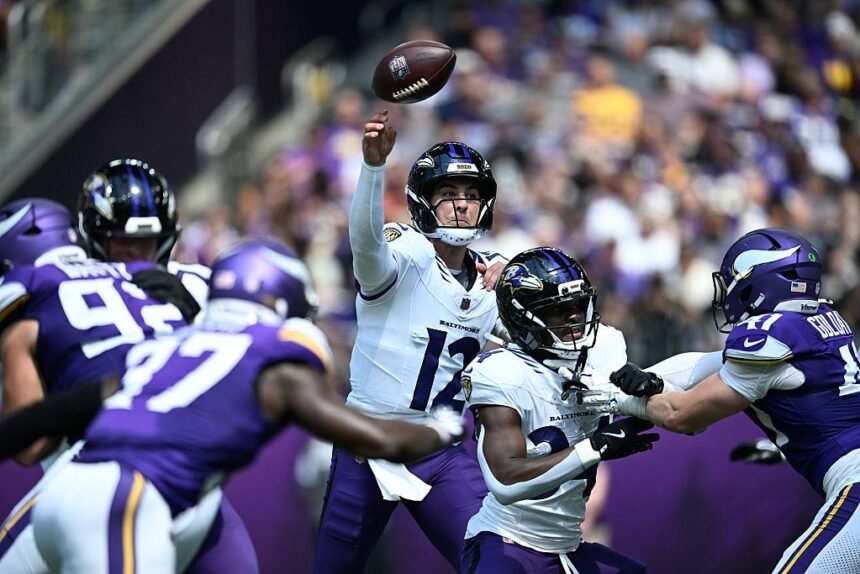
The Baltimore Ravens defeated the Minnesota Vikings 13-3 in their NFL preseason Week 2 matchup on August 22, 2026, at U.S. Bank Stadium. The game featured a strong defensive performance from Baltimore, a touchdown from quarterback Joe Fagnano’s passing game, and several notable contributions from both teams’ young players.
The Baltimore Ravens vs Minnesota Vikings match player stats provide a closer look at the passing, rushing, receiving, and defensive performances that shaped the final result. Although Minnesota produced more total yards according to the available team statistics, Baltimore converted key opportunities into points and kept the Vikings out of the end zone.
This article covers the final score, quarter-by-quarter scoring, individual player statistics, standout performances, and key takeaways from the preseason contest.
Baltimore Ravens vs Minnesota Vikings: Game Overview
Game details
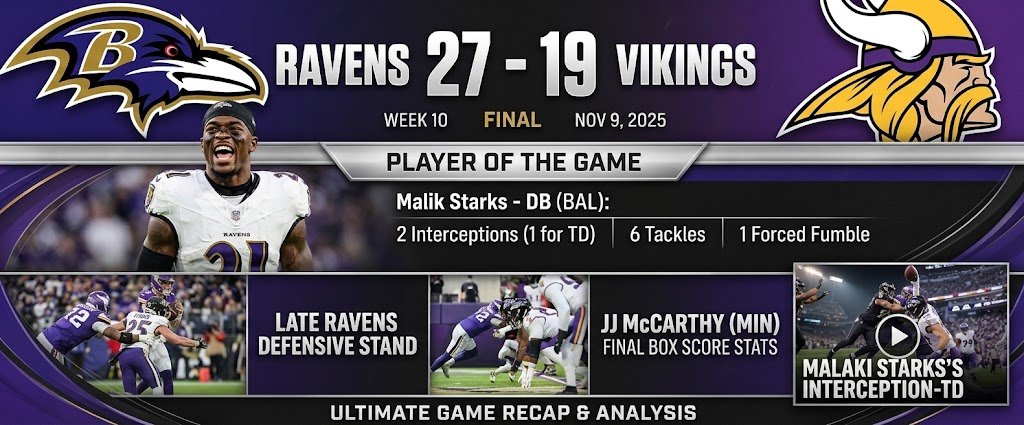
Final score: Baltimore Ravens 13, Minnesota Vikings 3
Date: August 22, 2026
Venue: U.S. Bank Stadium, Minneapolis, Minnesota
Competition: NFL preseason, Week 2
| Team statistic | Ravens | Vikings |
| Total net yards | 242 | 299 |
| Passing yards (net) | 184 | 234 |
| Rushing yards | 58 | 65 |
| Total plays | 53 | 61 |
| Time of possession | 30:40 | 29:20 |
| Penalties | 9 | 9 |
| Penalty yards | 80 | 73 |
Minnesota gained 57 more net yards than Baltimore, but the Vikings could not turn that advantage into touchdowns. Baltimore’s defense created important stops and a late interception, while its offense scored the game’s only touchdown. The comparison illustrates why total yardage alone does not determine a football game’s result.
| 🔗 You may also like: |
| New York Jets vs Baltimore Ravens match player stats |
| Texans vs Baltimore Ravens match player stats |
Quarter-by-Quarter Scoring
The game was tied at 3-3 at halftime. Baltimore took control in the third quarter with a touchdown and added another field goal in the fourth to secure the 13-3 victory.
| Quarter | Ravens | Vikings |
| First | 0 | 0 |
| Second | 3 | 3 |
| Third | 7 | 0 |
| Fourth | 3 | 0 |
| Final | 13 | 3 |
Second quarter: Both teams score field goals
Baltimore opened the scoring with a 49-yard field goal by Tyler Loop. Minnesota responded with a 52-yard field goal from Will Reichard, bringing the score level at 3-3.
Neither offense managed to score a touchdown in the first half. Both teams had opportunities to evaluate their passing games and depth players, but defensive pressure and limited rushing production kept the contest close.
Third quarter: Joe Fagnano connects with LaJohntay Wester
The key scoring play came in the third quarter when Ravens quarterback Joe Fagnano connected with wide receiver LaJohntay Wester for an eight-yard touchdown. Loop converted the extra point, giving Baltimore a 10-3 lead.
That touchdown was the difference between the teams’ offensive production. Minnesota was unable to answer with a touchdown of its own, leaving Baltimore in control for the remainder of the game.
Fourth quarter: Tyler Loop adds insurance
Baltimore extended its lead to 13-3 with a 20-yard field goal by Loop in the fourth quarter. Minnesota remained scoreless after halftime, and the Ravens held their ten-point advantage until the final whistle.
Baltimore Ravens vs Minnesota Vikings Passing Stats
Passing performance is an important part of the Baltimore Ravens vs Minnesota Vikings match player stats because both teams used multiple quarterbacks during the preseason contest.
Joe Fagnano led Baltimore’s passing attack with 123 yards and one touchdown. Minnesota’s quarterbacks collectively threw for more yards, but the Vikings did not record a passing touchdown and threw one interception.
Baltimore Ravens passing stats
| Player | Completions/Attempts | Passing yards | TD | INT |
| Joe Fagnano | 15/20 | 123 | 1 | 0 |
| Tyler Huntley | 5/8 | 63 | 0 | 0 |
| Austin Reed | 1/2 | 7 | 0 | 0 |
| Team total | 21/30 | 193 gross | 1 | 0 |
Baltimore recorded 193 gross passing yards and 184 net passing yards after sack yardage.
Fagnano completed 75% of his passes, making him Baltimore’s most productive quarterback by passing volume. His touchdown connection with Wester supplied the game’s only touchdown and helped the Ravens turn a close contest into a winning result.
Huntley completed five of eight attempts for 63 yards without an interception. Austin Reed completed one of two passes for seven yards. Together, the three quarterbacks completed 21 of 30 attempts, with no interceptions.
Minnesota Vikings passing stats
| Player | Completions/Attempts | Passing yards | TD | INT |
| J.J. McCarthy | 5/10 | 81 | 0 | 0 |
| Carson Wentz | 9/11 | 92 | 0 | 0 |
| Max Brosmer | 11/17 | 98 | 0 | 1 |
| Team total | 25/38 | 271 gross | 0 | 1 |
Minnesota recorded 271 gross passing yards and 234 net passing yards after sack yardage.
Max Brosmer led Minnesota in passing yards with 98, completing 11 of 17 attempts. However, his interception ended a promising fourth-quarter possession and prevented the Vikings from building further momentum.
Wentz completed nine of 11 passes for 92 yards, producing the highest completion percentage among Minnesota’s three quarterbacks. McCarthy finished with 81 yards on five completions from ten attempts. His performance included an impressive deep connection with Tai Felton, although Baltimore’s pass rush also put pressure on him.
Rushing Stats: Ravens vs Vikings
Both teams found the ground game challenging. Baltimore recorded 58 rushing yards on 22 attempts, while Minnesota gained 65 yards on 18 attempts. Neither side scored a rushing touchdown.
Baltimore Ravens rushing stats
| Player | Carries | Yards | Average | TD |
| Jonathan Ward | 10 | 35 | 3.5 | 0 |
| Tyler Huntley | 3 | 10 | 3.3 | 0 |
| Joe Fagnano | 2 | 10 | 5.0 | 0 |
| Elijah Tau-Tolliver | 2 | 5 | 2.5 | 0 |
| De’Marian McMillan | 3 | -1 | -0.3 | 0 |
| Austin Reed | 2 | -1 | -0.5 | 0 |
| Team total | 22 | 58 | 2.6 | 0 |
Jonathan Ward was Baltimore’s leading rusher, gaining 35 yards on ten carries. His workload gave the Ravens a consistent option on the ground, although the average of 3.5 yards per attempt shows that explosive running plays were limited.
Huntley and Fagnano each added ten rushing yards. Fagnano averaged five yards per carry, giving him a small contribution beyond his passing performance. Overall, Baltimore relied more on its passing game and defense than on a dominant rushing attack.
| 🔗 You may also like: |
| Buffalo Bills vs Miami Dolphins match player stats |
| Denver Broncos vs Indianapolis Colts match player stats |
Minnesota Vikings rushing stats
| Player | Carries | Yards | Average | TD |
| Zavier Scott | 7 | 28 | 4.0 | 0 |
| Demond Claiborne | 8 | 18 | 2.3 | 0 |
| Jermar Jefferson | 2 | 15 | 7.5 | 0 |
| Max Brosmer | 1 | 4 | 4.0 | 0 |
| Team total | 18 | 65 | 3.6 | 0 |
Zavier Scott led Minnesota with 28 rushing yards on seven attempts. Claiborne had the most carries among the listed Vikings running backs, recording 18 yards on eight attempts.
Jermar Jefferson delivered the longest run of the game among the listed rushing plays, gaining 15 yards on one attempt. Despite that contribution, Minnesota could not establish a consistent rushing attack or turn its yardage into a touchdown.
Receiving Stats: Top Wide Receivers and Tight Ends
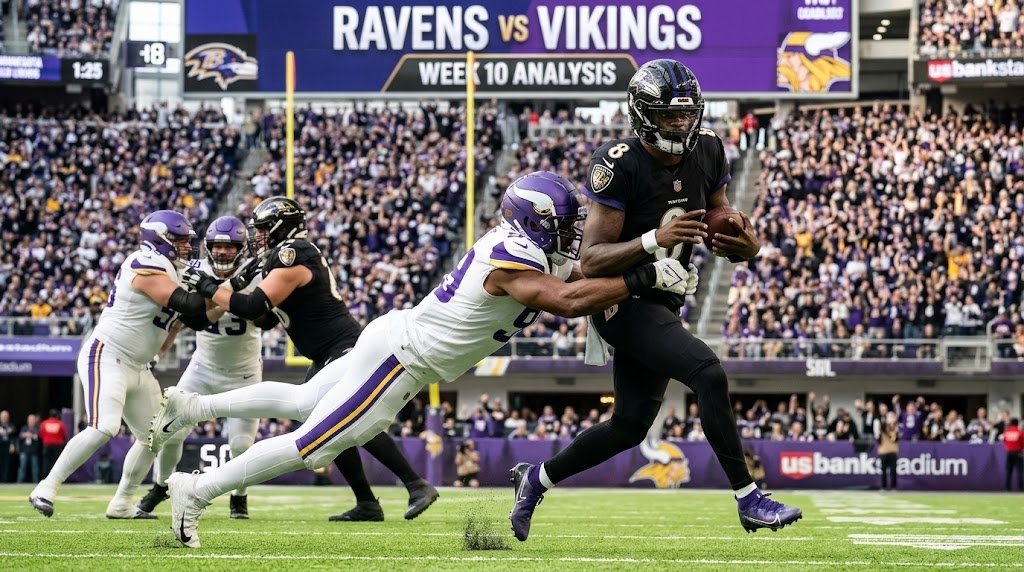
The receiving numbers show that Minnesota generated several substantial gains through the air, while Baltimore benefited from a touchdown reception and balanced contributions from its targets.
For the Ravens, Josh Cuevas led the listed receivers in yardage. For the Vikings, Tai Felton finished with the most receiving yards and recorded the longest reception among the listed players.
Baltimore Ravens receiving stats
| Player | Receptions | Yards | Average | TD |
| LaJohntay Wester | 5 | 24 | 4.8 | 1 |
| Josh Cuevas | 3 | 46 | 15.3 | 0 |
| Devontez Walker | 2 | 32 | 16.0 | 0 |
| Dayton Wade | 3 | 30 | 10.0 | 0 |
| Jonathan Ward | 1 | 15 | 15.0 | 0 |
| Elijah Tau-Tolliver | 3 | 14 | 4.7 | 0 |
| Xavier Guillory | 1 | 13 | 13.0 | 0 |
| Ja’Kobi Lane | 1 | 9 | 9.0 | 0 |
| Cornelius Johnson | 1 | 7 | 7.0 | 0 |
| Elijah Sarratt | 1 | 3 | 3.0 | 0 |
Josh Cuevas led Baltimore’s listed pass catchers with 46 yards on three receptions. His average of 15.3 yards per catch gave the Ravens an effective downfield option, while Walker added 32 yards on two catches.
Wade contributed three receptions for 30 yards, offering another reliable target. Wester, however, made the most important catch of the game. His eight-yard touchdown reception from Fagnano in the third quarter gave Baltimore the lead it would not surrender.
Wester’s five catches produced 24 yards, so his overall yardage was lower than that of Cuevas. Nevertheless, his touchdown made his contribution especially significant in a game with limited scoring.
Minnesota Vikings receiving stats
| Player | Receptions | Yards | Average | TD |
| Tai Felton | 3 | 66 | 22.0 | 0 |
| Jeshaun Jones | 5 | 63 | 12.6 | 0 |
| Dillon Bell | 6 | 51 | 8.5 | 0 |
| Dontae Fleming | 2 | 16 | 8.0 | 0 |
| Bryson Nesbit | 1 | 16 | 16.0 | 0 |
| Gavin Bartholomew | 1 | 15 | 15.0 | 0 |
| Jermar Jefferson | 1 | 9 | 9.0 | 0 |
| Zavier Scott | 1 | 8 | 8.0 | 0 |
| Myles Price | 1 | 8 | 8.0 | 0 |
| Terril Davis | 1 | 7 | 7.0 | 0 |
| Demond Claiborne | 1 | 7 | 7.0 | 0 |
| Marshall Lang | 1 | 6 | 6.0 | 0 |
| Benjamin Yurosek | 1 | -1 | -1.0 | 0 |
Tai Felton was Minnesota’s leading receiver, recording 66 yards on three catches. His average of 22 yards per reception highlights his ability to create significant gains, including a 50-yard reception.
Jeshaun Jones added 63 yards on five catches, while Dillon Bell led the team in receptions with six for 51 yards. These three players accounted for 180 receiving yards, providing much of Minnesota’s aerial production.
Despite these contributions, the Vikings did not score a receiving touchdown. Their challenge was not simply gaining yards; they needed to convert those gains into points against Baltimore’s defense.
Defensive Player Stats and Special Teams Highlights
The defensive and special-teams performances were central to Baltimore’s victory. Minnesota gained more total yards, but the Ravens made critical plays, including a sack, a forced fumble, and an interception that helped prevent a late comeback. The Vikings also lost a fumble during the game.
Baltimore Ravens defensive highlights
| Player | Tackles | Sacks | Other contribution |
| Keondre Jackson | 8 | 1.0 | 2 tackles for loss |
| Silas Walters | 4 | 0 | 1 interception |
| Ethan Burke | 3 | 1.0 | 1 forced fumble |
| Mike Green | 2 | 1.0 | Pass-rush pressure |
Keondre Jackson led the listed Baltimore defenders with eight total tackles, one sack, and two tackles for loss. His production helped limit Minnesota’s ability to maintain a productive running game.
Silas Walters made one of the game’s important defensive plays with an interception of Brosmer in the fourth quarter. The turnover ended a Minnesota drive that had advanced 57 yards, denying the Vikings a chance to narrow the score.
Ethan Burke recorded a sack and forced a fumble, while Mike Green contributed another sack. Baltimore’s ability to pressure opposing quarterbacks was particularly important against a Minnesota offense that generated yards but failed to score after halftime.
Kicking and special teams
| Kicker | Team | Field goals | Longest FG | Extra points | Points |
| Tyler Loop | Ravens | 2/2 | 49 yards | 1/1 | 7 |
| Will Reichard | Vikings | 1/1 | 52 yards | 0/0 | 3 |
Tyler Loop scored seven points for Baltimore, converting field goals from 49 and 20 yards and making the extra point after Wester’s touchdown. His two successful field goals helped Baltimore build a ten-point winning margin.
Will Reichard converted Minnesota’s 52-yard field goal, accounting for all three of the Vikings’ points. Both kickers were accurate on their field-goal attempts, but Baltimore’s touchdown provided the decisive scoring advantage.
Why Did the Baltimore Ravens Beat the Minnesota Vikings?
The final score may suggest a completely one-sided contest, but the team statistics tell a more detailed story. Minnesota finished with 299 total net yards compared with Baltimore’s 242. The Vikings also recorded more passing yards and rushing yards.
However, the Ravens were more successful at turning a scoring opportunity into a touchdown, and their defense made important plays at key moments.
1. Baltimore scored the only touchdown
Fagnano’s touchdown pass to Wester was the game’s most important offensive play. Minnesota could not match it, leaving the Vikings dependent on field goals to score. In a low-scoring contest, that difference proved decisive.
2. Defensive pressure disrupted Minnesota
Baltimore’s pass rush made life difficult for the Vikings’ quarterbacks. Minnesota’s offense was sacked multiple times, and the defense forced turnovers that interrupted promising drives. Mike Green’s pressure on McCarthy was among the notable defensive developments reported after the game.
3. Minnesota failed to convert yards into points
The Vikings produced 299 net yards but scored only three points. Felton, Jones, and Bell all recorded productive receiving performances, yet Minnesota could not turn its passing yardage into a touchdown.
This gap between yardage and scoring was one of the clearest differences between the teams. Baltimore did not need to win the yardage battle because it protected its lead and made better use of its scoring opportunities.
4. Turnovers affected Minnesota’s chances
The Vikings lost a fumble and threw an interception. Those mistakes reduced their opportunities to score and gave Baltimore chances to control the closing stages. Walters’ late interception was especially damaging because it ended a drive that had moved deep enough to offer Minnesota a potential scoring opportunity.
| 🔗 You may also like: |
| Philadelphia Eagles vs Dallas Cowboys match player stats |
| Pittsburgh Steelers vs Detroit Lions match player stats |
Key Takeaways From the Match Player Stats
The box score offers several useful takeaways for fans reviewing the Ravens vs Vikings preseason game.
- Joe Fagnano delivered Baltimore’s key passing performance. He completed 15 of 20 passes for 123 yards and one touchdown without an interception.
- LaJohntay Wester provided the decisive score. His touchdown reception was the only touchdown of the game.
- Tai Felton led Minnesota’s receivers. He finished with 66 yards on three catches, including a 50-yard reception.
- J.J. McCarthy had a mixed outing. He passed for 81 yards on five completions from ten attempts, while Baltimore’s pass rush created pressure.
- Baltimore’s defense made the difference. The Ravens recorded sacks, forced a fumble, and intercepted Brosmer.
- Special teams were reliable for both sides. Loop converted both field goals, while Reichard made Minnesota’s only field goal.
Because this was a preseason game, the statistics are best understood as a snapshot of player performance in that particular contest. Preseason results can help teams evaluate depth and execution, but they do not by themselves establish how players will perform over an entire regular season.
Conclusion
The Baltimore Ravens vs Minnesota Vikings match player stats show how Baltimore secured a 13-3 preseason victory despite finishing with fewer total yards. Joe Fagnano delivered the game’s only touchdown pass, LaJohntay Wester made the decisive reception, and Tyler Loop contributed seven points through reliable kicking.
Minnesota’s passing game produced useful yardage, particularly through Tai Felton, Jeshaun Jones, and Dillon Bell. However, turnovers, defensive pressure, and the inability to score a touchdown prevented the Vikings from converting their production into a comeback.
For fans examining the full box score, the main lesson is clear: Baltimore combined timely offense with important defensive plays, while Minnesota’s yardage advantage was not enough to change the result.
FAQs
Who won the Baltimore Ravens vs Minnesota Vikings game?
The Baltimore Ravens defeated the Minnesota Vikings 13-3 on August 22, 2026, in their NFL preseason Week 2 matchup at U.S. Bank Stadium.
How many passing yards did Joe Fagnano record?
Joe Fagnano threw for 123 yards, completing 15 of 20 passes. He recorded one touchdown and no interceptions, including the scoring pass to LaJohntay Wester.
Who was Minnesota’s leading receiver?
Tai Felton led the Vikings with 66 receiving yards on three receptions. His longest catch covered 50 yards, and he finished without a receiving touchdown.
How many points did Tyler Loop score?
Tyler Loop scored seven points for Baltimore. He made two field goals and one extra point.
Which team had more total yards?
Minnesota finished with 299 total net yards, while Baltimore recorded 242. Despite gaining more yards, Minnesota lost because it failed to score a touchdown and could not overcome Baltimore’s defensive stops.
What was the final score by quarter?
Baltimore scored 0, 3, 7, and 3 points across the four quarters. Minnesota scored 0, 3, 0, and 0, resulting in a final score of Ravens 13, Vikings 3.