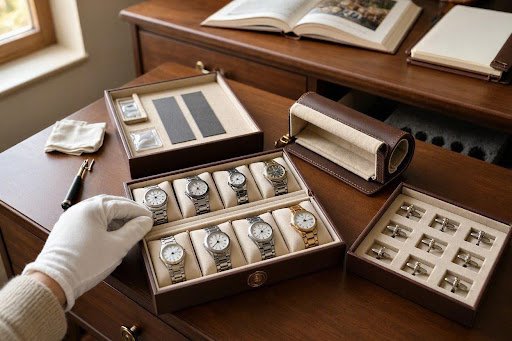
Most collections don’t get ruined by bad luck. They get ruined by bad storage.
A scratched crystal, a stalled automatic movement, a cufflink that vanishes into a junk drawer — these are storage failures, not accidents. The good news is that fixing them takes almost no effort once you know what actually matters.
This guide breaks down exactly how to store, protect, and organize watches and cufflinks so they stay in the condition you paid for.
Why Storage Matters More Than People Think
A watch or cufflink set represents real money sitting in a small object. Poor storage puts that value at risk in three ways:
- Physical damage. Loose watches knock against each other in a drawer, scratching cases and crystals.
- Movement damage. Automatic watches left still for weeks can develop lubrication issues when the movement dries out unevenly.
- Loss. Small items like cufflinks are the easiest things in a wardrobe to misplace.
None of these problems are expensive to solve. They’re just easy to ignore until something goes wrong.
What to Look for in Watch Storage
Not all watch boxes are built the same. Before buying anything, check for these five things:
- Individual compartments. Watches should never touch each other in storage.
- Soft interior lining. Velvet or microsuede protects cases and straps from micro-scratches.
- A secure, tight-fitting lid. Dust is the enemy of both leather straps and exposed crown mechanisms.
- Stable placement. A box on a wobbly shelf defeats the purpose of a box at all.
- Room to grow. Most collectors add more pieces than they planned for.
If you’re shopping for a starting point, the Aevitas UK store carries cases built around exactly these standards, which makes comparing options far easier than sorting through generic listings.
Cufflinks: The Most Underrated Storage Problem
Cufflinks get less attention than watches, but they’re arguably harder to store well. They’re small, easy to separate from their pair, and prone to getting mixed in with loose change or tossed into a catch-all tray.
A few habits fix this instantly:
- Store pairs together, always. Never place cufflinks loose in a drawer.
- Use a compartmentalized box, not a bowl. Bowls invite tangling and mismatched pairs.
- Keep cufflinks away from watches with exposed crowns. Metal-on-metal contact causes fine scratching over time.
- Label sections by occasion (formal, everyday, novelty) if your collection has grown past a dozen pairs.
Combination boxes that handle both watches and cufflinks in one unit solve most of this at once. If you want to see what a well-designed version looks like, you can explore watch cufflink boxes options built specifically for this dual purpose.
Automatic Watches: Why Storage and Motion Both Matter
Manual and quartz watches are simple to store — they just sit. Automatic watches are different. They rely on wrist movement to stay wound, and an automatic watch left untouched will stop within 24 to 48 hours.
That’s not damage on its own. But repeatedly letting a watch stop and restarting it by hand does two things:
- It forces you to reset the time and date every time, which is tedious on complicated movements.
- It means the watch spends long stretches completely still, which some watchmakers argue isn’t ideal for lubrication distribution over years of storage.
This is where a watch winder comes in. It keeps an automatic watch gently rotating on a schedule, so the movement stays lubricated and ready to wear without daily winding.
You don’t need to buy an expensive off-the-shelf winder to get this benefit. Several collectors have started building their own, and it’s simpler than it sounds. There’s a full walkthrough on building a quiet, low-power version yourself — check it out if you’d rather build than buy.
Choosing Between a Box, a Winder, or Both
Here’s a simple way to decide what your collection actually needs:
| Situation | Best Solution |
| Only quartz or manual watches | A basic compartmentalized box |
| One or two automatic watches worn in rotation | A box, plus manual winding when you switch |
| Three or more automatics worn irregularly | A winder for the ones you’re not wearing |
| Mixed collection with cufflinks | A combination storage box, plus a winder for automatics |
Most people overbuy at the start and underbuy later. Start with proper compartmentalized storage first. Add a winder once you notice you’re resetting an automatic watch more than once a week.
Placement and Environment Matter Too
Where you keep your storage matters almost as much as the storage itself.
- Avoid direct sunlight. UV exposure fades dials and dries out leather straps.
- Avoid humid rooms. Bathrooms and laundry areas introduce moisture that accelerates corrosion on metal components.
- Avoid extreme temperature swings. A closet near an exterior wall or a garage isn’t ideal for long-term storage.
- Keep it at a stable, moderate temperature, similar to normal room conditions.
The <cite index=”0-1″>American Watchmakers-Clockmakers Institute</cite> notes that consistent temperature and humidity control is one of the simplest ways to extend the working life of a mechanical movement, which is why placement deserves as much thought as the box itself.
A Simple Maintenance Routine
Good storage isn’t a one-time setup. A short routine keeps everything in shape:
- Wipe cases and lids weekly to prevent dust buildup.
- Check winder settings monthly to confirm rotation direction and turns-per-day match each watch’s manufacturer specs.
- Inspect cufflink pairs quarterly to catch any that have separated or gone missing.
- Reassess storage capacity yearly as your collection changes.
None of this takes more than a few minutes at a time, but skipping it for a year is exactly how small problems become expensive ones.
Final Thoughts
Organizing a watch and cufflink collection isn’t complicated, but it does require intention. Separate compartments, the right materials, sensible placement, and a small routine will do more for your collection’s condition than any single expensive purchase.
Start with proper storage for what you already own. Add a winder if your automatics are stopping more often than you’d like. From there, maintenance is mostly about consistency, not effort.
FAQs
Do I need a watch winder if I only own one automatic watch?
Not necessarily. If you wear it regularly, manual winding when you put it on is enough. A winder becomes useful once you own multiple automatics and don’t wear all of them daily.
Can I store watches and cufflinks in the same box?
Yes, as long as the box has separate compartments for each. Combination boxes are designed to prevent metal-on-metal contact between the two.
How often should I clean a watch storage box?
A quick wipe-down weekly keeps dust from building up, especially if the box sits in a bedroom or dressing area with regular foot traffic.
Will a cheap watch winder damage an automatic movement?
A poorly built winder with inconsistent rotation can cause more wear than benefit. If you’re building your own, following a tested design matters more than the cost of parts.
What’s the biggest mistake people make with cufflink storage?
Storing them loose in a drawer or bowl. Pairs get separated, and constant contact with other metal objects causes fine scratching over time.