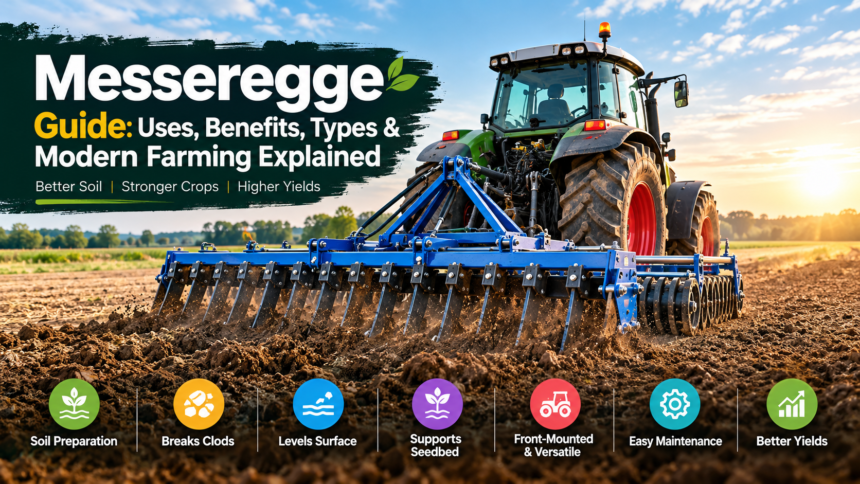
Messeregge is a German agricultural term used for a blade-equipped harrow or scarifying attachment designed for shallow soil preparation. It typically uses rows of steel knife-like elements to break larger soil clods, level the field surface, and create a more suitable seedbed before or alongside rolling.
Although the word is unfamiliar to many English-speaking readers, Messeregge has a clear connection to agricultural machinery. It is commonly found as a front-mounted attachment or as a leading tool on a front packer. Its purpose is surface conditioning rather than deep soil inversion.
This guide explains what Messeregge means, how it works, where it is used, how it compares with other harrows, and what farmers should consider when selecting and operating one.
What Is a Messeregge?
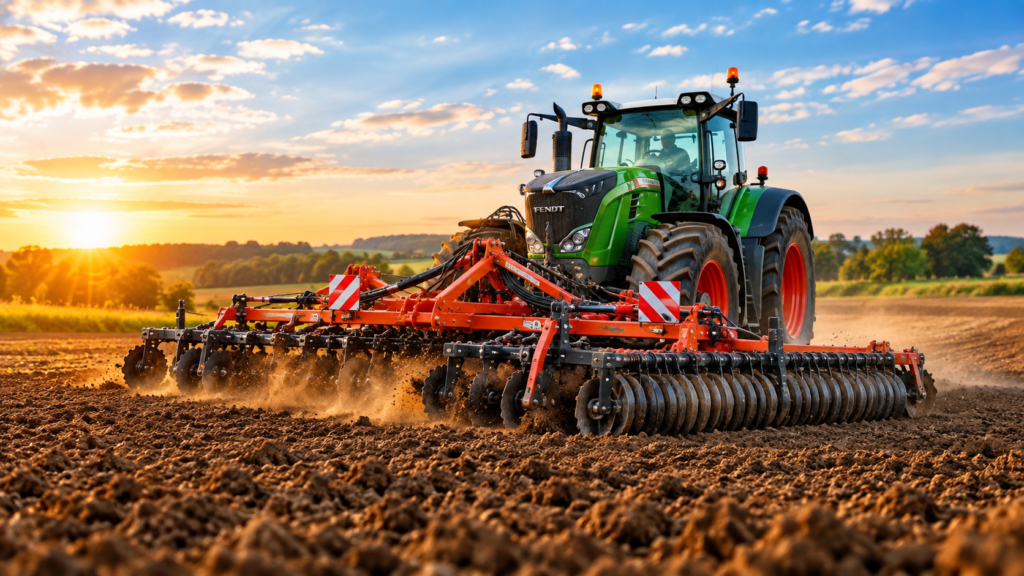
A Messeregge is a specialized agricultural soil-preparation implement that works primarily in the upper layer of cultivated soil. Unlike a plough, which can turn over soil at greater depth, a Messeregge focuses on cutting, breaking, and levelling the surface.
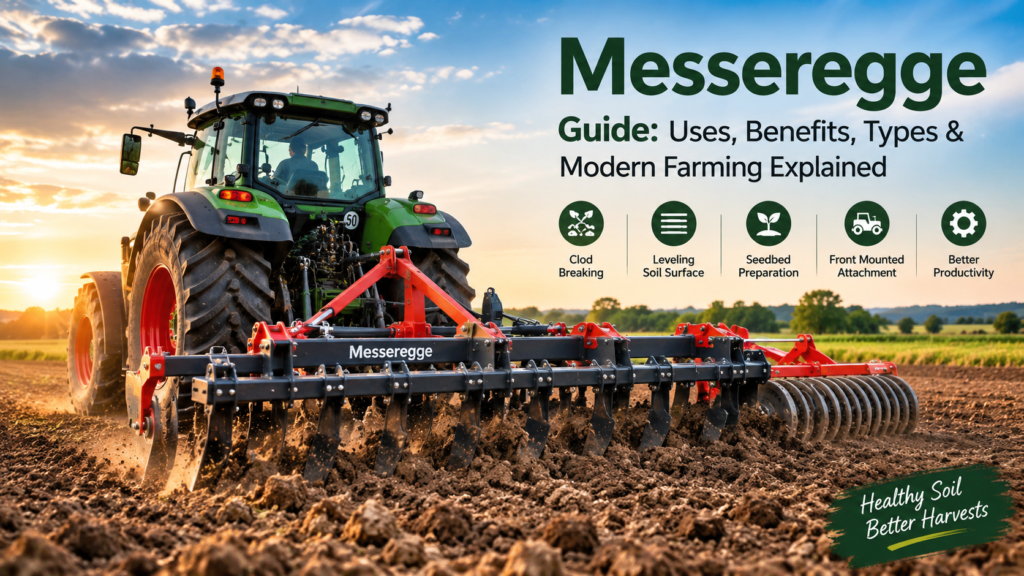
The machine normally consists of a carrying frame with steel knife-like working elements arranged across its width. Depending on the design, the working angle, height, or depth can be adjusted to suit field conditions.
In practical farming, the implement is often used ahead of a roller or front packer. The Messeregge works the soil first, while the following roller can further crush, press, or reconsolidate the prepared surface.
This combination makes it useful during secondary soil preparation, particularly when a field contains larger clods or an uneven surface after an earlier cultivation operation.
What Does the Word Messeregge Mean?
Messeregge is a German compound word. Messer means knife or blade, while Egge refers to a harrow. The agricultural meaning therefore describes a harrow that uses blade-like working elements.
English translations can vary depending on context. Scarifier, knife harrow, and blade harrow can all help explain the implement to English-speaking readers.
The important point is that Messeregge should not automatically be interpreted as a food, software product, business concept, or design term. In agricultural machinery documentation, the word specifically refers to soil-working equipment.
How Does a Messeregge Work?
A Messeregge works by moving blade-shaped steel elements across the prepared soil surface. As the tractor travels forward, the knives engage with raised clods and uneven soil, helping cut and redistribute surface material.
The action is generally shallower and more controlled than deep cultivation. Instead of completely turning the soil over, the implement concentrates on improving the condition of the upper layer.
A roller or front packer may follow the Messeregge during the same field pass. This allows the initial blade action to be combined with rolling, crushing, levelling, or reconsolidation.
The actual result depends on soil type, moisture, travelling speed, working depth, blade angle, and the equipment used before and after the Messeregge.
Main Components of a Messeregge
The exact construction differs between manufacturers and machine models, but a typical Messeregge includes a supporting frame, mounting system, steel knives or blades, and adjustment components.
The frame connects the attachment to the tractor, front packer, or other compatible equipment. The blades are positioned across the working width so they can interact with the soil as the machine moves forward.
Many designs provide adjustment for working position. This is important because the same setting will not necessarily produce good results in every field.
Wear parts are another important consideration. Since the knives work directly against soil, they gradually become worn. Replacement blades and related components are therefore part of normal Messeregge ownership and maintenance.
What Is a Messeregge Used For?
The primary purpose of a Messeregge is surface soil conditioning. It is particularly useful when the field needs additional levelling and clod reduction after previous cultivation.
Breaking Soil Clods
One of the clearest uses is reducing larger soil clods. Previous tillage can leave uneven pieces of soil across a field, especially when conditions are dry or when heavier equipment has been used.
The blade elements of a Messeregge can break or cut these larger pieces and distribute the soil more evenly across the working width.
This can help prepare the field for the next operation without requiring a separate, more aggressive cultivation pass.
Supporting Seedbed Preparation
A reasonably uniform seedbed is important for accurate sowing. Large clods and significant surface irregularities can make it more difficult for planting equipment to maintain consistent seed placement.
A Messeregge can help improve the upper surface before drilling or planting. However, it should not be viewed as a guarantee of better crop emergence because emergence also depends on moisture, soil structure, seed quality, drilling depth, weather, and other factors.
Levelling the Soil Surface
Another useful function is surface levelling. The knife-like working elements can help reduce small differences in surface height and redistribute loose soil.
When combined with a roller or packer, this can produce a more consistent field finish.
Combining Field Operations
Front-mounted equipment can allow the Messeregge to work while another implement operates behind the tractor.
Depending on the machinery combination, a single pass can include surface conditioning followed by rolling, reconsolidation, drilling, or another operation.
This can potentially reduce field passes, although the actual efficiency depends on tractor capacity, field conditions, machine weight, working width, fuel consumption, and the complete equipment setup.
Messeregge vs. Other Harrows and Cultivators
Messeregge is not simply another name for every type of harrow. Its blade-based working principle gives it a different role from several common soil-working machines.
| Implement | Main Working Element | Typical Action |
| Messeregge | Steel knives or blades | Cuts, levels, and breaks surface clods |
| Spring-tine harrow | Flexible tines | Scratches, combs, loosens, and levels |
| Disc harrow | Rotating discs | Cuts, mixes, and moves soil |
| Power harrow | PTO-driven rotating tines | Intensively crumbles and prepares soil |
| Roller/front packer | Rings, bars, or rolling elements | Presses, crushes, and reconsolidates soil |
A spring-tine harrow is often one of the closest alternatives because both can be used for surface preparation. However, the flexible tines create a different type of soil action compared with knife-like blades.
A disc harrow is generally more associated with cutting and mixing soil, while a power harrow uses PTO-driven components for more intensive preparation.
The best choice depends on the field rather than the machine name alone.
Benefits of Using a Messeregge
A properly selected Messeregge can provide several practical benefits in a suitable cultivation system.
Its focused surface action can help reduce larger clods and create a more uniform upper layer. This can make the field better prepared for following operations.
Another advantage is its potential to work as part of a combined front-and-rear machinery setup. A front attachment can prepare the soil while another implement completes the next stage behind the tractor.
Because the Messeregge is primarily a surface-conditioning tool, it can also be useful when a farmer wants to avoid unnecessarily aggressive soil disturbance after the main cultivation has already been completed.
However, these benefits depend heavily on correct adjustment and suitable field conditions.
When Might a Messeregge Not Be the Best Choice?
A Messeregge is not designed to solve every soil problem.
Very wet soil can be difficult to work because excessive moisture may cause smearing or unwanted compaction instead of producing a clean clod-breaking effect.
Extremely hard or dry ground may also require a different cultivation sequence. If deep compaction is the main problem, a shallow blade harrow cannot replace equipment specifically designed for deeper soil loosening.
Heavy crop residue can present another challenge depending on the frame and blade arrangement. Farmers should consider residue levels and the machine’s ability to pass through the material before selecting an attachment.
The goal should be to match the tool to the actual field condition rather than assuming deeper or more aggressive operation will always produce better results.
How to Choose the Right Messeregge
Choosing a Messeregge starts with compatibility. The attachment needs to match the tractor, front packer, or other equipment with which it will operate.
Working width is another important factor. The attachment should suit the width of the rest of the machinery so that the complete combination works efficiently without leaving untreated strips.
Farmers should also examine the machine’s adjustment system. Working height, depth, and blade angle can influence how strongly the knives interact with the soil.
Weight and front-axle loading are particularly important for front-mounted equipment. The tractor must be capable of safely carrying and operating the complete combination.
Before purchasing, it is sensible to check the machine’s working width, installed weight, mounting arrangement, hydraulic requirements, adjustment range, transport dimensions, replacement parts, and local dealer support.
Setup and Operation
Correct setup is essential for consistent results. The exact procedure depends on the manufacturer and model, so the operating manual should always be the primary reference.
Before entering the field, check that the implement is securely mounted and correctly aligned. Adjustment components should be set consistently across the working width.
A short test run can help determine whether the knives are engaging the soil correctly. After stopping in a safe location, inspect the worked surface rather than judging the result only from the tractor seat.
If the blades are working too aggressively, the setting may need to be reduced. If they are barely engaging the surface, an adjustment may be necessary.
The objective is controlled soil preparation, not maximum soil movement.
Messeregge Safety
Agricultural machinery can create serious hazards, particularly when sharp working elements, hydraulics, folding frames, and heavy mounted equipment are involved.
Operators should follow the manufacturer’s safety instructions and never inspect or adjust moving machinery. Before maintenance or manual inspection, the implement should be lowered or securely supported as instructed, the tractor should be stopped, and the required isolation procedure should be followed.
Regularly check mounting bolts, hydraulic connections, warning equipment, lighting, and other safety-related components.
Because exact procedures differ between machines, the manual for the specific Messeregge should always take priority over general advice.
Messeregge Maintenance
Regular maintenance helps preserve working performance and reduce unexpected downtime.
Inspect the knives for excessive wear, bending, cracking, or uneven deterioration. If one section becomes significantly more worn than another, the working result may become inconsistent across the field.
Mounting bolts and frame components should be checked according to the manufacturer’s maintenance schedule. Lubrication should also be carried out at the specified intervals.
After field work, removing accumulated soil and plant material makes it easier to identify damaged parts and potential corrosion.
Replacement knives should be selected according to the exact machine model rather than simply choosing a visually similar blade.
Messeregge and Modern Farming
Modern farming increasingly focuses on efficient field operations, appropriate soil disturbance, and reducing unnecessary passes. Within this approach, specialized implements such as Messeregge can serve a specific role in the cultivation sequence.
The implement does not replace every other tillage machine. Instead, it can complement deeper cultivation equipment, rollers, seed drills, and other tools.
Its value comes from controlled surface preparation. By focusing on clod reduction and levelling, a Messeregge can help prepare the field for the next operation without necessarily carrying out intensive soil inversion.
This makes the implement relevant to modern systems where farmers carefully select machinery according to soil condition, crop requirements, residue levels, and the desired seedbed structure.
Final Takeaway
Messeregge is a German agricultural term for a blade-equipped harrow or scarifying attachment used mainly for shallow soil preparation. Its primary functions include breaking larger clods, levelling the soil surface, and supporting seedbed preparation.
The implement is commonly used as a front-mounted tool or ahead of a front packer, where its blade action can be followed by rolling or reconsolidation.
It is different from spring-tine harrows, disc harrows, and power harrows because its knife-like working elements provide a specific cutting and surface-conditioning action.
For farmers considering one, the most important factors are compatibility, working width, adjustment options, soil conditions, tractor capacity, maintenance requirements, and replacement-part availability.
Ultimately, a Messeregge is best understood not as a universal tillage solution, but as a specialized tool for achieving a more controlled and consistent soil surface before the next stage of farming.
FAQs
What is a Messeregge?
A Messeregge is a German agricultural implement consisting of knife-like or blade-shaped working elements used for shallow soil preparation. It can break clods, level the surface, and support seedbed preparation.
What is a Messeregge used for?
It is mainly used to break larger soil clods, level uneven surface material, and condition the upper soil layer before or alongside rolling and other field operations.
What is Messeregge called in English?
Depending on context, Messeregge can be described as a scarifier, knife harrow, or blade harrow. “Knife harrow” is particularly useful when explaining its construction.
How is a Messeregge different from a spring-tine harrow?
A Messeregge uses knife-like steel working elements, while a spring-tine harrow uses flexible tines. As a result, they produce different types of surface-working action.
Can a Messeregge be fitted to any tractor?
No. Compatibility depends on the tractor, mounting system, working width, machine weight, front-axle capacity, hydraulics, and the specific front packer or implement being used.
Does a Messeregge replace a plough or cultivator?
No. A Messeregge is primarily a surface-conditioning tool. It does not replace equipment designed for deep soil inversion, deep loosening, or intensive cultivation.
Is Messeregge suitable for modern farming?
Yes, it can be useful in modern farming as part of a carefully selected soil-preparation system. Its main role is controlled surface conditioning rather than intensive deep tillage.