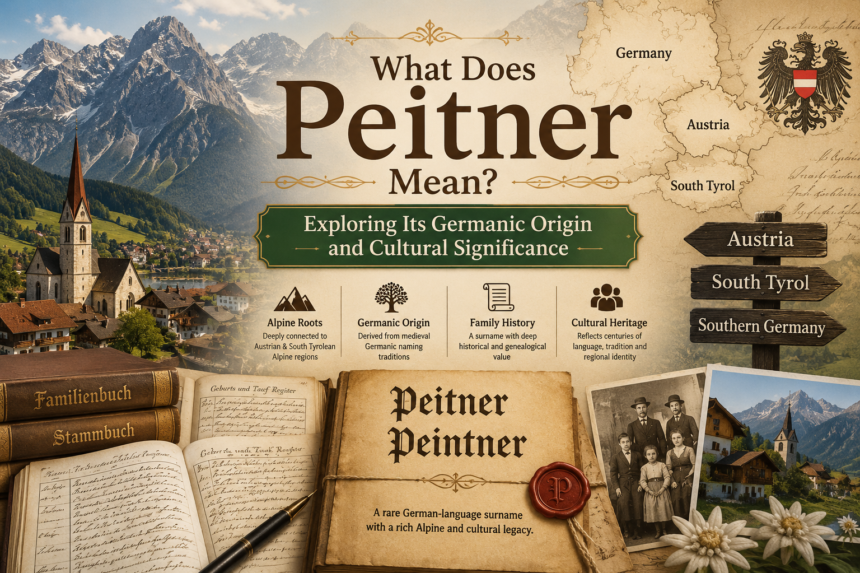
The surname Peitner is a relatively uncommon family name associated with German-speaking Central Europe, particularly the Alpine regions of Austria, South Tyrol, and southern Germany. It is also found in the spelling Peintner, making surname research slightly more complicated for people interested in genealogy and family history.
So, what does Peitner mean? The short answer is that its exact original meaning is not definitively established. Like many European surnames that developed during the medieval and early modern periods, Peitner may have been influenced by a person’s place of residence, geographical surroundings, property, occupation, or local identification. Its history is therefore better understood through the cultural and linguistic traditions of the German-speaking Alpine world.
The name is especially interesting because South Tyrol and neighboring Alpine regions have experienced significant political and linguistic changes throughout history. Families remained connected to the same valleys and communities while borders changed around them. As a result, surnames such as Peitner and Peintner can provide useful clues when studying regional migration, ancestry, and cultural identity.
What Does the Peitner Surname Mean?
There is no universally accepted literal translation of Peitner. Unlike surnames that clearly originate from recognizable occupations, such as German names associated with smithing or farming, Peitner’s original etymology is less certain.
Historical German-language surnames were often created from several different sources. A person might receive a surname based on the village where they lived, the farm or estate they managed, their occupation, a geographical feature, or a nickname used by the local community. Over generations, these descriptions could become hereditary family names.
The ending “-ner” appears in numerous German-language surnames and can sometimes indicate an association with a particular place or property. However, the presence of this suffix by itself does not establish one definitive interpretation of Peitner.
Therefore, it is more accurate to describe Peitner as a rare German-language surname with strong Alpine regional associations rather than claiming that it has one proven dictionary meaning.
For genealogy, this distinction matters. A surname’s general linguistic history can provide clues, but the origins of a particular Peitner family must ultimately be established through historical records.
Where Did the Peitner Name Originate?
The Peitner surname is strongly associated with Austria and South Tyrol, as well as parts of southern Germany. South Tyrol is particularly important because it has a long German-speaking cultural history despite being located in modern-day Italy.
The Alpine environment shaped the lives of communities in these regions for centuries. Villages were often separated by mountains and valleys, and people could be identified by the farms, estates, settlements, or geographical locations with which they were associated.
This environment contributed to the development of highly localized surnames. A family name could originate in one valley or settlement and later spread to nearby communities through marriage, trade, migration, military service, or changes in employment.
It is therefore possible to encounter Peitner or Peintner records in different parts of the Alpine region without assuming that every person with the surname belongs to exactly the same family branch.
The Importance of South Tyrol
South Tyrol provides an important cultural background for understanding the Peitner surname. The region has a complex history involving German-speaking, Italian-speaking, and Ladin-speaking communities.
For centuries, South Tyrol was connected politically and culturally with territories of the Austrian and German-speaking world. After major political changes in the twentieth century, the region became part of Italy, but a large German-speaking population retained its language and cultural traditions.
This history explains why a surname that appears distinctly German may be found in modern Italian records.
For surname researchers, geography should therefore be interpreted historically rather than only according to modern national borders. A Peintner family recorded in northern Italy may have ancestral connections to German-speaking communities that existed in the region long before modern political boundaries were established.
Peitner vs. Peintner: Are They the Same Name?

One of the most important questions surrounding this surname is the relationship between Peitner and Peintner.
The two spellings are closely associated and may represent spelling variations that developed through historical record keeping. Before standardized spelling became widespread, surnames could be written differently depending on the person recording the information, local pronunciation, language, or administrative system.
For example, a priest recording a baptism might spell a family name differently from a government official recording a civil document. When families moved between German-speaking and Italian-speaking areas, additional variations could also appear.
This means genealogists should avoid searching only for “Peitner.” Searching for Peintner at the same time can reveal records that would otherwise be missed.
The spelling difference does not automatically prove that every Peitner and Peintner family is related. Instead, it demonstrates why historical surname research needs to consider linguistic and regional variations.
How German Surnames Developed in the Alpine World
To understand Peitner, it helps to understand how surnames generally developed in German-speaking Europe.
During earlier periods, many people were identified simply by their first name. As populations increased, communities needed additional ways to distinguish individuals who shared the same given name.
A person might therefore be described according to their occupation, location, parentage, physical characteristics, or relationship to a particular property.
Over time, these identifiers became hereditary surnames.
In Alpine communities, location-based identification was particularly important. A person’s home could be associated with a farm, mountain settlement, valley, village, or estate. These geographical connections sometimes became permanent family names.
Peitner may belong to this broader tradition, although its precise historical formation cannot be established solely from the modern spelling.
Was Peitner an Occupational Surname?
It is tempting to assume that every surname ending in “-ner” represents an occupation. However, this would be too simplistic.
German-language surnames can use similar endings for different reasons, and the same suffix may occur in names derived from places, occupations, or other forms of identification.
For Peitner specifically, there is not enough evidence to confidently state that the name originated from one particular medieval occupation.
A more reliable interpretation is that the surname developed within the naming traditions of German-speaking Central Europe and may have had a local or geographical connection.
This is an important distinction for accurate surname research because popular websites sometimes present a single meaning as certain when historical evidence may actually be incomplete.
Historical Geography and the Peitner Name
The geographical distribution of a surname can reveal valuable information about its development.
Austria, South Tyrol, and southern Germany have historically been connected through language, trade, migration, political institutions, and family relationships. People frequently moved between neighboring Alpine communities, particularly for marriage, work, military service, or economic opportunities.
A surname could therefore spread gradually across regional boundaries.
At the same time, mountains did not always make communities completely isolated. Alpine passes and trade routes connected settlements and allowed people and names to travel.
The Peitner surname’s association with these regions should consequently be viewed as part of a larger network of German-speaking Alpine communities rather than as evidence of one specific village of origin.
Peitner Family History and Genealogy
For anyone with the Peitner surname, genealogy is the best way to move from general surname information to a specific family history.
The first step is to identify the oldest known Peitner ancestor in your own family. Record their full name, approximate birth date, marriage details, residence, occupation, and names of parents or children whenever possible.
Once you have established a location, historical records become much more useful.
Church registers can be especially valuable because baptism, marriage, and burial records often contain information about several generations. Civil registration records may provide additional birth, marriage, and death information.
Researchers should also consider immigration documents, census records, military records, cemetery databases, land documents, and regional archives.
Most importantly, search for both Peitner and Peintner.
A family that appears under one spelling in a modern database may have used another spelling in nineteenth-century or earlier records.
Why Historical Records Matter More Than Surname Meaning
A common mistake in genealogy is to assume that the meaning of a surname automatically reveals a family’s exact origin.
It does not.
Thousands of unrelated families can share a surname, while one family can change its spelling over generations. Migration can also move a surname far from its original geographical area.
For this reason, a surname meaning should be treated as a starting point rather than final proof.
If a person named Peitner believes their ancestors came from Austria, for example, the strongest evidence would be historical documents connecting that individual to an Austrian village or family rather than simply the general association between Peitner and Austria.
This approach produces a much more reliable family history.
Cultural Significance of the Peitner Name
The cultural significance of Peitner comes largely from its connection to the German-speaking Alpine world.
Family names can preserve traces of regional identity long after political borders change. A surname may continue to reflect the language and traditions of an ancestral community even when descendants live in another country.
This is particularly relevant to South Tyrol. Modern South Tyrol is part of Italy, but German remains an important language in the region, and many surnames preserve connections to its German-speaking heritage.
Peitner and Peintner can therefore be viewed as part of a broader historical record of Alpine cultural continuity.
Notable People Associated With the Peintner Name
Several people with the Peintner surname have become known in different fields.
One notable example is Max Peintner, an Austrian artist and architect whose work explored relationships between modern society, urban development, and the natural environment. His conceptual drawings have received attention for their environmental themes and their influence on discussions about nature and civilization.
Another historically notable individual is Maria Peintner, who was the mother of Pope Benedict XVI. Her family background provides another example of the surname’s presence within German-speaking Central European communities.
These individuals demonstrate that the Peintner spelling has appeared across different generations and professional backgrounds.
Where Is the Peitner Surname Found Today?
Today, people with the Peitner or Peintner surname may be found outside the regions traditionally associated with the name.
Migration has played an important role in spreading European surnames around the world. During the nineteenth and twentieth centuries, people from Austria, Germany, South Tyrol, and surrounding regions migrated to countries including the United States, Canada, Australia, and other parts of Europe.
Consequently, finding a Peitner family outside Central Europe does not necessarily indicate a separate origin.
Instead, researchers should trace individual family lines backward through immigration and historical records to identify where earlier generations lived.
How to Research the Peitner Surname
If you are researching your own Peitner ancestry, a practical approach is to begin with modern family information and work backward.
Start by collecting birth certificates, marriage documents, family photographs, obituaries, cemetery information, and stories passed down by relatives. Identify the locations connected with each generation.
Next, search historical records using both Peitner and Peintner. Pay particular attention to Austria, South Tyrol, southern Germany, and nearby Alpine communities.
Do not immediately assume that a similar-looking surname represents the same family. Compare dates, locations, parents, spouses, occupations, and other identifying information before connecting two records.
A successful genealogy is based on multiple pieces of evidence rather than surname similarity alone.
Final Thoughts
The Peitner surname offers an interesting window into the history of German-speaking Alpine Europe. Although its exact original meaning remains uncertain, the name is strongly associated with Austria, South Tyrol, and southern Germany, regions where geography, language, and local communities played a major role in surname development.
The related spelling Peintner is especially important when researching historical documents. Changes in spelling were common before modern naming standards became widespread, and searching only one version can cause important family records to be overlooked.
For people interested in the Peitner name, the most useful approach is to combine surname history with documented genealogy. Historical church registers, civil records, immigration documents, and regional archives can reveal much more about a specific family than a surname definition alone.
Ultimately, Peitner is more than a rare family name. It represents the complex history of Alpine communities, German-language culture, migration, and changing European borders. By examining both Peitner and Peintner, researchers can gain a broader and more accurate understanding of the name’s historical journey.
FAQs
What does Peitner mean?
The exact original meaning of Peitner is uncertain. It is a rare German-language surname associated with Alpine Central Europe, and its development may have involved a local, geographical, property-related, or occupational identification.
Is Peitner a German name?
Yes. Peitner is generally regarded as a German-language surname, particularly associated with German-speaking communities in Austria, South Tyrol, and southern Germany.
What is the difference between Peitner and Peintner?
Peintner is a closely related spelling form of Peitner. Historical records may use different spellings because surname spelling was not always standardized.
Is Peitner an Austrian surname?
Peitner is associated with Austria and the broader Alpine region. However, the surname is not limited to modern Austria and is also connected with South Tyrol and southern Germany.
Is Peintner a South Tyrolean surname?
The Peintner spelling is associated with German-speaking South Tyrol and other Alpine areas. However, individual family origins should be confirmed through genealogical records.
How rare is the Peitner surname?
Peitner is relatively uncommon compared with many widely distributed German surnames. Its rarity can be useful for genealogy, although spelling variations need to be considered.
Can Peitner and Peintner belong to the same family?
Yes, they can represent different historical spellings of a family name, but this cannot be assumed in every case. Genealogical records are needed to establish a connection.