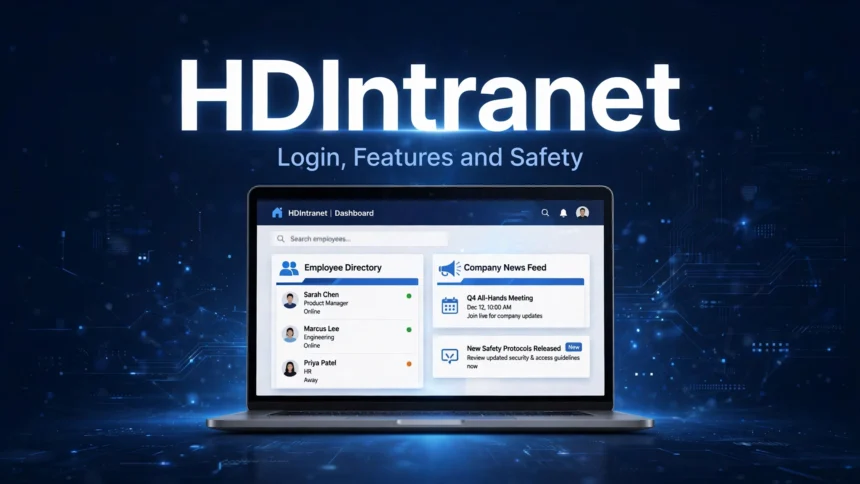
First, if you have been told to log in to HDIntranet, you may feel confused. Also, you may have been sent a link to hdintranet.com. Similarly, you may have been asked to use your company’s “HD Intranet”. In that case, you are probably confused about what it actually is. However, you are not alone. Slack, Microsoft Teams and SharePoint market themselves openly to businesses everywhere. HDIntranet, by contrast, has almost no public documentation. As a result, that gap has filled up with guides that disagree with each other.
Overall, this article gives you the checked picture. First, it covers what HDIntranet is, where it comes from, and how login works. It also covers what it offers, whether it is safe, and — honestly — what nobody can verify. Then, if you work for a company that uses it, you will know what to do next. Otherwise, you will know why you cannot sign up.
| 🔗 You may also like: |
|---|
| HRMtaila Explained: Is It a Real AI HR Platform or Just a Buzzword? |
| Syrenis Strategic Initiatives Explained: Cassie, Partnerships and the Future of Consent |
HDIntranet at a Glance
| Fact | Detail |
|---|---|
| What it is | A cloud-based intranet platform for a company’s own employees |
| Originally built for | Heartland Dental, a US dental support organisation (per several guides) |
| Who can use it | Employees of organisations using it, with company-issued credentials |
| Public sign-up | None — no visible public registration on hdintranet.com |
| Main features | Employee directory, document library, news feed, messaging, task management |
| Security claims | Encryption and HIPAA compliance, as reported by guides (not a public security page) |
| Main confusion | “HD Intranet” can also mean a generic high-definition intranet |
The Short Answer: What Is HDIntranet?
In short, HDIntranet is an intranet — a private network that only an organisation’s own staff can use. TechTarget’s definition is the simplest one. Specifically, the most careful guide to the platform quotes it: an intranet is a private network accessible only to an organisation’s staff. In other words, HDIntranet is that idea as a product. In fact, it is a secure, cloud-based portal where employees log in and find everything they need for work in one place.
First, the guides describe it as a digital headquarters. Instead of scattered emails, shared drives and printed memos, staff get a single dashboard. Also, it holds company news, documents, HR paperwork, training materials and the tools to talk to colleagues. For instance, one guide calls it “a private social network for your company”. In other words, it is a place to gather, exchange ideas, collaborate on projects and stay informed about company updates.
However, the important part is what HDIntranet is not. For example, it is not a public app you can download, not a service you can buy for yourself, and not a platform with a free trial. Instead, access appears to be restricted to employees of organisations that use the system. Also, login typically requires company-issued credentials and possibly VPN access. Therefore, if you do not work for such a company, you probably should not have access. In fact, there is no legitimate way to get it.
Where HDIntranet Comes From: Heartland Dental
First, the one fact the guides agree on is the origin. Specifically, several of them say HDIntranet was originally crafted for Heartland Dental. In fact, that is a large US dental support organisation, and the platform was built around the needs of its practices. For example, one guide puts the scale at over 1,600 US locations. Also, the platform serves dental professionals across them. In short, it holds payroll details, training resources, clinical procedures and company news, all in one hub.
Therefore, that origin explains a lot about the platform’s shape. After all, a dental support organisation has hundreds of separate practices. Specifically, they all need the same policies, the same training and the same HR paperwork. Yet they have no reason to talk to each other by email. Consequently, a central intranet is the natural answer. In other words, it gives every practice the same news, the same documents and the same procedures. For example, the guides list a company-wide news feed, a document library organised by department, and an employee directory. In fact, those are exactly the features a distributed organisation with many small sites would need.
The guides also say the platform’s uses have spread beyond dentistry, with mentions of education and small businesses. However, that claim is harder to check. For example, there is no public customer list, no public pricing page and no public case studies to confirm it. Nevertheless, the design would suit any organisation with many locations or many remote staff. In other words, it is a branded, cloud-based hub for internal communication. Overall, the dental origin is the verified part; the wider adoption is a claim the guides repeat without evidence.
What HDIntranet Actually Does
First, the guides describe a familiar set of intranet features. They are worth listing, because they are what an employee will actually see after logging in. But remember the honesty rule from this article’s introduction. In fact, these features come from guides, not from a public product page. So treat them as reported features, not verified ones.
Employee Directory
For example, the directory goes beyond names. Specifically, the guides describe profiles that make it easy to find a colleague. You can see their role and connect with them. That is the first thing a new starter in a 1,600-location organisation needs. It is the feature that turns a list of staff into a working network.
Document Library
First, documents sit in one central, searchable library. Specifically, it is organised by folders — HR, marketing, operations and the like — instead of living in email attachments. The guides describe version control and easy access to policies and procedures. As a result, everyone reads the current version rather than the one from three years ago.
News Feed and Communication
First, a company-wide news feed carries announcements, policy changes and events. Real-time messaging, forums and video calls let staff talk without waiting on email. One guide describes dedicated collaborative spaces where teams create, edit and comment on documents together.
Task and Project Management
For example, the platform includes task assignment, progress tracking and deadline management. In fact, the planning side is deliberately simple: tasks, owners and dates. That is because an intranet is a hub, not a specialist project tool. For example, a practice manager might assign a training task. They can track who has finished it and see the deadline in the same place the training document lives.
HDIntranet Login: How Access Works
Overall, logging in is simple in principle and impossible in practice without the right credentials. First, the guides describe the same basic flow. Then go to your organisation’s HDIntranet web address. Next, enter the username and password your employer issued. Then explore the dashboard. Also, it works from any device with a browser. In fact, the guides describe a mobile-friendly design for staff working remotely or on the move.
However, the catch is the first step. There is no public sign-up process on hdintranet.com, and you cannot create an account independently without employer authorisation. Specifically, login typically requires company-issued credentials and, for remote staff, a VPN connection. Therefore, if your employer’s IT department has not given you credentials, you likely cannot — and should not — access HDIntranet.
| Problem | Likely cause | What to do |
|---|---|---|
| Wrong password | Typo or an expired password | Reset it through your IT department, not a public page |
| Link does not open | You are not on the company network or VPN | Connect to the VPN first, then try again |
| No account at all | Your employer has not issued credentials | Ask your manager or IT — there is no public registration |
| Page looks different | Each organisation brands its own portal | Check with IT that you have the right address |
First, if you received a link to HDIntranet unexpectedly, do not enter credentials. For example, it may have come in an email you were not expecting, or from someone you do not know. In contrast, a real HDIntranet login will come through your employer’s own channels. Also, your IT department can confirm whether the link is genuine.
HDIntranet vs SharePoint vs Slack vs Teams
HDIntranet is not the only way to run an internal network, and the comparison shows what it is for. For example, SharePoint is a document platform that can be shaped into an intranet. Similarly, Slack and Teams are messaging tools that grew into collaboration hubs. In contrast, HDIntranet, as the guides describe it, is an intranet first. In other words, it is a branded home page for the whole company, with messaging and documents inside it rather than the other way round.
| Platform | Best at | Main difference from HDIntranet |
|---|---|---|
| HDIntranet | One branded hub for news, documents and staff | Built as a company intranet from the start |
| SharePoint | Document management inside Microsoft 365 | A toolkit you build an intranet from, not a ready hub |
| Slack | Fast team messaging and channels | Messaging first; no company-wide intranet home page |
| Microsoft Teams | Meetings and chat inside Microsoft 365 | Collaboration first; intranet features come via SharePoint |
Overall, the practical difference is who buys it and why. For example, a company that wants one front door for all staff is the HDIntranet buyer. Specifically, it wants news, HR paperwork, training and directories in one branded place. In contrast, a company that already lives in Microsoft 365 will usually build on SharePoint and Teams instead. Moreover, the comparison also explains the confusion. HDIntranet is not publicly marketed, so many people meet it only after their employer adopts it. Then they judge it against the tools they already know.
Is HDIntranet Safe to Use?
The short answer is that the guides say yes — with a caveat about evidence. For example, one guide states flatly that HDIntranet is built with strong encryption and complies with HIPAA regulations. Those are the US rules for handling health information. Therefore, they would matter a great deal for a dental organisation. Also, the same guide describes 24/7 chat assistance, email support and phone help during business hours.
In fact, those claims are plausible. A platform built for a dental support organisation would need to handle sensitive data. So HIPAA compliance would be a basic requirement rather than a selling point. But there is no public security page, no published audit and no independent verification to point to. Instead, the claims come from guides repeating each other, not from a document you can read. As a result, the honest answer is twofold. For an employee using their employer’s portal, the risk is the ordinary one of any workplace system. First, use the credentials you were given, keep them private and report anything suspicious to IT. If you are deciding whether to trust the platform as a buyer, ask the vendor directly. Moreover, the lack of public security documentation is itself a question to raise.
Finally, there is one more safety point, and it matters more than the encryption claim. Because HDIntranet is employee-only and little-known, its name is easy to imitate. For example, a fake login page using the name could harvest credentials from staff who expect to see it. The defence is simple. Only log in through the address your employer gave you. Also, never use a link in an unexpected email.
Who HDIntranet Is (and Is Not) For
HDIntranet fits organisations with many people in many places who need the same information. For example, a dental group with hundreds of practices is the model case. It has one news feed, one document library and one directory. As a result, every site sees the same version of the truth. The same shape suits hospital groups, school networks and retail chains. It also suits any business where head office needs to reach every employee at once. In addition, the HR software angle matters here too. The intranet is where HR paperwork, training and policies actually reach staff. So the platform stands or falls on whether employees can find those things.
It is not for individuals. In fact, there is no personal account, no free tier and no way to try it alone. In addition, it is not a replacement for specialist tools. It will not replace a proper project management system, a payroll system or a clinical records system. Instead, it is the hub that points to those systems, not the systems themselves.
Finally, it is not for a company that wants a public-facing website. An intranet is private by definition — the whole point is that only staff can see it. Therefore, a business looking for a website, a shop or a public knowledge base needs a different product entirely.
| 🔗 You may also like: |
|---|
| What Is Plangud? Real Meaning, Timber Uses and Planning Truth |
| What Is Milyom? The Blog, the Olive Disease and the Claims |
The Honest Problem: What We Cannot Verify
Most “What is X?” articles pretend to know more than they do. This one will not. The honest problem with HDIntranet is that there is very little public information about it. Moreover, the guides that exist were written at different times, by different sites. They had no access to the company behind the platform.
Here is what that means in practice. Several guides report the Heartland Dental origin. It is consistent with the platform’s design, so treat it as likely. Also, the feature lists are consistent across guides. Treat them as reported, not confirmed. Some claims appear in single guides. They cover wider adoption in education and small business, 24/7 support, and HIPAA compliance. However, other guides repeat them without a primary source. So treat them as unverified. And the idea that “HD Intranet” means “High-Definition Intranet” is a guess about the name, not a fact. In fact, the guides themselves note that the term could refer to several different things.
In short, real employees use HDIntranet, a real platform. The outline above is the best public picture available. But if you need a fact that decides money or safety, do not rely on any article, including this one. That covers whether it is HIPAA compliant, what it costs, and whether it will work for your organisation. Instead, ask the vendor, or ask your employer’s IT department, and get the answer in writing. That is not a weakness of this guide. In fact, it is the correct response to a platform that does not publish its own documentation.
How to Get Help With HDIntranet
If you use HDIntranet at work, your first stop is always your own organisation. First, your IT department issues credentials, resets passwords, confirms the correct web address and decides who gets access. Second, your manager can tell you which parts of the platform your team actually uses. After all, not every feature is switched on everywhere.
If you are locked out, do two things. First, check the obvious things. Check the right web address and the VPN connection if you work remotely. Also check whether your password has expired. Second, contact IT rather than searching for a public reset page, because there is not one. However, if you are considering HDIntranet for your own organisation, the guides describe customer support. It includes chat, email and phone help. But you will need to reach the vendor through its own channels. After all, there is no public signup or pricing page to start from. And if someone you do not know sent you a link to HDIntranet, do not log in. Instead, forward it to your IT security team.
The privacy question belongs here too. An intranet holds HR records, payroll details and internal documents. So the rules about who can see what are a consent and privacy matter, not just an IT one. Therefore, if your organisation uses HDIntranet, its privacy policy — not this article — is the document that governs your data.
Conclusion
HDIntranet is a cloud-based intranet built for a company’s own people. It is one branded hub for news, documents, directories and messaging. Heartland Dental and its hundreds of practices were its original home. Login needs company-issued credentials. There is no public sign-up. In short, the platform is best understood as a digital headquarters rather than a public app.
Overall, the honest summary is that the outline is clear but the details are thin. The origin, the employee-only access and the feature list are consistent across guides. However, the wider claims about adoption, support and compliance are unverified. Therefore, use this guide to understand what HDIntranet is and what to do next. Finally, go to your employer, or the vendor, for any fact that decides money, access or safety.
FAQs
What is HDIntranet?
HDIntranet is a cloud-based intranet platform. It is a private portal for a company’s own employees. Also, it holds company news, a document library, an employee directory, messaging and task management in one place. Originally, it was built for Heartland Dental, a US dental support organisation.
How do I log in to HDIntranet?
Go to your organisation’s HDIntranet web address and enter the username and password your employer issued. Also, you may need a VPN connection if you work remotely. There is no public sign-up, so if you have no credentials, ask your IT department.
Can I sign up for HDIntranet myself?
No. There is no visible public registration on hdintranet.com. In fact, access appears to be restricted to employees of organisations that use the system. Therefore, if you do not work for such a company, you cannot create an account.
Is HDIntranet safe to use?
Guides describe strong encryption and HIPAA compliance. After all, that would be expected for a platform built for a dental organisation. But there is no public security page to verify those claims against. So employees should log in only through the address their employer gave them and report anything suspicious to IT.
Is HDIntranet the same as SharePoint or Slack?
No. SharePoint is a document platform you build an intranet from, and Slack and Teams are messaging tools. In contrast, HDIntranet is an intranet first: a single branded hub for the whole company, with messaging and documents inside it.