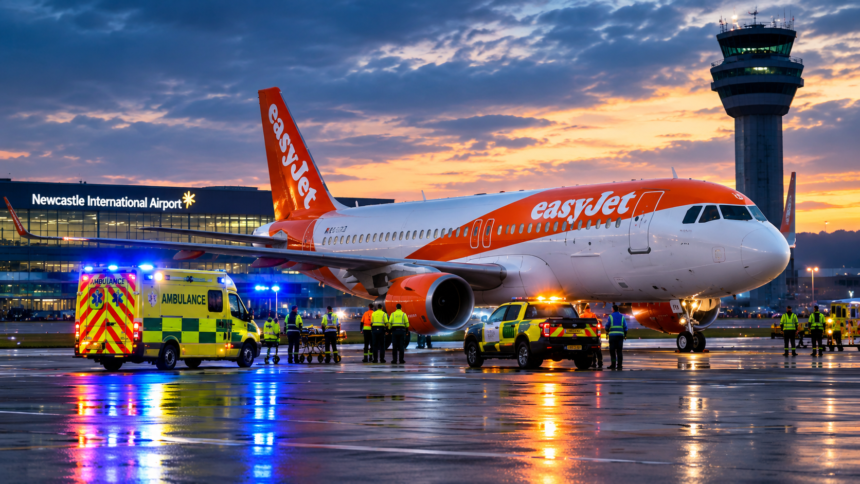
Search for “easyJet flight U2238 emergency landing in Newcastle” and you will find a dramatic story: a plane in trouble, an emergency landing, a city on alert. The real story is serious, but it is also simpler — and one important detail in the headline is wrong. There was no crash, no fire and no fault with the aircraft. A passenger became very unwell, the crew landed the plane at the nearest good airport so that person could reach a hospital fast, and the flight then carried on to its destination.
There is also a catch in the flight number itself. The flight that landed in Newcastle was not U2238. It was flight U22238, also written as EZY2238 — one digit more. That one small digit explains most of the confusion around this story, and it is why so many articles about the event argue with each other. This guide explains, in plain words, what really happened on the night of 27 October 2025, what the airline and the ambulance service actually said, and which parts of the story you can trust.
| 🔗 You may also like: |
|---|
| RN Fundamentals 2016 70 Questions: A Complete Practice and Study Guide |
| Tampons: A Practical Guide to Use, Absorbency, Safety and Comfort |
What Happened on 27 October 2025
On the evening of Monday 27 October 2025, easyJet flight EZY2238 was flying its normal scheduled route from Copenhagen in Denmark to Manchester. It is a regular evening service between the two cities, and the flight that night was operated by an Airbus A320. Reports say 178 passengers and six crew members were on board.
The flight left Copenhagen and climbed over the North Sea, heading for the east coast of England. During that crossing, a passenger became seriously unwell — unwell enough that the crew judged they needed proper medical help far faster than the rest of the flight to Manchester would allow. The pilots declared an emergency, and flight-tracking reports show the crew used the transponder code 7700, the general emergency signal that tells air traffic control an aircraft needs priority handling.
The aircraft turned towards Newcastle Airport and landed there safely late that evening. Flight-tracking reports put the touchdown at about 10.52pm UK time. Ambulance crews were already waiting. The unwell passenger was taken off the plane and driven to hospital, and the aircraft — once the handover was complete — took off again just after midnight and landed in Manchester at about 12.28am, completing the journey for everyone else on board.
That is the whole event, without the drama added: a medical diversion, handled the way diversions are meant to be handled, with a safe landing at both ends.
The Flight Number Problem: U2238 or U22238?
The confusion starts with how flight numbers are written. easyJet’s airline code is U2. Add the flight number 2238 and the full flight designator becomes U22238 — U2, then 2238. The same flight is also shown in aviation systems as EZY2238, because EZY is easyJet’s other official code, the one used by air traffic control.
Now drop one digit — the way people naturally do when they type quickly or copy a number from memory — and U22238 becomes “U2238”. That shorter number is not just an abbreviation. It belongs to a different easyJet service altogether, reported as the airline’s Newcastle to Bristol route. So the search phrase “easyJet flight U2238 emergency landing in Newcastle” mixes two flights into one: the Newcastle–Bristol number, and the Copenhagen–Manchester flight that actually diverted.
This is why some websites describe the event with the wrong route, the wrong direction, or details borrowed from other easyJet diversions. Once one page prints the wrong number, others copy it, and the error spreads faster than the correction. It is the same pattern by which one story becomes many different stories online, each a little different from the event itself. When you read about this incident, the reliable anchor is simple: if the article is about a Copenhagen to Manchester flight landing in Newcastle on 27 October 2025, the flight was U22238 / EZY2238, whatever its headline says.
What easyJet and the Ambulance Service Said
Official words matter more than commentary, and in this case both of the key organisations spoke clearly and early.
easyJet confirmed the diversion in a short statement: “Flight EZY2238 from Copenhagen to Manchester on 27 October diverted to Newcastle, due to a customer onboard requiring urgent medical attention. The customer was met by medical services on arrival and the flight continued to Manchester.” The airline did not name the passenger, did not describe the illness, and did not suggest any problem with the aircraft — and it has not added to that statement since.
The North East Ambulance Service, which covers Newcastle, confirmed its part of the response to local reporters: it sent an ambulance crew to the airport and took one patient to the Royal Victoria Infirmary in Newcastle for further treatment. The Royal Victoria Infirmary is the city’s main emergency hospital, a short drive from the airport, which is one reason a diversion to Newcastle made sense that night.
Beyond those two statements, the honest answer is that the public record stops. The passenger’s name, condition and later progress were never released — rightly, because a stranger’s medical emergency is private. Any article that claims to know exactly what was wrong with the passenger, or how the story ended for them, is guessing. Some details of an event like this simply cannot be verified, and a trustworthy report says so instead of filling the gap.
Was It Really an “Emergency Landing”?
Yes and no — and understanding the difference will make you read every flight story better.
In aviation, “emergency” is a wide word. When a crew declares an emergency, they are telling air traffic control: we need priority, we may need services waiting, do not treat us as routine. A passenger in a serious medical condition is a standard reason to declare one. The squawk code 7700 reported in this case is the general emergency code — it says “this flight needs help first”, not “this aircraft is falling apart”.
An emergency landing, in the sense most readers picture — smoke, fire, failing engines, a plane struggling to stay in the air — is not what happened here. No report from the airline, the airport, the ambulance service or any flight-tracking source points to a fire, a technical failure or damage to the aircraft. The strongest evidence is what the plane did next: after roughly seventy minutes on the ground, it flew on to Manchester with its remaining passengers. Aircraft with real mechanical faults do not simply continue their journey the same night.
So the fairest description is the one the airline’s own words support: an in-flight medical diversion, carried out under emergency priority, with a completely safe landing. “Emergency landing” is the headline version; “medical diversion” is the accurate one.
Why Pilots Divert When a Passenger Is Seriously Ill
People sometimes ask why the crew did not simply fly on to Manchester, which was not much further away. The answer is how medical decisions work in the air.
Cabin crew are trained in first aid, and airliners carry medical kits, oxygen and a defibrillator. Crew can also take advice from medical professionals on the ground by radio. But there are clear limits to what can be done in a cabin. When a passenger’s condition is serious and time matters — when minutes may change the outcome — the rule is simple: get the person to a hospital as fast as you safely can. The nearest suitable airport wins, even if it is not the destination.
That decision belongs to the captain, made with the crew, air traffic control and medical advice together. Newcastle was close, its runway and emergency services were ready, and a major hospital stood a short ambulance ride away. Continuing to Manchester would have added flying time the passenger may not have had. Understanding this is also why guides to the fundamentals of nursing and emergency care stress the same first principle on the ground as in the air: in a real emergency, the basics done quickly — assess, stabilise, reach proper care — matter more than anything advanced done late.
Medical diversions like this are not rare. Across the world’s airlines they happen regularly, most of them never making the news at all. This one was noticed because the emergency code and the diversion were spotted live by flight watchers online, and because the shortened flight number made the story spread in a confused form.
For the people in the cabin, a diversion in general follows a calm pattern. The crew explain that the aircraft is landing at a different airport so that an unwell passenger can be helped, the seatbelt signs come on, and the plane descends. It can feel unsettling — an unplanned landing always does — but it is one of the most practised situations in commercial flying. Newcastle Airport, as the main international airport for the North East of England, handles diverted aircraft as a routine part of its work, with the fire, medical and handling services that a diversion needs. The passengers on flight U22238 were not witnesses to a disaster. They were witnesses to a safety system doing exactly the job it exists for: putting a sick person’s needs ahead of a timetable.
| 🔗 You may also like: |
|---|
| Target Company URL Research: How to Find and Verify the Right Business Website |
| Research Dossier for a Target Company: How to Build a Complete Company Intelligence Report |
What Happened After the Landing
The sequence after touchdown was quick and orderly. The aircraft parked, paramedics came on board, and the unwell passenger was taken off and driven to the Royal Victoria Infirmary. The other passengers stayed with the aircraft while the handover and the paperwork of an unscheduled stop were completed.
Flight U22238 then left Newcastle at about two minutes past midnight, now on 28 October, and landed at Manchester at about twenty-eight minutes past midnight. Everyone else reached the destination they had paid for, late and tired, but on the same aircraft and the same night. For a diversion story, that is the ending you want: the emergency dealt with, the journey completed, nobody else harmed.
It is worth pausing on what did not happen. There was no evacuation, no fire service rescue, no runway closure drama, and no second incident. Several dramatic details circulating online — crash landings, cabin fires, engine failures — have no support in any statement or record connected to this flight. They belong to other stories, other flights, or pure invention.
What This Means for Passengers: Delays and Your Rights
If you fly often, the useful question is what a diversion like this would mean for you. Two things follow from an event like the Newcastle stop.
First, you will arrive late, and there is no way around it. A medical diversion costs an hour or more by the time the aircraft lands, hands over a patient, and is cleared to leave. In this case the flight reached Manchester well over an hour behind its schedule.
Second, your rights are different from an ordinary delay. Under the UK261 rules that cover flights in the UK and Europe, cash compensation is generally not payable when a delay is caused by extraordinary circumstances — events outside the airline’s control — and a passenger’s sudden medical emergency is a textbook example. The airline still owes you a duty of care while you wait: food and drink in reasonable amounts, a way to contact people, and a hotel if a delay forces an overnight stay. But the fix-it payment that applies to airline-caused delays does not normally apply when a stranger’s health forced the landing. Knowing the difference before you travel saves a lot of frustrated form-filling afterwards.
How to Check a Flight Story Before You Believe It
This incident is a small masterclass in checking online news, because almost every error in it came from one dropped digit. A few habits will protect you on any story like it:
Check the flight number character by character. U22238 and U2238 look alike and are entirely different flights. If two articles disagree about a route, the one whose number matches the airline’s own statement is the one to trust.
Go to the airline itself. Learning how to find and check a company’s real website takes a minute and ends most arguments: the airline’s statement and its flight-status pages are the primary record, and everything else is commentary on them.
Separate statements from storytelling. Ask of every dramatic detail: who actually said this? The airline, the ambulance service and the airport said very little about this event — short, plain, and consistent. Pages that add cockpit conversations, exact passenger counts in the cabin aisles, or a named illness are decorating, not reporting. Putting a claim through the same patient process used to build a research dossier on a company — who is the source, what is the evidence, does anyone independent agree — filters most of it out.
Expect invention around any trending phrase. When a search term spikes, pages appear that explain it with complete confidence whether or not the thing exists. The same week this flight story spread, the web also filled with confident explainers of a keyword that appears to mean nothing at all. A calm tone and a long article are not evidence; checkable facts are.
Conclusion
The easyJet flight U2238 emergency landing in Newcastle turns out, on the verified record, to be a different and better story than the headline suggests. On 27 October 2025, flight U22238 — EZY2238 — was flying from Copenhagen to Manchester when a passenger became seriously unwell over the North Sea. The crew declared an emergency, landed safely at Newcastle, and handed the passenger to an ambulance crew, who took them to the Royal Victoria Infirmary. The flight then continued to Manchester the same night. There was no crash, no fire and no fault with the aircraft, and the passenger’s private medical details were, properly, never made public. The only real mystery in the whole event is a typing habit: drop one digit from U22238 and a routine act of care turns into a dramatic tale about the wrong flight. The crew did their job, the system worked, and the most dramatic thing about the night is how ordinary a safe outcome it was.
FAQs
Did easyJet flight U2238 really make an emergency landing in Newcastle?
A flight did land in Newcastle under emergency priority on 27 October 2025, but it was flight U22238, also written EZY2238 — the Copenhagen to Manchester service. “U2238” is a shortened form of that number which belongs to a different easyJet service. The event is real; the popular flight number is one digit short.
Why did the easyJet flight divert to Newcastle?
Because a passenger on board needed urgent medical attention. easyJet said so in its own statement, and the North East Ambulance Service confirmed it met the aircraft and took one patient to hospital. Diverting to the nearest suitable airport is the standard response when a passenger’s condition is serious and time matters.
Was the aircraft itself in danger or damaged?
There is no evidence of that in any official statement or reliable report. No fire, engine failure or technical fault was reported, and the same aircraft flew on to Manchester about seventy minutes after landing — something that would not happen with a genuine mechanical problem.
What happened to the unwell passenger?
The passenger was met by ambulance crews at Newcastle Airport and taken to the Royal Victoria Infirmary for further treatment. Their name, exact condition and later progress were never made public, and no reliable update exists. Anything more specific that you read online is speculation.
Did the flight ever reach Manchester?
Yes. After the passenger was handed over to medical services, flight U22238 left Newcastle just after midnight on 28 October and landed in Manchester at about 12.28am. Passengers arrived well over an hour late, but the journey was completed the same night.