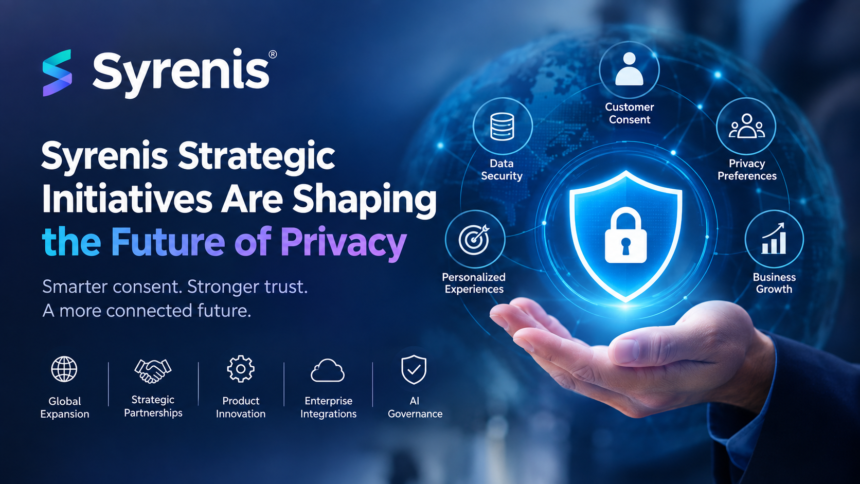
Syrenis strategic initiatives are helping redefine how large organizations manage privacy, consent, customer preferences, and first-party data. Privacy is no longer simply a legal requirement handled by compliance teams. It has become an important part of marketing, customer experience, data management, artificial intelligence, and business growth.
As companies operate across websites, apps, regions, brands, and digital platforms, keeping customer choices consistent has become increasingly difficult. Syrenis addresses this challenge through enterprise consent and preference management, partnerships, product development, integrations, and international expansion.
The wider goal is straightforward: businesses should be able to use customer data responsibly while giving people greater control over how their information is collected and used.
What Are Syrenis Strategic Initiatives?
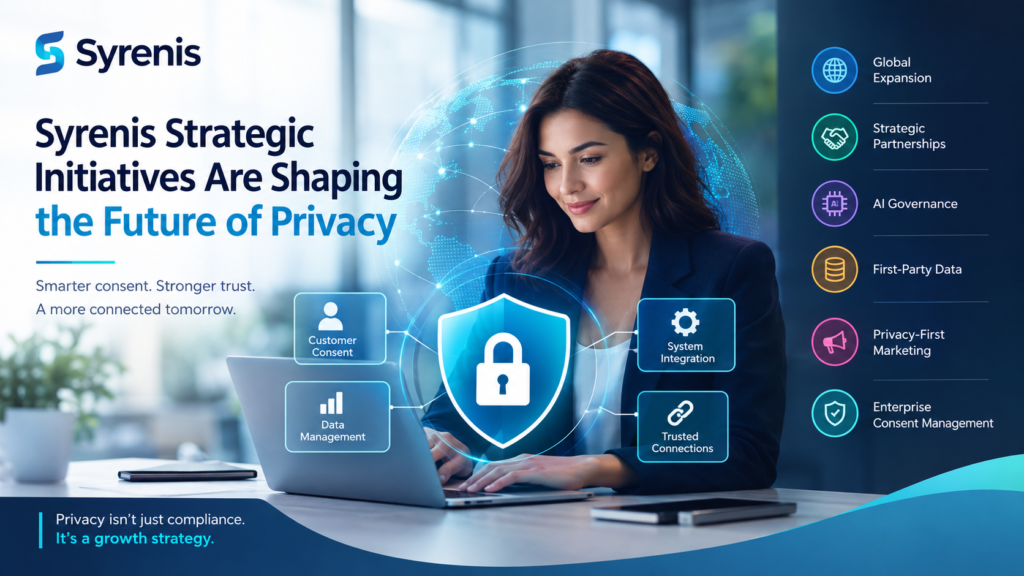
Syrenis strategic initiatives are focused on several connected areas, including global expansion, enterprise growth, product development, strategic partnerships, AI governance, integrations, and privacy-first marketing.
At the center of this strategy is the idea that consent should not remain isolated inside a website banner or a single privacy tool. Instead, consent and preference information should become part of an organization’s broader data infrastructure.
For a large company, this approach can be particularly valuable. A customer might interact with a brand through a website, mobile application, customer service team, email campaign, and physical store. If each channel stores privacy preferences differently, the organization can easily create conflicting records.
Syrenis aims to create a centralized and trusted view of those choices. When a customer gives, changes, or withdraws permission, that information can be shared with the systems that need it.
Why Enterprise Privacy Needs a New Model
Modern privacy management is becoming more complicated because businesses collect information through more channels than ever before. A global organization may operate several websites, brands, applications, marketing platforms, customer databases, and analytics systems.
Traditional privacy tools are often designed around individual websites or specific compliance requirements. That can create fragmented records. One system may show that a customer has opted in, while another system may still contain an outdated preference.
This is where Syrenis strategic initiatives take a broader approach. Instead of treating consent as a one-time interaction, the strategy connects consent with identity, customer preferences, and enterprise systems.
The result is intended to be a more consistent privacy experience. Legal, marketing, technology, data, and customer service teams can work with the same underlying preference information instead of maintaining separate records.
Global Growth and U.S. Expansion
Global expansion is an important part of Syrenis strategic initiatives. Privacy requirements differ between countries and, in some markets, between individual states or regions. This creates demand for enterprise technology that can manage different requirements without creating unnecessary complexity.
The United States is particularly important because organizations may need to consider multiple state privacy laws. California, for example, has the California Consumer Privacy Act and California Privacy Rights Act, while other states have developed their own privacy frameworks.
Syrenis has expanded its presence in the United States, including operations in locations such as Austin and Atlanta. A stronger North American presence allows the company to work more closely with enterprise customers and partners in sectors such as financial services, healthcare, retail, media, and technology.
For Syrenis, local operations can also provide better insight into the needs of organizations dealing with complex privacy environments.
Enterprise Sales Leadership Drives Growth
Another part of Syrenis strategic initiatives is enterprise sales and commercial expansion. Selling privacy technology to large organizations is different from selling a simple software subscription.
Enterprise buyers may involve privacy officers, legal departments, IT teams, cybersecurity professionals, data specialists, marketing leaders, and senior executives. Every group needs to understand how the platform fits into its existing systems and business objectives.
A strong commercial strategy can therefore help Syrenis communicate the broader value of consent management. Instead of positioning privacy software only as a compliance expense, the company can demonstrate how reliable preference data may support marketing, personalization, customer trust, and data governance.
This approach is particularly relevant as businesses search for ways to improve their first-party data strategies while reducing dependence on uncertain tracking methods.
Strategic Partnerships Add More Value
Software alone cannot solve every enterprise privacy challenge. Organizations often need help with privacy policies, data mapping, implementation, governance, training, and long-term program management.
That is why partnerships are an important part of Syrenis strategic initiatives. Consulting relationships can combine Syrenis technology with professional privacy expertise.
One notable example is the alliance with The Data Privacy Group (DPG). The partnership brings together Syrenis consent and preference technology with DPG’s privacy consulting capabilities.
This type of relationship can make it easier for organizations to move from privacy planning to practical implementation. A company may understand that it needs centralized consent management but still require specialist assistance to determine how the technology should work across its existing environment.
KPMG Collaboration and Privacy Strategy
Syrenis has also developed resources around its collaboration with KPMG. The relationship highlights an important shift in the privacy market: consent management can be connected to wider business value rather than being treated purely as a compliance function.
Topics such as progressive profiling and the potential return from consent programs show how privacy data can contribute to better customer relationships.
For organizations, this means the privacy conversation can move beyond questions such as “Are we compliant?” and toward broader questions such as “Are we collecting useful data responsibly?” and “Are customers receiving better experiences because they have more control?”
That shift is central to the wider direction of Syrenis strategic initiatives.
AI Governance Creates a New Opportunity
Artificial intelligence is creating another important use case for privacy and consent management.
AI systems can process large amounts of information, but businesses still need to understand whether they have the right to use particular data. A privacy policy alone does not necessarily provide the operational evidence needed to answer that question.
Consent records can provide an important part of this governance layer. Organizations can maintain information about what a customer agreed to, when the decision occurred, what purpose it related to, and whether that permission was later changed or withdrawn.
Syrenis strategic initiatives connect consent management with this emerging need for AI governance. A reliable consent record can help privacy and data teams determine whether information is appropriate for particular uses.
However, consent is only one element of responsible AI. Organizations still need security controls, access management, model governance, human oversight, data-quality processes, and appropriate risk assessments.
More Than 350 Integrations Connect Privacy Data
One of the biggest challenges for enterprise privacy is getting different systems to communicate.
A company might use a CRM for customer records, a marketing automation platform for campaigns, analytics tools for measurement, and separate systems for customer service. If consent information remains trapped in one system, other platforms may not know about the latest customer decision.
Syrenis addresses this challenge through integrations and APIs. The company states that its platform supports more than 350 integrations, helping connect consent and preference information with broader enterprise technology environments.
This connected model can reduce data gaps without requiring an organization to completely replace its existing technology stack.
For example, if a customer changes an email preference, that update needs to reach the marketing system responsible for future communications. A connected consent architecture can help ensure that the newest preference becomes the record used by downstream systems.
Creating One Trusted Source of Consent
A central concept behind Syrenis strategic initiatives is the creation of a single source of truth for customer consent and preferences.
Imagine a customer has previously agreed to receive certain communications but later changes their mind. If that change is recorded in one system but not another, the organization could continue using outdated information.
A centralized consent record can reduce this problem by providing a consistent reference point.
It can also help organizations answer important questions during internal reviews or customer requests. They may need to know what choice was made, when it was made, what purpose it covered, and whether the preference was later modified.
Time-stamped and auditable records can therefore support both compliance and operational efficiency.
Cross-Domain Consent Improves User Experience
Large organizations often operate multiple websites and digital properties. Asking users to make the same privacy choice repeatedly can create frustration and consent fatigue.
Syrenis offers Cross Domain Consent to help address this issue across approved connected domains.
The basic idea is simple: when appropriate, a customer’s consent choice can be recognized across related digital properties instead of requiring the same decision to be repeated on every site.
This is more than a technical feature. It can improve the overall privacy experience by reducing unnecessary interruptions.
A good privacy experience should allow users to understand their choices without forcing them through repetitive or confusing interactions. Better design can help build trust while also making consent management more efficient for the organization.
Privacy-First Marketing and First-Party Data
Marketing is another area where Syrenis strategic initiatives have significant relevance.
Modern marketers want accurate customer information for personalization and campaign targeting. At the same time, customers increasingly expect transparency and control over their data.
This creates an opportunity for first-party data. Instead of relying heavily on third-party tracking, organizations can build relationships directly with customers and collect information that people knowingly choose to share.
Consent and preference management can support this approach by recording customer choices in a structured way.
A customer might choose which subjects interest them, which communication channels they prefer, or how frequently they want to receive messages. This information can help marketing teams create more relevant campaigns without ignoring customer privacy.
The result can be a better balance between personalization and control.
Progressive Profiling Makes Data Collection More Natural
Progressive profiling is another useful concept connected with Syrenis strategic initiatives.
Rather than asking a customer to provide a large amount of information in one long form, progressive profiling allows a company to collect useful preference information gradually.
For example, a customer may initially provide only an email address. During later interactions, the organization may ask about communication interests, product preferences, or other relevant information.
When done transparently, this approach can create a smoother user experience. Customers are not overwhelmed with unnecessary questions, while businesses can gradually develop more useful first-party profiles.
The key is that data collection should remain clear, relevant, and connected to meaningful customer choices.
Why Consent Management Matters for Businesses
The value of consent management extends beyond compliance.
For marketing teams, accurate preference information can reduce unwanted communications and improve campaign targeting. For privacy teams, centralized records can make audits and reviews easier. For technology teams, integrations can reduce manual synchronization between systems.
For customers, the biggest benefit is control.
When people can clearly understand and manage their choices, they are more likely to feel that a company respects their privacy. That trust can become an important part of the overall customer relationship.
This is why Syrenis strategic initiatives position privacy as business infrastructure rather than simply another legal requirement.
Challenges Syrenis Must Continue to Address
Despite the opportunities, enterprise privacy technology comes with significant challenges.
Every large organization has a different technology stack. Some businesses operate legacy databases alongside modern cloud platforms, while others have complex identity structures across multiple brands and regions.
Connecting these systems can require substantial planning. Privacy teams must also make sure that policies, technology, and business processes remain aligned.
AI introduces another layer of complexity. Consent information can support AI governance, but companies must also consider security, model risk, data provenance, access controls, and human oversight.
Partnerships can help address some of these challenges, but successful implementation still depends on clear governance and strong execution.
The Future of Syrenis Strategic Initiatives
The future of Syrenis strategic initiatives is closely connected to the broader evolution of enterprise privacy.
As companies collect more data across websites, applications, connected services, and AI systems, they need reliable ways to understand what customers have allowed and how those choices should be honored.
Syrenis is building its position around this requirement through international expansion, enterprise sales, strategic partnerships, product development, integrations, and privacy-focused marketing solutions.
The larger trend is clear: consent is becoming more than a checkbox. It is becoming an important data signal that can influence marketing, customer experience, compliance, analytics, and AI governance.
If businesses can make privacy controls reliable and easy to use, they can potentially create a stronger relationship between responsible data use and business growth.
Conclusion
Syrenis strategic initiatives reflect a major change in how organizations think about privacy. Instead of treating consent as a small compliance task, the approach places consent and customer preferences closer to the center of enterprise data infrastructure.
Global expansion can increase market reach, strategic partnerships can add consulting expertise, integrations can connect fragmented systems, and AI governance can create new opportunities for consent data.
The most important idea is simple: customers want control, while businesses need reliable data. A modern consent and preference management strategy aims to support both.
As privacy expectations continue to rise, companies that make customer choice transparent, consistent, and actionable will be better positioned to build trust. This is where the long-term importance of Syrenis strategic initiatives becomes clear.
FAQs
What are Syrenis strategic initiatives?
Syrenis strategic initiatives focus on global growth, enterprise sales, product development, partnerships, integrations, privacy-first marketing, and the use of consent data for emerging areas such as AI governance.
What does Syrenis do?
Syrenis provides enterprise consent and preference management technology. Its platform is designed to help organizations collect, manage, synchronize, and honor customer privacy choices across different systems and channels.
Why is consent management important?
Consent management helps businesses keep track of customer choices and ensure those choices are reflected across relevant systems. It can support privacy compliance, customer trust, marketing accuracy, and better first-party data management.
How can Syrenis help with first-party data?
Syrenis can help organizations collect and manage customer preferences and consented information. This can give marketing teams a more reliable foundation for personalized communication while respecting customer choices.
How could Syrenis support AI governance?
Consent records can provide evidence about whether customer data was collected with permission and for what purpose. This information can support AI data governance, although responsible AI also requires security, access controls, risk management, and human oversight.