
Some Olympic stories are remembered for a single medal. Others become part of sporting history because of the career behind that medal. The Flying Elephant: Memoirs of an Olympic Champion tells the story of Alexander Savin, a major figure in Soviet volleyball whose career included two Olympic Games, an Olympic silver medal, an Olympic gold medal, World Championship victories, World Cup success, and recognition by the International Volleyball Hall of Fame.
Savin’s journey is especially interesting because it connects individual athletic achievement with the history of Soviet volleyball. His career developed during a period when the Soviet Union was one of the dominant forces in international volleyball, and his experiences offer readers a closer look at the discipline, teamwork, pressure, and preparation behind elite competition.
For volleyball fans, Olympic sports enthusiasts, athletes, coaches, and readers interested in sports history, The Flying Elephant provides an opportunity to explore much more than a list of medals.
What Is The Flying Elephant: Memoirs of an Olympic Champion?
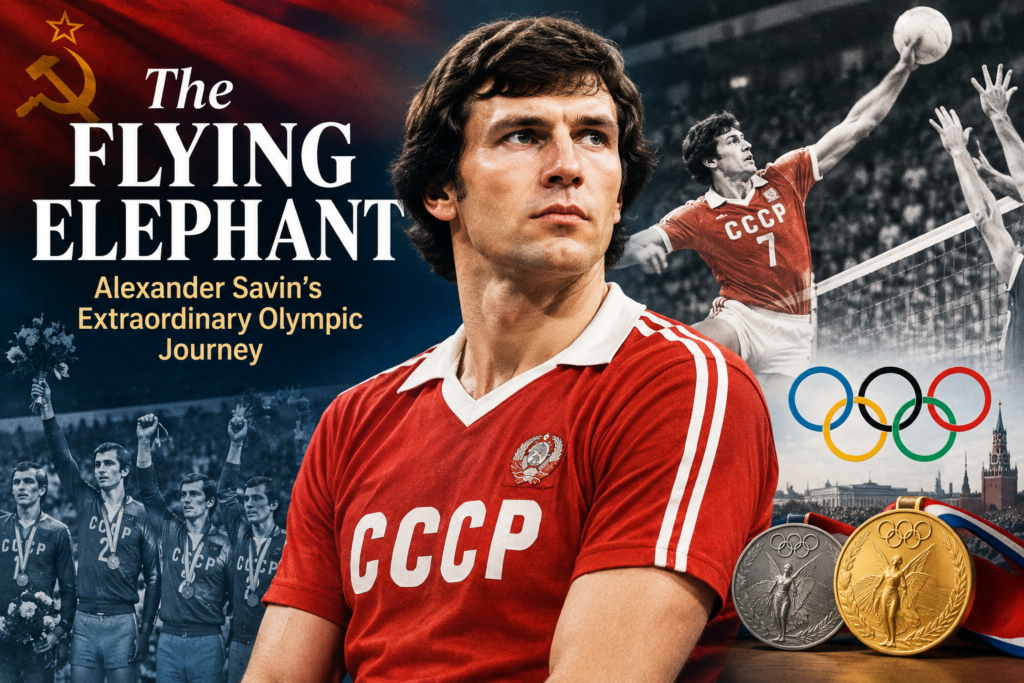
The Flying Elephant: Memoirs of an Olympic Champion is a sports memoir centered on Alexander Savin and his career in international volleyball.
Savin represented the Soviet Union at the 1976 Montreal Olympics and the 1980 Moscow Olympics. His Olympic journey produced two different outcomes: silver in Montreal and gold in Moscow. Those competitions form an important part of his sporting legacy, but his career extended far beyond the Olympic Games.
The memoir places athletic achievement within a wider story involving training, teammates, coaches, competition, discipline, international tournaments, and the sporting environment of the Soviet era.
Rather than viewing Olympic success as a single moment, the story helps readers consider the years of preparation required to reach that stage.
The Book at a Glance
| Detail | Information |
| Full title | The Flying Elephant: Memoirs of an Olympic Champion |
| Central figure | Alexander Savin |
| Sport | Volleyball |
| Genre | Sports memoir / volleyball autobiography |
| Olympic appearances | 1976 and 1980 |
| Olympic medals | Silver in 1976, Gold in 1980 |
| 1980 Olympic host city | Moscow |
| Major achievements | Olympic, World Championship and World Cup success |
| Hall of Fame recognition | International Volleyball Hall of Fame, 2010 |
| Main themes | Teamwork, discipline, competition, pressure and sporting history |
Who Is Alexander Savin?
Alexander Borisovich Savin was born on July 1, 1957, in Taganrog, in the Russian SFSR of the Soviet Union.
He became one of the notable volleyball players of the Soviet era and represented the Soviet national team at the highest level of international competition. His career coincided with a particularly successful period for Soviet men’s volleyball.
Savin’s Olympic career is central to his legacy. At the 1976 Montreal Games, the Soviet men’s volleyball team won the silver medal. Four years later, at the 1980 Moscow Olympics, Savin and the Soviet team won gold.
His achievements were not limited to the Olympics. His career included major international victories such as World Cup and World Championship titles, helping establish his reputation as one of the important players of his generation.
His contribution to volleyball was later recognized when he was inducted into the International Volleyball Hall of Fame in 2010.
Why Is It Called The Flying Elephant?
The title The Flying Elephant immediately creates curiosity.
The phrase can be understood as a contrast between physical size and athletic movement. Volleyball players need power, but elite performance also requires speed, coordination, timing, jumping ability, positioning, and technical control.
The image of an elephant suggests strength and physical presence, while “flying” suggests movement and athletic explosiveness.
That combination makes the title an appropriate metaphor for an elite volleyball player whose effectiveness depended on more than physical size.
At the highest level, a volleyball player cannot simply rely on height or strength. Successful performance requires the ability to react quickly, understand the game, coordinate with teammates, and execute technical movements under pressure.
From Montreal Silver to Moscow Gold
The most recognizable part of Savin’s Olympic journey is the contrast between his two Olympic appearances.
The 1976 Montreal Olympics
Savin competed at the 1976 Summer Olympics in Montreal, where the Soviet men’s volleyball team finished with the silver medal.
Winning an Olympic silver medal is a major achievement, but for an athlete competing at the highest level, second place can also become part of a longer competitive journey.
The Montreal result provided Savin with Olympic experience before his second Games. Four years later, he would return to the world’s biggest sporting stage under very different circumstances.
The 1980 Moscow Olympics
The 1980 Moscow Olympics represented the defining Olympic moment of Savin’s career.
The Soviet Union hosted the Games, and the men’s volleyball team competed with the expectations that came with playing on home soil.
This time, the result was different.
Savin and his teammates won the Olympic gold medal, giving him a complete Olympic medal record across his two appearances: silver in 1976 and gold in 1980.
The progression from Montreal to Moscow is one of the most compelling elements of his Olympic story.
The Golden Era of Soviet Volleyball
Understanding Savin’s career requires understanding the strength of Soviet volleyball during his competitive years.
The Soviet Union developed a highly organized sporting system in which elite athletes were trained through structured programs and extensive competition. Volleyball was one of the sports in which Soviet teams achieved considerable international success.
The environment emphasized preparation, technical development, physical conditioning, tactical organization, and team discipline.
Savin developed within that system and became part of a generation capable of competing successfully against strong international opponents.
This makes his story relevant not only to volleyball fans but also to readers interested in the history of Olympic sport during the Cold War period.
More Than an Olympic Medal Story
An Olympic medal can summarize an athlete’s achievement, but it cannot explain the entire journey.
Behind every major tournament are years of preparation that spectators rarely see.
Athletes have to deal with training schedules, competition for selection, injuries and fatigue, tactical preparation, relationships with coaches, expectations from teammates, and the psychological pressure of important matches.
A sports memoir can provide context that statistics cannot.
In Savin’s case, the larger story includes the environment surrounding Soviet volleyball and the people who contributed to the team’s success.
That makes The Flying Elephant more than a record of Olympic results. It can also be viewed as a personal account connected to a significant chapter in volleyball history.
Major Themes in The Flying Elephant
Discipline and Long-Term Preparation
Elite sport is built through consistency.
Olympic champions do not become successful because of one outstanding training session. Their performance develops through years of repetition, physical preparation, technical work, competition, and learning.
Savin’s career illustrates how sustained preparation can eventually produce results on the world’s biggest sporting stage.
For modern athletes, this is one of the most recognizable lessons from Olympic sport: long-term development matters more than short-term excitement.
Teamwork Over Individual Glory
Volleyball is fundamentally a team sport.
A powerful attacker cannot succeed without effective passing and setting. A strong blocker depends on positioning and communication. Defensive players depend on the entire team structure.
This makes Savin’s story particularly useful for understanding collective achievement.
His Olympic gold medal was not an individual victory. It belonged to a team whose players had to trust one another and execute a common strategy.
Resilience After Disappointment
The movement from silver in 1976 to gold in 1980 also illustrates the importance of resilience.
Athletes often experience disappointment even after reaching an extremely high level.
An Olympic silver medal represents enormous success, but the difference between second and first place can be psychologically significant for competitors.
Savin’s return to the Olympics four years later provides a clear example of how an athlete’s career can continue after both achievement and disappointment.
Performing Under Pressure
Olympic competition creates an environment unlike ordinary sporting events.
Athletes are competing against the world’s best while representing their teams and countries. The attention surrounding the Games can add another layer of pressure.
For Savin, the 1980 Olympics also took place in the Soviet Union.
Playing at home meant competing in front of a large audience with expectations surrounding the host nation’s team.
Managing that environment is an important part of understanding elite Olympic performance.
The Soviet Sporting Context
Savin’s career unfolded during the Cold War, when international sport often carried significance beyond the competition itself.
Olympic results could become symbols of national sporting achievement, and elite athletes competed within highly organized national systems.
This historical context adds another dimension to The Flying Elephant.
The book can be approached not simply as an athlete biography but also as a window into a particular period of international sports history.
Readers interested in the relationship between sport, national teams, coaching systems, and international competition may therefore find Savin’s story especially interesting.
The Importance of Coaches and Teammates
Successful athletes rarely reach the top entirely on their own.
Behind an Olympic champion are usually coaches, teammates, training partners, medical professionals, conditioning specialists, and other members of a sporting organization.
Volleyball makes this especially obvious.
A national team must build coordination between players with different roles and abilities. Communication, tactical understanding, trust, and shared preparation can determine whether a team succeeds under pressure.
For this reason, Savin’s career can also be understood as a story about the wider volleyball community surrounding an elite player.
International Success Beyond the Olympics
Although Olympic gold is one of Savin’s best-known achievements, his international record extends beyond the Games.
His career included participation in Soviet teams that achieved major success at the FIVB World Cup and World Championship level.
Among the major team achievements associated with his career are World Cup titles in 1977 and 1981 and World Championship titles in 1978 and 1982.
These results demonstrate that Savin’s career was not based on one successful Olympic tournament.
Instead, he competed successfully across multiple major international competitions.
That broader record helps explain why his career has continued to attract attention among volleyball historians.
Why His Hall of Fame Recognition Matters
Savin’s long-term contribution to volleyball received formal recognition when he was inducted into the International Volleyball Hall of Fame in 2010.
Hall of Fame recognition places his career within the broader historical record of the sport.
For readers discovering Savin through The Flying Elephant, this provides useful context. His story is not simply about one Olympic appearance or one medal. His career represents a larger contribution to international volleyball during an important period in the sport’s development.
What Makes This Memoir Interesting for Modern Readers?
Modern sports fans experience competition very differently from audiences during Savin’s playing years.
Today, athletes are followed through social media, instant statistics, video analysis, performance tracking, and constant online coverage.
Savin’s generation competed in a very different media environment.
That historical distance makes the memoir valuable because it allows modern readers to consider how elite sport functioned before today’s digital ecosystem.
At the same time, many fundamental aspects of high-performance sport remain recognizable.
Athletes still need discipline.
Teams still need trust.
Coaches still influence development.
Competition still creates pressure.
And Olympic success still requires years of preparation.
What Modern Athletes Can Learn From Savin’s Journey
Savin’s career offers several broader lessons that remain relevant.
Consistency Matters
Long-term athletic development depends on repeated effort rather than occasional bursts of motivation.
Physical Ability Is Only One Part of Performance
Strength, height, and athleticism matter, but technique, timing, decision-making, positioning, and teamwork are equally important.
Setbacks Can Become Part of Development
The transition from Olympic silver in Montreal to Olympic gold in Moscow shows that one result does not necessarily define an entire career.
Team Success Requires Individual Responsibility
Every player has a role. Individual excellence becomes more valuable when it contributes to the team’s overall performance.
Sporting History Provides Context
Understanding the era in which an athlete competed can make their achievements more meaningful.
Who Should Read The Flying Elephant?
Volleyball fans are the most obvious audience. Readers interested in the history of international volleyball can use Savin’s career as a route into the Soviet era of the sport.
Athletes and coaches may also find value in the themes of preparation, teamwork, discipline, leadership, and competition.
Olympic history enthusiasts can explore the experiences of an athlete who competed at two consecutive Olympic Games and won both silver and gold.
Sports biography readers can approach the book as a personal story connected to a much larger sporting system.
You also do not need to be an expert in volleyball to understand its central themes. Competition, pressure, ambition, disappointment, teamwork, and achievement are universal subjects.
Why Alexander Savin’s Olympic Story Still Matters
Sports history can sometimes become dominated by the newest generation because modern competitions are easier to watch, search, and discuss online.
Older athletes can gradually become less familiar to new audiences.
Alexander Savin’s career provides an example of why sporting history is worth preserving.
His Olympic record tells a concise story: silver at Montreal 1976 and gold at Moscow 1980.
His wider career tells a much larger story involving international championships, World Cup success, Soviet volleyball, teammates, coaches, preparation, and the changing world of elite sport.
That difference is important.
Statistics tell readers what happened.
A memoir can provide insight into the journey behind those results.
Conclusion
The Flying Elephant: Memoirs of an Olympic Champion offers more than a story about an Olympic gold medal.
Alexander Savin’s career connects two Olympic Games with very different outcomes: silver in Montreal in 1976 and gold in Moscow in 1980. Around those results was a much longer journey involving international championships, World Cup success, teammates, coaches, discipline, competition, and the distinctive sporting environment of the Soviet era.
What makes the story particularly interesting is the human journey behind the medals.
Olympic success is visible for a few moments, but reaching that stage can require years of preparation, sacrifice, teamwork, and persistence. Savin’s career demonstrates why sporting achievements are best understood within the larger context of an athlete’s development and era.
For volleyball enthusiasts, the memoir provides a connection to an important period in the sport’s history. For athletes and coaches, it offers themes of discipline, teamwork, resilience, and competitive pressure. For general sports readers, it provides a window into the career of an Olympic champion whose achievements extended well beyond a single tournament.
FAQs
What is The Flying Elephant: Memoirs of an Olympic Champion about?
The Flying Elephant: Memoirs of an Olympic Champion is a sports memoir centered on Alexander Savin and his career in Soviet and international volleyball, including his Olympic experiences and wider sporting achievements.
Who is Alexander Savin?
Alexander Savin is a former Soviet volleyball player who represented the Soviet Union at the 1976 and 1980 Olympic Games. He won silver in Montreal and gold in Moscow and was inducted into the International Volleyball Hall of Fame in 2010.
Did Alexander Savin win an Olympic gold medal?
Yes. Savin won Olympic gold with the Soviet men’s volleyball team at the 1980 Moscow Olympics.
Did Alexander Savin compete at the 1976 Olympics?
Yes. Savin represented the Soviet Union at the 1976 Montreal Olympics, where the team won the silver medal.
Why is the book called The Flying Elephant?
The title evokes the contrast between physical power and athletic movement. In elite volleyball, large and powerful players must also demonstrate coordination, jumping ability, timing, speed, and technical skill.
Is The Flying Elephant a volleyball autobiography?
It can broadly be described as a volleyball memoir or sports autobiography because it focuses on Savin’s life and experiences as an elite volleyball player and Olympic champion.
Why is Alexander Savin important in volleyball history?
Savin was part of a highly successful generation of Soviet volleyball players. His Olympic medals, international championships, and 2010 International Volleyball Hall of Fame induction place him among the notable figures of his era.