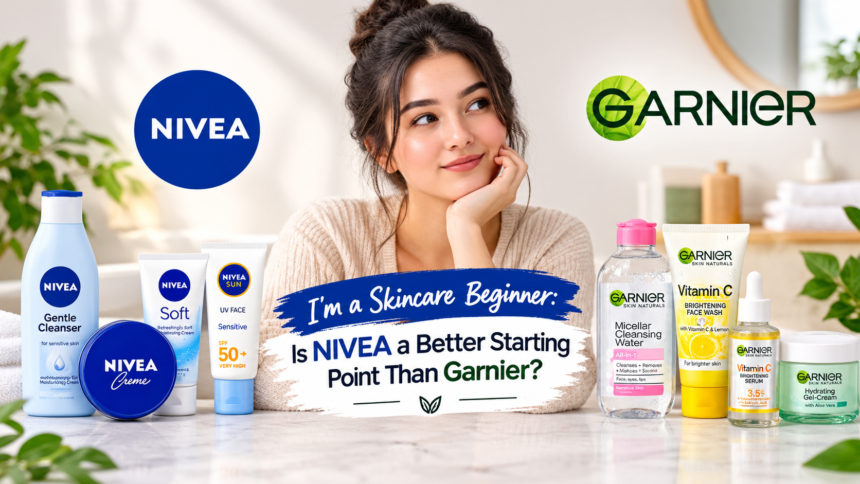
If you’re a skincare beginner, choosing your first products can be surprisingly confusing. Walk into a pharmacy, supermarket, or beauty store and you may find cleansers, moisturizers, serums, toners, vitamin C products, exfoliators, masks, and sunscreens from dozens of brands.
Two names that commonly stand out are NIVEA and Garnier.
So, if you’re wondering, “I’m a skincare beginner: is NIVEA a better starting point than Garnier?”, the answer is not simply yes or no. Both brands offer products that can fit a beginner routine, but they have different product ranges and different strengths.
For someone starting skincare for the first time, the most important factor is not the brand name. Your skin type, product ingredients, specific concern, simplicity, and consistency matter more.
The good news is that you do not need a complicated 10-step routine. Dermatologists generally recommend starting with a simple foundation built around cleansing, moisturizing, and sun protection.
NIVEA vs Garnier: Which Is Better for a Beginner?
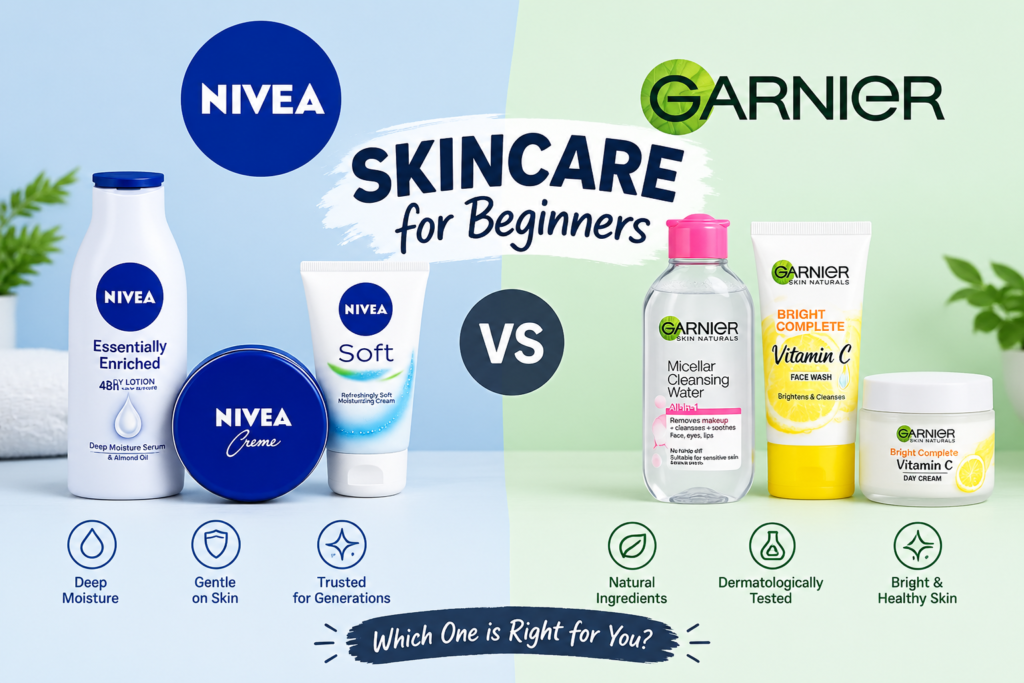
There is no universal winner between NIVEA and Garnier.
NIVEA is widely associated with moisturizing and everyday skin care. Its current product range includes traditional moisturizers as well as facial products designed for sensitive skin and products containing ingredients such as niacinamide, hyaluronic acid, salicylic acid, and vitamin C.
Garnier has a broad facial-skincare range that includes cleansers, micellar waters, moisturizers, vitamin C products, and other targeted formulas. For example, Garnier’s Vitamin C Micellar Water is designed to remove makeup and impurities while also targeting the appearance of dull or uneven-looking skin.
This means the better question is not:
“Which brand is better?”
Instead, ask:
“Which specific product fits my skin and my skincare goal?”
That change in thinking can make choosing your first routine much easier.
Why NIVEA Can Be a Good Starting Point
NIVEA can be particularly appealing to beginners because moisturizing is such a major part of its product identity.
If your skin feels dry, tight, rough, or uncomfortable after cleansing, a suitable NIVEA moisturizer may be a straightforward product to introduce.
For example, the classic NIVEA Creme contains ingredients including glycerin and panthenol and is designed as an intensive moisturizer. However, the formula also contains fragrance components, so it should not automatically be assumed to be ideal for every sensitive face.
NIVEA also has products specifically marketed for sensitive skin. Its Sensitive Night Cream, for example, is perfume-free and contains ingredients such as glycerin, panthenol, and licorice extract.
This illustrates an important beginner lesson:
NIVEA is not one formula.
Different products can have completely different textures, ingredients, and purposes.
Therefore, don’t assume that because one NIVEA product works for you, every product from the brand will automatically suit your skin.
Why Garnier Can Also Be a Good Starting Point
Garnier can be useful for beginners who want more targeted skincare options.
Its product range includes cleansing products, micellar waters, vitamin C-focused products, moisturizers, and other formulas aimed at specific skincare concerns.
One example is Garnier’s Vitamin C Micellar Water. According to Garnier, its micellar technology helps capture makeup and impurities, while a vitamin C derivative is included for glow-boosting and brightening-focused care.
That can make Garnier interesting for someone whose main concern is cleansing, makeup removal, or dull-looking skin.
However, beginners should not assume that a product with more active ingredients is automatically better.
A complicated routine can make it harder to understand what your skin actually needs. Dermatologists emphasize that more products are not necessarily better, and consistency with a simpler routine can be more useful.
NIVEA vs Garnier at a Glance
| Category | NIVEA | Garnier |
|---|---|---|
| Basic moisturization | Strong range | Good range |
| Cleansing | Good range | Strong range |
| Micellar products | Available | Strong selection |
| Brightening-focused care | Available | Strong selection |
| Sensitive-skin options | Available | Available |
| Targeted ingredients | Available | Widely available |
| Beginner routines | Suitable | Suitable |
| Best approach | Start simple | Start simple |
This comparison should not be interpreted as a fixed ranking.
A specific Garnier cleanser may work better for you than a NIVEA cleanser, while a NIVEA moisturizer may work better for your skin than a Garnier moisturizer.
The formula matters more than the logo.
What Should a Skincare Beginner Start With?
If you have never followed a skincare routine before, resist the temptation to buy everything at once.
You usually don’t need a cleanser, toner, vitamin C serum, niacinamide serum, retinol, exfoliating acid, eye cream, face mask, moisturizer, and several other products on day one.
A simple foundation is enough.
1. Gentle Cleanser
A cleanser removes dirt, oil, makeup, sunscreen, and other substances from the skin.
The American Academy of Dermatology recommends using a gentle, non-abrasive cleanser and avoiding aggressive scrubbing. For many people, cleansing twice a day and after heavy sweating is reasonable, although people with dry or sensitive skin may need a gentler approach.
If your skin is dry, choose a cleanser that does not leave your face feeling tight.
If your skin is oily, look for a gentle cleanser designed to remove excess oil without aggressively stripping the skin.
2. Moisturizer
Moisturizer is another basic product that most beginners can understand easily.
Its purpose is to help maintain hydration and reduce water loss from the skin.
Moisturizers come in gels, lotions, creams, and ointments, so texture matters. A lighter gel or lotion may feel more comfortable on oily skin, while a richer cream may be preferable for dry skin.
Ingredients such as glycerin, hyaluronic acid, and ceramides are commonly used in moisturizing products.
If you have sensitive skin, paying attention to fragrance can also be important because added fragrance may trigger irritation in some people.
3. Sunscreen
Sunscreen is one of the most important parts of a beginner skincare routine.
The American Academy of Dermatology recommends choosing sunscreen that offers broad-spectrum protection, SPF 30 or higher, and water resistance.
This is one area where you do not need to force yourself to use the same brand for every product.
You can use a NIVEA moisturizer, a Garnier cleanser, and a sunscreen from another brand if those products suit you.
Is NIVEA Better for Dry Skin?
NIVEA can be a practical choice for people who prioritize moisturization, but it is too broad to say that every NIVEA product is best for dry skin.
The specific formula matters.
For example, the classic NIVEA Creme is a rich moisturizer containing ingredients such as mineral oil, glycerin, paraffin, and panthenol. It is designed for intensive moisturizing and protective care.
However, someone with dry skin should still consider whether the product feels comfortable and whether fragrance is appropriate for their skin.
If your skin is persistently cracked, painful, bleeding, severely itchy, or inflamed, a cosmetic moisturizer may not be enough. The AAD recommends seeking dermatological care when severe or persistent dryness does not improve with appropriate skincare.
Is Garnier Better for Oily Skin?
Garnier has many lightweight and cleansing-focused products, which can make it attractive to people with oily or combination skin.
But again, brand does not determine skin compatibility.
If you have oily skin, look for products labeled non-comedogenic or “won’t clog pores” where appropriate. The AAD recommends non-comedogenic products for people who are concerned about clogged pores.
Also, don’t make the common mistake of skipping moisturizer because your skin is oily.
The AAD specifically recommends moisturizing even for oily skin. A suitable lightweight moisturizer can help keep the skin comfortable without requiring a heavy texture.
What About Sensitive Skin?
Sensitive skin requires a little more caution.
If products regularly cause burning, itching, redness, or discomfort, avoid introducing several new products at the same time.
A simple approach is:
Cleanser → moisturizer → sunscreen
Introduce one new product at a time so you can identify which product your skin tolerates or does not tolerate.
NIVEA has perfume-free sensitive-skin products, while Garnier also has products marketed for sensitive skin. But a “sensitive skin” label does not guarantee that every individual will tolerate a formula.
Ingredient lists still matter.
NIVEA or Garnier for Acne-Prone Skin?
If you’re dealing with acne-prone skin, don’t choose a brand based only on its reputation.
Instead, look at the individual product.
Some skincare formulas contain ingredients such as salicylic acid, which can help unclog pores and reduce blemishes. NIVEA’s ingredient resources describe salicylic acid as a BHA used to exfoliate and help unclog pores, while Garnier also offers targeted products containing acne-focused ingredients.
However, stronger products can sometimes irritate when used incorrectly.
If acne is persistent, painful, severe, or leaving scars, professional dermatological advice is more appropriate than repeatedly changing products.
Do Beginners Need Vitamin C?
Not necessarily.
Vitamin C is a popular skincare ingredient, particularly in products designed to improve the appearance of dull or uneven-looking skin.
Garnier has a visible presence in vitamin C skincare, including its Vitamin C Micellar Water.
NIVEA also lists vitamin C among the active ingredients used in its skincare products.
But a beginner does not need vitamin C simply because it is popular.
First establish the basics.
If your routine is inconsistent, your skin is irritated, or you are not using sun protection, adding another serum may only make your routine more complicated.
What About Niacinamide?
Niacinamide is another ingredient found across modern skincare.
NIVEA describes niacinamide as an ingredient that can help support the skin barrier, even skin tone, and reduce the appearance of pores.
Garnier also uses niacinamide in selected formulations.
Again, this demonstrates why comparing brands alone can be misleading.
Two products from different brands may contain similar ingredients but have different concentrations, textures, supporting ingredients, and intended uses.
Instead of asking:
“Which brand has better ingredients?”
ask:
“Does this particular formula solve a problem I actually have?”
Can You Use NIVEA and Garnier Together?
Yes.
No rule says your entire routine must come from one skincare brand.
For example, a beginner might use:
Morning:
Garnier cleanser → NIVEA moisturizer → sunscreen
Night:
Garnier cleanser → NIVEA moisturizer
Another person might prefer a NIVEA cleanser and a Garnier targeted product.
Mixing brands is completely reasonable when each product has a useful role, and your skin tolerates the combination.
Common Beginner Skincare Mistakes
Buying Too Many Products
More products can mean more irritation, more expense, and more confusion.
A simple routine is easier to maintain and troubleshoot.
Changing Products Too Quickly
If you change three or four products simultaneously, you won’t know which product caused an improvement or irritation.
Introduce new products gradually.
Scrubbing Your Face
Aggressive scrubbing does not mean cleaner skin.
Dermatologists recommend gentle cleansing with your fingertips and lukewarm water rather than abrasive scrubbing.
Skipping Moisturizer Because of Oily Skin
Oily skin still needs hydration. The goal is to find a comfortable formula rather than eliminate moisturizer.
Ignoring Sunscreen
A good skincare routine should include appropriate sun protection, particularly when you are outdoors.
Copying Someone Else’s Routine
A skincare routine that works for an influencer, friend, or family member may not work for you.
Skin type, sensitivity, environment, lifestyle, and individual product tolerance are different.
A Simple NIVEA Routine for Beginners
If you want to start with NIVEA, keep your routine uncomplicated.
Morning
1. Cleanse
Use a gentle facial cleanser appropriate for your skin.
2. Moisturize
Choose a moisturizer based on your skin type and how the product feels on your skin.
3. Sunscreen
Use a broad-spectrum SPF 30 or higher sunscreen.
Night
1. Cleanse
Remove makeup, sunscreen, dirt, and excess oil.
2. Moisturize
Apply your moisturizer while your skin is comfortable and clean.
That’s enough for a beginner.
You can add a targeted serum later if you have a specific reason to use one.
A Simple Garnier Routine for Beginners
The same basic structure works with Garnier.
Morning
Cleanser → Moisturizer → Sunscreen
Night
Cleanser → Moisturizer
If dullness or another specific concern remains after you establish your basic routine, you can consider adding a targeted product.
For example, Garnier’s vitamin C range provides options for people interested in brightening-focused skincare.
The key is to add one new product at a time.
How Should You Choose Between NIVEA and Garnier?
Before buying your first product, ask yourself five simple questions.
1. What Is My Skin Type?
Is your skin dry, oily, combination, normal, or sensitive?
Knowing this gives you a better starting point than simply choosing a popular brand.
2. What Is My Main Concern?
Choose one primary goal.
It could be:
- Dryness
- Oiliness
- Dull-looking skin
- Uneven-looking skin tone
- Occasional breakouts
- Sensitivity
You don’t need to fix everything at once.
3. What Does the Product Actually Do?
Read the label.
Don’t buy something simply because it is trending on social media.
4. What Ingredients Are Included?
Look beyond the front of the packaging.
Ingredients and product instructions tell you much more about whether a product is designed for your needs.
5. Will I Use It Consistently?
A simple moisturizer that you use consistently can be more practical than an expensive serum that you use twice and forget about.
The AAD similarly emphasizes that effective skincare does not have to be expensive and that a simple routine can be enough.
Should NIVEA Be Your First Skincare Brand?
If you’re asking specifically, “I’m a skincare beginner: is NIVEA a better starting point than Garnier?”, NIVEA is certainly a reasonable place to start.
Its moisturizing-focused products can make sense for someone who wants a straightforward routine, particularly when hydration is a major concern.
But that does not make Garnier a poor choice.
Garnier may be a better fit for someone particularly interested in cleansing, micellar water, vitamin C, or other targeted skincare products.
The important distinction is that neither brand should be selected automatically for every skin type.
A dry-skinned beginner may prefer a richer moisturizer. An oily-skinned beginner may prefer a lighter texture. Someone with sensitive skin may prioritize fragrance-free products. Someone who wears makeup may place greater importance on effective cleansing.
Your skin should make the decision—not the brand logo.
Final Answer: NIVEA vs Garnier for Beginners
So, is NIVEA a better starting point than Garnier for a skincare beginner?
NIVEA can be an excellent starting option, especially if you want simple, moisturizing-focused skincare. Garnier can also be an excellent starting option if you are more interested in cleansing, micellar products, brightening, or targeted ingredients.
There is no universal winner.
For a first skincare routine, prioritize:
Skin compatibility → simple formulas → appropriate ingredients → consistency → sun protection
A practical beginner routine can be as simple as:
Morning: Cleanser → Moisturizer → SPF 30+ sunscreen
Night: Cleanser → Moisturizer
Once your skin is comfortable with those basics, you can decide whether you actually need a serum, exfoliant, vitamin C, niacinamide, or another targeted product.
The goal of beginner skincare is not to collect the most products. It is to create a routine that your skin tolerates and that you can realistically follow.
Whether you choose NIVEA, Garnier, or a combination of both, start slowly, read product labels, and pay attention to how your skin responds.
If you develop persistent acne, severe irritation, painful inflammation, or another ongoing skin problem, consider speaking with a qualified dermatologist rather than repeatedly experimenting with new products.
FAQs
Is NIVEA good for skincare beginners?
Yes. NIVEA can be a suitable starting brand, particularly for beginners looking for straightforward moisturizing and everyday skincare. The suitability still depends on the individual product and your skin type.
Is Garnier good for skincare beginners?
Yes. Garnier offers a range of beginner-friendly cleansers, micellar products, moisturizers, and targeted skincare. Its suitability depends on the formula and your specific skin needs.
Is NIVEA better than Garnier?
There is no universal answer. NIVEA may appeal to people prioritizing moisturization, while Garnier offers many cleansing and targeted skincare options. The individual product matters more than the overall brand.
Can I use NIVEA and Garnier together?
Yes. You can combine products from both brands. For example, you can use a Garnier cleanser with a NIVEA moisturizer and a sunscreen from another brand.
Should a beginner use vitamin C?
Vitamin C is optional. Start with cleansing, moisturizing, and sun protection before adding targeted products. If you later have a specific reason to use vitamin C, introduce it gradually.
What is the simplest skincare routine for a beginner?
A simple routine is cleanser, moisturizer, and sunscreen in the morning, followed by cleanser and moisturizer at night. Dermatologists generally support keeping beginner routines simple.
Is NIVEA good for dry skin?
Some NIVEA moisturizers can be suitable for dry skin, particularly richer formulas. However, always check the individual ingredients and choose a product that feels comfortable for your skin.
Is Garnier good for oily skin?
Some Garnier products may suit oily or combination skin, particularly lightweight cleansing and skincare formulas. Look for products appropriate for oily skin and consider non-comedogenic options when clogged pores are a concern.
How many skincare products should a beginner use?
You can start with just three core categories: cleanser, moisturizer, and sunscreen. Additional products can be introduced later when you have a specific skincare goal.