Syrenis is positioning itself as more than a provider of cookie consent technology. Its current strategy centers on enterprise consent and preference management, connected privacy data, international expansion, partnerships, and the growing need for trustworthy data in an AI-driven business environment.
The company’s Cassie platform is designed for organizations that manage customer choices across multiple websites, applications, brands, jurisdictions, and business systems. Rather than treating consent as an isolated compliance task, Syrenis connects it with customer experience, marketing, data governance, and operational workflows.
That approach matters because enterprise privacy is becoming increasingly complex. A customer may interact with a company through a website, mobile application, CRM, email platform, loyalty program, customer-service team, or connected product. A privacy choice made in one place may need to be reflected across several of those systems.
This article examines the major Syrenis strategic initiatives, including its growth strategy, U.S. expansion, Cassie platform, partnerships, integrations, preference management, privacy UX, enterprise applications, and potential role in AI governance.
What Are Syrenis Strategic Initiatives?
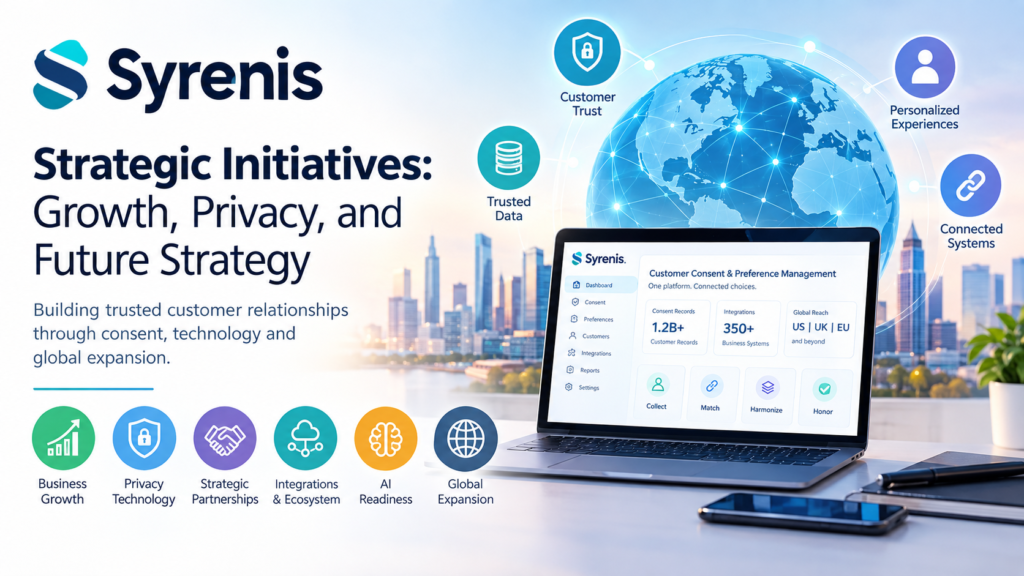
Syrenis strategic initiatives are the company’s broader efforts to expand its enterprise privacy business while developing technology for consent and preference management.
Several themes stand out in Syrenis’s current positioning: global growth, enterprise technology, connected privacy data, system integrations, customer preference management, and stronger privacy experiences.
The company describes its platform as a way to create a single source of truth for consent across systems, jurisdictions, and customer touchpoints. Its current website also highlights more than 350 integrations and real-time synchronization capabilities.
This reflects a larger change in how organizations approach privacy. Consent is not useful if it remains trapped inside one website or database. Businesses need customer choices to reach the systems that actually use personal information.
For example, if someone changes a marketing preference, that change may need to reach a CRM, email platform, analytics environment, and other connected tools. The objective is to make those systems work from the same current information.
| 🔗 You may also like: |
|---|
| Global Trader Programme |
| Growth Navigate |
Cassie Is at the Center of the Strategy
Cassie is Syrenis’s enterprise consent and preference management platform. The company positions it for organizations dealing with complex privacy requirements and large technology environments.
At a basic level, consent management answers a legal and governance question: what has a person permitted, for what purpose, and can the organization demonstrate how that permission was collected?
Preference management addresses a related but different question: what does the customer actually want?
Syrenis makes this distinction explicit. Its preference-management offering focuses on choices such as topics, channels, frequency, and other communication preferences, while consent management focuses on permission and its associated records.
That distinction is important for enterprise organizations because a customer can legally permit communication while still preferring a particular channel or subject area.
Building a Single Source of Truth
One of the central ideas behind the Syrenis strategy is creating a consistent record of customer choices.
Consider a large retailer with a website, mobile app, loyalty program, CRM, customer-service platform, and email system. Each environment may interact with the same customer.
Without coordination, different systems can end up holding different versions of the customer’s preferences.
Syrenis’s integration model is designed to address this fragmentation by connecting consent and preference data across systems and workflows. The company says its platform can synchronize privacy data in real time and provide APIs, connector services, data exports, and system mapping.
The goal is not simply to store a consent record. It is to make that information useful throughout the enterprise.
Global Growth and U.S. Expansion
International expansion is another important part of Syrenis strategic initiatives.
Syrenis currently lists offices in Austin, Atlanta, and the United Kingdom. Its contact information identifies Austin as its North American head office and Atlanta as another North American office.
The company has also described a dedicated U.S. go-to-market operation based in Atlanta as part of its North American expansion. Its brand-relaunch announcement said the unified Syrenis brand was intended to support international growth across the United States, United Kingdom, and Europe.
This expansion makes strategic sense for an enterprise privacy provider because organizations operating in the United States face a growing collection of state-level privacy requirements.
At the same time, multinational companies may need to coordinate U.S. requirements with European and other international privacy frameworks.
A global privacy platform therefore has to handle more than one regulatory environment. It needs to give organizations flexibility without turning every country or state into an entirely separate data-management project.
Why Atlanta Matters
An Atlanta presence can provide Syrenis with a closer base for U.S. enterprise sales and partnerships.
However, the more important strategic issue is not simply physical expansion. The platform needs to support organizations whose privacy operations cross borders, business units, brands, and technology stacks.
Syrenis’s current messaging emphasizes exactly this type of enterprise complexity.
| 🔗 You may also like: |
|---|
| How Can Private Clinics Build Patient Trust Online? |
| Target Company URL Research |
Enterprise Growth and Leadership
Syrenis marked its 25th anniversary in 2025 with several senior leadership appointments.
The company announced Adam Binks as CEO, Martin Audcent as CFO, and Paul Glynn as Chief Sales Officer. Syrenis said the appointments were intended to support its next phase of global growth.
The announcement also stated that Syrenis’s customers collectively oversee more than 1.2 billion customer records and that the company had set an ambition to more than double revenue over the following five years. These are company-reported figures and goals rather than independent market measurements.
The leadership structure is relevant because enterprise software growth requires more than product development.
A company selling into large organizations must build sales capacity, implementation relationships, customer support, partnerships, and technology integrations at the same time.
That makes commercial expansion closely connected to Syrenis’s product strategy.
Strategic Partnerships
Partnerships are another part of Syrenis’s approach to enterprise growth.
Privacy projects often involve more than installing software. Organizations may need assistance with privacy strategy, process design, regulatory interpretation, implementation, data mapping, and organizational change.
A technology company can therefore benefit from working alongside specialist consulting organizations.
Syrenis and The Data Privacy Group
Syrenis has highlighted an alliance with The Data Privacy Group as part of its partnership activity.
The broader logic is straightforward: privacy consulting can help an organization determine what it needs to achieve, while technology can help operationalize those requirements across business systems.
This model can be particularly useful for large organizations where privacy decisions affect legal, marketing, data, IT, and customer-experience teams.
The important point is that partnerships extend the potential reach of a technology platform without requiring every implementation task to be handled directly by the software provider.
KPMG Resource Hub
Syrenis also maintains a dedicated KPMG resource hub. The company describes it as having been created following a workshop and product demonstration, with material aimed at implementation partners and enterprise privacy programs.
The hub references capabilities including consent management, privacy notices, connector services, APIs, exports, identity services, and progressive profiling.
This is best understood as a specific collaboration and resource relationship rather than evidence of a blanket claim about every KPMG operation worldwide.
Integrations Are a Major Strategic Focus
Consent information has limited value when it cannot reach the systems that use customer data.
That is why integrations are central to Syrenis strategic initiatives.
Syrenis currently advertises more than 350 integrations and describes its platform as an integration layer for CRM, marketing, analytics, customer-service, and operational systems.
Its API capabilities are also designed to support real-time privacy-data calls, flexible endpoints, and updates to connected systems.
This creates a practical workflow.
A customer changes a preference. The change is recorded. Connected systems receive the updated information. Marketing, customer service, analytics, and other teams can then work from the latest available customer choice.
That can reduce the risk of fragmented records.
Why Real-Time Synchronization Matters
Customer preferences are not permanent.
A person can subscribe today and withdraw permission tomorrow. They can change their preferred communication channel or update other choices.
If one system receives the change immediately while another continues using an older record, the organization can end up with inconsistent behavior.
Syrenis therefore emphasizes real-time synchronization as part of its data-management approach.
The actual result still depends on implementation quality, identity matching, system configuration, and the specific integrations being used.
Preference Management and Better Customer Experiences
Syrenis strategic initiatives are not limited to compliance.
The company also presents preference management as a way to improve customer experience.
A preference center can allow customers to select what they want to receive, which channels they prefer, and potentially how frequently they want to hear from a business.
This is different from presenting a customer with one broad subscribe-or-unsubscribe choice.
For example, a customer might want product updates but not promotional emails. Another person may prefer email over SMS. A third customer may want information about a specific product category.
A well-designed preference system can capture those distinctions.
Syrenis describes its preference-management platform as capturing customer choices once and keeping systems, channels, and teams aligned with those choices.
Privacy UX Is Becoming More Important
Privacy experiences can affect both trust and data quality.
If a consent interface is confusing, users may make choices without understanding what they mean. If it is difficult to change a preference later, the experience can feel unnecessarily restrictive.
Syrenis has increasingly positioned privacy UX as part of its enterprise offering.
Its brand relaunch described a go-to-market approach aimed at privacy, legal, and marketing leaders while emphasizing customer trust and better buying journeys.
The underlying idea is simple: privacy controls should be understandable and usable.
Good privacy design does not mean encouraging users to choose one particular answer. It means presenting meaningful information and allowing people to exercise their choices clearly.
| 🔗 You may also like: |
|---|
| Why Ranking #1 Is No Longer Enough for Singapore Businesses in 2026 |
| Capacity Requirements Planning |
First-Party Data and Progressive Profiling
Another strategic area is the relationship between consent, preferences, and first-party data.
First-party data is information collected directly through a company’s own customer relationships. When customers voluntarily provide preferences or information, businesses can potentially build more useful profiles while maintaining a clearer connection to the source of the data.
Progressive profiling takes this idea further by collecting information gradually instead of asking for a large amount of information during the first interaction.
For example, a company might initially ask for basic information and later request additional preferences when they become relevant.
This can make customer journeys less burdensome.
The important qualification is that collecting more information is not automatically better. Organizations still need a legitimate purpose, appropriate controls, clear notices, and suitable retention and security practices.
AI Governance and Trusted Data
AI is adding another dimension to enterprise data governance.
Organizations increasingly need to understand where data came from, what permissions apply to it, and whether it is appropriate for a particular use.
Consent records can contribute to that picture.
For example, a company may need to determine whether information collected from customers can be used for a particular marketing, analytics, personalization, or AI-related purpose.
A clear consent history can provide useful evidence about the customer’s choices.
However, consent management is not the same thing as complete AI governance.
Organizations still need controls for security, access, data quality, risk assessment, model governance, human oversight, and applicable laws.
Syrenis can therefore be viewed as one potential layer in a broader data-governance architecture rather than a complete solution to every AI governance problem.
Industry Applications
Syrenis targets organizations where customer data, privacy requirements, and complex technology environments intersect.
Its current industry materials cover areas including financial services, healthcare and life sciences, retail, travel, technology, telecommunications, and other enterprise sectors.
Healthcare and Life Sciences
Healthcare and life-sciences organizations can face particularly demanding privacy environments.
Syrenis recently published a case study describing a global life-sciences organization operating across more than 100 countries. The company said the organization implemented a geo-aware consent platform, cross-domain consent, and an identity service to support global direct-to-consumer expansion.
The example illustrates why enterprise consent can become complicated when different jurisdictions, languages, customer journeys, and data rules are involved.
Automotive
Connected vehicles create another challenging environment.
Syrenis published a July 2026 case study describing a global automaker that needed to manage vehicle-data consent across a very large international customer base, including situations involving multiple vehicles per user.
This type of use case demonstrates why basic website consent tools may not be sufficient for organizations managing identity-linked data across products and services.
Cross-Domain and Identity-Based Consent
Enterprise companies frequently operate multiple websites and digital properties.
A user may encounter several related websites owned by the same organization. If every site asks the same privacy question independently, the experience can become repetitive.
Syrenis offers cross-domain and identity-based approaches intended to help organizations maintain more consistent consent experiences. Its documentation also describes consent linked to identifiers such as customer IDs or login credentials, allowing preferences to persist beyond an individual browser or device when the appropriate systems are connected.
This can be particularly useful for companies with multiple brands, websites, applications, or customer accounts.
It does not mean that consent should automatically be shared everywhere. Organizations still need to define the appropriate purposes, jurisdictions, systems, and legal requirements before configuring such behavior.
What Could Shape the Future of Syrenis?
The future direction of Syrenis strategic initiatives appears closely connected to the convergence of privacy, data management, customer experience, and AI governance.
Its recent expansion in North America, continued emphasis on integrations, and positioning around enterprise-scale consent all point toward a broader role for privacy data inside business infrastructure.
The company’s September 2026 privacy material also emphasizes a shift from simply having privacy tools to operationalizing privacy programs across real business environments.
That distinction could become increasingly important.
Organizations do not simply need a consent banner. They need to know whether customer choices are correctly recorded, synchronized, applied, monitored, and updated throughout the technology stack.
The companies that can make that process reliable and understandable may have an advantage as privacy regulation and data-driven business models continue to evolve.
Challenges Syrenis Needs to Address
The enterprise privacy market remains demanding.
One challenge is integration complexity. Large companies often have legacy systems, modern cloud platforms, custom applications, and multiple databases operating simultaneously.
Another is organizational ownership. Privacy is rarely the responsibility of one department. Legal, compliance, marketing, IT, security, data, and customer-experience teams may all have different requirements.
Regulatory change is another ongoing challenge. Privacy requirements can differ by country, state, industry, and data type.
Finally, technology alone cannot guarantee compliance.
A consent-management platform can provide infrastructure and records, but organizations still need appropriate policies, security controls, governance procedures, legal analysis, and ongoing monitoring.
Bottom Line
Syrenis strategic initiatives combine enterprise growth with a broader vision for consent and preference management.
The company is expanding its presence in North America, developing enterprise relationships, emphasizing integrations, and positioning its Cassie platform as a central layer for connected privacy data. Its current platform messaging highlights more than 350 integrations, real-time synchronization, APIs, identity-based consent, preference management, and enterprise-scale architecture.
The most significant idea is that consent should not remain isolated inside a cookie banner or privacy database.
For large organizations, customer choices need to follow the customer through relevant systems and channels. When implemented correctly, that can support better privacy governance, more consistent customer experiences, and more reliable data operations.
The future opportunity for Syrenis will depend on how effectively it continues connecting those capabilities with enterprise growth, changing privacy requirements, and the emerging governance needs surrounding AI and first-party data.
FAQs
What are Syrenis strategic initiatives?
Syrenis strategic initiatives refer to the company’s broader efforts around enterprise growth, consent and preference management, integrations, international expansion, partnerships, privacy UX, and connected privacy data.
What is Syrenis?
Syrenis is an enterprise privacy technology company focused on consent and preference management. Its Cassie platform is designed to help organizations manage customer choices across systems, channels, and jurisdictions.
What is Cassie?
Cassie is Syrenis’s consent and preference management platform. It is designed to centralize privacy choices and connect them with enterprise systems and workflows.
Does Syrenis offer integrations?
Yes. Syrenis currently advertises more than 350 integrations and also provides APIs, connector services, data exports, and system-mapping capabilities.
Does Syrenis have a U.S. presence?
Yes. Syrenis lists North American offices in Austin and Atlanta, alongside its European location in the United Kingdom.
How does Syrenis support preference management?
Its preference-management offering is designed to capture customer choices such as topics, channels, and communication frequency, then apply those preferences consistently across connected systems.
Can Syrenis help with AI governance?
Consent and preference records can contribute to data governance by helping organizations understand how customer information was collected and what choices were associated with it. However, AI governance also requires security, risk management, legal review, model controls, and other safeguards.
Why are Syrenis strategic initiatives important?
They reflect a broader shift from treating privacy as a standalone compliance function toward integrating privacy choices with customer experience, enterprise data systems, marketing operations, and governance.