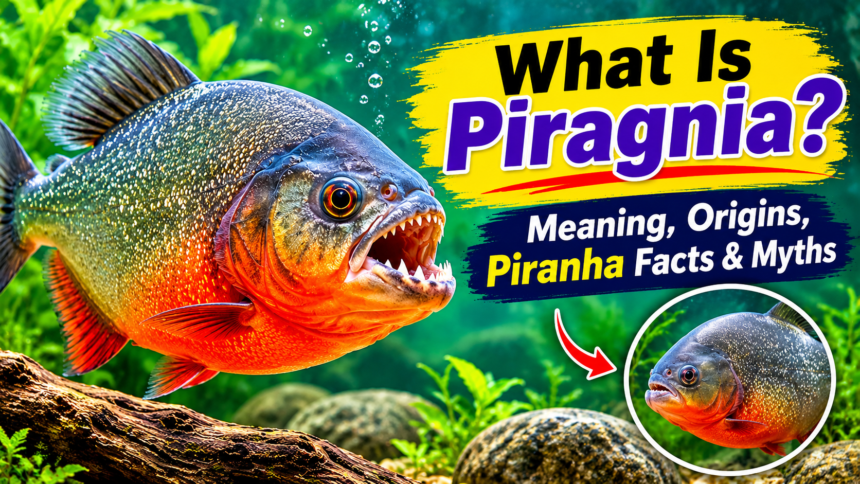
Unusual words often attract attention because they appear unfamiliar, mysterious, or connected to something people already recognize. Piragnia is one such term. It has appeared in online searches and informational discussions, leading readers to wonder whether it describes a particular animal, an unusual freshwater fish, or an alternative name for a well-known aquatic predator.
The term is closely associated with piranhas, the freshwater fish famous for their sharp teeth and powerful jaws. However, there is an important distinction between an unfamiliar spelling and an established biological name. Piragnia is not recognized as a separate fish species or scientific classification. It is generally understood as a misspelling or informal variation of the word piranha.
Understanding the connection requires looking beyond the spelling itself. Piranhas have a fascinating biological history, diverse feeding habits, distinctive physical characteristics, and an important place in South American freshwater ecosystems. Their reputation has also been influenced by popular entertainment, historical accounts, and stories that sometimes exaggerate their behavior.
Exploring Piragnia therefore provides an opportunity to understand the language behind the term while discovering the scientific reality of piranhas, their natural environments, feeding patterns, and relationship with humans.
What Is Piragnia?
Piragnia is an unusual spelling associated with the word piranha. It does not represent an independently recognized species, genus, or scientific category of freshwater fish.
The confusion largely comes from the similarity between the two words. Someone encountering Piragnia without additional information might reasonably assume that it identifies a rare aquatic animal or a regional variety of piranha. However, established biological references use the spelling piranha when discussing these fish.
Online searches can sometimes make unfamiliar words appear more significant than they actually are. When a spelling variation appears in multiple articles, websites, or search results, readers may begin treating it as an independent subject. Repeated use, however, does not establish scientific recognition.
The most accurate way to understand Piragnia is as a search term connected to piranhas rather than the name of a newly discovered animal.
Why Does the Word Create Confusion?
Several factors can explain why people encounter unfamiliar spellings of established animal names.
- Typing variations: People sometimes enter words according to how they remember or pronounce them.
- Spelling confusion: Unfamiliar words borrowed from other languages can be difficult to reproduce accurately.
- Online repetition: Websites may repeat unusual spellings after encountering them elsewhere.
- Search behavior: Search engines can display results for misspelled terms because users continue searching for them.
These factors help explain the appearance of Piragnia without suggesting that it has a separate biological identity.
The Linguistic Origins of Piragnia and Piranha
Understanding the linguistic background of piranha helps explain why its spelling may be unfamiliar to some readers.
The word piranha has roots in Indigenous South American languages, particularly the Tupi-Guarani linguistic tradition. It entered wider international use through Portuguese and subsequently became familiar in English and other languages.
Its traditional interpretation is commonly associated with the idea of a fish with teeth. The name reflects one of the animal’s most recognizable physical characteristics: its powerful jaws and distinctive teeth.
Piranhas have become internationally recognizable through wildlife documentaries, scientific publications, travel literature, and popular entertainment. Their unusual appearance and reputation have helped make the name memorable.
How Spelling Variations Develop
Words borrowed from one language often change slightly when they enter another. Differences in pronunciation, writing systems, regional accents, and informal communication can influence how people reproduce unfamiliar terms.
The spelling Piragnia may reflect this type of confusion, particularly when someone is attempting to remember or type the name piranha.
However, a spelling variation should not automatically be treated as a regional word, traditional Indigenous name, or scientific term. Such claims require reliable linguistic documentation.
For readers researching the animal, piranha remains the appropriate standard spelling.
| 🔗 You may also like: |
| How to Plan the Ultimate Day Trip to Culebra, Puerto Rico |
| How long do solar panels last |
Understanding the Biology of Piranhas
Piranhas are freshwater fish belonging to the family Serrasalmidae. They are part of the order Characiformes, a diverse group of freshwater fishes found mainly in tropical and subtropical regions.
Although piranhas are commonly described as aggressive meat-eating predators, their biology is more complicated than popular descriptions suggest. Different species have different physical characteristics, feeding preferences, and ecological roles.
Some species primarily consume other fish, while others include insects, crustaceans, fruits, seeds, and other plant materials in their diets.
Physical Characteristics
Piranhas generally have strong, compact bodies, relatively deep profiles, and powerful jaws. Their physical structure helps them move through freshwater environments while searching for food.
One of their most distinctive features is their triangular, closely arranged teeth. These teeth fit together in a way that allows the fish to grip, cut, and remove pieces of food efficiently.
Their lower jaws are particularly strong, supporting the biting ability for which the group is famous.
Body coloration varies between species. Red-bellied piranhas, for example, commonly display silver or gray sides with reddish coloration along the underside. Other species have different patterns, making identification dependent on more than color alone.
Scientific Classification
Piranhas are not a single species. The common name covers multiple related freshwater fish.
Their general classification includes:
- Kingdom: Animalia
- Phylum: Chordata
- Class: Actinopterygii
- Order: Characiformes
- Family: Serrasalmidae
Individual piranha species belong to different genera, including Pygocentrus and Serrasalmus.
This distinction is important because different species can have noticeably different diets, sizes, distributions, and behaviors. Treating every piranha as biologically identical creates an incomplete picture of the group.
Natural Habitat and Geographic Distribution
Piranhas are native to freshwater environments in South America. Their distribution includes several major river systems, where they occupy habitats ranging from flowing rivers to slower-moving water and connected floodplain environments.
The Amazon River basin is among the best-known regions associated with piranhas. However, their geographic distribution extends beyond the Amazon and includes other important South American drainage systems.
These environments provide food, shelter, breeding areas, and suitable water conditions for different species.
The Amazon River Basin
The Amazon basin contains an extensive network of rivers, streams, lakes, and seasonal floodplains. Its ecological diversity supports an enormous variety of aquatic organisms.
Piranhas occupy different parts of this freshwater network depending on their species and ecological requirements.
Vegetation, submerged branches, and other underwater structures can provide useful shelter. Such environments also support smaller fish, insects, crustaceans, and other organisms that contribute to the food supply.
Seasonal changes affect water levels and the availability of food. During periods of flooding, aquatic habitats expand and connect previously separated areas. When water levels decline, fish may become concentrated in smaller bodies of water.
Other South American River Systems
Piranhas are also associated with the Orinoco, Paraguay-Paraná, and São Francisco river systems.
Each region has different environmental conditions, including variations in water flow, vegetation, temperature, and seasonal flooding.
These differences influence the distribution and behavior of individual species.
Their presence across several major river systems demonstrates that piranhas are not restricted to one famous location. They are part of a much wider freshwater ecosystem throughout tropical South America.
Feeding Habits and Diet
Piranhas are well known for their teeth and feeding behavior, but their diets are more varied than many people expect.
Different species consume different types of food. Fish and other aquatic animals are important dietary components, but piranhas may also eat insects, crustaceans, fruits, seeds, and organic material.
Some species are primarily predatory, while others demonstrate more varied feeding strategies.
Carnivorous Feeding Behavior
Many piranhas feed on smaller fish and other aquatic organisms. Their sharp teeth help them capture prey and remove pieces of flesh efficiently.
They may also feed on injured animals or consume dead organisms when available. Such scavenging behavior is a natural part of freshwater ecosystems.
Feeding on sick, injured, or dead animals can help recycle nutrients and remove organic material from aquatic environments.
Omnivorous Feeding Patterns
Not every piranha depends exclusively on animal matter.
Some species consume fruits and seeds that enter the water from surrounding vegetation. Insects, aquatic invertebrates, and other food sources can also contribute to their nutrition.
Such dietary flexibility allows different piranha species to use the food resources available in their habitats.
Their feeding behavior can change according to seasonal conditions, food availability, age, and environmental circumstances.
How Piranhas Behave in Their Natural Environment
Piranhas display a range of behaviors related to feeding, reproduction, protection, and survival.
One particularly interesting characteristic is their tendency to gather in groups. These groups are often called schools or shoals.
Although group swimming is sometimes presented as evidence of coordinated attacks, research suggests that schooling can provide protection against predators.
Larger aquatic animals, including caimans, river dolphins, and certain birds, may prey on piranhas. Remaining in groups can reduce the risk faced by individual fish.
Communication and Social Behavior
Piranha behavior is not limited to feeding. Some species use sounds and physical displays during interactions with other fish.
Research has identified acoustic communication in red-bellied piranhas, including sounds associated with social and aggressive situations.
Interactions can also involve changes in swimming patterns, body positioning, and defensive displays.
These behaviors demonstrate that piranhas have more complex social and survival strategies than their popular image suggests.
Reproduction and Parental Protection
Reproduction is another important aspect of piranha biology.
Many piranhas reproduce by laying eggs in protected locations. Depending on the species, breeding behavior may involve preparing a nesting area among aquatic vegetation or within suitable riverbed environments.
In some species, males protect the nest and developing offspring.
Such defensive behavior helps explain why people occasionally experience bites in areas where piranhas are reproducing. A fish protecting its nest may respond defensively when a swimmer approaches too closely.
Common Myths About Piranhas
Piranhas have become famous through films, television programs, and dramatic stories. Unfortunately, these portrayals often exaggerate their natural behavior.
Separating popular myths from scientific observations helps readers understand the animals more accurately.
Myth 1: Piranhas Attack Everything That Enters the Water
Piranhas do not automatically attack every person or animal entering their habitat.
Their behavior depends on several factors, including species, food availability, environmental conditions, and reproductive activity.
They generally use their energy to find suitable food rather than continuously attacking large animals.
Myth 2: Every Piranha Has the Same Diet
Piranhas have different feeding preferences.
Although some species consume substantial amounts of animal matter, others also eat fruits, seeds, insects, and other plant-based materials.
Their dietary differences are an important part of their biological diversity.
Myth 3: Piranhas Always Hunt Together
Swimming in groups does not necessarily mean that piranhas cooperate to attack large prey.
Schooling behavior can serve a defensive purpose, helping fish reduce their individual exposure to predators.
Some species may feed near one another, but the familiar image of an organized group systematically attacking large animals is misleading.
Myth 4: Human Attacks Are Common
Piranha bites are possible, but the popular idea that people are regularly attacked and consumed by schools of piranhas is greatly exaggerated.
Documented incidents can involve defensive behavior, breeding areas, or environmental conditions that bring fish and people into closer contact.
A realistic understanding recognizes that these animals deserve respect without treating every encounter as an unavoidable attack.
Myth 5: All Piranhas Are Extremely Large
Piranha species vary in size. Many commonly encountered species are relatively small freshwater fish, although some can grow considerably larger.
Size depends on the particular species, habitat, food availability, and individual development.
It is therefore inaccurate to apply one measurement to every fish described as a piranha.
Are Piranhas Dangerous to Humans?
Piranhas have powerful jaws and sharp teeth, meaning their bites can cause serious injuries. Their reputation should not be dismissed entirely, but it should be understood in the correct context.
Human encounters are influenced by local environmental conditions and fish behavior.
Risk may increase when water levels become low, fish are concentrated in restricted areas, food resources are limited, or people disturb breeding locations.
Fishing and handling piranhas also require caution because a captured fish can bite when it feels threatened.
Basic Safety Considerations
People visiting South American freshwater environments should follow local guidance and avoid unnecessary contact with wildlife.
Practical precautions include:
- Avoid swimming in locations where local authorities have issued warnings.
- Stay away from known breeding or nesting areas.
- Never attempt to handle a wild piranha.
- Avoid disposing of food waste or fish remains in swimming areas.
- Pay attention to local environmental conditions and seasonal restrictions.
Responsible behavior helps reduce unnecessary encounters while protecting both people and aquatic wildlife.
The Ecological Importance of Piranhas
Piranhas play an important role in the freshwater ecosystems where they naturally occur.
Their feeding activities influence populations of smaller aquatic organisms and contribute to the movement of nutrients through food webs.
As predators, they can help regulate populations of other fish and aquatic animals. As scavengers, some species also consume dead organisms and contribute to the natural breakdown of organic material.
They are also part of the food supply for larger predators.
Caimans, aquatic birds, river dolphins, and other animals may consume piranhas, demonstrating how these fish connect different levels of the freshwater food chain.
Removing or significantly reducing a native species can influence relationships among other organisms. Maintaining healthy aquatic habitats is therefore important for the long-term ecological balance of South American river systems.
Piragnia in Online Searches and Digital Discussions
The appearance of Piragnia in online searches demonstrates how unusual spelling variations can develop their own digital visibility.
People frequently search for unfamiliar terms after encountering them in articles, discussions, social media posts, or search suggestions.
When several websites publish information using the same unusual spelling, the term can become more familiar to readers even if it does not represent a recognized scientific subject.
For publishers and researchers, this creates an important distinction between search terminology and factual accuracy.
An article about Piragnia should explain the term directly rather than inventing a separate animal, unsupported historical background, or fictional biological characteristics.
The most useful content connects the search phrase to reliable information about piranhas while clearly identifying what is known and what remains unverified.
Why Accurate Information About Piragnia Matters
Accuracy is especially important when discussing wildlife because misleading descriptions can create confusion about animal identification, behavior, and safety.
Presenting Piragnia as a scientifically established species would give readers an incorrect understanding of biological classification.
A better approach is to explain the spelling variation and then introduce the actual animal behind the search term.
This distinction also makes wildlife information more useful. Readers can learn about real piranha species, their habitats, feeding patterns, and ecological importance instead of relying on an invented classification.
Reliable scientific information should always take priority over repeated online claims.
Conclusion
Piragnia is an unusual term that has attracted attention because of its close association with piranhas. However, it is not recognized as an independent fish species or scientific classification. The standard spelling is piranha, which refers to a diverse group of freshwater fish native to South America.
The real story behind the term is more interesting than an invented mystery species. Piranhas have distinctive teeth, varied feeding habits, complex behaviors, and important ecological roles within their natural environments.
Their reputation for attacking everything in the water is largely exaggerated, although their powerful jaws mean that caution is necessary around wild individuals.
Understanding the linguistic background, biology, natural habitat, and common myths surrounding piranhas provides a much clearer picture of these fascinating freshwater animals. Ultimately, accurate information helps separate an unfamiliar search term from the genuine wildlife it represents.