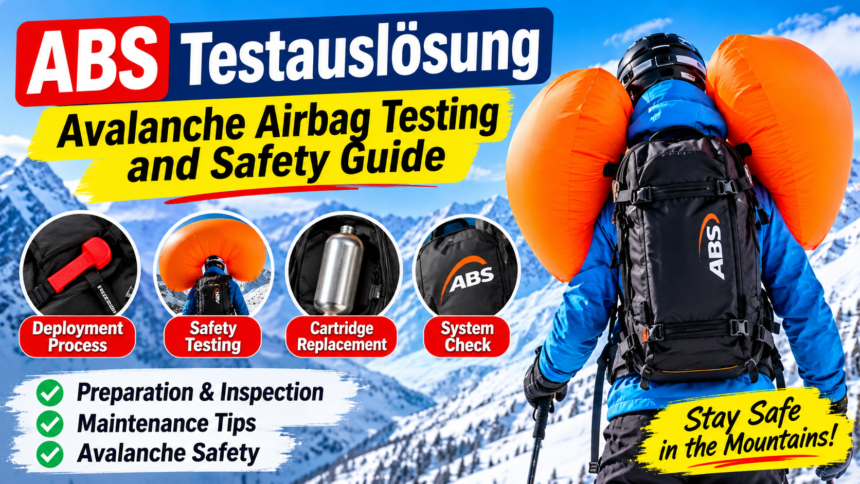
Avalanche safety depends on preparation, reliable equipment, and the ability to respond quickly when mountain conditions become dangerous. For people who enjoy backcountry skiing, snowboarding, ski touring, and other winter activities, an avalanche airbag can be an important part of their safety equipment. However, carrying an airbag backpack is not enough. Users also need to understand how the system operates, how its components should be inspected, and why regular practice matters.
ABS Testauslösung refers to the controlled test deployment of an ABS avalanche airbag system. It allows users to experience the activation process outside an actual avalanche emergency. Rather than discovering how the equipment works during a dangerous situation, a practice deployment provides an opportunity to become familiar with the activation handle, deployment mechanism, airbag inflation, and post-deployment procedures.
Understanding this process is particularly important before the winter season begins. An avalanche airbag contains several components that must work together, and problems with any part of the system can affect its performance. Regular inspections and appropriate maintenance help users identify potential issues before heading into avalanche terrain.
This guide explores the meaning of ABS Testauslösung, how avalanche airbags operate, why practice deployments matter, what users should inspect, and how to maintain their equipment responsibly.
What Is ABS Testauslösung?
ABS Testauslösung is the deliberate activation of an ABS avalanche airbag under controlled conditions. It is designed to demonstrate how the airbag deploys and to help users become familiar with the equipment’s activation process.
ABS is a recognized name in avalanche airbag technology. Its systems are designed to help improve a person’s chances of remaining closer to the snow surface during an avalanche. When activated, the backpack releases an inflatable airbag that increases the user’s overall volume.
A test deployment provides practical experience with this mechanism. Users can observe how the activation handle feels, how quickly the system responds, and how the airbag unfolds.
The purpose is not simply to inflate the airbag once. It is also an opportunity to understand the equipment’s condition and become more confident with its operation.
A controlled test deployment can help users:
- Become familiar with the activation handle.
- Understand the airbag deployment process.
- Observe how the inflation mechanism operates.
- Check the visible condition of the inflated airbag.
- Identify possible equipment or handling problems.
- Understand the steps involved in preparing the system again.
A test deployment should always follow the instructions for the exact ABS model. Different generations and configurations may use different activation technologies, cartridges, and preparation procedures.
How Does an ABS Avalanche Airbag Work?
An avalanche airbag is designed around the physical principle known as inverse segregation, sometimes described as the Brazil nut effect.
During the movement of granular materials, larger objects can rise toward the surface while smaller particles move downward. In an avalanche, the snow behaves as a moving mixture of particles and debris. An inflated airbag increases the volume of the person caught in the moving snow.
This increased volume can improve the possibility of remaining near the surface rather than becoming deeply buried.
An ABS system generally includes several important components that work together to achieve deployment.
1. Activation Handle
The activation handle is the part that the user operates when deployment is necessary. It is usually positioned on a shoulder strap so it can be reached while wearing the backpack.
The handle is connected to the deployment mechanism. When activated according to the manufacturer’s instructions, it initiates the inflation process.
During a practice deployment, users can become familiar with the handle’s location and operation. This familiarity is valuable because an avalanche emergency can involve considerable stress and limited time.
2. Inflation System
The inflation system provides the mechanism responsible for filling the airbag. Depending on the ABS model, the system may use a compressed-gas cartridge or another manufacturer-designed technology.
The inflation mechanism must be compatible with the specific backpack and airbag configuration.
Users should never assume that every cartridge or inflation component works with every ABS model. Compatibility should always be checked against official manufacturer documentation.
3. Airbag Compartments
ABS avalanche airbags are designed with inflatable compartments that deploy from the backpack.
Depending on the model, the system may feature one or more airbags. The design, shape, positioning, and deployment arrangement can vary between product generations.
When inflated, the airbag increases the user’s overall volume and is intended to support the person’s position within moving avalanche debris.
4. Backpack and Deployment Connections
The backpack holds the airbag system and protects its components during normal use.
Its straps, compartments, closures, and deployment openings are all important parts of the overall design.
Incorrect packing, damaged fabric, or obstructed deployment areas may interfere with the system. Therefore, users should inspect the backpack regularly and follow the manufacturer’s packing instructions.
Why Is ABS Testauslösung Important?
An avalanche airbag is emergency equipment, so users should understand how it works before entering environments where avalanches are possible.
A practice deployment offers experience that cannot be obtained simply by reading the product manual or watching a demonstration.
One of its biggest benefits is familiarity. When someone has already experienced the activation process, the equipment may feel less unfamiliar during an emergency.
Building Confidence Through Practical Experience
Confidence comes from understanding equipment and knowing how to use it correctly.
A person who has never activated an avalanche airbag may be uncertain about the handle, deployment response, or inflated configuration. A controlled practice session helps remove some of that uncertainty.
It also allows users to recognize the physical sensation associated with activation.
However, confidence should never be confused with complete avalanche preparedness. An airbag is only one part of a broader safety strategy.
Understanding the Deployment Mechanism
A practice deployment helps users observe how their particular system behaves.
They can become familiar with the opening of the backpack’s deployment area and the appearance of the inflated airbag.
This practical understanding can make it easier to recognize unusual conditions during later equipment inspections.
Identifying Visible Equipment Problems
A controlled deployment may reveal visible concerns that were not immediately obvious during a routine backpack inspection.
These could include damaged fabric, unusual deployment behavior, or problems with components that require professional assessment.
Not every internal fault can be identified through a test deployment. Manufacturer-approved inspections and servicing remain important.
Preparing for Winter Adventures
Before winter activities begin, users often check skis, boots, helmets, clothing, and other equipment.
An avalanche airbag deserves the same attention.
Completing the recommended inspection and training procedures before the season helps ensure that the equipment is prepared for its intended use.
ABS Testauslösung: Understanding the Preparation Process
Preparation is an important part of any controlled test deployment. Before activating the system, users should understand the equipment configuration and confirm that the testing environment is appropriate.
The manufacturer’s instructions should always take priority over general information.
Check the Manufacturer’s Instructions
Start by identifying the exact ABS backpack model and its corresponding operating instructions.
Different systems may have different deployment mechanisms, cartridge requirements, and post-deployment procedures.
An older system should not automatically be treated like a newer product.
The instructions should explain the approved activation method, compatible components, inspection requirements, and procedures for returning the equipment to service.
Inspect the Backpack
Examine the exterior of the backpack for visible damage.
Pay attention to fabric condition, stitching, shoulder straps, waist belts, buckles, and zippers.
The airbag compartment should also be checked for obstructions or damage.
If any structural problem is identified, the equipment should be assessed before further use.
Check the Activation Handle
The activation handle should be in the correct position according to the product instructions.
Look for visible damage, unusual wear, or signs that the mechanism has been incorrectly handled.
Do not modify, force, or attempt to repair the activation mechanism yourself.
If anything appears unusual, contact an authorized service provider.
Confirm System Compatibility
The inflation system and its associated components must match the backpack’s requirements.
Users should verify the correct cartridge or activation configuration through official ABS documentation.
This is especially important when using equipment that has been stored for a long period or purchased second-hand.
What Happens During an ABS Testauslösung?
The actual deployment experience can vary depending on the product generation and inflation technology.
In general, a controlled test activation demonstrates how the system responds when the activation mechanism is operated.
The airbag is released from its storage compartment and inflates according to the system’s design.
During the test, users can observe several important characteristics.
Activation response: The user becomes familiar with the physical operation of the activation handle.
Deployment movement: The airbag emerges from its designated storage area and opens.
Inflation behavior: The system demonstrates its intended inflation response.
Final configuration: The inflated airbag can be visually examined for obvious damage or unusual conditions.
Post-deployment condition: The backpack and system can be inspected after activation.
The test should take place in an appropriate controlled environment with enough space for deployment.
It should never be performed casually in a crowded location or in a way that risks injury to nearby people.
A practice deployment is also not an opportunity to experiment with internal mechanisms. The system should remain in its manufacturer-approved configuration.
How to Inspect an ABS Airbag After Deployment
The inspection stage is just as important as the initial preparation.
Once the test has been completed, users should examine the equipment according to the manufacturer’s post-deployment instructions.
Examine the Airbag Fabric
Look for visible tears, holes, damaged seams, or unusual deformation.
The airbag should be checked carefully because damage to its material can affect its ability to function as intended.
Small areas of damage should not be ignored simply because the system successfully inflated.
Check the Deployment Area
Inspect the backpack compartment from which the airbag emerged.
Look for damaged fabric, loose stitching, broken fasteners, or obstructions.
The deployment area should remain consistent with the manufacturer’s design.
Examine the Activation Components
Check the accessible parts of the activation system for visible wear or damage.
Do not disassemble the mechanism to investigate internal components unless the manufacturer specifically authorizes the procedure.
Review the Overall Backpack Condition
The shoulder straps, waist belt, buckles, and other backpack components should also be inspected.
A reliable airbag system depends on more than the inflation mechanism. The complete backpack must remain in suitable condition.
If the inspection reveals uncertainty, the system should be evaluated by an authorized ABS service center before being used again.
Cartridge Replacement and Refill After an ABS Testauslösung
One of the most important considerations following a practice deployment is the condition of the inflation system.
Depending on the ABS model, the activation process may consume or affect the cartridge or another part of the deployment mechanism.
This means the system may not be ready for another deployment immediately after testing.
Users should never assume that an airbag is ready simply because it has been deflated and packed again.
| 🔗 You may also like: |
| Thelifestyleedge com: Complete Guide to Modern Living, Wellness, and Travel |
| How to Plan the Ultimate Day Trip to Culebra, Puerto Rico |
Why Cartridge Compatibility Matters
Cartridges are designed for particular systems and technical requirements.
Using an incompatible component may prevent the equipment from functioning correctly.
Before replacing or refilling anything, users should confirm:
- The exact backpack model.
- The approved cartridge type.
- Manufacturer compatibility requirements.
- Any replacement or inspection requirements.
- Whether professional servicing is necessary.
Understanding Refill Requirements
Refilling and preparing an ABS system should follow the manufacturer’s official procedure.
Some systems may require specific cartridge handling, while others may have different replacement or servicing requirements.
Users should not attempt to improvise a refill method or modify pressurized components.
If the instructions require professional servicing, an authorized technician should complete the work.
A successfully completed test deployment does not automatically confirm that the equipment is ready for mountain use.
Common Mistakes to Avoid During ABS Testauslösung
Although a practice deployment is intended to improve equipment familiarity, mistakes can reduce its usefulness or create unnecessary risks.
Understanding common problems can help users approach the process more responsibly.
Ignoring the Product Manual
One of the most common mistakes is assuming that all avalanche airbags operate in the same way.
Different ABS models can have different components and procedures.
Always consult the correct documentation before testing or servicing a system.
Using Incompatible Components
Using an incorrect cartridge or replacement component can compromise system compatibility.
Never rely on appearance alone when determining whether a component is suitable.
Treating a Test as a Complete Safety Check
A successful deployment demonstrates that the system activated under the conditions of the test.
It does not necessarily confirm that every internal component is free from defects.
Professional servicing may still be necessary.
Packing the Airbag Incorrectly
The airbag must be returned to its storage compartment according to the manufacturer’s instructions.
Incorrect packing can interfere with the intended deployment arrangement.
Users should avoid rushing this process or forcing components into place.
Forgetting Post-Test Preparation
After activation, the system may require cartridge replacement, inspection, or other manufacturer-approved servicing.
An airbag that has already been deployed should not be considered ready for another trip until all required procedures have been completed.
How Often Should an ABS Avalanche Airbag Be Tested?
There is no single testing schedule that applies to every ABS avalanche airbag.
The recommended frequency depends on the model, operating technology, manufacturer guidance, and the user’s experience.
A controlled practice deployment can be particularly useful when someone purchases a new system or begins using an unfamiliar model.
However, testing should not be performed unnecessarily or without considering the cost and servicing requirements associated with deployment.
Users should consult the manufacturer’s recommendations for:
- Initial system familiarization.
- Recommended practice deployments.
- Pre-season inspections.
- Post-deployment servicing.
- Storage and maintenance.
- Cartridge replacement or system refurbishment.
Regular visual inspections are also important between practice deployments.
The goal is to maintain familiarity without treating unnecessary activation as a replacement for proper maintenance.
ABS Avalanche Airbag Maintenance and Storage
Proper maintenance helps preserve equipment condition and reduces the possibility of problems caused by neglect.
An avalanche airbag may remain unused for months between winter trips. During that time, storage conditions can affect its components.
Keep the Backpack Clean
After a trip, remove dirt, snow residue, and other visible debris according to the cleaning instructions.
Avoid harsh chemicals or cleaning methods that could damage technical fabrics and components.
Store Equipment Properly
The backpack should be stored in a clean, dry environment that follows the manufacturer’s temperature and storage recommendations.
Avoid exposing cartridges or other system components to conditions outside their approved limits.
Inspect Before Every Trip
Before entering avalanche terrain, examine the backpack and its accessible components.
Confirm that the activation system is prepared according to the instructions and that no visible damage has developed.
Follow Professional Servicing Recommendations
Some components may require inspection or maintenance by trained technicians.
If the equipment has been deployed in an actual avalanche, exposed to unusual conditions, or involved in an incident, follow the manufacturer’s servicing guidance before using it again.
ABS Testauslösung and Overall Avalanche Safety
An avalanche airbag can be a valuable piece of safety equipment, but it should never be viewed as protection against every avalanche-related danger.
Avalanches remain unpredictable and extremely dangerous natural events.
The effectiveness of an airbag depends on several factors, including the characteristics of the avalanche, the surrounding terrain, and the circumstances of the incident.
This is why avalanche education remains essential.
People entering backcountry terrain should understand avalanche forecasts, recognize dangerous slope conditions, and know how to make informed route decisions.
Learn to Read Avalanche Conditions
Avalanche forecasts provide information about snowpack stability, weather influences, and regional avalanche danger.
Understanding these reports can help winter sports enthusiasts make safer decisions.
Carry Essential Rescue Equipment
An avalanche transceiver, probe, and shovel are important parts of standard backcountry rescue equipment.
Users should know how to operate them and practice rescue procedures regularly.
Travel With Trained Partners
Backcountry activities are generally safer when participants understand group communication, terrain assessment, and emergency response.
Partners should know where their equipment is located and how to use it.
Continue Avalanche Education
Training courses help users understand snow conditions, terrain hazards, rescue techniques, and emergency decision-making.
An avalanche airbag should support these skills rather than replace them.
Choosing the Right ABS Avalanche Airbag System
Selecting an appropriate avalanche airbag requires more than comparing prices or backpack capacity.
Users should consider their activities, equipment requirements, experience, and the manufacturer’s technical specifications.
Backpack Capacity
Different winter activities require different amounts of storage space.
Ski touring may require room for additional clothing, food, water, and rescue equipment.
A suitable backpack should provide enough capacity without becoming unnecessarily heavy or uncomfortable.
Weight and Carrying Comfort
Weight is an important consideration for people who spend long periods climbing or moving through mountainous terrain.
Shoulder straps, back support, and waist-belt design can influence overall comfort.
Activation Technology
ABS systems can differ in their deployment and inflation technologies.
Buyers should understand the operating requirements and maintenance responsibilities associated with the specific model.
Availability of Service and Replacement Parts
Before purchasing an avalanche airbag, consider whether compatible cartridges, replacement components, and authorized servicing are available.
Long-term support can be just as important as the initial purchase price.
Conclusion
ABS Testauslösung is an important concept for understanding and maintaining ABS avalanche airbag equipment. A controlled practice deployment provides valuable familiarity with the activation mechanism, inflation process, and overall system design. It also creates an opportunity to inspect visible components and identify potential maintenance concerns.
However, testing should always follow the manufacturer’s instructions for the exact backpack and activation system. Cartridge compatibility, post-deployment inspection, correct repacking, and professional servicing are essential considerations before returning the equipment to use.
Most importantly, an avalanche airbag should be considered one component of a broader mountain safety strategy. Proper training, reliable rescue equipment, careful terrain assessment, and informed decisions remain fundamental to reducing avalanche risks.
FAQs
What does ABS Testauslösung mean?
ABS Testauslösung means the controlled test activation of an ABS avalanche airbag. It allows users to experience the deployment process and become familiar with their equipment outside an actual avalanche emergency.
Why should an ABS avalanche airbag be tested?
A practice deployment helps users understand how the activation handle works, observe airbag inflation, and become familiar with the system. It can also provide an opportunity to identify visible equipment problems.
Is ABS Testauslösung necessary before winter?
A practice deployment can be useful, particularly for people using a new or unfamiliar system. However, users should follow the testing recommendations for their exact ABS model rather than assume that every system requires the same procedure.
Does an ABS test deployment consume the cartridge?
This depends on the specific ABS system and its activation technology. Some configurations require cartridge replacement or other preparation after deployment. The manufacturer’s instructions provide the correct requirements.
Can an ABS airbag be reused after testing?
In many cases, an airbag system can be prepared for future use after a test deployment. However, it must first undergo all required inspection, replacement, refilling, and repacking procedures.
How long does an ABS avalanche airbag take to inflate?
Inflation time depends on the particular model and its technical design. Users should consult the manufacturer’s specifications for accurate performance information rather than rely on a general estimate.
Can I perform ABS Testauslösung at home?
A controlled test may be possible in an appropriate private environment, provided the manufacturer permits it and all safety requirements are met. There must be sufficient deployment space, and the procedure must follow the official instructions.
What should I inspect after deployment?
Users should examine the airbag fabric, seams, deployment compartment, accessible activation components, and overall backpack condition. Any suspected damage should be assessed before the system is returned to service.
Does an avalanche airbag prevent burial?
An avalanche airbag is designed to increase the user’s volume and potentially improve the chances of remaining closer to the snow surface. It does not guarantee that someone will avoid burial or survive an avalanche.
Is an avalanche airbag enough for backcountry safety?
No. An airbag is only one part of avalanche safety equipment. Users also need an avalanche transceiver, probe, shovel, appropriate training, and the ability to assess terrain and snow conditions.