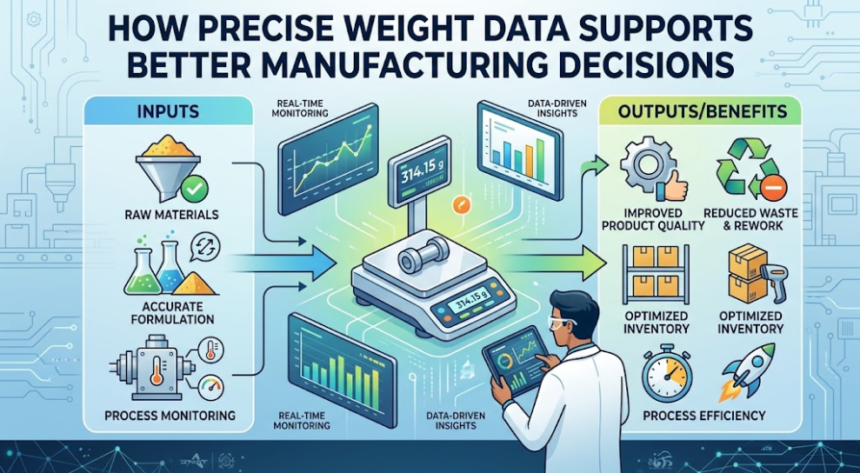
It isn’t a secret that manufacturers benefit from having reliable information when they need to make decisions about production, quality, and getting the best out of their resources. The right precision weighing scales can be an excellent source of such data at multiple stages of manufacturing.
However, it’s one matter to have well-chosen data-gathering equipment to hand, and quite another thing to understand how such information and insights translate into improved manufacturing decisions.
Here are the essentials of the relationship, as all manner of manufacturers continue drawing upon precise weight data to help monitor materials, improve consistency, and make more informed operational choices.
- Strengthening Quality Control
When a manufacturer has access to precise weight data, this can greatly help it transform raw production into controlled and optimised processes.
Across such industries as automotive, aerospace, food, pharmaceuticals, and chemicals, even modest measurement errors can lead to costly problems. The overfilling or underfilling of packaging, for instance, can result in product giveaway or non-compliance with weights and measures regulations.
The availability of dependable weight data, though, eliminates guesswork and can support evidence-based decisions at every stage of the quality-control process.
- Improving Inventory and Materials Management
Today’s manufacturers are accustomed to operating in line with lean principles, including keeping scrap and inventory holding costs as low as possible.
So, when incoming raw materials, work-in-progress, and finished stock can be weighed accurately, this can greatly help a manufacturing business by providing a clearer picture of usage weights and stock levels.
The integration of such weight data with manufacturing execution systems (MES) or enterprise resource planning (ERP) software can give decision-makers visibility that helps them respond quickly to supply disruptions or fluctuations in demand.
- Driving Process Optimisation
It isn’t merely the most recently recorded weight data that can be greatly useful for manufacturers. That’s because when live weight data is looked at alongside historical information, important patterns can become apparent, such as a gradual drift in filling machines or variations between production shifts.
Previously, changes like these might have gone unnoticed. Today, engineers being able to see such data allows them to fine-tune equipment, adjust formulations, or revise procedures with confidence.
During the present era in which manufacturers in parts of the world like the UK face a daunting mix of persistently high energy costs and stiff net-zero targets, this scope for well-targeted process optimisation can be particularly beneficial in energy-intensive sectors. It can mean that materials are portioned more accurately, thereby potentially contributing to lower resource consumption and improved sustainability metrics.
- Controlling Costs and Protecting Margins
The better the weight data a given manufacturer can access, the more advantageously placed it can be to drive down costs. When product giveaway can be lowered, quality failures minimised, and inventory more tightly managed, this can all better protect the manufacturer’s profit margins.
In high-value manufacturing, even seemingly “minor” weight inaccuracies can bring about significant financial impact. This underscores the clear return that investment in dependable weighing instruments can deliver for manufacturers, thanks to fewer errors and improved utilisation of resources.
Precise Weight Data Can Turn Measurements into Manufacturing Insights
All in all, precise weight data should be treated as more than a simple measurement. Such information, if used consistently, can make a profound difference to a manufacturer’s efforts to monitor material usage, identify variations, support quality control, and make better-informed decisions about production processes.