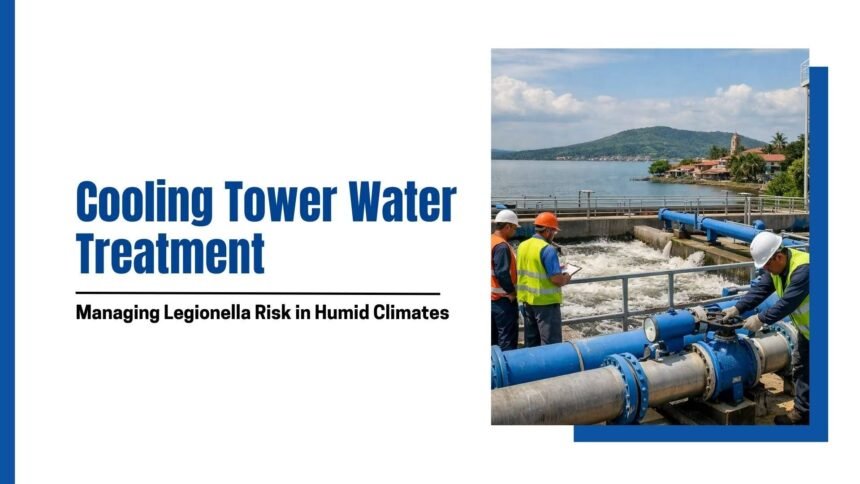
Cooling tower water treatment controls the conditions that let Legionella bacteria multiply inside a recirculating water system. In humid climates, warm ambient air slows evaporation and keeps water temperatures inside the ideal range for bacterial growth for longer stretches of the year.
A documented water treatment program built around biocide dosing, drift control, and regular cooling tower inspection keeps bacterial counts low across cooling tower systems supporting industrial processes and protects both equipment and the people working near the tower.
Why Humid Climates Raise Legionella Risk in Cooling Towers
Legionella pneumophila grows best in water between roughly 20°C and 45°C, with the fastest growth typically reported in the upper part of that range. Cooling towers sit squarely in this window most of the year, since the whole point of a cooling system is to hold warm water in an open tower system where it contacts air directly.
Left unchecked, this is exactly the kind of buildup cooling tower water treatment is designed to prevent before it reaches this stage.
- No seasonal cold snap to reset the system: In a temperate climate, cooler months naturally push water temperature below the bacteria’s preferred range for part of the year. In a humid, tropical climate, that natural check does not happen, so water temperatures stay warm year-round and biological growth gets a longer uninterrupted window to establish itself.
- Slower evaporation extends bacterial contact time: High ambient humidity slows the rate of evaporation compared to a dry climate. Since evaporation is part of how a cooling tower rejects heat, a humid environment sometimes needs a larger tower or a longer contact time to hit the same cooling target, and that extra dwell time gives bacteria more opportunity to colonize surfaces before the water cycles back out.
- Ongoing cooling tower maintenance needs become more frequent: Because the risk window never fully closes, facilities in humid climates typically need tighter tower operation and cleaning intervals than the same equipment would require in a cooler region.
- Aging components raise the risk further: Once fill media or basin structure has degraded to the point where proper cleaning access is limited, no amount of chemical treatment fully offsets the exposure risk, and that is usually the point where a facility needs to weigh repair against cooling tower replacement.
How Legionella Establishes Itself Inside a Cooling Tower
Legionella bacteria rarely grow as free-floating organisms in open water. They typically colonize inside a biofilm, a thin layer of slime formed by other bacteria, algae, and organic matter that sticks to wet surfaces. This layer forms most readily on surfaces with low flow or where sediment settles, and it also carries dissolved oxygen and nutrients that keep the colony active.
Common Growth Sites Inside the Tower
Several areas inside a typical cooling tower create the low-flow, high-surface-area conditions biofilm needs to take hold.
- Basin sediment: Debris, scale, and suspended solids that settle in the basin floor create a sheltered surface for biofilm to build up undisturbed.
- Fill media surfaces: The fill pack is designed to maximize water-to-air contact, which also means it has a large surface area where biofilm can spread if cleaning is inconsistent.
- Dead legs in piping: Sections of pipe with little or no flow hold stagnant water that never gets the benefit of active biocide circulation.
- Drift eliminator surfaces: A worn or poorly fitted eliminator lets more fine mist escape the tower, and that mist can carry bacteria into the surrounding air if the source water is contaminated.
Why Drift Matters for Human Exposure
Legionella infection does not happen through drinking contaminated water. It happens through inhaling fine water droplets, known as drift, that carry the bacteria into the lungs.
A cooling tower with damaged or missing drift eliminators releases more of this mist than a well-maintained one, which raises the exposure risk for anyone working or walking near the process equipment, not just people directly interacting with the tower itself.
Fouling and Its Effect on Heat Transfer
Biofilm and scale do not stay confined to the tower. Water fouled with microbiological growth and mineral deposits eventually reaches connected heat exchanger units, coating heat transfer surfaces and heat exchange surfaces with an insulating layer that reduces thermal efficiency.
As heat transfer drops, tower performance declines, energy consumption rises to compensate, and a facility ends up facing increasing energy costs on top of the biological risk.
Building a Water Treatment Program for Legionella Control
An effective cooling tower treatment program combines chemical treatment, mechanical maintenance, and ongoing testing. No single step covers all the risk on its own.
Biocide Treatment and Dosing
Biocides fall into two broad categories: oxidizing biocides like chlorine or bromine, which kill bacteria on contact, and non-oxidizing biocides, which disrupt bacterial cell function over a longer exposure period. Treatment chemicals need rapid mixing into the recirculating flow to reach an even concentration and control microbial growth before it settles into the biofilm layer.
Many programs alternate biocide types on a rotating schedule and track pH levels alongside dosing, since bacteria can develop resistance to a single biocide used continuously at the same concentration.
Scale and Corrosion Control Alongside Biological Treatment
Proper water treatment for a cooling tower is not only about killing bacteria. Untreated cooling water also carries total dissolved solids that precipitate out as calcium carbonate scale on metal surfaces, and that same water can corrode copper components and steel fittings without protection.
- Corrosion inhibitors: Chemical additives that form a protective film on metal surfaces to prevent corrosion and extend equipment service life.
- pH adjustment chemicals: Operators use sodium hydroxide to raise pH or hydrochloric acid and phosphoric acid to lower it, keeping the water in a range that limits both scaling and corrosion.
- Chemical handling procedures: Acids and caustic chemicals used in treating water require trained handling and proper storage, since they carry their own safety risk separate from the biological one.
Skipping this side of the program does not just risk equipment failure. It also leads to costly repairs on pumps, piping, and the heat exchanger units the tower supports.
Controlling Cycles of Concentration and Blowdown
As water evaporates from a cooling tower, dissolved minerals stay behind and concentrate in the remaining water. A cooling tower blowdown system removes a controlled portion of this concentrated water through a blowdown valve and replaces it with makeup water, which keeps mineral buildup and scale formation within a manageable range.
Mechanical Cleaning and Inspection
Chemical treatment alone cannot remove biofilm that has already established itself on a surface. Physical cleaning, most often during a scheduled tower inspection, is needed to actually strip the biofilm layer rather than just suppress its growth rate.
- Basin cleaning: Scheduled draining and sediment removal prevent the basin floor from becoming a long-term reservoir for biofilm.
- Fill pack inspection: Fill media should be checked for scale and slime buildup, since fouled fill reduces both system efficiency and water treatment effectiveness.
- Drift eliminator condition check: Cracked or warped eliminators need replacement, not just cleaning, since physical damage cannot be treated away chemically.
Monitoring and Testing: Confirming the Program Is Working
A water treatment system only works if it is verified regularly. Relying on dosing schedules alone, without testing actual bacterial counts and overall water quality, leaves a facility with no way to confirm the treatment is actually controlling risk.
Routine testing typically includes total bacterial counts, Legionella-specific culture testing, and basic water chemistry checks. Many facilities work directly with a water treatment provider to schedule this testing on a fixed interval and to adjust dosing when results trend upward between visits.
Cooling Tower Water Treatment Checklist
The table below breaks down the core elements of a Legionella control program, what each one addresses, and how often it typically needs attention in a humid, year-round warm climate.
| Task | Purpose | Typical Frequency | Who Performs It | Risk If Skipped |
| Biocide dosing | Kills bacteria in circulating water | Continuous or scheduled dosing | Water treatment provider or trained staff | Uncontrolled bacterial growth |
| Blowdown and conductivity control | Limits dissolved solids and organic buildup | Automated, continuous | Conductivity controller | Scale buildup, favorable biofilm conditions |
| Basin cleaning | Removes sediment that shelters biofilm | Quarterly to annually | Maintenance team | Sediment-based biofilm reservoirs |
| Drift eliminator inspection | Reduces bacteria-carrying mist released to air | Every seasonal inspection | Maintenance team | Increased exposure to nearby occupants |
| Legionella culture testing | Confirms treatment program is working | Monthly to quarterly | Water treatment provider | Undetected bacterial spikes |
Best Practices for Legionella Risk Management
Facility managers who keep Legionella risk consistently low tend to treat testing and mechanical cleaning as equally important as chemical dosing, not as a backup step.
- Test before and after major cleaning events: Comparing bacterial counts before and after a basin cleaning confirms the cleaning actually reduced the load rather than just moving sediment around.
- Flush dead legs on a fixed schedule: Piping sections with low flow need deliberate flushing, since normal system circulation does not reach them.
- Rotate biocide types on a set interval: Alternating chemistry reduces the chance of bacteria adapting to a single treatment approach over time.
- Track maintenance costs against downtime risk: Comparing routine operating costs to the cost of an unplanned shutdown usually justifies the treatment program on its own, before factoring in health risk at all.
Conclusion
Cooling tower water treatment in a humid climate depends on consistent biocide dosing, controlled blowdown, and regular mechanical cleaning, since warm year-round temperatures give Legionella more time to establish itself.
Routine testing confirms the program works rather than assuming dosing alone is enough. Facilities that pair biological treatment with scale and corrosion control protect both equipment life and cooling tower operation over the long term.
FAQs
How often should a cooling tower be tested for Legionella?
Most water treatment providers recommend testing every one to three months, with more frequent testing during periods of heavy use or after any maintenance event that disturbs the system, such as basin cleaning or a filter change.
Can Legionella be fully eliminated from a cooling tower?
Complete elimination is not a realistic goal for an open recirculating system exposed to outside air. The objective of a water treatment program is to keep bacterial counts consistently low through combined chemical and mechanical control, not to reach zero permanently.
Does humidity directly cause Legionella growth?
Humidity itself does not cause bacterial growth, but it affects how a cooling tower operates. Warmer, more humid ambient conditions keep water temperatures inside the bacteria’s preferred growth range for longer stretches of the year compared to drier or cooler climates.
What is the difference between biocide treatment and blowdown control?
Biocide treatment actively kills or disrupts bacteria in the water. Blowdown control manages dissolved solids and organic buildup by removing concentrated water and replacing it with fresh makeup water. Both are needed, since one controls bacteria directly and the other limits the conditions that support bacterial growth.
When does a cooling tower need replacement instead of continued water treatment?
A tower that shows persistent biofilm regrowth despite a consistent treatment program, along with structural wear in the fill media or basin that limits proper cleaning access, is usually a candidate for replacement rather than continued repair, since water treatment cannot compensate for physical degradation in the system.