Modern businesses generate enormous amounts of information every day. Employees communicate through messaging applications, store documents in cloud drives, manage projects through collaboration platforms, and exchange important updates through email. Although these tools support productivity, they can also make it difficult to find the right information when it is needed.
Zecway is an AI-powered workplace assistant designed to address this challenge by connecting company information across different workplace applications. Instead of searching through multiple platforms individually, employees can ask questions in natural language and receive answers based on information available through connected sources.
The platform’s approach combines unified workplace search, AI-generated answers, source references, and AI agents designed to support more complex tasks. Understanding these capabilities can help businesses determine whether Zecway fits their information management needs and where its technology may offer practical value.
What Is Zecway?
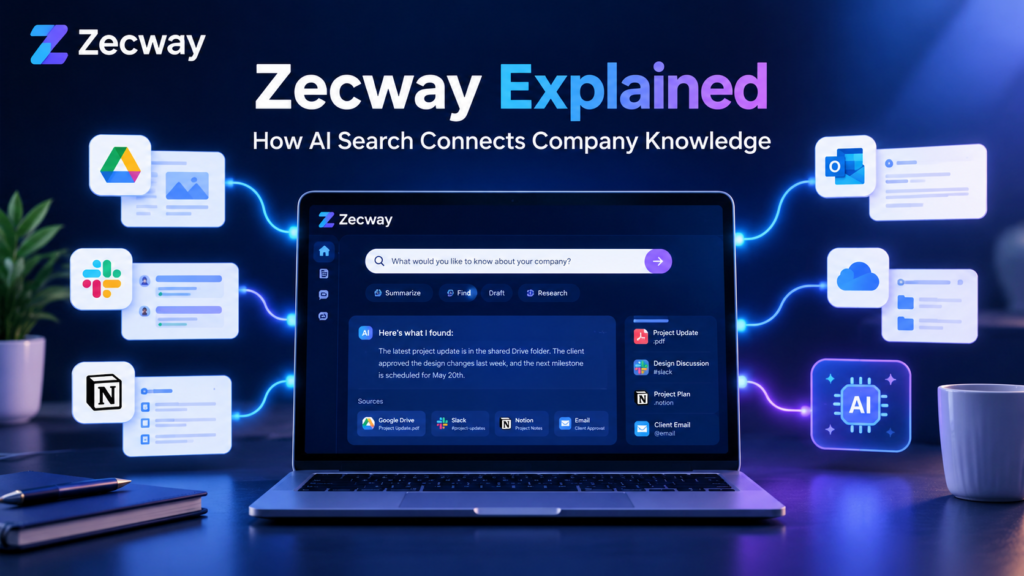
Zecway is an enterprise AI workplace assistant and unified search platform designed to help businesses access information distributed across their digital tools. Its product positioning emphasizes connecting applications such as Google Drive, Slack, Notion, and email through a centralized search experience.
Traditional workplace search often requires employees to remember where information was created. A project decision might be recorded in a chat conversation, a proposal could be saved in a cloud drive, and a customer request might exist in an email thread. Zecway aims to make this information easier to discover without requiring users to search every application separately.
The platform also focuses on answering questions using relevant company information rather than providing only general AI responses. Source references can help employees check the original material behind an answer. However, businesses should verify the available integrations, features, pricing, and access requirements before relying on the platform.
Why Businesses Need Connected Workplace Search
Information Is Scattered Across Multiple Applications
Companies rarely use a single application for every activity. Marketing teams may manage campaigns in project management tools, sales teams may maintain customer records separately, and managers may communicate through internal messaging platforms. Over time, important knowledge becomes distributed across these systems.
This arrangement creates difficulties when employees need information that crosses departmental boundaries. Preparing for a client meeting, for example, may involve locating a proposal, reviewing earlier conversations, and confirming the latest project decision. Even when the information exists, collecting it can consume valuable time.
Unified workplace search aims to reduce this fragmentation by making information from supported applications discoverable through one interface. Instead of remembering exactly where something was stored, employees can search for the information they need and review the relevant sources.
Traditional Search Does Not Always Understand Context
Conventional search tools often depend on keywords, document titles, or exact phrases. These methods work well when employees remember specific details, but they can become less useful when someone remembers the subject of a conversation without knowing its original wording.
Natural-language search offers a more conversational approach. An employee might ask, “What changes did the client request for the latest campaign?” rather than searching several applications for individual keywords. An AI assistant can attempt to interpret the question and identify relevant documents or discussions.
The quality of the result depends on the available information, the accuracy of retrieval, and the system’s ability to understand the request. Businesses should therefore assess whether natural-language search consistently provides relevant answers for their everyday questions.
How Zecway Works
1. Unified Search Across Workplace Tools
Zecway’s first layer focuses on searching information across connected workplace applications. The goal is to make relevant company knowledge accessible from one place rather than forcing employees to move between separate platforms.
For example, an employee preparing a product launch might need the original campaign plan, feedback from colleagues, and a discussion about the delivery schedule. A unified search experience can help locate these materials without requiring the employee to remember where every conversation or document was stored.
The usefulness of this capability depends on supported integrations, indexing quality, and how frequently connected information is updated. Businesses should confirm which applications and content types are supported before assuming that every source can be searched.
2. AI-Powered Answers and Assistance
The second layer focuses on interpreting questions and turning retrieved information into useful answers. Rather than simply displaying a list of documents, an AI assistant can summarize relevant material and help employees understand the main points.
For instance, a project manager might ask for a summary of a lengthy discussion. The assistant could help identify documented decisions, outstanding questions, and possible follow-up items based on the information it can access. This can reduce the need to read every message individually.
AI assistance may also support document summaries and draft replies. However, generated content should be checked before it is used for important business decisions, customer communications, financial commitments, or contractual matters.
3. AI Agents for Multi-Step Tasks
The third layer involves AI agents designed to support more complex activities. Unlike a basic search function, an agent may be configured to perform a sequence of related tasks, such as gathering information, organizing research, and preparing a summary for review.
Zecway describes agents as supporting scheduled work and multi-step actions that require human approval. This suggests an approach that goes beyond answering individual questions and aims to help businesses manage recurring information-based workflows.
The practical value depends on which tasks are supported and what controls are available. Before deploying agents, organizations should establish approval requirements, define permitted actions, and understand how results can be reviewed or corrected.
| 🔗 You may also like: |
| Software discovery is broken |
| Workforce management system cloud technology |
Key Features of Zecway
Natural-Language Search
Natural-language search allows employees to describe what they want to find using ordinary language. They do not always need to remember exact document titles or the precise wording used in a conversation.
This approach can make workplace information more accessible, particularly when employees remember the context of a discussion but not its location. Nevertheless, results should be checked for relevance and completeness, especially when a question involves several projects or conflicting information.
Connected Knowledge Sources
Zecway’s main proposition is to connect information from different workplace tools in one search experience. This can help employees discover documents, conversations, and other available information without opening every application separately.
Integration coverage is an important consideration when evaluating the platform. Businesses should confirm whether their existing applications are supported, which types of information can be accessed, and whether updates become searchable quickly enough for their workflows.
Source-Cited Answers
Source references help employees trace AI-generated answers back to the underlying information. Instead of accepting a response without context, users may be able to open relevant documents or conversations and check what was originally recorded.
This feature is particularly useful when employees need to verify decisions, understand conflicting statements, or review details before taking action. However, citations do not guarantee correctness, so users should confirm that the cited material genuinely supports the answer.
Permission-Aware Information Retrieval
Zecway describes its search as permissions-aware, meaning the system is designed to respect restrictions on which company information a user can access. This is important for businesses that store confidential financial documents, personnel records, customer information, or internal strategy materials.
Organizations should verify how these permissions are enforced and synchronized with connected applications. They should also review access logging, administrative controls, and data protection arrangements before connecting sensitive information.
AI-Assisted Drafting and Summarization
AI-assisted drafting and summarization can help employees turn existing information into useful working material. Examples include preparing a summary of a meeting, outlining the main points of a report, or drafting an internal response based on available documentation.
These capabilities may reduce repetitive writing and help teams process large amounts of text more efficiently. Generated material should still be reviewed for accuracy, tone, missing context, and outdated information before being shared with colleagues or customers.
Scheduled and Multi-Step Agents
AI agents may help organize recurring information tasks, including research and the preparation of internal summaries. Depending on the supported capabilities, an agent could gather information from connected sources and prepare results for an employee to review.
Businesses should begin with clearly defined, low-risk workflows and establish appropriate oversight. Tasks involving external communications, sensitive records, or consequential decisions should have explicit approval procedures and a reliable way to investigate errors.
Practical Use Cases for Zecway
Sales and Customer Success
Sales professionals often need quick access to proposals, product documentation, customer conversations, and previous commitments. Searching through multiple tools before a meeting can delay preparation and make it harder to build a complete picture of a customer’s situation.
An AI workplace assistant could help locate a recent proposal, summarize earlier discussions, or identify documented customer questions. Customer success teams may also use connected search to find relevant troubleshooting guidance and previous explanations of recurring issues.
The main potential benefit is faster access to existing knowledge. Employees should still verify contract terms, pricing, deadlines, and customer commitments against authoritative records before communicating them externally.
Marketing Teams
Marketing departments produce campaign briefs, audience research, content calendars, brand guidelines, and performance reports. These resources may be maintained in separate applications and updated by different team members.
Zecway’s approach could help marketers find the latest campaign brief, review feedback from a previous launch, or gather information before planning new content. Summarizing existing research may also help teams prepare internal reports without manually reviewing every source.
However, marketing claims and performance figures should be checked against reliable evidence. An AI-generated summary should not replace original analytics, approved brand guidelines, or proper research when accuracy matters.
Human Resources
Human resources teams manage onboarding materials, employee policies, training documents, and internal procedures. A connected search system could help employees find approved information without contacting HR for every routine question.
For example, an employee might ask where to find the leave policy or which document explains the onboarding process. If the relevant information is available through a supported connection, an assistant may help locate and summarize it.
HR information can be sensitive, so permissions are essential. Organizations must ensure that confidential personnel records remain restricted to authorized users and that summaries of company policies reflect the current official documentation.
Operations and Project Management
Project managers frequently need to review deadlines, decisions, dependencies, and unresolved issues. Relevant information may be distributed across planning documents, task management systems, and internal conversations.
A workplace assistant could help gather information for a project update or locate the documented reasoning behind an earlier decision. This may reduce the time required to prepare status reports and help team members find information they missed.
The accuracy of these results depends on the quality of project documentation. Teams should continue recording decisions, assigning responsibilities, and updating deadlines instead of expecting AI search to compensate for missing or outdated information.
Leadership and Management
Business leaders often need information from multiple departments to prepare for meetings and make informed decisions. A centralized search interface may help them locate project updates, review documented discussions, and identify relevant company information.
AI-generated summaries can provide a useful starting point when reviewing lengthy documents or multiple conversations. Leaders can then inspect the original sources to understand the context and confirm important details.
Access controls must remain in place, even for senior employees. Leadership convenience should not override confidentiality, employee privacy, or established company information governance policies.
Benefits of Using an AI Workplace Assistant
Less Time Spent Searching
One potential benefit of connected workplace search is reducing the effort needed to locate documents and conversations. When employees can search across supported sources from one interface, they may spend less time switching between applications.
The actual time saved will vary by organization. Businesses should measure how long common information searches take before and after implementation rather than assuming that the technology automatically improves productivity.
Better Access to Organizational Knowledge
Companies often rely on employees who remember where important information is stored. This can become a problem when team members change roles, leave the organization, or are unavailable to answer questions.
Making documented knowledge easier to discover can reduce dependence on individual memory. However, the benefits are greatest when employees maintain accurate records and store important decisions in accessible, approved systems.
More Efficient Information Processing
AI summaries and draft responses may help employees process lengthy documents and discussions. Instead of starting from scratch, workers can use relevant information to create a first draft or identify the most important points.
Human review remains necessary because summaries can omit qualifications or misunderstand context. Employees should verify critical information before using it in reports, decisions, or external communications.
Improved Cross-Team Collaboration
When employees can find relevant information from other departments, they may gain a clearer understanding of existing projects and decisions. This can reduce unnecessary duplication and make collaboration easier.
The results depend on whether teams document their work consistently and have appropriate access to shared information. A search tool cannot fully solve communication problems when essential decisions are never recorded.
Support for Repetitive Workflows
AI agents may help businesses organize recurring information tasks, such as collecting updates or preparing research summaries. These workflows can be useful when the steps are predictable and the information sources are reliable.
Businesses should start with a limited set of measurable tasks and review the results before expanding automation. Clear approval rules and error-handling procedures are important when workflows involve sensitive or consequential information.
Zecway vs. Traditional Workplace Search
Traditional workplace search generally helps employees locate files, messages, and stored information. Users then open the relevant items, interpret their contents, and combine the findings themselves.
An AI-powered workplace assistant aims to go further by interpreting questions, retrieving relevant sources, and generating a synthesized response. AI agents may add support for multi-step activities, although capabilities vary across products.
The distinction is not absolute because many existing enterprise search platforms also offer conversational interfaces, AI summaries, and automation. Businesses should compare specific products according to their supported integrations, retrieval accuracy, security, administrative controls, and overall cost.
| 🔗 You may also like: |
| Guru knowledge base software |
| Buy or build AI agents companies |
Security, Privacy, and Data Governance
Connecting company information to an AI assistant creates important questions about access and data handling. Businesses should determine how the platform respects existing application permissions and whether restricted information remains inaccessible to unauthorized users.
Organizations should also review the provider’s privacy policy, data retention practices, security measures, and rules governing the use of company information for AI training. Additional considerations include access logs, administrator controls, incident reporting, and the handling of sensitive data.
Finally, employees should understand that AI-generated answers may be incomplete or incorrect. Source references, human review, and clear internal policies can reduce risks, but businesses should independently verify the safeguards available for their intended deployment.
Limitations Businesses Should Consider
No AI workplace search platform can guarantee that every answer will be complete or correct. Search quality depends on the information available, the relevance of connected sources, and the system’s ability to interpret a question accurately.
Integration coverage is another consideration. A company may rely on specialized applications that are not supported or whose information cannot be accessed in the required way. Businesses should confirm compatibility and test important workflows before making a purchasing decision.
AI-generated responses may also overlook context, misinterpret ambiguous questions, or rely on outdated material. These limitations make human verification essential, particularly for financial, legal, customer-related, and operational decisions.
Is Zecway Suitable for Small Businesses?
Small businesses may benefit from connected workplace search when employees regularly struggle to locate information across multiple applications. A centralized assistant could help them find proposals, review internal discussions, locate procedures, and prepare meeting summaries.
However, suitability depends on the company’s existing software, data sensitivity, budget, and actual information needs. A business with few applications and well-organized documents may have less need for an additional platform than a company whose knowledge is spread across numerous tools.
Before adopting Zecway, small businesses should verify its current availability, supported integrations, pricing, setup requirements, and security arrangements. A limited pilot can help establish whether the platform provides useful answers and saves time on real workplace tasks.
How to Evaluate Zecway Before Adopting It
Businesses should begin by identifying common questions employees struggle to answer. Examples include locating the latest project brief, finding a documented customer decision, or identifying the current version of an internal policy.
Next, confirm whether the platform supports the applications containing that information. Test search quality, source references, update frequency, and performance across different types of questions. Security testing should also establish whether restricted information remains protected for users with different access levels.
Finally, compare the results with the existing process. Useful measures include search time, answer accuracy, employee satisfaction, and the frequency of corrections required. These findings can help businesses determine whether the platform delivers enough practical value to justify its cost.
The Future of AI-Powered Company Knowledge
AI workplace assistants reflect a broader shift in how businesses interact with information. Instead of navigating separate applications for every question, employees can increasingly use conversational interfaces to locate, interpret, and organize company knowledge.
As these systems develop, search, assistance, and automation may become more closely connected. An employee might discover a document, summarize its contents, prepare a draft, and create a follow-up task through a single workflow, depending on the tools and permissions available.
Long-term value will depend on more than advanced AI models. Reliable information retrieval, source references, effective access controls, privacy protections, and human oversight will remain essential to making these systems trustworthy and useful.
Conclusion
Zecway is an AI-powered workplace assistant designed to connect scattered company information through unified search, conversational assistance, and AI agents. Its central goal is to help employees find relevant knowledge without manually searching through multiple workplace applications.
Potential applications include sales preparation, customer support, marketing research, HR information retrieval, project management, and internal reporting. Source-cited answers and permissions-aware search are particularly relevant because businesses need both convenient access to information and appropriate protection for sensitive data.
Before adopting the platform, organizations should evaluate integration coverage, answer accuracy, security, pricing, and availability. AI-generated responses still require human judgment, and automation should be introduced with clear approval procedures. Ultimately, Zecway’s value will depend on how well its capabilities fit a company’s workflows and how reliably it turns existing information into useful answers.