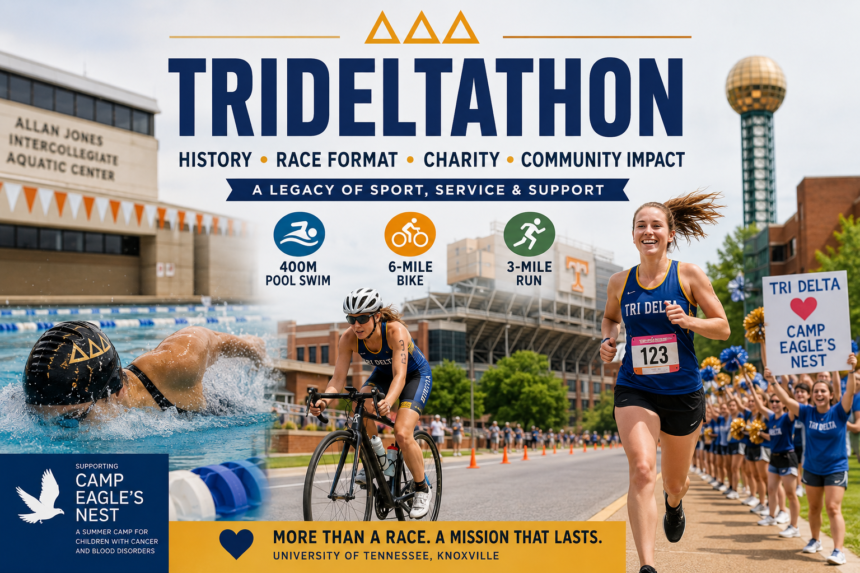
TriDeltathon is a historic Knoxville endurance event associated with the University of Tennessee and the Delta Delta Delta sorority. For decades, the race combined swimming, cycling, and running in a compact pool-based triathlon while raising support for children and families in East Tennessee. Its unusual indoor swim, short course, campus setting, and charity mission helped it become a memorable part of Knoxville’s local sports history.
Unlike many traditional triathlons, TriDeltathon did not begin with a mass start in a lake or river. Athletes started inside the University of Tennessee Student Aquatic Center before moving onto a bike course and finishing with a campus run. Older race records describe the event as the oldest running pool triathlon in the country.
Today, however, anyone searching for TriDeltathon should know that the event has evolved. The current 2026 listing is TriDeltaRUN, a 5K connected with the same Delta Delta Delta and charity tradition.
What Is TriDeltathon?
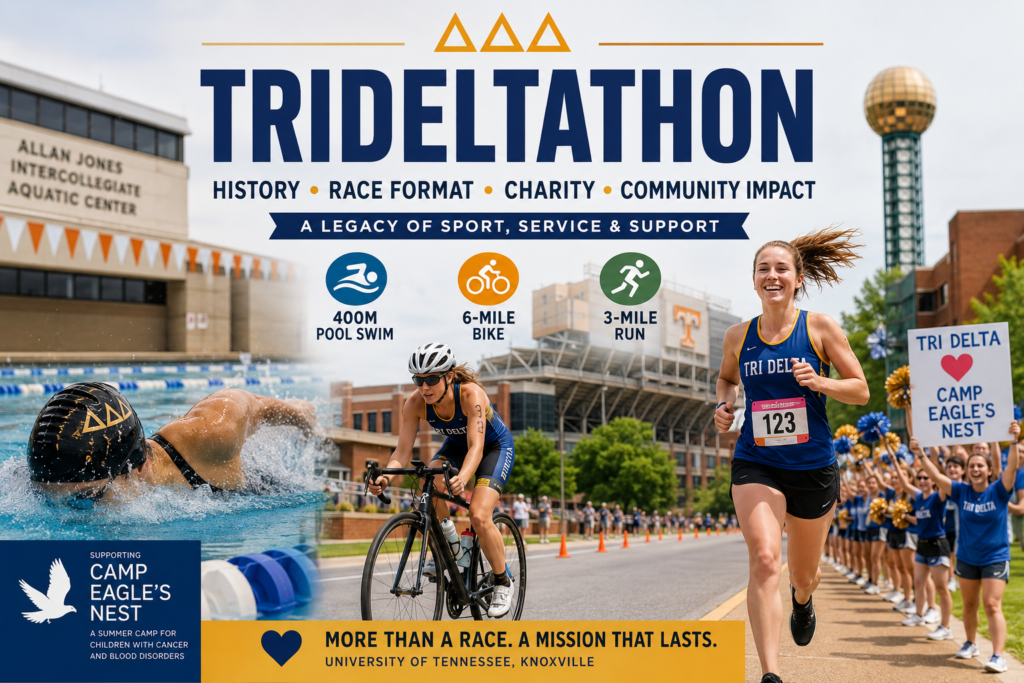
TriDeltathon was a short-distance charity triathlon held in Knoxville, Tennessee, around the University of Tennessee campus. It brought together three different endurance disciplines: swimming, cycling, and running.
The race became especially recognizable because its swimming section took place indoors. The University of Tennessee Student Aquatic Center served as the starting point, giving athletes a controlled environment before they headed onto the cycling and running portions.
The event was connected to Delta Delta Delta, commonly known as Tri Delta. Sorority members provided volunteer support, helping create the community atmosphere that surrounded the competition. The race was therefore more than a sporting event. It was also a student-led fundraising activity with a long-standing connection to children’s causes in East Tennessee.
Its relatively short distances made the event different from longer triathlons. Competitors could experience all three sports without taking on the distances associated with larger endurance races. That combination helped make TriDeltathon appealing to experienced athletes, students, relay participants, and people interested in trying a triathlon.
The History of TriDeltathon
TriDeltathon developed as part of the University of Tennessee and Knoxville community, with historical accounts dating its beginning to 1984. By 2020, the race’s event materials described it as being in its 36th year and promoted it as the oldest running pool triathlon in the country.
Over the years, the race developed a distinctive identity. Rather than relying on a large open-water swim, it used the university’s indoor aquatic center. Athletes then moved through Knoxville’s university area by bicycle before completing the final running section.
The event also benefited from its connection to campus life. Students could compete, volunteer, or help with race organization, while local athletes could take part alongside the university community. That combination gave TriDeltathon a character that was different from a typical commercial endurance race.
Its longevity was another important part of its reputation. When an event continues for decades, it becomes more than an annual competition. It becomes a recurring part of local community life, with former participants, volunteers, and supporters contributing to its history.
Why the Pool Format Made TriDeltathon Unique
The indoor pool was one of the clearest features separating TriDeltathon from many other triathlons.
Traditional triathlons frequently use open water, where athletes may encounter waves, changing conditions, and crowded starts. TriDeltathon instead placed swimmers in the University of Tennessee Student Aquatic Center, creating a much more controlled swimming environment.
The historic race format also used a staggered swim start. Swimmers entered the water individually at approximately seven-second intervals and were seeded according to their estimated 400-meter swim time. The course used eight 50-meter lanes, with swimmers moving between lanes to complete the distance.
This setup had an important practical advantage. Athletes were not fighting for space with a large group at the beginning of the race. Instead, each swimmer could concentrate on maintaining a steady pace and completing the required distance.
For newer triathletes, that controlled environment could make the idea of a triathlon feel more approachable. It also allowed experienced swimmers to race aggressively over a short distance.
The 400-Meter Indoor Swim
The first section of the historic TriDeltathon was a 400-meter indoor pool swim.
Because swimmers were seeded according to estimated performance, the race did not depend on a traditional mass start. Athletes entered the pool individually and worked through the marked lanes. The documented format required swimmers to move under the lane rope at the end of each length and continue through the pool until completing the full distance.
Although 400 meters is relatively short compared with many endurance swimming events, the challenge came from what followed. Swimmers could not simply treat the opening section as an isolated swimming race. They needed enough energy and control to transition into cycling and eventually running.
That made pacing important. A competitor who pushed too hard in the pool could reach the bike portion already tired, while someone who maintained an efficient pace could enter the next stage in a stronger position.
The Six-Mile Bike Course
After the pool swim, athletes moved to the cycling portion of the race.
The historic course covered approximately six miles, taking competitors around parts of the University of Tennessee campus and along Neyland Drive.
Six miles may sound short compared with longer cycling races, but the bike section was still an important part of TriDeltathon. The compact format meant athletes had limited time to settle into their rhythm. Competitors had to move efficiently from swimming into cycling and maintain their effort before the final run.
The bike section also allowed stronger cyclists to gain time. Because the overall race was short, relatively small differences in speed or transition efficiency could have a noticeable effect on the final result.
For beginners, meanwhile, the six-mile distance helped keep the event manageable. It allowed participants to experience cycling as part of a triathlon without committing to a much longer course.
The Three-Mile Campus Run
The final stage of the historic TriDeltathon was a three-mile run.
By the time competitors reached the running portion, they had already completed a swim and a bike ride. The transition from cycling to running can feel very different from beginning a normal run, so athletes needed to adjust their stride and settle into a sustainable pace.
The campus setting gave this section a strong Knoxville identity. Historic race descriptions say runners passed recognizable University of Tennessee landmarks, including Neyland Stadium and Thompson-Boling Arena.
Finishing the three-mile run completed a compact but demanding swim-bike-run challenge. For experienced triathletes, the course provided a fast race. For newcomers, it offered a way to experience the three disciplines without the distances of a longer triathlon.
Why TriDeltathon Was Attractive to Beginners
One of the strongest features of a pool triathlon is accessibility.
Someone nervous about open-water swimming may feel more comfortable starting in an indoor pool. There are clearly marked lanes, familiar surroundings, and a structured start instead of a large group entering a lake or river simultaneously.
TriDeltathon also kept its distances relatively short. A 400-meter swim, six-mile bike ride, and three-mile run require preparation, but they are considerably more approachable than many longer multisport races.
The event also included relay opportunities in its historic format, allowing participants to divide the swimming, cycling, and running responsibilities.
That community-oriented approach helped the race appeal to different types of participants. Some people could compete for time, while others could simply challenge themselves or participate with friends.
The Importance of Transitions
TriDeltathon was not only about swimming, biking, and running. The transitions between those activities were also important.
After completing the swim, athletes needed to move efficiently toward their bicycles. After cycling, they had to prepare for the final run. In a short race, unnecessary delays could have a noticeable impact on the overall result.
This is one reason short triathlons can be surprisingly competitive. The course may be compact, but competitors still need to manage several different skills in a limited amount of time.
For beginners, however, transitions were less about chasing every second and more about staying organized. Knowing where equipment was located and moving calmly from one stage to the next could make the entire experience smoother.
Tri Delta and the Charity Mission
The charitable purpose is central to the TriDeltathon story.
Delta Delta Delta volunteers supported the event, while proceeds were directed toward children’s causes in East Tennessee. The historic race listing identifies East Tennessee Children’s Hospital as a beneficiary.
Current TriDeltaRUN information specifically identifies East Tennessee Children’s Hospital and Camp Eagles Nest, a summer camp for children with cancer and rare blood disorders, as beneficiaries of the event’s proceeds.
This connection gave the race a purpose beyond competition. Participants were not simply paying an entry fee to complete a course. Their involvement contributed to a community fundraising effort.
That combination of athletics and service is one of the strongest reasons the TriDeltathon name has remained recognizable in Knoxville.
Community Impact in Knoxville
The impact of an event like TriDeltathon cannot be measured only by finishing times.
A university race can bring together students, alumni, local athletes, volunteers, families, businesses, and charitable organizations. Every group contributes something different to the event.
Students gain experience in organizing and supporting a major community activity. Athletes receive an opportunity to compete. Volunteers help the race operate smoothly. And charitable organizations benefit from fundraising and public attention.
The TriDeltathon therefore became an example of how a relatively small sporting event can connect several parts of a community.
Its long history also helped strengthen that connection. An event that returns year after year can become a familiar spring tradition for people who live, study, and work in the area.
What Happened to the Original TriDeltathon?
This is one of the most important points for people searching for TriDeltathon today.
The historic pool triathlon appears in older race records and event pages, but the current event format is different. The 2026 race listing is for TriDeltaRUN, a 5K organized by Delta Delta Delta and Race Day Events.
The 2026 TriDeltaRUN was scheduled for April 19 at UT Gardens on the University of Tennessee Agriculture Campus. The course was described as being largely contained on the Third Creek Greenway.
This means people should not assume that an old TriDeltathon page represents the current race. Historic pages can still appear in search results because of the event’s long history.
The best way to understand the change is to view TriDeltaRUN as the modern continuation of the event’s community and fundraising tradition, rather than as the exact same swim-bike-run competition.
TriDeltathon vs. TriDeltaRUN
The historic and modern events share a name and charitable roots, but their formats are different.
| Feature | Historic TriDeltathon | Current TriDeltaRUN |
| Race type | Pool triathlon | 5K |
| Swimming | 400 meters | None |
| Cycling | 6 miles | None |
| Running | 3 miles | 5 kilometers |
| Main setting | UT campus and Student Aquatic Center | UT Gardens / Third Creek Greenway |
| Organization | Delta Delta Delta with race support | Delta Delta Delta and Race Day Events |
| Charity connection | East Tennessee Children’s Hospital | East Tennessee Children’s Hospital / Camp Eagles Nest |
The historic TriDeltathon required participants to prepare for three sports. The current TriDeltaRUN is much simpler because participants only need to prepare for a 5K run or walk.
The two formats therefore serve slightly different audiences. The original race appealed to people interested in multisport competition, while the current format can reach runners, walkers, students, families, and casual participants with less specialized equipment.
Why the Move to a 5K Matters
Changing from a triathlon to a 5K represents more than a change in distance.
A triathlon requires access to a swimming facility, bicycle, cycling equipment, transition areas, and multiple types of course support. A 5K removes much of that complexity.
That can make participation easier for people who do not own a bicycle or regularly train in swimming. It also allows families and casual runners to participate without preparing for three separate disciplines.
The 2026 TriDeltaRUN listing shows that the event continues to offer student discounts, race shirts, awards, refreshments, and the same broad charitable purpose.
In that sense, the format has become simpler while the community mission has remained recognizable.
How Athletes Could Approach the Historic Race
Training for the original TriDeltathon required a balanced approach because no single sport could carry the entire race.
Swimmers needed to become comfortable completing 400 meters continuously while maintaining enough energy for the bike. Cyclists needed to handle a short, fast course after swimming. Runners then had to adapt to running after two previous disciplines.
One useful concept in triathlon training is the brick workout, where two disciplines are performed consecutively, such as cycling followed by running. This helps athletes become familiar with the transition between sports.
The most important principle would be consistency rather than extreme training. Because the historic distances were short, athletes could focus on technique, pacing, safe equipment handling, and smooth transitions.
The Current TriDeltaRUN
For readers interested in the event today, TriDeltaRUN is the relevant modern race.
The 2026 edition was scheduled as a 5K beginning at 10 a.m. at UT Gardens. The course was largely based around the Third Creek Greenway, and day-of registration was scheduled to open at 9 a.m.
The event was listed as the fifth year of the 5K format. Race information also noted student discounts, overall and age-group awards, race shirts, and post-race refreshments.
Most importantly, proceeds continue to support East Tennessee Children’s Hospital and Camp Eagles Nest.
So while someone looking for the historic TriDeltathon may expect a pool, bicycle, and three-mile run, the current event is a standalone 5K.
Why the TriDeltathon Legacy Still Matters
TriDeltathon is interesting because its history connects several themes that rarely appear together in one local race.
It was a sporting competition, a university activity, a volunteer project, and a charity fundraiser. Its pool-based format also gave it a distinctive identity within Knoxville’s endurance sports community.
The event demonstrated that a race does not need to be extremely long to create a meaningful challenge. A 400-meter swim, six-mile bike ride, and three-mile run could test speed, endurance, transitions, and mental focus.
At the same time, its charitable purpose reminded participants that the finish line was not the only goal.
A Lasting Knoxville Sports Tradition
The story of TriDeltathon ultimately reflects the changing nature of community sporting events.
The original triathlon belonged to an era when a small campus race could combine three sports, volunteers, and fundraising into one distinctive annual tradition. Its long-running history helped establish a connection between Delta Delta Delta, the University of Tennessee, local athletes, and East Tennessee children’s causes.
The modern TriDeltaRUN shows how that tradition can adapt. Instead of requiring participants to swim, cycle, and run, the current event uses a more accessible 5K format while maintaining its connection to charity and the university community.
That evolution is important for understanding the event correctly. TriDeltathon is both a historical race name and part of a continuing community tradition.
Conclusion
TriDeltathon earned its place in Knoxville sports history through a distinctive combination of a pool swim, bike course, campus run, student involvement, and charitable fundraising. The historic race featured a 400-meter indoor swim, six-mile bike ride, and three-mile run, with the course centered around the University of Tennessee.
Its indoor swimming format made it different from many open-water triathlons, while its short distances allowed beginners, experienced athletes, and relay teams to participate. Delta Delta Delta volunteers and the race’s charitable connections added a community purpose that extended beyond competition.
Today, the original swim-bike-run format is no longer the current race listing. The tradition has continued through TriDeltaRUN, a 5K associated with Delta Delta Delta and Race Day Events. The 2026 event was held at UT Gardens and continued supporting East Tennessee Children’s Hospital and Camp Eagles Nest.
For anyone researching TriDeltathon, the key distinction is simple: the historic TriDeltathon was a pool triathlon, while the current TriDeltaRUN carries forward its community and charity tradition as a 5K. That combination of sports history, university involvement, and philanthropy is what makes TriDeltathon more than just an old race name.
FAQs
What is TriDeltathon?
TriDeltathon was a historic pool-based triathlon associated with Delta Delta Delta and the University of Tennessee in Knoxville. It combined swimming, cycling, and running while supporting charitable causes in East Tennessee.
What were the original TriDeltathon distances?
The historic race consisted of a 400-meter indoor pool swim, six-mile bike ride, and three-mile run. The swim took place at the University of Tennessee Student Aquatic Center.
Why was TriDeltathon different from other triathlons?
Its most distinctive feature was the indoor pool swim. Instead of starting in open water, athletes entered the pool individually at short intervals and completed a structured lane-based course.
What charity did TriDeltathon support?
Historic race information connects TriDeltathon proceeds with East Tennessee Children’s Hospital. Current TriDeltaRUN information specifically identifies East Tennessee Children’s Hospital and Camp Eagles Nest as beneficiaries.
Is TriDeltathon still held as a triathlon?
The current 2026 event listing is TriDeltaRUN, a 5K at UT Gardens, rather than the historic swim-bike-run format. The event continues the Delta Delta Delta and charitable tradition associated with the older race.