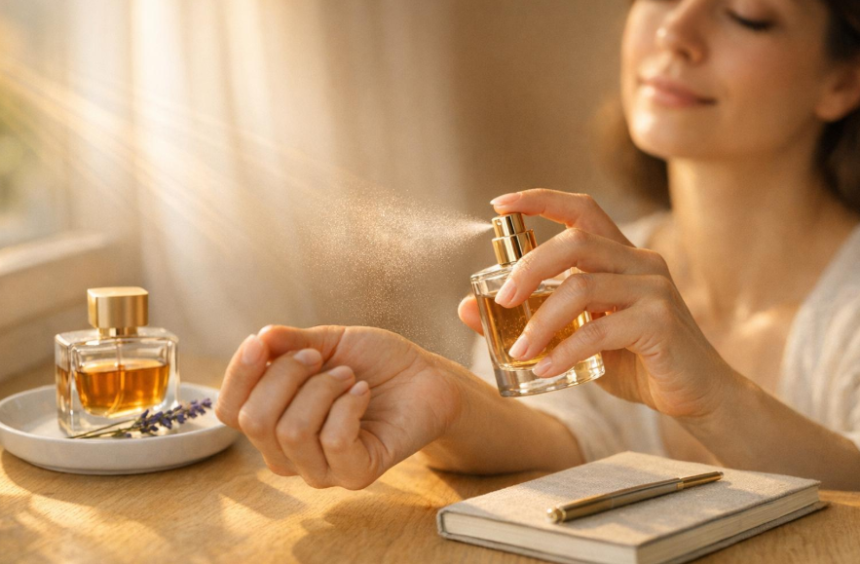
Open the product page for a perfume you’ve never smelled. Read it once, close the tab and write down what you expect to smell two hours after spraying. If the only words you can come up with are “fresh, expensive and long-lasting”, you haven’t got much of a prediction. You’ve mostly remembered how the page made the perfume sound.
Yes, you can choose which perfume to try online without smelling it first. Choosing a full bottle you’ll be glad to own is a different decision. The page can give you a good reason to pick a sample. Once that sample arrives, the most interesting question isn’t simply whether you like the perfume. It’s whether the clues you used actually helped you choose it.
Try this as a small experiment before your next purchase. The prediction happens online. The first sniff comes later. You don’t need to spend a full bottle’s worth of money to find out how good your blind-buy judgement is.
First, make a prediction you can get wrong
Choose one exact fragrance. Write down the brand, full name and version. If the page says Eau de Parfum Intense, put all of that in your notes. A review of the original may be interesting, but it won’t explain why your prediction was wrong if you sampled a different formulation.
Now make three short predictions. One should describe the opening, one should describe what you expect to be left behind, and one should name the thing that could make you stop wearing it. Add a question mark wherever you’re guessing. Leave performance out if the page only gives you notes; you can like the smell of dry wood without knowing how far it will travel.
Here’s a worked example using the description of Alfred Dunhill Custom Eau de Toilette in ScentRepublic’s men’s fragrance range. The retailer describes a crisp apple opening, pepper and a later cedar and incense direction. Say you like dry woods but are wary of smoke:
“I expect crisp fruit at first and drier woods later. I’m unsure how much I’ll notice the smoke. If incense takes over after the fruit fades, I probably won’t wear it to work.”
That’s a prediction you can test. It also shows how the same listing can send two buyers in opposite directions. A person looking for smoke might put this at the top of their list. Someone who wants nothing beyond the apple should probably look elsewhere. Neither needs to pretend they know how the exact perfume smells.
Save what you wrote before looking at reviews. Then read one or two accounts of the exact version and add any new prediction on a separate line. Keeping the original lets you see whether the reviews improved your guess or merely made you more confident in it.
The part your imagination supplies
If the word “apple” made you think of a Granny Smith rather than apple sweets, some of that detail came from you. That’s where the exercise gets interesting. Two readers can have the same note list in front of them and picture very different fragrances. Neither reader necessarily made a careless mistake. The page left a gap and they supplied different memories to fill it.
In a study of sniffing during mental imagery, Moustafa Bensafi and colleagues found that people spontaneously sniffed when imagining smells, in a way that resembled sniffing during perception. In a separate weak-odour detection experiment, Jelena Djordjevic and colleagues found that imagining a different odour could interfere with detecting the one actually presented. These experiments weren’t about shopping and don’t give us a blind-buy success rate. They do show that imagining a smell is an active process. A vivid impression is still your impression of what might be there.
The mistake is treating that vividness as information about the perfume. If a page names vanilla and you can almost smell a custard tart, check whether anyone actually described the fragrance that way. Vanilla may be mentioned alongside wood, smoke or spice, and the listing may say very little about which impression dominates. A good prediction acknowledges that gap. It doesn’t fill it in with certainty.
What to order for the experiment
If there’s a sample of the exact version, start there. A manufacturer’s vial is one option; a decant is perfume transferred into a smaller container by the seller. Check which you’re getting, who supplies it and how much is included. ScentRepublic noted that if you’d rather buy a discovery set, choose one with fragrances you can distinguish by name and buy individually later. Keep your prediction focused on one scent before the parcel arrives.
As a South African example, Jo Malone London’s local Cologne Discovery Collection lists five fragrances in a discovery format. That gives you the option of comparing several scents from the same house without buying five bottles. It’s a retail example, not evidence that the set produces better choices. A mixed set is also poor value for this exercise if you’re interested in just one of its contents and can get that sample on its own.
Sometimes postage makes a single vial feel disproportionately expensive. Compare the delivered cost in rand with what you’d be comfortable losing on an unworn bottle. If there’s a counter nearby, ask whether it has the exact version and use the same written predictions when you visit. If your only online option is a bottle you wouldn’t happily keep if it disappointed you, put the purchase on hold. You can still have a good shortlist without buying the winner today.
When the parcel arrives, keep the product page closed
Smell the sample before rereading your prediction. If you’re comfortable trying it on skin, wear it the way you normally would, without another perfume competing for your attention. A strip is fine for deciding whether you want to wear it at all. The skin wear is the better comparison if your purchase depends on how it smells to you during an ordinary day.
Write what you notice in your own words. At first it might be “crisp apple, then pepper”. Later it might be “cedar with a little incense; less smoky than I thought”. If all you can say is “something sweet that wasn’t there at the start”, that’s enough. There’s no prize for naming everything in the copy. Make the later note at a time that matters to you, such as once you’ve been at work for a while or after you’ve had dinner. Two hours is a useful example, not a deadline for every perfume to finish developing.
Before you look back at what you wrote, answer one separate question: would I choose to wear this again? If the answer is yes, give it another wear on a day that resembles the one you were shopping for. Being impressed by a sample on a quiet Sunday doesn’t settle whether you’ll enjoy it in close quarters on Monday.
Read the two verdicts separately
- You predicted it well and liked wearing it. Keep the perfume on the shortlist. Check the total price and choose the size you expect to use, especially if the sample only really appealed on one kind of day.
- You predicted it well and didn’t like it. The listing helped, and you’ve learnt something about your taste. Maybe you enjoy incense in a room but don’t enjoy wearing it. Use that observation to make the next prediction better.
- You predicted it badly and liked it. The sample was a good purchase. Your next blind buy isn’t automatically a better bet, because the clue you relied on didn’t describe what you ended up enjoying.
- You predicted it badly and didn’t like it. Check the exact version and the evidence you used. If you relied on a listed note, you may have assumed it would be more prominent than it was. If you relied on a review, see whether the reviewer even described the stage of wear you cared about.
The third result is easy to misread. Finding a lovely perfume by accident is worth enjoying. It doesn’t make your method more reliable. Conversely, a sample you don’t like can be a useful result when it stops you spending full-bottle money on a style you were sure would work.
When the full bottle is the only option
A full-bottle blind buy is a reasonable gamble if you’re comfortable with the cost even if you don’t wear it, you know what could disappoint you, and you’ve ruled out easier ways to try it. A familiar brand or note can make the choice feel more comfortable, but it can’t remove the risk. If your budget only allows for one everyday perfume this year, you have more reason to wait than someone buying a small bottle out of curiosity.
Check the seller’s terms on the exact product before opening it if the ability to return it matters. Don’t assume you can spray it and send it back because the seller offers returns. ScentRepublic’s guide to buying perfume online safely is useful for checking practical details such as the listing and seller. Those checks help you get the item you ordered; they can’t tell you whether you’ll enjoy wearing it.
Questions that can change the result
Does smelling a perfume on someone else count as trying it? It tells you that you like at least one impression of it. It might have been the trail they left after several hours, while the part you find hard to wear is the opening. If that distinction matters, sample it yourself before paying for a large bottle.
Should I go with the perfume whose reviews are most consistent? Consistent detail is useful when it answers your question. Three accounts of a dry finish can help if you’re avoiding syrupy sweetness. Three people saying it’s gorgeous don’t give you the same help. Look for what they agree on before you decide how much weight to give it.
How many successful samples make me good at blind buying? There’s no useful magic number. A few comparisons in one style may teach you how to shop for that style without telling you much about another. Keep track of which clues you keep getting right. They’re more useful than your winning streak.
What if I like a perfume better before I look up the notes? You can leave it there. The experiment is meant to make shopping easier, and you already know whether you enjoy what’s on your skin. Reading the notes afterwards can be interesting, but there’s no need to revise a good experience to match the page.
Before you order, write a prediction you’d be willing to cross out. Then buy the smallest useful way of checking it. The skill you’re building is knowing when a description gives you a reason to try a perfume and when it’s doing little more than making the bottle hard to resist.
Read Also:- magazinerate.co.uk