Every large company has its own way of building staff email addresses, and Magazine Luiza is no different. If you have ever needed to write to someone at Magalu — as Brazilians call it — you have probably wondered what comes before the @ sign. Is it a first name? A first name and a last name? A department?
This guide explains the magazineluiza com br email format in simple words. It covers the pattern that contact databases report most often, the other patterns that also appear, how to check an address before you send anything, and how to spot the fake “Magalu” emails that scammers send. One honest note before we start: Magazine Luiza does not publish a staff directory or an official email rule, so everything about patterns comes from outside databases that collect addresses they have seen. Treat a pattern as a strong hint, never as proof.
| 🔗 You may also like: |
|---|
| Target Company URL Research: How to Find and Verify the Right Business Website |
| Research Dossier for Target Company: How to Build a Complete Company Intelligence Report |
The Short Answer
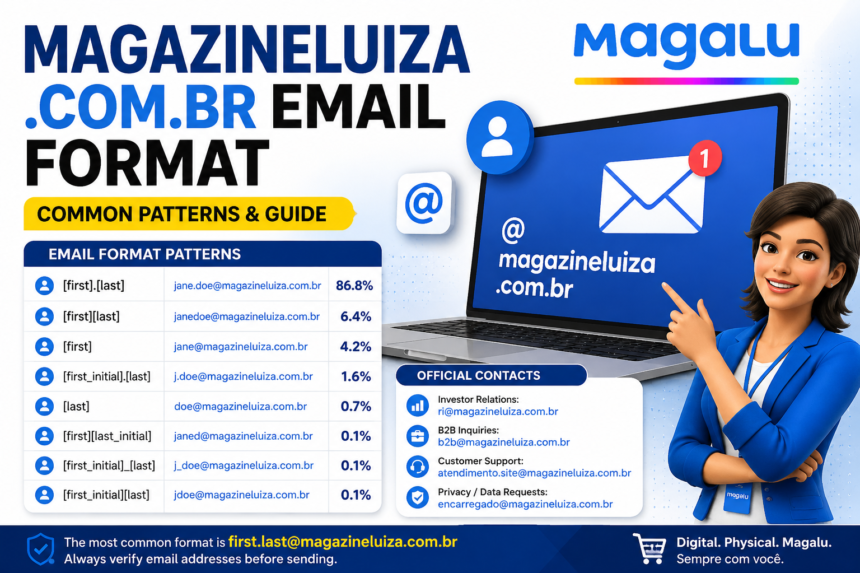
The most commonly reported Magazine Luiza email format is first name, a dot, then last name, all in small letters, on the company’s real domain:
firstname.lastname@magazineluiza.com.br
For a made-up employee called Maria Silva, the pattern would produce maria.silva@magazineluiza.com.br. That example only shows the shape — it does not mean that this exact mailbox exists. Independent contact databases that track work emails put this dotted pattern clearly in first place for Magazine Luiza, although they disagree on the exact share, with reported figures ranging from about three quarters of sampled addresses to almost all of them. A smaller number of addresses use other shapes, such as the two names joined together with no dot, or a first name on its own. And for most everyday needs — an order problem, a business proposal, a job application — a department address or an official page is a better door than any guessed staff address.
A Quick Word About Magazine Luiza
Magazine Luiza is one of the biggest retail companies in Brazil. It was founded in 1957 in Franca, in the state of São Paulo, and grew from a single shop into a giant chain of stores plus one of the country’s largest online shops and marketplaces. Most Brazilians know it by its short name, Magalu. A company of that size employs tens of thousands of people across stores, warehouses, offices and technology teams, so it is no surprise that its email system is large — and that no single rule covers every mailbox ever created inside it.
The part of the address that never changes is the domain: magazineluiza.com.br. That is the company’s official home on the internet, the same address as its shop website. If an email claims to come from Magazine Luiza but the part after the @ sign is anything else — a different spelling, a different ending, extra words — it is not the company’s real domain, and you should be careful. We will come back to that in the safety section below, because it matters a lot.
The Most Common Pattern: First Name, Dot, Last Name
The pattern that almost every email database puts first for Magazine Luiza joins the person’s first name and last name with a dot:
firstname.lastname@magazineluiza.com.br
There are good reasons why big companies like this shape. It is clear: you can usually tell who the mailbox belongs to just by reading it. It also copes well with common names. A huge company will have many people called Maria or João, but far fewer who share the same first name and last name pair. The dot keeps the two names easy to read and easy to type.
Two small details are worth knowing. First, the whole address is written in small letters, as email addresses almost always are. Second, Brazilian names often carry accents and special letters — ã, ç, é and so on — but email addresses drop them. A name written as João appears in the address as “joao”, and Gonçalves becomes “goncalves”. If you are building an address from a person’s name, always use the plain version of the name, without accents.
How strong is this pattern? Databases that index work emails — services that collect addresses from public documents, signatures and business records — consistently rank it first for this domain. Depending on which database you read, it covers roughly 75% to over 95% of the Magazine Luiza addresses they have sampled. That spread sounds wide, and it is, because each service samples a different set of addresses. The safe conclusion is not a number. The safe conclusion is: if a Magazine Luiza staff address exists, the dotted first-and-last-name shape is the most likely shape it takes.
The Other Reported Patterns
The dotted pattern leads, but it is not alone. The same databases report a handful of other shapes on this domain, each with a much smaller share:
First name and last name joined, with no dot — firstnamelastname@magazineluiza.com.br. This is usually the second most common shape, reported at roughly 6–7% of sampled addresses. It often belongs to older accounts created under an earlier rule.
First name only — firstname@magazineluiza.com.br. Reported at roughly 3–4%. Short addresses like this are easy to remember, but hard for a huge company to hand out, because only one person can have each first name. They tend to belong to senior or long-serving staff.
First initial plus last name — f.lastname@magazineluiza.com.br. A small share. Companies often use this shape when two employees share the same full name, or when an older account needs to be kept distinct.
Why do several patterns live side by side? Because big companies are not built in one day. Accounts created ten years ago may follow the rule of ten years ago. When two people share a name, one of them needs a different shape. When a company buys another business or changes its systems, old addresses often keep working. The result is a clear favourite pattern with a long tail of exceptions — which is exactly why guessing an address and treating it as certain is a mistake.
Why the Percentages Differ Between Databases
If you search this topic, you will find pages quoting very exact numbers — 86.8%, 88.6%, 96% — as if they were official facts. They are not. Magazine Luiza has never published its email statistics. Each figure comes from a private database describing only the addresses that database has happened to collect, and different databases collect different samples: one may hold mostly office staff found in documents, another mostly sales contacts, another a mix built from the open web.
The clearest proof that these are estimates is that the databases do not even agree with each other. Most rank the dotted pattern first by a wide margin, but at least one well-known email checker ranks a different pattern — first name, underscore, last name — as its most common find for this domain. Both cannot be describing the whole company. They are describing their own samples. So read every percentage on this topic the same way: as a rough guide to what is likely, not as a fact about a real person’s mailbox.
Department Addresses: Often the Better Door
Not every useful address belongs to one person. Large companies also run shared inboxes for whole teams, and Magazine Luiza is no exception. The company itself publishes a small number of these addresses for set purposes. Two of the best known are:
ri@magazineluiza.com.br — the Investor Relations inbox, printed in the company’s own investor documents. This is the right door for shareholders and financial questions.
b2b@magazineluiza.com.br — the published address for business enquiries, for companies that want to sell to or work with Magalu as a business.
For other needs, the company steers people to pages rather than inboxes. Customers with an order, delivery or payment problem are directed to the help area of the official website and the Magalu app, where support is tied to their account. People looking for a job are directed to the company’s official careers system, where applications are tracked properly. In each case the official channel exists for a reason: a shared inbox or a proper system keeps working when one employee is on holiday, changes team or leaves — a guessed personal address does not.
How to Verify an Address Before You Send
Suppose you have a real reason to write to a specific person — a supplier contact you met at an event, a name given on a business card — and you want to check an address built from the pattern. Do it in this order, from strongest proof to weakest:
Step 1: Look for the address in an official source. If the exact address appears in a company document, an official page, a press release or the person’s own email signature, that is real evidence. This is the same habit used in any careful company research: a good research dossier for a target company is built from what the company itself has published, not from guesses.
Step 2: Check the name and role are current. People change jobs and teams. An address built for someone who left the company last year helps no one. A current profile, a recent document or a recent news mention beats an old one.
Step 3: Use the pattern only as a cross-check. If the address you found matches the common first.last shape, that adds a little confidence. If it follows one of the rarer shapes, it may still be right — remember the exceptions are real.
Step 4: Be ready for a bounce. If the message comes back as undeliverable, the address was wrong or the mailbox is closed. Do not keep trying variation after variation of a stranger’s name — that is spam behaviour, and it can get your own address blocked. Go back to the official channels instead.
How to Write a Short, Professional Email
Once you have the right address — ideally an official one — the message itself should do the work. Busy teams read subject lines first, so make yours say the point in a few words: “Supplier enquiry: kitchenware range” tells the reader more than “Hello” ever will. Open with one line about who you are, follow with what you need, and close with exactly what you are asking for: a reply, a meeting, a document. Three or four short paragraphs are enough.
This is normal business practice everywhere. Companies that live on partnerships, such as the firms matched with sponsors in our guide to Quartz Events sponsor matching companies, expect clear, short first emails. So do the agencies described in our article on PPC management in the USA: the first message is an introduction, not a sales brochure. If you represent a business, name it. If you have an order number or a reference, include it through the proper support channel rather than sending private details to a guessed address.
Warning: Fake Magalu Emails and Phishing
Now the part of this guide that may save you money. Because Magazine Luiza is so well known in Brazil, criminals copy its name. Fake emails and messages pretend to come from Magalu and try to push the reader into one of three traps: paying a fake payment slip, clicking a link that steals a password, or handing over card details for a “prize”, a “delivery fee” or an “account check”. The email address at the top of such a message can look close to the real thing — that is the trick.
Protect yourself with a few simple habits:
Read the full sender address, not the display name. A message can show the name “Magazine Luiza” while the real address behind it is something entirely different. Open the sender details and check what comes after the @ sign. The real domain is exactly magazineluiza.com.br — not magazine-luiza.com, not magazineluiza.com, not magazineluiza-oficial.com.br, and not any version with extra letters.
Be suspicious of urgency and payment requests. Real support teams do not threaten to close your account within hours, and the company does not collect surprise fees by email. A message that rushes you is a message that does not want you to think.
Never use the links or slips inside an unexpected email. If a message says you owe money or must confirm something, close it. Open the official Magalu app or type the real website address yourself, sign in there, and check your account in the normal place. If the claim is real, it will be waiting for you inside your account. If it is not there, the email was fake.
Do not open strange attachments. Fake delivery notes and fake bills are common carriers for harmful files. A real document about your order lives inside your account, not in a surprise attachment.
Common Mistakes to Avoid
Treating a pattern as a promise. Even the strongest pattern fails sometimes. A well-formed guess is still a guess until an official source confirms it.
Writing to staff about shop problems. An employee’s inbox is the slowest route for an order problem. The help channels in the app and on the site exist precisely so your case is logged, tracked and answered.
Sending private details to unverified addresses. Never send passwords, card numbers, identity documents or codes to an address you have not verified — and never to anyone who asks for them by email at all. No real company needs your password.
Trusting a familiar name without checking the domain. As the safety section showed, the name on a message proves nothing. The domain is the identity. One wrong letter is enough.
| 🔗 You may also like: |
|---|
| How the Global Trader Programme Helps Trading Companies Save Tax in Singapore |
| Comisaco Explained: The Dam Partnership Behind Uruguay’s Rice |
Conclusion
The magazineluiza com br email format has a clear favourite and a long tail. The favourite — first name, a dot, last name, on the magazineluiza.com.br domain — is the pattern that independent databases report most often for Magazine Luiza staff, even though their exact percentages are only estimates from their own samples. Around it sit smaller patterns: joined names, first names alone, initials. None of them turns a guess into a fact. For most people, most of the time, the smartest move is to skip the guessing entirely: use the published department addresses such as the investor and business inboxes, the help channels in the app and on the site for orders, and the careers system for jobs. And in the other direction, treat every unexpected “Magalu” email with care — check the real domain, ignore pressure, and go to the company directly. The format is a useful map. The official channels are the road.
FAQs
What is the most common magazineluiza com br email format?
The most commonly reported pattern is first name, a dot, then last name — firstname.lastname@magazineluiza.com.br. Contact databases put this shape clearly in first place for Magazine Luiza, although their estimated shares differ, from about three quarters of sampled addresses to almost all of them.
Has Magazine Luiza officially published its email format?
No. The company does not publish a staff directory or an official rule for employee addresses. The pattern information comes from third-party databases that sample addresses they have seen, so it should be read as a likely pattern, not a company promise.
What official Magazine Luiza email addresses are published?
The company prints a few shared addresses for set purposes, including ri@magazineluiza.com.br for Investor Relations and b2b@magazineluiza.com.br for business enquiries. For orders and account help, customers are directed to the help channels in the official app and website instead of email.
How can I tell if a Magalu email is fake?
Check the full sender address: real company mail uses exactly the magazineluiza.com.br domain. Be wary of urgent demands, surprise payment slips, prize claims and links asking for passwords or card details. Close the message and check your account by opening the official app or website yourself — if the claim is real, it will show there.
Should I guess an employee’s email address?
It is better not to rely on a guess. A pattern can suggest a likely shape, but it cannot confirm that a mailbox exists or that the person still works there. If you must write to a specific person, check the address against an official source first; otherwise, use the department inbox or official page that matches your reason for writing.