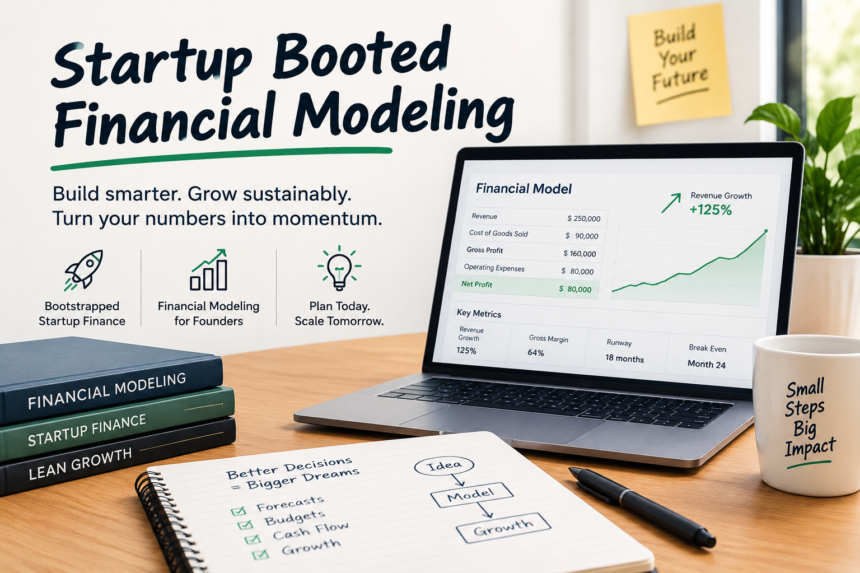
Building a startup without depending heavily on outside capital changes the way financial decisions need to be made. When customer revenue is helping fund operations, every hiring decision, pricing change, marketing expense, and payment delay can affect the company’s ability to keep growing.
That is where startup booted financial modeling becomes valuable. Instead of treating a financial model as a spreadsheet created for investors, a founder can use it as an operating system for making better decisions.
A useful model connects business assumptions—such as customers, pricing, sales activity, churn, expenses, hiring, and payment timing—to outcomes such as revenue, profitability, cash balance, break-even, and runway.
The objective is not to predict the future perfectly. It is to understand what needs to happen for the business to remain financially sustainable and what could go wrong if important assumptions change.
Note: This article is for educational purposes and is not accounting, tax, legal, investment, or other professional advice. Business owners should verify material assumptions with appropriately qualified professionals.
What Is Startup Booted Financial Modeling?

Startup booted financial modeling is the process of building financial projections for a bootstrapped or primarily self-funded startup.
The model takes operational assumptions and turns them into financial outputs. For example, a founder might start with the number of customers, average selling price, expected churn, employee costs, software expenses, and collection timing.
Those inputs can then show how revenue, expenses, profit, and cash could develop over time.
The important distinction is that a good model does not simply say, “Revenue will grow by 15% each month.” It asks why revenue should grow.
For a SaaS company, growth might come from new customers, pricing, expansion revenue, or retention. For an agency, it could depend on projects, clients, average project value, and delivery capacity.
This makes financial modeling a decision-making tool rather than a collection of optimistic numbers.
| 🔗 You may also like: |
|---|
| Capacity Requirements Planning |
| Growth Navigate |
Why Financial Modeling Matters More for Bootstrapped Startups
A venture-backed company may have substantial external capital available to fund a period of heavy investment. A bootstrapped company generally has less room for financial mistakes because operating resources are more closely connected to existing cash and customer revenue.
That does not mean every bootstrapped startup must avoid spending. It means spending should have a clear relationship with the company’s strategy and financial capacity.
A useful model can help answer questions such as:
- Can the company afford its next hire?
- How much revenue is required to cover current costs?
- What happens if customer acquisition slows?
- How much cash is required before a new product launches?
- What happens if customers pay invoices later than expected?
- Can the business afford additional marketing?
- When does a growth investment become financially reasonable?
The U.S. Small Business Administration recommends developing financial projections and, where appropriate, using detailed monthly or quarterly projections for the early period of a business plan.
For a founder, however, the model should go beyond producing numbers for a document. It should be updated as the business generates real information.
The Strategic Foundation of a Bootstrapped Financial Model
A practical model can be organized around six connected layers:
- Assumptions
- Revenue drivers
- Costs and headcount
- Cash timing
- Financial outputs
- Scenarios and decisions
Keeping these layers connected makes it easier to understand how one operational change affects the rest of the business.
1. Build a Clear Assumptions Layer
Important assumptions should be visible rather than hidden inside formulas.
Depending on the business, inputs may include:
- Starting customer count
- Product or service pricing
- New customer acquisition
- Conversion rate
- Churn
- Average order value
- Payroll
- Contractor costs
- Software expenses
- Marketing spending
- Inventory costs
- Payment-processing fees
- Customer collection timing
- Planned hiring dates
It is also useful to distinguish between facts and estimates.
An actual payroll figure is different from a forecasted salary. A signed customer agreement is different from an assumption about future demand.
A simple reliability classification can include:
Actual: supported by historical business data.
Committed: supported by an existing agreement or known obligation.
Evidence-based estimate: supported by recent operating information.
Hypothesis: still substantially untested.
This prevents a spreadsheet from giving uncertain assumptions an appearance of false precision.
2. Build Revenue From Business Drivers
Revenue should ideally be connected to the activities that actually produce sales.
For example:
SaaS
Customers × average revenue per customer = revenue
Service business
Projects × average project value = revenue
E-commerce
Orders × average order value = revenue
Marketplace
Transaction volume × take rate = platform revenue
Consider a simple service business with 20 projects per month and an average project value of $500.
20 × $500 = $10,000 monthly revenue
Now the founder can change project volume or pricing and immediately see the financial effect.
That is more useful than simply entering a fixed annual growth percentage.
Bottom-Up vs. Top-Down Forecasting
A bottom-up forecast starts with operational activity.
For example:
100 qualified leads × 20% conversion × $500 average contract value = $10,000 potential sales
A top-down forecast might instead start with a large market estimate and assume the startup captures a certain percentage.
Top-down analysis can be useful for understanding market opportunity, but bottom-up modeling is generally more actionable for day-to-day operating decisions because the founder can compare the individual drivers with actual performance.
3. Model Costs According to How They Behave
Not every expense behaves in the same way.
A useful model can distinguish between:
- Fixed costs: relatively stable over the relevant operating range
- Variable costs: change with sales or activity
- Step costs: increase when additional capacity becomes necessary
- One-time costs: unusual or non-recurring expenses
This distinction matters during growth.
Suppose a startup doubles its customer base. Software usage, payment fees, support requirements, fulfillment costs, or staffing may also increase.
Headcount deserves particular attention. A new employee should normally enter the model in the month the company expects the hire to begin rather than being spread evenly across the entire year.
Founder compensation should also be visible when assessing the underlying economics of the business. A company can appear inexpensive to operate if substantial founder labor is effectively treated as free.
4. Treat Cash Flow Separately From Profit
One of the most important principles in startup financial modeling is that profit and cash are not the same thing.
A company may recognize revenue before receiving the corresponding payment.
For example, a consulting business could complete $30,000 of work in March and collect the money in April. Meanwhile, salaries and supplier bills may still need to be paid in March.
An e-commerce company can face the opposite timing problem: cash may leave the business to purchase inventory before the inventory generates sales.
Therefore, the model should consider:
- Customer collections
- Supplier payments
- Payroll dates
- Inventory purchases
- Financing payments
- Capital expenditures
- Large annual expenses
- Relevant tax cash requirements
This is why a founder should monitor ending cash, not just projected profit.
SBA guidance on business planning includes cash-flow projections alongside projected income statements, balance sheets, and capital expenditure budgets.
| 🔗 You may also like: |
|---|
| Global Trader Programme |
| Research Dossier for a Target Company |
5. Connect the Core Financial Statements
As a startup becomes more financially complex, its model may connect three major statements:
Income Statement
Shows revenue and expenses over a period and helps assess profitability.
Balance Sheet
Shows the company’s financial position at a particular point, including assets, liabilities, and equity.
Cash Flow Statement
Shows how cash moves through operating, investing, and financing activities.
An early-stage founder does not necessarily need a highly complex three-statement model on day one.
If the immediate question is whether the company can afford a new employee over the next six months, a focused operating and cash model may be more useful than a complicated workbook nobody updates.
The model should become more sophisticated when the business actually needs that sophistication.
Break-Even Analysis for Bootstrapped Founders
Break-even analysis helps determine how much activity is required to cover modeled fixed costs.
A simplified formula is:
Break-even units = Fixed costs ÷ (Selling price − Variable cost per unit)
Suppose a business has:
- $12,000 in monthly fixed costs
- $120 selling price
- $40 variable cost per sale
Contribution per sale is:
$120 − $40 = $80
Estimated break-even volume:
$12,000 ÷ $80 = 150 sales
This is a simplified calculation. Businesses with multiple products, changing margins, taxes, financing costs, or working-capital requirements may need a more detailed model.
The SBA also provides guidance and tools for break-even analysis.
Understanding Runway and Burn
Bootstrapped founders should understand how quickly available cash is being consumed.
A simplified runway calculation is:
Available cash ÷ assumed monthly net cash decline
For example:
$60,000 cash ÷ $10,000 monthly cash decline = 6 months
But this should be treated as a scenario, not a guaranteed expiration date.
If revenue increases, customers pay faster, expenses change, or the founder delays a planned hire, the result can change significantly.
Likewise, a company with highly variable monthly cash movements should not rely on a single average burn figure without examining the underlying causes.
The goal is to understand the cash trajectory and identify decisions before liquidity becomes a problem.
Unit Economics: Know What Each Customer or Transaction Contributes
Financial modeling becomes more useful when the founder understands the economics behind individual transactions.
The appropriate unit depends on the business.
For example:
- SaaS: customer or account
- E-commerce: order
- Agency: project or client
- Marketplace: transaction
Relevant measures might include revenue per unit, direct delivery cost, acquisition cost, servicing cost, retention, and contribution.
Consider a simple customer acquisition example:
$5,000 marketing spend ÷ 100 new customers = $50 CAC
That calculation alone does not determine whether the marketing channel is good.
The founder also needs to understand how much contribution those customers generate and how long they remain active.
Strong unit economics do not automatically guarantee strong cash flow. Inventory purchases, delayed collections, hiring, and other timing issues can still create cash pressure.
Scenario Planning: Never Rely on One Forecast
A single forecast can create false confidence.
A stronger model includes at least three coherent cases:
Base Case
The operating plan currently considered most reasonable.
Downside Case
A scenario where important assumptions deteriorate.
This could include:
- Slower customer acquisition
- Lower order values
- Delayed payments
- Higher costs
- Increased churn
- Delayed product launch
Upside Case
A scenario where demand or execution exceeds expectations.
But an upside case should not assume that additional revenue comes without additional costs.
Rapid growth might require more staff, inventory, support, software capacity, fulfillment, or working capital.
Sensitivity Analysis
Scenario planning changes several related assumptions together.
Sensitivity analysis changes one important assumption to see how strongly the result responds.
For example, a founder might test what happens when conversion falls from 20% to 15%.
This helps identify which assumptions deserve the most attention.
Build the Model Around Decisions
The most useful financial models are built around questions rather than spreadsheet tabs.
| Founder Question | Useful Output |
| Can we hire? | Cash after additional payroll |
| Can we reduce prices? | Contribution and break-even |
| Should marketing increase? | Acquisition economics and cash impact |
| Can we purchase inventory? | Cash requirements and payment timing |
| What if sales slow? | Downside cash position |
| When could we break even? | Revenue or unit threshold |
This approach prevents founders from spending time modeling information that does not influence an actual decision.
How Financial Modeling Changes by Business Model
The core principles remain similar, but the drivers change significantly.
SaaS
A SaaS model may focus on:
- Beginning customers
- New customers
- Churn
- Pricing
- Expansion or contraction
- Recurring revenue
- Customer-support costs
Agency or Service Business
The model may focus on:
- Active clients
- Projects
- Average project value
- Delivery capacity
- Contractor costs
- Employee capacity
A service company cannot assume revenue can grow indefinitely without additional delivery capacity.
E-Commerce
An e-commerce model may need:
- Orders
- Average order value
- Product costs
- Shipping
- Payment fees
- Returns
- Inventory purchases
Inventory timing makes cash forecasting particularly important.
Marketplace
A marketplace may connect:
Transaction volume × take rate = platform revenue
But transaction volume itself may depend on buyer activity, seller activity, transaction frequency, and average transaction size.
The model should reflect the actual economic engine of the business rather than assumptions copied from another startup.
Bootstrapped vs. Venture-Backed Financial Modeling
The difference is primarily about financial constraints, not a completely different set of accounting principles.
| Area | Bootstrapped | Venture-backed |
| Main funding source | Customer revenue and founder capital | Often external equity plus revenue |
| Key constraint | Available cash and operating economics | Funded runway and growth milestones |
| Hiring | Often closely tied to affordability | May be planned around funded expansion |
| Growth | Frequently linked to sustainable cash generation | May prioritize growth ahead of profitability |
| Scenario focus | Cash preservation and sustainability | Growth, milestones and future capital needs |
These are tendencies rather than universal rules.
A bootstrapped company may deliberately invest heavily, while a funded startup may operate conservatively. The model should reveal the actual financial constraint facing the company.
Comparing Forecasts With Actual Results
A financial model becomes substantially more useful when actual business results are fed back into it.
A practical monthly cycle is:
Forecast → Actual → Variance → Cause → Decision → Revised Forecast
Suppose the model predicted $50,000 in revenue but actual revenue was $40,000.
The important question is not simply why revenue was $10,000 lower.
The founder should investigate the operating driver:
- Were there fewer leads?
- Did conversion decline?
- Were deals delayed?
- Was average order value lower?
- Did customers churn?
- Was delivery capacity constrained?
SBA forecasting guidance emphasizes comparing forecasts with actual results and investigating the business causes behind differences rather than treating variance as just an accounting number.
This turns the financial model into a learning system.
Common Financial Modeling Mistakes
Using Arbitrary Revenue Growth
“Revenue grows 15% every month” is easy to type but difficult to defend without an operating explanation.
Ignoring Payment Timing
Revenue recorded in a forecast does not necessarily mean the money is already available.
Treating Every Cost as Fixed
Growth can increase support, software, fulfillment, commissions, inventory, and staffing costs.
Hiding Assumptions Inside Formulas
Hard-coded numbers make models difficult to review and update.
Forgetting Founder Labor
Long-term economics may look artificially strong if founder work is assumed to remain free.
Building Only a Best-Case Forecast
A forecast should help the founder understand what happens when important assumptions fail.
Adding Detail Without Evidence
A 30-tab spreadsheet is not automatically better than a six-tab model.
The right amount of detail is the amount that improves decisions.
Can AI Help Build a Startup Financial Model?
AI can be useful as a modeling assistant.
It can help founders:
- Explain formulas
- Structure spreadsheet tabs
- Identify missing assumptions
- Create scenario ideas
- Review spreadsheet logic
- Summarize forecast variances
- Document assumptions
- Turn business questions into modeling frameworks
But AI-generated financial outputs should not automatically be treated as accurate.
NIST’s AI Risk Management Framework emphasizes managing AI risks, while its Generative AI Profile includes practices around evaluating information, documenting processes, and verifying generated content.
For financial modeling, that means founders should verify source data, inspect important formulas, test extreme scenarios, and separately confirm accounting and tax assumptions.
AI can accelerate the modeling process, but the founder remains responsible for understanding what the model is actually calculating.
A Practical Monthly Financial Modeling Routine
A simple monthly process can keep the model useful without turning financial planning into a full-time job.
- Lock the previous forecast.
Preserve what the business expected before the month started. - Enter actual results.
Replace completed-period estimates with real numbers. - Identify meaningful variances.
Focus attention on differences that could affect decisions. - Find the operational cause.
Determine whether the variance came from customers, pricing, costs, timing, capacity, or another driver. - Decide whether the change is temporary or structural.
A one-month delay should not automatically become a permanent assumption. - Update future assumptions.
Change assumptions when new evidence supports doing so. - Record important decisions.
A short explanation can make future model reviews much easier.
This creates a continuous feedback loop instead of a financial model that becomes outdated after it is first created.
What a Startup Financial Modeling Template Should Include
A useful template does not need dozens of worksheets.
A practical structure could include:
Assumptions
Pricing, customer activity, expenses, hiring, and payment timing.
Revenue Schedule
Business-specific drivers that produce forecast revenue.
Cost Schedule
Fixed costs, variable costs, headcount, step costs, and significant one-time expenses.
Cash Forecast
Opening cash, inflows, outflows, and ending cash.
Financial Statements
Income statement, balance sheet, and cash-flow projections when the business requires an integrated model.
Scenario Analysis
Base, downside, and upside cases with adjustable assumptions.
Actual vs. Forecast
A place to compare projections against real performance.
Documentation
Definitions for important assumptions, formulas, and update dates.
The best template is one the founder can understand, maintain, and revise as the business changes.
| 🔗 You may also like: |
|---|
| Target Company URL Research |
| FintechZoom.com |
How to Know Whether Your Financial Model Is Reliable
Before using the model for an important decision, perform a basic stress test.
Check whether:
- Starting cash matches the actual balance.
- Important assumptions are clearly identifiable.
- Calculated cells do not contain unexplained hard-coded numbers.
- Changing customer volume changes revenue logically.
- Changing collection timing affects cash appropriately.
- A zero-revenue scenario behaves sensibly.
- Downside assumptions flow through to the final outputs.
- Material cash movements have identifiable causes.
- Future-period formulas roll forward correctly.
- Actual results can replace forecast values without breaking the model.
If the business uses a fully integrated three-statement model, the statements should also reconcile appropriately.
For major accounting, tax, payroll, financing, or legal decisions, professional review may be appropriate.
Conclusion
Startup-booted financial modeling is not about producing the most complicated spreadsheet. It is about making the financial consequences of business decisions visible.
A strong model connects:
Assumptions → Business Drivers → Revenue → Costs → Cash → Scenarios → Decisions
Start with the smallest model that answers the question in front of you.
If you are considering a hire, model the hire. If you are considering a pricing change, model the contribution and break-even effect. If customers are paying slowly, model the collection timing. If growth accelerates, model the additional capacity and working capital required to support it.
Then compare the forecast with reality and improve the assumptions.
For a bootstrapped founder, that discipline can be more valuable than an impressive five-year projection. The real purpose of financial modeling is not to claim that the future is predictable. It is to make uncertainty easier to understand—and important decisions easier to make.