
The Norwegian word innøve is a verb associated with practice, rehearsal, and learning through repetition. It describes the process of developing a skill, preparing a performance, or becoming familiar with something by practising it repeatedly. The word is particularly relevant in situations involving music, acting, speeches, dance, and other activities that require preparation and repeated effort.
For English-speaking readers, understanding innøve involves more than knowing its English translation. It is also helpful to understand its Norwegian grammar, different verb forms, pronunciation, and relationship with similar words such as øve, trene, and repetere.
Although innøve may look similar to the English word “innovate,” the two words have different meanings. Innøve focuses on rehearsal and practice, whereas innovate refers to introducing something new. Understanding this distinction helps readers avoid common translation mistakes.
This article explains the meaning of innøve, its grammatical structure, conjugation, practical examples, synonyms, and everyday applications. It also explores how the word can be used naturally in Norwegian sentences.
What Does Innøve Mean?
Innøve is a Norwegian verb that generally means to rehearse, practise, or train something through repetition. It often describes the process of learning a specific skill, performance, routine, or role until it becomes familiar enough to perform or use confidently.
For example, a musician may innøve a new composition before a concert. An actor may innøve a role before appearing on stage, while students may practise a speech until they can deliver it comfortably.
The main idea behind the word is focused preparation. Rather than simply performing an activity once, a person repeats it to develop familiarity, accuracy, or confidence.
Depending on the context, innøve can be translated into English in several ways:
- To rehearse a performance or role.
- To practise something until it is learned.
- To train someone in a particular skill.
- To prepare a routine through repetition.
- To drill or exercise a specific ability.
These translations are related, but they are not always interchangeable. The most appropriate English expression depends on what is being practised and the purpose of the activity.
The Norwegian Meaning and Usage of Innøve
Norwegian contains several verbs associated with practice and learning. Innøve has a more specific focus than some of these alternatives because it often refers to preparing something particular through repeated exercise.
Imagine a theatre group preparing for a performance. The actors may understand the story and their characters, but they still need to learn their lines, movements, and timing. Repeated rehearsal helps them perform the production smoothly. In this situation, innøve can describe the process of preparing the play.
The same principle applies to music. A musician might understand a musical score but still need to practise it repeatedly before performing it confidently. Innøve can describe this focused preparation.
The verb can also be relevant to speeches, dance routines, and other activities in which repetition helps someone learn a specific performance.
However, innøve should not be treated as the universal Norwegian word for every kind of practice. Someone exercising at a gym would generally use trene, while someone practising a language might use øve. Choosing the appropriate verb depends on the situation.
Origin and Structure of the Word Innøve
The structure of innøve provides a useful clue to its meaning. The word combines the Norwegian elements inn and øve, forming a verb associated with practising or rehearsing something until it has been learned.
The element øve is connected with practising, exercising, and developing an ability through repeated activity. The complete word has a more specific meaning related to learning or preparing something for use.
This structure can help Norwegian learners understand the word without memorising it as an isolated vocabulary item. Recognising the connection with øve also makes it easier to understand related expressions.
For example, øve inn is a closely related expression that can describe rehearsing or learning a performance through practice. Both constructions may be used when discussing preparation for a particular task.
Innøve is an established Norwegian word rather than simply an internet expression or a newly created brand name. Its use in discussions of music, theatre, and training reflects its connection with traditional learning and rehearsal activities.
| Internal Link |
|---|
| 🔗 You may also like: HQPotner: Understanding the Platform and Its Online Presence |
| 🔗 You may also like: ByNethi.com: Understanding the Website and Its Purpose |
Innøve Grammar and Conjugation
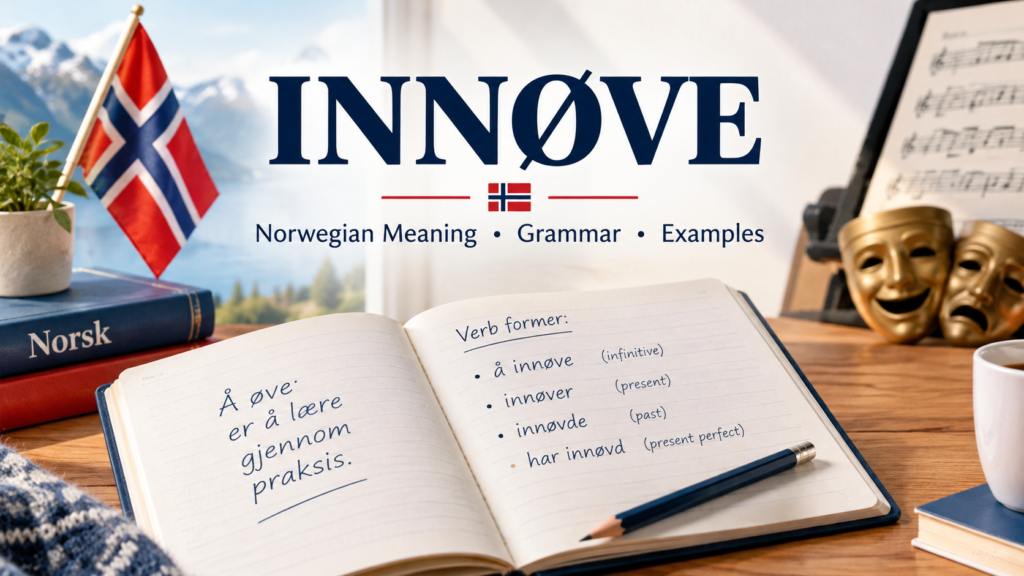
Understanding verb conjugation is essential for using Norwegian vocabulary correctly. In Bokmål, innøve has several forms that appear in different grammatical situations.
The following table presents common forms of the verb.
| Grammatical form | Norwegian | English meaning |
| Infinitive | å innøve | To rehearse or practise |
| Present tense | innøver | Rehearses or practises |
| Past tense | innøvde | Rehearsed or practised |
| Alternative past form | innøva | Rehearsed or practised |
| Present perfect | har innøvd | Has rehearsed or practised |
| Alternative participle form | innøvet | Rehearsed or practised |
| Imperative | innøv! | Rehearse or practise! |
Norwegian dictionaries recognise certain alternative forms, including forms ending in -a. The form chosen may depend on the spelling convention and style being followed. For formal writing, it is best to maintain consistency.
1. Infinitive: Å innøve
The infinitive is the basic form of the verb. Norwegian commonly places å before an infinitive, similar to the English word “to.”
Examples:
- Å innøve en rolle kan ta tid.
- Hun ønsker å innøve en ny sang.
- Det er viktig å innøve bevegelsene.
Their English meanings are:
- To rehearse a role can take time.
- She wants to rehearse a new song.
- It is important to practise the movements.
The infinitive is useful when describing an activity in general, explaining a goal, or discussing something a person intends to do.
2. Present Tense: Innøver
The present-tense form is innøver. It can describe an activity happening now or something that takes place regularly.
Examples:
- Skuespilleren innøver en ny rolle.
- Gruppen innøver et teaterstykke.
- Hun innøver talen før møtet.
These sentences mean that an actor is rehearsing a new role, a group is rehearsing a play, and someone is practising a speech before a meeting.
Norwegian generally uses the present tense for both habitual activities and actions taking place at the moment. Context helps determine which meaning is intended.
3. Past Tense: Innøvde
The past-tense form innøvde describes an activity that took place in the past.
Examples:
- De innøvde en ny dans.
- Hun innøvde talen i går.
- Teatergruppen innøvde forestillingen før premieren.
These sentences describe a group rehearsing a dance, a person practising a speech yesterday, and a theatre group rehearsing before a premiere.
The past tense is useful when explaining how someone prepared for a completed event or describing a previous learning activity.
4. Present Perfect: Har innøvd
The construction har innøvd combines the verb har with the past participle innøvd. It often describes an activity that has been completed and remains relevant to the present.
Examples:
- Vi har innøvd et nytt teaterstykke.
- Hun har innøvd alle dansetrinnene.
- De har innøvd talen grundig.
These examples mean that the speakers have rehearsed a play, practised all the dance steps, and thoroughly rehearsed a speech.
The present perfect is useful when the focus is on preparation already completed rather than on the exact time when it occurred.
Real Examples of Innøve in Everyday Contexts
One of the best ways to understand a Norwegian verb is to examine how it might appear in realistic situations. The following illustrative examples demonstrate common contexts associated with rehearsal and preparation.
Innøve in Music
Musicians often repeat sections of a composition before performing it. They may focus on difficult notes, timing, rhythm, or transitions between musical sections.
Example:
Pianisten innøver et vanskelig musikkstykke.
English translation: The pianist is rehearsing a difficult piece of music.
The sentence focuses on preparing a specific composition. If the person is simply practising the piano as a general activity, another construction using øve may sound more natural.
Innøve in Theatre and Acting
Theatre provides a clear example of how innøve can be used. Actors repeatedly practise their dialogue, movements, and timing before a performance.
Example:
Skuespillerne har innøvd rollene sine før premieren.
English translation: The actors have rehearsed their roles before the premiere.
The sentence emphasises preparation for a specific performance rather than acting as a general occupation.
Innøve in Education
Students may need to practise speeches, presentations, songs, or routines until they can perform them confidently.
Example:
Elevene innøver en kort presentasjon til skolen.
English translation: The students are rehearsing a short presentation for school.
The word is suitable when the focus is on practising a specific presentation. For general studying or acquiring knowledge, verbs such as lære and studere may be more appropriate.
Innøve in Dance
Dancers frequently repeat choreography to improve coordination, timing, and consistency.
Example:
Danserne har innøvd de nye trinnene.
English translation: The dancers have practised the new steps.
This example also illustrates how the participle form can describe movements that have already been practised.
Innøve in Public Speaking
Public speakers often rehearse presentations before delivering them to an audience. Repeated practice can help them become familiar with the wording, timing, and structure.
Example:
Hun innøver talen før konferansen.
English translation: She is rehearsing the speech before the conference.
The sentence highlights preparation for a particular event rather than general communication skills.
Innøve vs. Øve vs. Trene
Innøve, øve, and trene are related Norwegian verbs, but they do not have identical meanings.
| Norwegian word | General meaning | Typical context |
| Innøve | Rehearse or practise something until learned | Roles, performances, and routines |
| Øve | Practise or exercise | Music, languages, and general skills |
| Trene | Train | Sports, fitness, and skill development |
| Repetere | Repeat or review | Reviewing information or repeating material |
| Lære | Learn | Acquiring knowledge or abilities |
| Drille | Drill or practise intensively | Repeated exercises and structured training |
The most important distinction is that øve is a broad term for practising, while innøve is more closely associated with learning or preparing something specific through repetition.
For example, someone might say:
Jeg øver på norsk hver dag.
This means, “I practise Norwegian every day.”
A theatre group preparing a production might instead say:
Teatergruppen innøver et nytt stykke.
This means, “The theatre group is rehearsing a new play.”
Both verbs are useful. The best choice depends on the activity being described.
Innøve and Øve Inn: Understanding the Difference
The expression øve inn is closely related to innøve. Both can describe preparing something through repeated practice.
Consider the following examples:
- Vi innøver en ny sang.
- Vi øver inn en ny sang.
Both sentences communicate that a group is rehearsing a new song.
However, the two constructions have different grammatical structures. Innøve is a single verb, while øve inn is a verb combined with a separate particle. The particle can affect word order in a sentence, so learners should study complete examples rather than automatically joining or separating words.
Understanding both forms makes it easier to recognise Norwegian vocabulary in written texts and everyday conversation.
Synonyms and Related Norwegian Words
Learning related words helps readers recognise subtle differences in meaning and express themselves more naturally.
Øve: A general term for practising an activity or developing a skill. It can describe language practice, music lessons, and many other activities.
Trene: Commonly used for physical training, sports, and the development of practical abilities. It can also describe training for a particular task.
Repetere: Means to repeat or review something. It is useful when someone revisits information or repeats material to remember it.
Drille: Suggests repeated, often structured practice intended to develop accuracy or automatic responses.
Lære: Means to learn. It focuses on acquiring knowledge or an ability rather than specifically on rehearsing something.
These words overlap in certain contexts, but they cannot always replace one another. The appropriate choice depends on the activity, intended meaning, and style of Norwegian being used.
Common Mistakes When Using Innøve
Learners can misunderstand innøve when they rely exclusively on English translations or use the verb in every situation involving practice.
Confusing Innøve with Innovate
Although the spelling of innøve resembles the English word “innovate,” the meanings are different.
Innøve refers to rehearsal, practice, and learning through repetition. Innovate means introducing a new idea, method, product, or process.
For example, a business might innovate by creating a new service. Its employees might then rehearse a presentation about that service. These activities are related within the same situation, but they require different words.
Using Innøve for Every Kind of Practice
Not all practice is best described with innøve.
Someone exercising at the gym would generally use trene. A person practising a foreign language might use øve. A musician preparing a particular composition could use innøve when the focus is on learning the piece through rehearsal.
Choosing the right verb makes Norwegian sentences clearer and more natural.
Ignoring Verb Forms
Using innøve instead of innøver or innøvde can create grammatical errors when the sentence requires a different tense.
Remember the basic forms:
- Infinitive: å innøve
- Present: innøver
- Past: innøvde
- Present perfect: har innøvd
Practising these forms in complete sentences is more useful than memorising them separately.
Forgetting the Letter Ø
The letter ø is an important part of Norwegian spelling. Writing innove instead of innøve changes the spelling and may cause confusion with other words or names.
When learning Norwegian vocabulary, preserve the original characters whenever possible. If a keyboard does not support Norwegian characters, alternative input methods can help.
Is Innøve Common in Everyday Norwegian?
Innøve is an established Norwegian verb, but it is more specific than the widely used verb øve. It is especially relevant in discussions of rehearsal, preparation, and learning particular performances or routines.
In everyday conversation, speakers may choose øve or trene instead, depending on the activity. Someone practising guitar, training for a race, and rehearsing a theatre role may use different verbs because their activities have different purposes.
For learners, the most useful approach is to recognise innøve when reading or listening, understand its relationship with øve inn, and practise using it in suitable contexts.
It is also important to avoid assuming that every unfamiliar Norwegian word has a special technological, business, or brand-related meaning simply because it appears online. The context and reliable dictionary definitions should guide interpretation.
Conclusion
Innøve is a useful Norwegian verb for describing the process of rehearsing, practising, or learning something through repetition. Its meaning becomes easier to understand when examined alongside its grammar, conjugation, related expressions, and practical applications.
The principal forms to remember are å innøve, innøver, innøvde, and har innøvd. Learning these forms helps readers recognise the verb in Norwegian texts and use it in appropriate sentences.
It is equally important to distinguish innøve from broader verbs such as øve and trene, as well as from the English word innovate. Each term has its own meaning and appropriate context.
By studying realistic examples and paying attention to Norwegian grammar, learners can build a clearer understanding of innøve and use it more confidently when discussing practice, rehearsal, and preparation.
FAQs
What does innøve mean in English?
Innøve means to rehearse, practise, or learn something through repeated exercise. It is often associated with preparing a role, speech, musical piece, or routine.
Is innøve a Norwegian word?
Yes. Innøve is an established Norwegian verb used to describe practising or rehearsing something. It appears in Norwegian dictionary references.
What is the past tense of innøve?
A common past-tense form is innøvde. Norwegian also recognises alternative forms, including innøva, depending on the spelling convention.
What is the difference between innøve and øve?
Øve is a general verb meaning to practise or exercise. Innøve more specifically describes rehearsing or learning something through repeated practice, often in preparation for a particular task or performance.
What does innøvd mean?
Innøvd is a participle form associated with something that has been rehearsed, practised, or learned through repetition. For example, innøvde dansetrinn means practised or rehearsed dance steps.
Is innøve the same as innovate?
No. Innøve concerns practice and rehearsal, whereas innovate means introducing something new. Their similar appearance does not mean they have the same definition.
How can I learn to use innøve correctly?
Start by learning its principal verb forms and studying sentences about music, theatre, speeches, and routines. Compare it with øve, trene, and repetere to understand which word fits each situation.
Can innøve describe learning a speech?
Yes. It can describe rehearsing a speech repeatedly until the speaker becomes familiar with the wording and delivery. The exact expression used depends on the sentence and context.