
If you are searching for Test.com Enterprise pricing in 2026, the first number you will probably notice is the published Enterprise software price of $10,000 per year. But that figure does not tell the complete story.
Organizations planning to use Test.com for large-scale testing may also need to account for hosting, setup, testing volume, proctoring, integrations, support, and other requirements. The supplied pricing information lists $1,000 per year for hosting and a $2,000 one-time setup fee, bringing the basic first-year calculation to approximately $13,000 before additional services or usage-related costs.
Test.com is closely associated with Gauge Online, a testing and certification platform designed for organizations that need more than a basic quiz system. It supports online assessments, certification programs, digital credentials, reporting, integrations, security controls, and large-scale exam delivery.
The Enterprise plan is particularly relevant to organizations with substantial testing requirements. The supplied material identifies Enterprise as being designed for organizations delivering more than 10,000 tests per year.
This complete guide explains Test.com Enterprise pricing, costs, plans, features, per-test pricing, hosting, setup fees, integrations, security, proctoring, and the factors that can influence the final cost.
What Is Test.com?
Test.com is associated with an online testing and certification software business that currently presents its platform through Gauge Online.
The platform is designed for professional assessment and certification workflows rather than only simple classroom quizzes. Organizations can create examinations, manage question banks, configure exam rules, evaluate candidate results, and manage certification-related processes.
Typical organizations that may require this type of platform include:
- Professional certification organizations
- Trade and industry associations
- Training providers
- Government programs
- Corporate certification departments
- Continuing education providers
- Professional licensing programs
- Organizations running high-stakes examinations
The supplied source describes the platform as supporting online assessments, certification programs, credential management, reporting, integrations, security controls, and high-volume exam delivery.
That distinction is important when evaluating the price.
A basic quiz platform might be suitable for a teacher creating occasional classroom questions. A professional certification organization, however, may need candidate management, secure exams, credentials, reporting, integrations, authentication, and proctoring.
Test.com/Gauge is positioned around that broader workflow.
Test.com Enterprise Pricing in 2026
The published Enterprise pricing structure contains several different cost components.
| Enterprise Cost | Published Starting Price |
| Enterprise software | $10,000/year |
| Annual hosting | $1,000/year |
| One-time setup | $2,000 |
| Basic first-year calculation | Approximately $13,000 |
| Software + hosting after setup | Approximately $11,000/year |
The Enterprise software starts at $10,000 annually. Hosting is listed separately at $1,000 annually, while the setup fee is $2,000 one time.
Therefore, a simple first-year calculation is:
$10,000 software + $1,000 hosting + $2,000 setup = $13,000
After the one-time setup fee has been accounted for, the basic software and hosting amount would be approximately:
$10,000 + $1,000 = $11,000 per year
However, these calculations should not be interpreted as a guaranteed final invoice.
The supplied source specifically explains that the published figures are starting prices and that actual pricing can depend on testing volume, integrations, implementation requirements, and additional services.
That is why organizations should evaluate the complete pricing structure instead of looking only at the $10,000 headline figure.
Is Test.com Enterprise Pricing Fixed?
Not completely.
The Enterprise plan has a published starting software price, but the supplied information also describes volume-based Enterprise pricing.
Gauge states that Enterprise volume pricing starts at approximately $3 per test, with the per-test rate decreasing as testing volume increases. The supplied source also notes that the highest-volume customers may pay considerably less than $1 per test.
This means the effective cost can vary between organizations.
For example, a company delivering approximately 10,000 exams annually could have a different pricing arrangement from an organization delivering 50,000 or 100,000 exams.
Therefore, the most useful information to provide when requesting Enterprise pricing is the expected annual testing volume.
What to Include in a Custom Quote Request
An organization should ask for a quote that clearly identifies:
- Expected annual exam volume
- Enterprise software cost
- Hosting cost
- Setup and implementation fees
- Per-test charges
- Proctoring costs
- Integration costs
- API requirements
- Support costs
- Additional usage charges
- Renewal pricing
This approach makes it easier to compare the actual cost of different solutions.
Test.com Enterprise Cost Per Test
The per-test component is particularly important for large organizations.
The supplied information states that Enterprise volume pricing begins at approximately $3 per test, while the effective price can decrease at higher testing volumes.
This means the number of examinations delivered each year can have a significant impact on the economics of the platform.
For an organization with a relatively small number of exams, the fixed platform and hosting costs may represent a larger portion of its budget.
For an organization processing a very large number of candidates, the per-test rate becomes increasingly important.
The exact commercial arrangement should therefore be confirmed directly in the organization’s Enterprise quote.
Test.com Professional vs. Enterprise Pricing
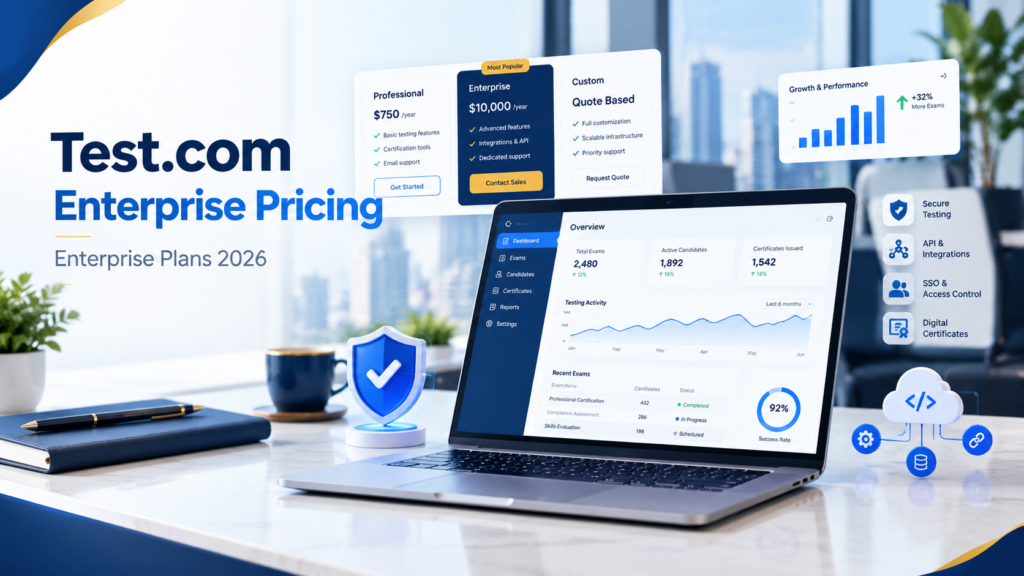
One of the most useful comparisons is between the Professional and Enterprise plans.
The supplied pricing information lists the Professional plan from $750 per year, with $250 annual hosting and a $500 one-time setup fee. Enterprise starts at $10,000 per year, plus $1,000 annual hosting and a $2,000 setup fee.
| Pricing Factor | Professional | Enterprise |
| Software | From $750/year | From $10,000/year |
| Hosting | $250/year | $1,000/year |
| Setup | $500 one-time | $2,000 one-time |
| Intended scale | Growing programs | 10,000+ tests/year |
| Volume-oriented pricing | Not the primary focus | Yes |
| Advanced integrations | More enterprise-oriented | Supported |
| Large-scale certification | More limited | Designed for enterprise use |
The difference in price is substantial, but the plans are aimed at different types of organizations.
Professional is described as being intended for growing testing or certification programs. Enterprise is designed for organizations with much larger assessment requirements.
Therefore, comparing the plans purely by subscription price can be misleading.
The more useful question is which plan matches the organization’s actual testing volume, operational requirements, and integration needs.
What Does the Test.com Enterprise Plan Include?
The Enterprise package focuses on capabilities required by larger testing and certification operations.
The supplied source identifies the following capabilities:
- Certification management
- Digital badges
- Proctoring integrations
- Lessons and learning features
- eCommerce functionality
- REST API access
- Webhooks
- Single sign-on
- Advanced security controls
- User permissions
- Audit trails
- Reporting and analytics
These capabilities can become increasingly important as an organization grows.
For example, manually managing certificates for thousands of candidates can create considerable administrative work. Digital credentialing can help create a more structured process.
Likewise, API and SSO capabilities can reduce the need for disconnected systems.
Online Testing and Assessment Features
The testing experience is one of the core components of the platform.
According to the supplied source, Gauge supports multiple assessment formats, including:
- Multiple-choice questions
- Matching
- Sorting
- True/false
- Text-based answers
- Likert-scale questions
Administrators can also configure:
- Time limits
- Attempt limits
- Passing scores
- Question randomization
- Answer randomization
- Hints
- Media
- Scoring rules
Question banks can be reused across multiple assessments.
This can be useful for organizations that run recurring examinations, certification renewals, employee assessments, or multiple versions of similar tests.
Instead of rebuilding every examination from the beginning, administrators can manage reusable assessment content and apply different exam settings when necessary.
Certification Management
Certification is one of the areas that separates a professional assessment platform from a basic quiz tool.
A certification program may involve:
- Candidate registration
- Prerequisites
- Training or learning requirements
- Examination
- Passing criteria
- Credential issuance
- Digital badges
- Renewal or continuing requirements
The supplied information describes Gauge as supporting certification management and digital badging.
For organizations issuing credentials to large numbers of candidates, having testing and credential workflows connected can simplify administration.
Digital Badges and Credentials
Digital badges can provide candidates with a digital representation of a completed certification or credential.
For professional organizations, badges can also become part of a broader credentialing program.
The value of this feature depends on how an organization manages its certification ecosystem, but it can be useful when the testing process needs to continue beyond the examination itself.
Proctoring Support
Not every exam needs proctoring, but it can be important for high-stakes assessments.
The supplied source states that Gauge provides integrations with third-party proctoring services and options for supervised testing environments.
Organizations should carefully separate platform pricing from proctoring pricing.
A proctoring service may have its own pricing based on:
- Number of candidates
- Exam duration
- Type of supervision
- Number of examinations
- Service configuration
Therefore, a business should ask whether proctoring is included in its quote or billed separately.
API and Webhook Integrations
Enterprise testing often needs to connect with other software.
The supplied Enterprise feature information includes REST API access and webhooks.
These technologies can allow testing information to communicate with other systems.
Potential systems include:
- Learning management systems
- CRM platforms
- HR platforms
- Membership databases
- Training portals
- Internal applications
- Identity management systems
For example, a training organization may want candidate information to move between its learning platform and assessment platform without requiring administrators to repeatedly enter the same information manually.
The exact implementation depends on the organization’s technical environment and integration requirements.
Single Sign-On and Authentication
Single sign-on, commonly called SSO, can be particularly useful for organizations with established identity systems.
Instead of maintaining completely separate authentication workflows, an organization may connect the assessment environment with its existing authentication infrastructure.
The supplied source identifies SSO among the Enterprise capabilities.
Businesses should nevertheless confirm exactly which SSO configuration and identity providers are supported for their particular implementation.
Enterprise Security Features
Security is another important consideration for organizations handling professional examinations.
The supplied information identifies security-related capabilities such as:
- Authentication
- SSO
- IP restrictions
- User groups
- Permissions
- Audit trails
These features can help organizations control access to exams and administrative areas.
However, businesses should conduct their own security and compliance review before signing an Enterprise contract.
Product features alone do not establish that a platform meets every organization’s legal, regulatory, contractual, or internal security requirements.
Security Questions to Ask
A prospective customer can ask about:
- Data encryption
- Data retention
- Backup procedures
- Incident response
- Employee access controls
- Audit logging
- Compliance certifications
- Data residency
- Subprocessors
- Privacy requirements
- Data-processing agreements
This is especially important when candidate information or high-stakes examination data is involved.
What Can Increase Test.com Enterprise Costs?
The published $10,000 software price is only one component of the potential Enterprise budget.
Exam Volume
Testing volume can affect the effective price because Enterprise pricing includes a volume-oriented component.
Hosting
Enterprise hosting is listed separately at $1,000 per year.
Setup
The published one-time setup charge is $2,000.
Proctoring
Third-party proctoring may carry separate costs.
Integrations
API, SSO, webhook, and other integration requirements may involve additional technical work.
Support
Organizations should confirm what support is included in the Enterprise agreement and whether additional support arrangements are available.
Additional Services
Organizations should also ask whether specialized implementation, migration, customization, or other services create additional charges.
How Much Is the First-Year Test.com Enterprise Cost?
Using only the published starting figures, the calculation is straightforward:
Enterprise software: $10,000/year
Hosting: $1,000/year
Setup: $2,000 one-time
First-year starting calculation: $13,000
The second-year basic software and hosting calculation would be approximately:
$10,000 + $1,000 = $11,000/year
These numbers do not necessarily represent the total amount an organization will pay because the final arrangement can depend on testing volume and additional services.
The supplied source specifically recommends considering software, hosting, setup, proctoring, integration development, data migration, administrative costs, certification management, support, and renewal costs when calculating total ownership cost.
How to Calculate Your Total Cost of Ownership
A useful Enterprise budget should go beyond the subscription fee.
Consider these categories:
| Cost Category | What to Check |
| Software | Annual Enterprise subscription |
| Hosting | Annual hosting charge |
| Setup | One-time implementation fee |
| Exams | Volume and per-test pricing |
| Proctoring | Provider and candidate costs |
| Integrations | Development and configuration |
| Migration | Existing candidate or assessment data |
| Support | Included and premium support |
| Certification | Credential management requirements |
| Renewal | Future annual pricing |
This creates a much more realistic picture of the overall investment.
Who Should Consider Test.com Enterprise?
Enterprise is primarily relevant to organizations with substantial testing programs.
Potential users include:
Professional Certification Organizations
Organizations issuing professional credentials may need examinations, certification workflows, digital credentials, reporting, and security.
Training Providers
Large training companies may use assessments as part of a broader learning and certification process.
Government Programs
Government organizations managing structured testing programs may require strong administration, security, reporting, and access controls.
Corporate Certification Programs
Large businesses may need to assess employees, partners, contractors, or customers.
Professional Associations
Associations may administer certification examinations to members and other candidates.
Continuing Education Providers
Organizations that combine education with assessment and credentials may benefit from an integrated workflow.
The supplied source lists professional certification, trade associations, government testing, corporate certification, continuing education, training organizations, professional licensing, large-scale examinations, and high-stakes assessments among relevant use cases.
Who May Not Need Enterprise?
Enterprise is not automatically necessary for every organization.
A small business that conducts only occasional internal quizzes may have little reason to use an enterprise-level certification platform.
Similarly, a small training team that needs only basic quizzes may not require advanced APIs, SSO, certification workflows, or extensive security controls.
The Professional plan or another assessment platform may be worth comparing when testing volume is limited.
The right choice depends on actual requirements rather than the number of features available.
Test.com Enterprise Buying Checklist
Before purchasing, create a checklist based on your organization’s actual requirements.
Testing
- How many tests will be delivered each year?
- What question types are required?
- Do candidates need multiple attempts?
- Are randomized questions required?
- Are timed examinations necessary?
Certification
- Do candidates receive certificates?
- Are digital badges required?
- Are prerequisites part of the certification?
- Is credential management needed?
Security
- Is SSO required?
- Are IP restrictions necessary?
- Are audit trails required?
- What security documentation must the vendor provide?
Integrations
- Does the organization need an API?
- Are webhooks required?
- Does the platform need to connect to an LMS?
- Is CRM or HR integration necessary?
Proctoring
- Are exams high stakes?
- Is remote proctoring necessary?
- Is a third-party provider already being used?
- Are proctoring costs included in the quote?
Pricing
- What is the annual software fee?
- What is the hosting fee?
- What is the setup fee?
- How does volume pricing work?
- Are there additional usage charges?
- What will renewal cost?
This checklist can help prevent unexpected costs later.
Questions to Ask Test.com Before Signing
A potential Enterprise customer should request clear answers to the following:
- What is the total annual cost for our expected testing volume?
- How does Enterprise volume pricing work?
- What is the effective per-test cost at our expected volume?
- Is hosting billed separately?
- What does the setup fee include?
- Are APIs included?
- Is SSO included?
- Are webhooks included?
- Are proctoring services included?
- What support is included?
- Are integrations charged separately?
- Are there data migration costs?
- Are there additional usage fees?
- How are renewals priced?
- What security and privacy documentation is available?
A written answer to these questions can make the final cost much easier to understand.
Is Test.com Enterprise Worth the Cost?
The answer depends on the organization’s specific testing requirements.
For an organization delivering a large number of professional examinations, the relevant question is not simply whether $10,000 is expensive or inexpensive. The organization needs to consider what it receives in return and what it would cost to operate the same workflow using separate systems.
The supplied source recommends considering total ownership costs such as software, hosting, setup, proctoring, payment processing, integration development, data migration, administrative labor, certification management, support, and renewal costs.
For a large certification program, those operational costs may be more important than the initial subscription price.
For a small organization with only occasional testing requirements, enterprise-level functionality may be unnecessary.
Therefore, the appropriate evaluation should be based on:
- Annual exam volume
- Required features
- Security requirements
- Certification needs
- Integration requirements
- Proctoring requirements
- Administrative workload
- Long-term ownership cost
Is Test.com the Same as Gauge Online?
The supplied material identifies Gauge Online as the testing and certification platform associated with Test.com, Inc.
This distinction can be useful because someone searching for Test.com pricing may encounter references to both names.
When researching pricing, features, or Enterprise capabilities, users should make sure they are looking at information relating to the same testing and certification platform.
Conclusion
The main point to remember when researching Test.com Enterprise pricing is that the published subscription price is only the starting point.
The current supplied pricing information lists an Enterprise software starting price of $10,000 per year, plus $1,000 annual hosting and a $2,000 one-time setup fee. That produces a basic first-year starting calculation of approximately $13,000.
Enterprise volume pricing is also an important part of the model. The supplied information states that volume pricing starts at approximately $3 per test, with the effective rate potentially decreasing as testing volume increases.
Beyond pricing, the platform provides capabilities relevant to large testing and certification operations, including online assessments, certification management, digital badges, proctoring integrations, APIs, webhooks, SSO, security controls, reporting, and analytics.
For organizations considering the platform, the best approach is to start with three numbers: expected annual exam volume, required features, and required integrations. From there, calculate hosting, setup, proctoring, support, implementation, and other potential costs.
Most importantly, treat the advertised price as a starting figure rather than a universal final price. A customized written quote based on your organization’s actual requirements provides a much clearer picture of the eventual investment.
That makes it easier to compare Test.com Enterprise with other assessment and certification solutions based on the complete workflow and total cost of ownership rather than the headline subscription price alone.
FAQs
What is Test.com Enterprise pricing in 2026?
The published Enterprise software starting price is $10,000 per year, with $1,000 annual hosting and a $2,000 one-time setup fee.
How much is Test.com Enterprise in the first year?
Using the published starting figures, the basic calculation is approximately $13,000:
$10,000 software + $1,000 hosting + $2,000 setup.
Additional services or usage costs may increase the final amount.
How much does Test.com cost per test?
The supplied information states that Enterprise volume pricing starts at approximately $3 per test, with lower effective rates possible as testing volume increases.
Is Test.com Enterprise pricing fixed?
The published software price provides a starting point, but the final commercial arrangement can depend on testing volume, integrations, implementation requirements, and additional services.
Does Test.com charge a hosting fee?
Yes. The published Enterprise information lists $1,000 per year for hosting.
Is there a Test.com Enterprise setup fee?
Yes. The published Enterprise starting information lists a $2,000 one-time setup fee.
Does Test.com Enterprise support more than 10,000 tests?
Yes. The supplied information positions Enterprise for organizations delivering more than 10,000 tests annually.
Does Test.com Enterprise include proctoring?
Enterprise supports integrations with third-party proctoring providers and supervised testing options. However, proctoring charges may be separate from the core platform price.
Does Test.com Enterprise support API and SSO?
Yes. The supplied Enterprise feature information includes REST API access, webhooks, and single sign-on.
Who is Test.com Enterprise designed for?
Enterprise is designed for organizations managing large testing programs, particularly those delivering more than 10,000 tests per year.
Is Test.com suitable for small businesses?
It can depend on the use case, but smaller organizations should compare their actual requirements against the Professional plan and simpler testing platforms before committing to Enterprise.
What should I ask before buying Test.com Enterprise?
Ask for a customized quote based on annual testing volume and confirm software, hosting, setup, proctoring, integrations, support, renewal, and additional usage costs in writing.